
Clinical Research Certification Red Flags: Reddit Complaints, Accreditation Confusion & How to Verify a Program Before Paying
Clinical research certification programs can cost hundreds or thousands of dollars, yet applicants frequently discover that their new credentials carry less hiring value than expected. Reddit discussions reveal recurring frustrations involving questionable job placement promises, confusing accreditation claims, unexpected renewal expenses, and certificates that employers barely recognize.
The biggest financial risk comes from buying a program before understanding what it actually qualifies you to do. This guide explains how to distinguish professional certification from training certificates, investigate provider credibility, evaluate employer recognition, and verify 30 critical program details before spending your money.

1. Why Clinical Research Certification Buyers Get Misled: Seven Red Flags Reddit Keeps Exposing
The clinical research education market includes professional certification examinations, university programs, short training courses, employer-required GCP instruction, and specialized career preparation.
These options serve different purposes, creating opportunities for marketing claims that sound impressive while leaving important qualification details unclear.
Someone investigating whether clinical research certification is worth it should first establish whether the proposed credential addresses a genuine hiring requirement.
Red Flag 1: Guaranteed employment or unrealistic placement deadlines
A November 2025 Reddit discussion described a learner who enrolled with a small clinical research training provider after being promised assistance obtaining a job within approximately three months.
The learner reported completing two months of training covering GCP, monitoring, source data verification, documentation, and pharmacovigilance. However, after submitting a resume for the promised career support, they reported receiving no feedback for several weeks.
This type of experience highlights the importance of investigating employment claims before enrollment.
A responsible provider should explain the difference between resume assistance, interview preparation, employer introductions, internships, and guaranteed placements.
Anyone comparing clinical research jobs without experience should request written placement terms and independently confirm employer partnerships.
Ask for the percentage of graduates obtaining relevant positions, the measurement period, and the number of students included.
Red Flag 2: Marketing professional credentials to candidates who cannot meet examination eligibility
Professional certification bodies frequently impose substantial experience requirements.
For example, ACRP's CCRC and CCRA certifications generally require 3,000 hours of verifiable qualifying clinical research experience, subject to specified eligibility provisions.
SOCRA's CCRP certification also requires qualifying clinical research experience through one of its documented eligibility categories.
A beginner should therefore investigate clinical research certification versus experience before paying for examination preparation.
Some educational programs may qualify for specific experience waivers or alternative eligibility pathways, but the credentialing organization must confirm the applicable rules.
Critical question: Does completing this course make you eligible for the exact examination advertised?
Request the official eligibility policy and written clarification from the examination organization when necessary.
Red Flag 3: Vague accreditation language
A provider might advertise itself as internationally accredited, industry approved, university recognized, or globally certified.
Each phrase requires independent verification.
An institution's academic accreditation, a training provider's course approval, and accreditation of a professional certification program represent different forms of recognition.
For example, professional certification applicants should consult which GCP credentials employers recognize and examine the issuer's published credentialing requirements.
Ask the provider to identify the accrediting organization, the exact program covered, its current accreditation status, and the public verification directory.
An accreditation claim becomes meaningful when an independent authority confirms precisely what has been accredited.
Red Flag 4: A course completion certificate presented as proof of professional experience
Completing an educational program can demonstrate that a student studied clinical research concepts.
However, a training certificate does not establish that the graduate independently conducted monitoring visits, obtained informed consent, or managed clinical trial documentation.
Employers assessing CRC hiring requirements may distinguish classroom knowledge from supervised site responsibilities.
Likewise, candidates pursuing CRA jobs without monitoring experience should question any claim that completing online modules automatically makes them experienced monitors.
A reputable program should describe exactly what graduates can demonstrate, including practical exercises, supervised activities, and assessment methods.
Red Flag 5: Hidden renewal and continuing education expenses
An August 2026 Reddit discussion about ACRP certifications included complaints concerning renewal fees, continuing education expenses, and limited employer reimbursement.
Other contributors argued that certification provides value when employers recognize it for promotion, while some experienced professionals believed work history carried substantially more weight.
These perspectives expose an important financial issue: the total cost extends beyond initial enrollment.
Before paying, calculate examination fees, membership costs, preparation materials, retakes, continuing education, and recertification.
Compare these expenses with your actual chances of meeting clinical research employer requirements.
Red Flag 6: Outdated GCP content sold as current preparation
Clinical research training must account for applicable regulatory requirements and current guidance.
The FDA finalized its ICH E6(R3) Good Clinical Practice guidance in September 2025, introducing updated approaches involving quality by design, proportionate oversight, and clinical trial modernization.
Courses advertising contemporary GCP preparation should explain how they address ICH E6(R3) clinical research expectations.
Ask whether the syllabus covers investigator responsibilities, participant protection, essential records, and risk-based quality management.
A program can contain older reference material for historical context, but its teaching should accurately reflect the requirements applicable to the learner's work.
Red Flag 7: Sales pressure replaces transparent program information
Immediate-payment discounts, unverifiable employer endorsements, unexplained acceptance deadlines, and refusal to disclose refund policies deserve investigation.
A genuine training provider should be able to provide a syllabus, assessment criteria, faculty information, learning outcomes, cancellation terms, and clear credential descriptions.
Someone comparing GCP certification value should have adequate information to evaluate alternatives.
The strongest warning signal is a provider unwilling to put an important promise in writing.
| Clinical Research Certification: 30-Point Red Flag & Verification Matrix | ||||
|---|---|---|---|---|
| Claim or Feature | Potential Red Flag | What to Verify | Evidence to Request | Decision Rule |
| 1. Accreditation | Unidentified accreditor | Exact accredited organization or program | Official accreditor directory entry | Verify independently |
| 2. Accreditation scope | Institutional approval presented as course approval | Which entity and program are covered | Accreditation scope statement | Reject misleading equivalence |
| 3. Credential issuer | Unclear certificate ownership | Who issues the final award | Sample credential and issuer details | Confirm before enrollment |
| 4. ACRP affiliation | Implied official authorization | Nature of any relationship | Direct confirmation from ACRP | Never infer endorsement |
| 5. SOCRA affiliation | Preparatory course presented as CCRP award | Whether the course actually awards CCRP | Official SOCRA credential rules | Separate training from certification |
| 6. Exam eligibility | Beginners promised unrestricted professional certification | Experience and education thresholds | Official candidate handbook | Confirm eligibility first |
| 7. Experience waiver | Waiver claimed without authority | Whether the certifier accepts the program | Written certifier confirmation | Do not rely on sales claims |
| 8. Job guarantee | Employment promised after payment | Written conditions and exclusions | Guarantee contract | Reject unverifiable promises |
| 9. Placement rate | High percentage without denominator | Graduate count and measurement period | Auditable placement methodology | Discount unsupported figures |
| 10. Employer partnerships | Logos without confirmation | Actual partnership type | Employer-issued confirmation | Verify directly |
| 11. Internship promise | Unpaid simulation described as placement | Location, supervision, responsibilities | Internship agreement | Determine whether genuine experience results |
| 12. Practical training | Video-only program claiming job readiness | Actual assignments and feedback | Sample assessment rubric | Favor demonstrable work |
| 13. Faculty qualifications | Unverifiable instructor expertise | Professional experience and credentials | Instructor biographies | Validate relevant expertise |
| 14. Curriculum currency | Outdated regulatory instruction | Current ICH E6(R3) coverage | Dated module outline | Seek current relevant content |
| 15. GCP recognition | Universal acceptance promised | Target employer and sponsor requirements | Written training acceptance policy | Match actual requirements |
| 16. Exam pass rate | Near-perfect success claims | Cohort size and exclusions | Results methodology | Question unverifiable statistics |
| 17. Examination security | Answers sold instead of competency testing | Assessment integrity | Exam policies and blueprint | Avoid compromised assessments |
| 18. Course fees | Late disclosure of add-ons | Full payment obligation | Itemized invoice | Calculate total cost |
| 19. Exam fees | Certification exam excluded from advertised price | Separate examination charges | Written fee breakdown | Include in budget |
| 20. Renewal costs | Ongoing expenses undisclosed | Recertification and CE requirements | Official maintenance policy | Model multi-year cost |
| 21. Refund policy | Nonrefundable terms hidden | Cancellation deadlines and exclusions | Signed enrollment terms | Read before paying |
| 22. Financing | Monthly payment disguises large obligation | Total repayment and interest | Financing agreement | Compare cash cost |
| 23. Support availability | Mentorship promised without schedules | Response times and availability | Support service description | Require measurable terms |
| 24. Career services | Resume templates advertised as placement services | Specific deliverables | Career support agreement | Value actual services |
| 25. Graduate outcomes | Testimonials without verifiable career results | Graduate roles and timelines | Consenting alumni contacts | Seek independent accounts |
| 26. Job title claims | Course described as equivalent to CRA employment | Required role competencies | Real job descriptions | Identify experience gaps |
| 27. Geographic acceptance | Worldwide employer acceptance promised | Country-specific employer requirements | Regional recognition evidence | Verify target market |
| 28. Credential verification | Employers cannot confirm completion | Verification method and retention period | Credential verification procedure | Require usable records |
| 29. Provider identity | Missing legal or contact details | Registered entity and service address | Registration and contact records | Investigate unresolved inconsistencies |
| 30. Sales pressure | Immediate payment required before review | Written offer and cancellation rights | Complete enrollment contract | Delay payment until verified |
2. ACRP vs SOCRA vs GCP Certificates: Understanding Accreditation and Credential Recognition
Confusion often begins when candidates see three different types of documents described using the same word: certification.
Understanding the issuing authority, examination requirements, and intended purpose can prevent expensive purchasing mistakes.
ACRP professional certifications
The Association of Clinical Research Professionals supports professional credentials administered through the Academy of Clinical Research Professionals.
Its established credentialing pathways include Certified Clinical Research Coordinator (CCRC), Certified Clinical Research Associate (CCRA), ACRP Certified Professional (ACRP-CP), and Certified Principal Investigator (CPI).
These credentials are associated with defined competencies, examination requirements, and eligibility criteria.
The four principal certification programs have National Commission for Certifying Agencies (NCCA) accreditation.
NCCA accreditation relates to the certification program and its credentialing standards. It should not be interpreted as government licensure or an endorsement of unrelated training businesses.
ACRP's CCRC and CCRA pathways generally require 3,000 hours of qualifying experience, with specified provisions for eligible applicants.
Candidates should examine whether their intended career involves CRC operational responsibilities or CRA monitoring expectations.
Verification test: Can you locate the exact certification program, its current eligibility policy, and its accreditation record through the issuing organization?
SOCRA Certified Clinical Research Professional
The Society of Clinical Research Associates offers the Certified Clinical Research Professional (CCRP) credential.
SOCRA describes multiple eligibility categories based on qualifying clinical research experience and, for certain categories, relevant academic preparation.
Under its standard Category 1 pathway, applicants generally need two years of qualifying full-time clinical research experience within the previous five years, or the equivalent 3,500 part-time hours.
Other categories may allow applicants with qualifying academic credentials to apply after one year of eligible clinical research experience.
SOCRA's CCRP program is NCCA-accredited.
For professionals evaluating clinical research certification return on investment, the crucial consideration is whether they meet the relevant eligibility criteria and whether employers value the credential for the intended position.
A candidate who has never conducted qualifying clinical research work should verify their eligibility before paying for examination preparation.
Good Clinical Practice training certificates
GCP training certificates document completion of instruction covering relevant Good Clinical Practice concepts.
A course may address ethical conduct, informed consent, safety reporting, investigator responsibilities, study documentation, and data reliability.
Such training may satisfy specific employer, institutional, or sponsor requirements when the content and format are accepted.
The NIH clarified in April 2026 that GCP training consistent with ICH E6(R3) meets its stated GCP training requirement for relevant NIH-funded clinical trial personnel.
However, an employer may still require particular training modules or institution-specific education.
Candidates should review GCP certification employer recognition alongside ICH E6(R3) professional expectations.
University certificate programs
A university certificate may provide structured academic education in clinical research.
Its value depends on curriculum relevance, faculty expertise, practical learning opportunities, institutional recognition, and the specific qualification awarded.
Academic accreditation should be verified through the appropriate recognized accrediting authority.
Where a professional certifier allows education-based eligibility provisions, the academic program must meet that certifier's stated requirements.
For example, SOCRA's Category 3 pathway includes specific clinical research coursework and experience requirements.
Candidates should investigate these details before assuming that a short university course automatically fulfills professional certification eligibility.
Training provider certificates
Private education providers may offer role-specific preparation in clinical monitoring, coordination, regulatory operations, pharmacovigilance, and project management.
Such programs should be evaluated according to their documented curriculum, assessments, practical training, instructor expertise, and employer relevance.
For someone investigating pharmacovigilance certification value, role-specific training may provide useful foundational knowledge.
However, candidates should distinguish program completion from the experience needed for drug safety case processing or independent regulatory responsibility.
Buyer rule: Confirm who issues the credential, what competency it assesses, which organizations recognize it, and what professional activities it actually qualifies you to perform.
3. What Reddit Complaints Reveal About Certification ROI, Training Programs, and Employer Recognition
Reddit discussions offer useful accounts of how certification decisions affect working professionals, especially when candidates have already spent money or struggled to obtain employment.
The experiences vary by employer, seniority, and career goals. Evaluating those differences is more informative than treating every positive or negative review as universally applicable.
Complaint 1: Paying for qualifications that do not improve hiring outcomes
A January 2025 Reddit discussion about ACRP-CP certification included a professional asking whether the credential produced better job opportunities or higher compensation.
One respondent with multiple professional credentials reported receiving no obvious employment or salary improvement while still appreciating the continuing education and professional recognition.
Another professional explained that maintaining certification made sense because their employer required it and covered the expense.
The difference reveals how to evaluate clinical research certification ROI.
Certification may have substantial practical value when linked to promotion requirements, professional development expectations, or employer reimbursement.
Self-funded applicants should investigate whether the same investment could produce greater value through targeted experience, professional networking, or clinical research entry-level job preparation.
Complaint 2: Course providers promise opportunities that remain difficult to obtain
The November 2025 Reddit training complaint demonstrates the danger of evaluating a program primarily through its advertised employment promises.
A course can cover legitimate clinical research topics yet provide limited practical assistance with recruitment.
Before enrollment, candidates should determine whether the provider offers individualized resume reviews, actual interview preparation, direct introductions, or supervised practical activities.
Someone targeting clinical trial assistant positions may benefit from document control exercises and trial tracking assignments.
Prospective CRAs need exposure to the expectations surrounding monitoring visits, escalation, and risk-based monitoring.
Request examples of actual assessments and feedback before agreeing to pay.
Complaint 3: Professional certification becomes an expensive maintenance obligation
In August 2026, Reddit contributors discussed the ongoing costs associated with maintaining professional clinical research credentials.
Some described continuing education and renewal requirements as financially burdensome, particularly where employers no longer provided support.
Others viewed the credential as useful for specific promotions or distinguishing similarly qualified applicants.
The lesson is to calculate the full certification lifecycle cost, including preparation, examination, retesting, membership, renewal, and continuing education.
For someone weighing CRA salary and advancement prospects, a certification expense should be evaluated against actual compensation policies and employer requirements.
Ask whether your organization offers reimbursement, paid study time, a credential allowance, or promotion eligibility.
These benefits can materially change the investment calculation.
Complaint 4: Education alone fails to overcome experience requirements
An April 2026 Reddit discussion involved a clinical research master's graduate struggling to secure entry-level opportunities despite substantial academic preparation.
Contributors emphasized the importance of practical clinical research experience.
This concern also applies to short-course graduates who expect a certificate to solve the entire entry-level clinical research experience problem.
Employers recruiting study personnel may require familiarity with participant interactions, regulatory documentation, specimen workflows, electronic systems, and operational problem-solving.
A candidate seeking site work should evaluate opportunities to develop protocol adherence skills and research assistant competencies.
Training should contribute to a broader employment strategy with evidence of practical readiness.
Complaint 5: Employer recognition varies considerably
A February 2026 Reddit discussion about SOCRA CCRP certification included professionals who described certification as useful for advancement within academic research institutions.
Others questioned its value without employer reimbursement.
This variation explains why advertisements claiming universal employer recognition deserve scrutiny.
A research hospital may use certification as part of its coordinator promotion structure. Another organization may prioritize direct experience managing clinical research site operations.
For monitoring positions, sponsors and CROs may place greater emphasis on clinical monitoring experience, therapeutic expertise, and operational performance.
Candidates should inspect actual vacancies rather than relying entirely on provider marketing.
The five-question Reddit complaint test
Before purchasing, ask yourself whether the proposed program addresses a real eligibility requirement, provides competencies you lack, produces verifiable proof of learning, has clear recognition among target employers, and remains financially reasonable over time.
If several answers are unclear, collect more evidence before paying.
The most effective certification choice supports a specific professional outcome: qualifying for an examination, meeting an employer's training requirements, preparing for a new function, or maintaining an established credential.
What's Your Biggest Clinical Research Certification Concern?
Choose one. Your answer identifies the most important verification step before paying.
Request the exact accrediting organization, program name, accreditation number if applicable, and current public listing. Contact the accreditor independently and confirm what the accreditation actually covers.
Review 15–20 current vacancies for your intended role. Identify which credentials appear as required or preferred qualifications, and ask relevant recruiters whether the specific training certificate affects candidate screening.
Request written placement terms, verified employer relationships, graduate employment data, and the definition of successful placement. Examine exclusions and refund conditions before relying on the promised outcome.
Read the current candidate handbook for your exact credential. Check qualifying experience, education, documentation, and any permissible waivers. Contact the certifying organization before purchasing exam preparation.
Add course tuition, examination fees, study resources, retakes, membership, renewal, and continuing education. Confirm the refund policy and compare the full cost against employer reimbursement and realistic career benefits.
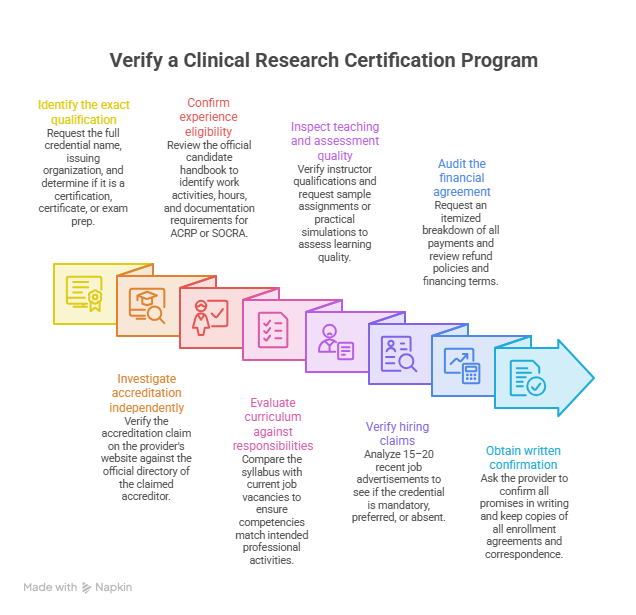
4. How to Verify a Clinical Research Certification Program Before Paying: A Step-by-Step Due Diligence Process
A trustworthy enrollment decision should be based on independently verifiable evidence, clearly documented terms, and relevance to your intended career.
The following process can be completed before committing to any clinical research education provider.
Step 1: Identify the exact qualification being sold
Request the full credential name and issuing organization.
Determine whether the award is a professional certification, academic certificate, training completion certificate, or examination preparation program.
Ask whether an independent examination is required.
For someone seeking ACRP or SOCRA certification, this distinction determines whether the program directly awards a qualification or merely prepares applicants for an examination conducted elsewhere.
A preparatory course may still be useful. Its value should be assessed against what it actually provides.
Step 2: Investigate accreditation independently
Find the accreditation claim on the provider's website and record its exact wording.
Next, visit the claimed accreditor's official directory.
Verify the organization's identity, the accredited program, the accreditation period, and whether any restrictions apply.
For professional certification programs, accreditation through NCCA can be checked through the official credentialing accreditation system.
For academic programs, investigate the institution's recognized academic accreditor.
Do not assume that a certificate qualifies for an education-based waiver simply because the provider describes itself as accredited.
Examine clinical certification recognition and eligibility requirements whenever professional examination eligibility is involved.
Step 3: Confirm experience eligibility before purchasing exam preparation
Review the official candidate handbook issued by the certifying body.
Identify eligible work activities, minimum hours, lookback periods, education provisions, and documentation requirements.
For ACRP credentials, confirm how the relevant certification defines qualifying experience.
For SOCRA, determine which eligibility category applies.
A person with significant laboratory experience may still need additional qualifying human clinical research experience.
Likewise, a new graduate pursuing entry-level clinical research jobs should establish whether professional certification is realistic at their current career stage.
If eligibility remains uncertain, obtain clarification directly from the credentialing body.
Step 4: Evaluate the curriculum against real job responsibilities
Compare the syllabus with current vacancies in your target position.
For a CRC pathway, look for instruction involving informed consent, participant scheduling, protocol adherence, source documentation, and handling protocol deviations.
For CRA preparation, examine training in site monitoring techniques, risk assessments, documentation review, monitoring reports, and issue escalation.
Pharmacovigilance candidates should look for relevant content covering adverse-event reporting and global drug safety compliance.
Clinical project management candidates should prioritize trial timelines and milestones, budget oversight, and cross-functional coordination.
A program should teach competencies connected to the professional activities its graduates intend to perform.
Step 5: Inspect teaching and assessment quality
Ask who teaches the modules, how instructors' qualifications are verified, and whether students receive individualized feedback.
Request sample assignments or assessment descriptions.
A course covering site monitoring could reasonably include a fictional monitoring report, an issue escalation exercise, or a documentation review scenario.
Someone training for clinical quality work could benefit from a simulated investigation using risk-based clinical quality management.
A data-focused course should provide opportunities to practice record review and clinical data verification.
Practical simulations demonstrate applied learning, although they should be identified as training rather than actual employment experience.
Step 6: Verify hiring claims using independent employer evidence
Select 15–20 recent job advertisements aligned with your desired position.
Record whether the credential is mandatory, preferred, or absent from each posting.
Then examine whether employers ask for clinical experience, academic qualifications, therapeutic expertise, or specific operational skills.
If most target vacancies prioritize direct experience, investigate clinical research certification versus experience before committing substantial funds.
If the provider claims partnerships with particular organizations, request the nature of those relationships and verify them independently.
An employer hosting a webinar for students may have a different relationship from one offering structured placements or hiring graduates.
Step 7: Audit the complete financial agreement
Request an itemized breakdown of every required and optional payment.
Review tuition, examination fees, preparation materials, retakes, membership charges, continuing education, and recertification.
Ask when payments become nonrefundable and what happens if the provider cancels a course or materially changes the promised services.
If financing is offered, determine the total repayment amount and whether interest or other charges apply.
Candidates should evaluate the expense against their current employment situation and the likely benefit of the specific qualification.
Someone pursuing clinical research employment without prior experience may need to prioritize practical exposure and employer-recognized training over expensive credentials that cannot yet be used.
Step 8: Obtain written confirmation of important promises
Before payment, ask the provider to confirm the exact award, accreditation scope, eligibility relationship, services included, instructor access, assessment criteria, and refund conditions.
Keep copies of enrollment agreements, advertised claims, invoices, and support correspondence.
A provider that responds clearly to verification questions offers a stronger basis for trust than one relying entirely on sales conversations.
Final approval test: You should be able to explain exactly what you are buying, which professional requirement it addresses, how its legitimacy is verified, and what the financial consequences are if you do not obtain a job.
5. Clinical Research Certification ROI: Who Should Pay, Who Should Wait, and Which Alternatives Offer Better Value?
Certification return on investment depends on the candidate's current experience, target position, employer reimbursement, and expected professional benefit.
A program that improves advancement opportunities for an experienced coordinator may provide limited immediate benefit to a graduate who cannot meet the requirements for an entry-level job.
For complete beginners: prioritize foundational training and practical evidence
Candidates with no relevant clinical research experience should begin by reviewing entry-level requirements.
Useful starting knowledge includes GCP, ethical conduct, investigator responsibilities, trial documentation, participant safety, and clinical research terminology.
Study research assistant training requirements and compare the demands of research assistant, CTA, and CRC positions.
Before buying expensive training, investigate suitable employer-provided instruction, supervised research opportunities, and accessible foundational courses.
A candidate who can demonstrate documentation accuracy, scheduling competence, protocol literacy, and professional communication may be more competitive for suitable support roles than someone relying entirely on an impressive-looking certificate.
For working CRCs: evaluate promotion requirements
An experienced coordinator may benefit from professional certification when their institution recognizes it for advancement or requires it for certain positions.
Review current eligibility requirements and determine whether your employer covers examination and renewal expenses.
The practical value may increase if certification supports progression toward senior coordination, site management, or specialized operations.
However, established competence in patient retention strategies, site monitoring preparation, and protocol deviation management remains important.
Assess whether certification complements these responsibilities and contributes to an identifiable promotion pathway.
For CRAs: compare certification with actual monitoring experience
CRAs considering additional credentials should investigate whether prospective employers recognize them for recruitment, promotion, or professional development.
Experience handling monitoring findings, conducting site visits, assessing risks, and managing investigator relationships can be highly influential in hiring decisions.
Professional credentials may demonstrate continued learning, particularly when maintained through rigorous examinations and continuing education.
Still, candidates should compare certification costs with alternative investments in advanced monitoring skills and CRA-to-Clinical Trial Manager career progression.
If an employer funds the certification and provides clear professional benefits, the financial decision becomes more favorable.
For biotechnology professionals changing careers: choose training around transferable skills
Biotech scientists, quality specialists, and regulatory professionals should select programs according to their intended clinical functions.
A quality specialist may benefit from training in GCP quality oversight, while a laboratory scientist could prioritize research support or biomarker operations.
Regulatory professionals should focus on clinical regulatory submission requirements and relevant study documentation processes.
Candidates should evaluate the available clinical research career entry routes before purchasing general-purpose courses.
Calculate the financial value before enrolling
Use a simple estimate:
Total certification cost = tuition + examination + required materials + expected retake costs + renewal + continuing education + financing charges.
Then estimate the economic benefit using employer-specific evidence.
For example, if a candidate expects to spend $1,500 on training and certification but has no indication that employers prefer it, the financial return remains uncertain.
If a current employer reimburses the cost and offers a documented promotion opportunity tied to certification, the decision has stronger financial justification.
Do not rely solely on generalized salary increase claims.
Research relevant CRA compensation expectations or pharmacovigilance salary trends alongside actual qualification requirements.
A higher-paying occupation does not establish that purchasing a particular certificate will provide access to it.
Three decisions that prevent expensive mistakes
Pay when: The program addresses a documented employer requirement, your eligibility is confirmed, costs are transparent, and you can explain the expected professional benefit.
Investigate further when: The curriculum appears useful but the accreditation scope, job placement claims, or employer recognition remain uncertain.
Consider alternatives when: The credential is irrelevant to your target vacancies, examination eligibility is unavailable, or the price would create substantial financial pressure without a clear benefit.
Your objective is to purchase education that advances a defined professional goal while preserving money for other essential career-development activities.
6. FAQs: Clinical Research Certification Scams, Accreditation, Employer Recognition, and Verification
-
Start by confirming the provider's legal identity, credential issuer, curriculum, assessment requirements, and stated accreditation.
Verify claims directly through the accrediting organization or credentialing body.
Investigate whether the program provides documented learning outcomes, transparent fees, accessible support, and clear refund conditions.
Candidates should also review employer recognition of clinical research certifications before paying.
A legitimate course may still be inappropriate for your particular career objectives, so recognition and relevance should both be evaluated.
-
ACRP's principal professional certification programs, including ACRP-CP, CCRC, CCRA, and CPI, have NCCA accreditation.
SOCRA's CCRP certification program also holds NCCA accreditation.
Accreditation applies to the specified certification programs and does not automatically extend to independent training providers offering examination preparation.
Review the exact issuer and accreditation status, alongside professional certification eligibility requirements.
-
These credentials generally require qualifying clinical research experience.
ACRP's CCRC and CCRA examinations have defined experience requirements and specific eligibility provisions.
SOCRA provides several categories that combine eligible experience with, in some cases, qualifying academic education.
Candidates should consult the current official rules before enrolling.
Those beginning their careers may find entry-level clinical research training and employment routes more immediately relevant.
-
GCP training generally documents completion of instruction in Good Clinical Practice principles.
Professional certification credentials such as CCRC, CCRA, and CCRP have separate issuing authorities, examinations, and eligibility requirements.
Employers may require acceptable GCP training for personnel performing clinical trial duties.
For current expectations, review GCP certification and employer requirements and the applicable ICH E6(R3) guidance.
-
Employment guarantees require careful examination.
Request the written conditions, qualifying requirements, placement definitions, exclusions, and refund provisions.
Ask how the provider measures graduate outcomes and whether claimed hiring relationships can be independently verified.
Someone pursuing CRC employment without previous experience should also examine whether the program addresses the responsibilities employers actually require.
Avoid relying on testimonials or sales conversations as the only evidence of hiring success.
-
The financial benefit varies according to role, employer, experience, location, and compensation policies.
Some organizations recognize professional certification for advancement, while others emphasize direct clinical experience.
Reddit discussions include both positive accounts and professionals reporting little compensation benefit.
Investigate certification versus experience in clinical hiring before predicting a salary increase.
Where possible, request written confirmation of employer reimbursement or certification-related compensation.
