
Pharmacovigilance Exam Study Schedule: Complete 4-Week Plan
Four weeks can be enough to build a strong foundation for a pharmacovigilance certification exam, provided every study session targets the knowledge and decisions that assessments actually test. Candidates often spend too much time memorizing regulatory terminology while neglecting adverse event classification, ICSR processing, MedDRA coding, causality assessment, and safety reporting scenarios. This 28-day study schedule combines focused theory, practical case exercises, timed quizzes, and mock examinations. Whether you are entering pharmacovigilance without experience or strengthening your drug safety career credentials, the plan provides a structured route toward exam readiness.

1. How to Prepare for a Pharmacovigilance Exam in Four Weeks
A successful pharmacovigilance study schedule needs to balance regulatory knowledge, technical terminology, medical reasoning, and practical safety operations.
Many candidates make the mistake of treating pharmacovigilance as a collection of definitions. They memorize adverse events, adverse drug reactions, SUSARs, and reporting deadlines but struggle when a question asks them to determine whether a particular case qualifies for expedited reporting.
Examinations may assess the ability to apply definitions to unfamiliar clinical scenarios. This makes case-based practice essential.
First, identify which pharmacovigilance exam you are taking
Pharmacovigilance certification programs vary in their examination format, curriculum, passing requirements, and jurisdictional emphasis.
Some concentrate on clinical trial safety reporting, while others cover postmarketing surveillance, safety signal management, regulatory systems, and pharmacovigilance quality management.
Before beginning, obtain your provider's latest syllabus or examination blueprint.
Compare the stated objectives with your existing knowledge and identify which subjects receive the greatest emphasis.
Candidates evaluating pharmacovigilance certification value should also distinguish a provider's course-completion assessment from independently administered professional certification examinations.
The four-week plan below is a comprehensive preparation framework. Adjust topic weighting to match your actual examination requirements.
Recommended daily study commitment
Weekday commitment
2–2.5 hrs
Focused learning and practice
Weekend commitment
3–4 hrs
Case exercises and mock tests
Four-week target
65–75 hrs
Illustrative study allocation
A useful daily structure allocates approximately 45 minutes to concept study, 35 minutes to applied examples, 30 minutes to practice questions, and 20 minutes to error review. The remaining time can support spaced recall and difficult topics.
For a candidate already familiar with clinical trial safety monitoring, more time may be allocated to regulatory differences and advanced case assessment.
Beginners should devote additional attention to medical terminology and foundational adverse event reporting principles.
Four critical study phases
Week 1 — Build the foundation: Learn pharmacovigilance terminology, adverse event classifications, ICSR validity, causality, seriousness, expectedness, and essential safety concepts.
Week 2 — Master operational case processing: Practice ICSR intake, MedDRA terminology, medical coding, case narratives, follow-up requests, and case quality assessment.
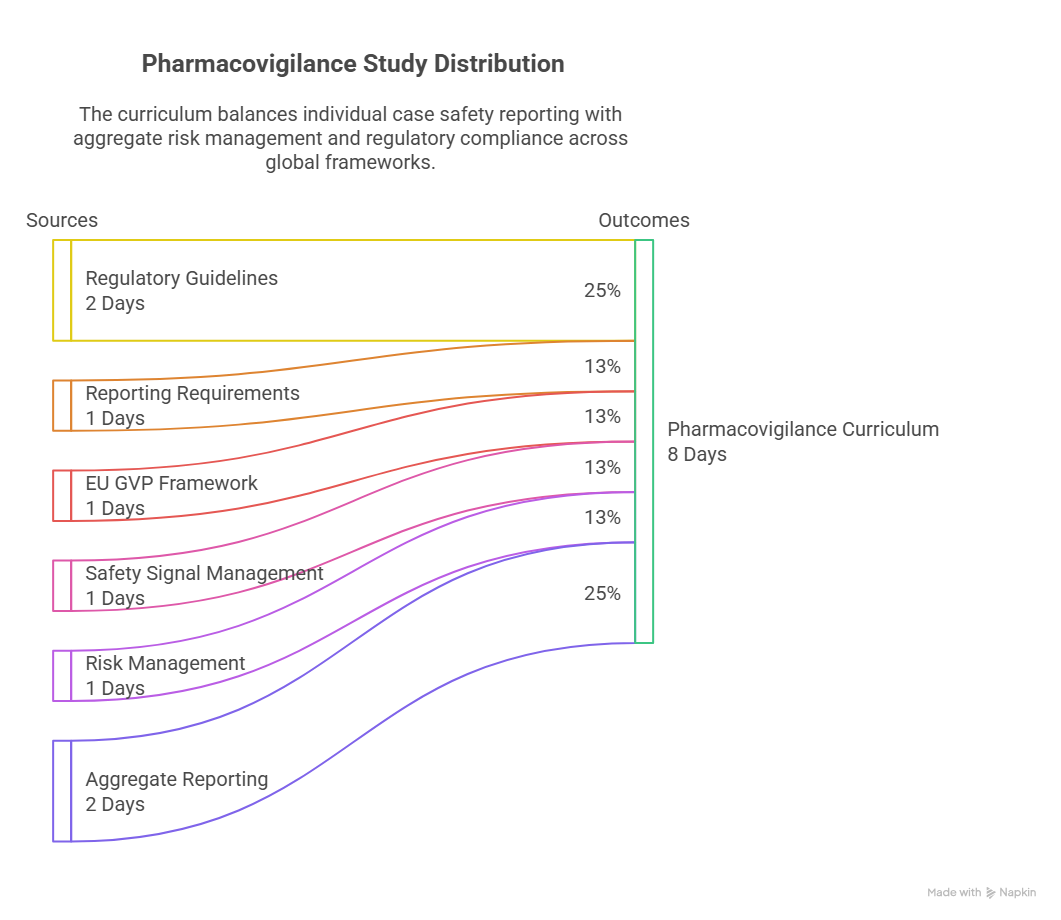
Week 3 — Understand regulations and advanced safety management: Study clinical trial versus postmarketing reporting, pharmacovigilance systems, signal management, risk management plans, aggregate reports, and audit requirements.
Week 4 — Test and correct: Complete timed assessments, investigate incorrect answers, practice integrated cases, and consolidate high-risk exam topics.
Candidates preparing for entry-level clinical research positions benefit from using this same structure to build job-relevant competence.
The study method that prevents false confidence
Use a three-stage process for every topic.
First, explain the concept without consulting your notes.
Second, apply it to a case involving real-world ambiguity.
Third, verify your reasoning against the applicable regulatory or technical source.
For example, after studying the definition of a serious adverse event, evaluate cases involving emergency department visits, hospitalization, life-threatening conditions, and medically important events.
You should be able to explain why each event meets or fails to meet the relevant criteria.
This approach develops the type of reasoning required in pharmacovigilance safety assessment and regulatory compliance.
How to track progress
Create an error log with six fields: topic, question, selected answer, correct reasoning, underlying knowledge gap, and date for retesting.
Categorize mistakes as:
Knowledge errors: You misunderstood or forgot a rule.
Application errors: You knew the rule but applied it incorrectly.
Interpretation errors: You misread the scenario or confused reporting responsibilities.
Timing errors: You spent too long answering or rushed through important information.
Revisit knowledge errors through short targeted study sessions. Correct application errors by working through additional scenarios.
A candidate who scores 80% on repeated familiar questions may still struggle with unseen clinical cases. Track first-attempt performance separately from scores obtained after reviewing an answer key.
The decision matrix below establishes a complete 28-day preparation route with specific daily outputs and testing objectives.
| Pharmacovigilance Exam Preparation: Complete 28-Day Study Matrix | ||||
|---|---|---|---|---|
| Day | Study Focus | Essential Concepts | Practical Assignment | Daily Success Check |
| Day 1 | PV Foundations | PV objectives, lifecycle, stakeholders | Draw a drug safety workflow | Explain 10 core terms |
| Day 2 | AE vs ADR | AE, ADR, suspected reaction, side effect | Classify 12 fictional events | At least 10 correct |
| Day 3 | Seriousness & Severity | SAE criteria, clinical intensity, expectedness | Assess 15 case scenarios | At least 12 correct |
| Day 4 | ICSR Validity | Reporter, patient, product, event | Validate 10 fictional reports | At least 9 correct |
| Day 5 | Causality Assessment | Temporality, dechallenge, rechallenge | Review 8 causality scenarios | Explain each rationale |
| Day 6 | Case Classification | Seriousness, expectedness, suspected causality | Complete a 30-question quiz | Target 80% |
| Day 7 | Week 1 Review | Integrated safety fundamentals | 40-question timed mock | Target 75–80% |
| Day 8 | ICSR Processing | Intake, triage, review, closure | Map the complete case lifecycle | Identify all handoffs |
| Day 9 | MedDRA Basics | LLT, PT, HLT, HLGT, SOC | Practice terminology mapping | Explain 5 hierarchy levels |
| Day 10 | MedDRA Coding | Verbatim terms, coding context | Code 15 fictional event terms | Defend term selection |
| Day 11 | Case Narratives | Chronology, clinical context, completeness | Write 2 sample narratives | Pass narrative checklist |
| Day 12 | Follow-Up & Duplicates | Missing information, duplicate assessment | Review 10 follow-up scenarios | Identify priority queries |
| Day 13 | E2B(R3) & Safety Systems | Structured fields, electronic transmission | Build an ICSR data-field checklist | Identify critical fields |
| Day 14 | Week 2 Review | End-to-end safety case processing | 50-question mock + 2 cases | Target 80% |
| Day 15 | ICH Guidelines | E2A, E2B, E2D, E2E, E2F | Create guideline comparison notes | Match purpose to guideline |
| Day 16 | FDA Safety Reporting | IND, postmarketing requirements | Solve reporting timeline cases | Correct jurisdictional rules |
| Day 17 | EU GVP & EudraVigilance | GVP modules, reporting workflows | Map EU safety responsibilities | Distinguish major processes |
| Day 18 | Signal Management | Detection, validation, assessment | Interpret a fictional signal dataset | Explain signal limitations |
| Day 19 | Risk Management | RMP, risk minimization, PASS | Draft a sample risk matrix | Classify key risk categories |
| Day 20 | Aggregate Reporting | DSUR, PSUR/PBRER, benefit-risk | Compare reporting document purposes | Accurate report selection |
| Day 21 | Week 3 Review | Regulations, signals, risk systems | 60-question timed mock | Target 80–85% |
| Day 22 | PV Quality Systems | SOPs, audits, CAPA, inspection readiness | Investigate 5 fictional compliance failures | Complete CAPA rationale |
| Day 23 | Special Situations | Pregnancy, overdose, medication errors | Classify 15 special cases | Separate case validity from reportability |
| Day 24 | Integrated Case Exercise | ICSR, coding, causality, reporting | Complete 3 full simulated cases | No critical classification errors |
| Day 25 | Full Mock Exam 1 | All syllabus domains | Exam-length timed assessment | Target 85% |
| Day 26 | Targeted Remediation | Weakest 3 subject areas | Redo missed topics with new questions | Reduce repeated errors |
| Day 27 | Full Mock Exam 2 | Mixed unfamiliar questions | Timed assessment + review | Target 85–90% |
| Day 28 | Final Revision | Definitions, regulatory distinctions, case logic | Review error log and concise notes | Ready for exam conditions |
2. Week 1: Master Pharmacovigilance Fundamentals, AE Classification, and Causality
The first week should establish the concepts used throughout every subsequent topic. Weak foundations create errors in case coding, reporting, signal assessment, and regulatory interpretation.
Day 1: Understand pharmacovigilance and the drug safety lifecycle
Begin by studying the purpose of pharmacovigilance: detecting, assessing, understanding, and preventing adverse effects or other medicine-related problems.
Map the movement of safety information from the original reporter through intake, validity assessment, processing, medical evaluation, reporting, and ongoing safety surveillance.
Learn the responsibilities of investigators, sponsors, marketing authorization holders, health authorities, pharmacovigilance associates, and qualified safety personnel.
Use clinical trial safety monitoring alongside global pharmacovigilance compliance to understand how clinical development and postmarketing responsibilities differ.
Deliverable: Draw a one-page workflow showing where safety information originates, who receives it, and how it reaches the appropriate reviewer.
Day 2: Distinguish adverse events from adverse drug reactions
This is one of the most important conceptual distinctions in pharmacovigilance.
An adverse event is an untoward medical occurrence associated with drug exposure, regardless of whether a causal relationship has been established. An adverse drug reaction involves a suspected causal relationship under the applicable definitions.
The precise terminology and scope can differ between clinical-trial and postmarketing frameworks.
Practice situations where a participant experiences an illness after treatment but available evidence does not support attributing it to the investigational product.
Next, evaluate situations where a reasonable possibility of causality exists.
Study the distinction between adverse events, suspected adverse reactions, medication errors, and clinically important medical occurrences.
Review adverse event reporting principles and clinical research safety oversight.
Deliverable: Classify 12 fictional examples and explain the reasoning for every classification.
Day 3: Learn seriousness, severity, and expectedness
Candidates frequently confuse a severe event with a serious event.
Severity describes intensity, while seriousness is determined using defined criteria such as death, life-threatening outcomes, inpatient hospitalization or its prolongation, persistent or significant disability, congenital anomaly, or other medically important events.
A severe headache may be intense without meeting a seriousness criterion. A comparatively mild event may nevertheless be serious because of its consequences.
Expectedness is another separate judgment, assessed against the appropriate reference safety information.
Study the definition of an unexpected event within the applicable reporting framework.
For clinical trial reporting, use the definitions in ICH E2A.
Deliverable: Complete 15 questions requiring separate assessments of severity, seriousness, and expectedness.
Day 4: Memorize and apply the four minimum ICSR elements
A valid individual case safety report generally requires an identifiable patient, identifiable reporter, suspected medicinal product, and suspected adverse reaction.
Understanding what makes someone identifiable requires more care than memorizing the four elements.
For example, a report containing an identifiable healthcare professional, a named medicine, and an adverse reaction still requires sufficient patient-identifying information to satisfy the applicable validity criteria.
Practice distinguishing incomplete but valid reports from reports lacking minimum information.
Consider how a follow-up request might obtain essential missing details while preserving privacy.
This prepares candidates for pharmacovigilance case-processing careers.
Deliverable: Assess ten fictional reports and identify exactly which minimum criteria are present.
Day 5: Practice causality assessment
Causality assessment examines whether evidence supports a potential relationship between a medicinal product and an adverse event.
Important factors include temporal association, biological plausibility, alternative explanations, dechallenge, rechallenge, known product effects, and relevant diagnostic findings.
Candidates should understand the limitations of each factor.
For example, improvement following discontinuation can support a causal hypothesis, but the participant may also have received additional treatment or experienced spontaneous recovery.
A positive temporal relationship by itself rarely establishes causality.
Review how investigators and sponsors may perform different assessments within their assigned responsibilities.
Use clinical trial medical oversight and safety monitoring practices to understand the broader decision process.
Deliverable: Complete eight short causality assessments with written justifications.
Days 6–7: Test integrated fundamentals
On Day 6, complete 30 mixed questions covering terminology, case validity, seriousness, expectedness, and causality.
On Day 7, attempt a 40-question timed assessment without referring to notes.
Analyze errors rather than concentrating solely on your percentage.
A candidate who regularly confuses severity with seriousness needs targeted conceptual revision. Someone who selects the correct definition but misclassifies realistic cases needs more application practice.
Aim for approximately 75–80% accuracy by the end of Week 1 as a personal preparation milestone.
Keep a separate record of mistakes involving SAE reporting compliance and medical safety interpretation, since those errors can recur during advanced topics.
3. Week 2: Learn ICSR Processing, MedDRA Coding, and Safety Case Narratives
The second week converts theoretical understanding into skills used in pharmacovigilance operations.
By Day 14, you should be able to interpret an incoming adverse event report, establish whether it is valid, identify missing information, understand appropriate coding, and prepare a structured case narrative.
Days 8–9: Understand the ICSR lifecycle and MedDRA hierarchy
Begin with the sequence followed by a safety case:
Receipt, intake, validity assessment, triage, case creation, data extraction, medical coding, quality control, reporting assessment, submission where required, follow-up, and reconciliation.
The sequence and responsible roles vary by organization, but each stage has a distinct operational purpose.
Practice identifying which errors can arise at each handoff.
On Day 9, concentrate on the five MedDRA hierarchy levels:
SOC — System Organ Class
Broadest grouping
HLGT — High Level Group Term
HLT — High Level Term
PT — Preferred Term
LLT — Lowest Level Term
Most specific coding level
Study the hierarchy alongside the official MedDRA hierarchy explanation.
Learn why Lowest Level Terms support the selection of coded concepts and how Preferred Terms support consistent analysis.
Your goal is to understand terminology relationships and select medically appropriate terms rather than memorize thousands of entries.
Day 10: Practice medical coding without changing clinical meaning
Coding questions become difficult when reported language is ambiguous.
Suppose a patient reports feeling faint without experiencing loss of consciousness. Coding the event as syncope may misrepresent the report.
Similarly, a documented laboratory abnormality should not automatically be converted into a confirmed disease diagnosis.
Practice using the reported information, relevant medical documentation, and coding conventions.
Avoid inferring clinical details that the original source never provided.
Develop a coding justification worksheet containing the verbatim event, available evidence, selected term, potential ambiguity, and reason for selection.
These skills connect directly to drug safety case processing and clinical safety monitoring.
Days 11–12: Write case narratives and manage follow-up
A strong safety narrative presents clinically important facts in chronological order.
Include relevant patient characteristics, product exposure, adverse event onset, clinical findings, treatment, outcome, and available causality information.
Missing information should be identified accurately.
For example, a narrative describing an adverse event as resolved requires evidence supporting that outcome. The absence of additional correspondence alone does not prove resolution.
On Day 12, practice identifying follow-up priorities.
Missing event-onset dates, product administration details, hospitalization information, treatment outcomes, and clinical investigations may materially affect assessment.
Duplicate detection also deserves attention. Cases may originate from different reporters, literature sources, or safety systems and describe the same underlying event.
Evaluate matches using patient information, treatment details, dates, events, and other permitted identifiers.
Learning pharmacovigilance audit preparation helps demonstrate why accurate documentation and duplicate management matter.
Day 13: Understand electronic case transmission and E2B(R3)
ICH E2B(R3) defines a structured electronic standard for exchanging individual case safety report information.
Candidates should understand its purpose, rather than attempting to memorize technical transmission specifications outside their syllabus.
Study how structured safety information supports data exchange, validation, reporting, and reconciliation.
Understand why incorrect fields, missing data, coding inconsistencies, or transmission failures can affect downstream reporting.
Distinguish an electronically transmitted ICSR from the underlying medical judgment used to assess the case.
This knowledge supports global safety reporting compliance and clinical trial data integrity.
Day 14: Conduct a practical safety processing assessment
Complete a 50-question timed quiz and two integrated case-processing exercises.
Each practical case should require you to determine validity, identify missing information, assess seriousness, select appropriate follow-up questions, consider medical coding, and establish the next procedural step.
Use fictional cases only.
Review answers using the applicable standards rather than treating generated practice material as regulatory authority.
Aim for approximately 80% accuracy and identify whether remaining errors are caused by coding, classification, or workflow knowledge.
A learner seeking pharmacovigilance certification should enter Week 3 with reliable foundational case-processing knowledge.
What Is Your Biggest Pharmacovigilance Exam Preparation Struggle?
Choose one challenge to receive a targeted study recommendation.
4. Week 3: Study Pharmacovigilance Regulations, Signal Detection, and Risk Management
Week 3 introduces the subjects that often separate basic familiarity from strong professional understanding.
Regulatory reporting, signal evaluation, risk management, and aggregate safety assessments require candidates to connect multiple concepts.
The biggest risk is memorizing reporting deadlines without understanding which regulations apply.
Day 15: Master the major ICH pharmacovigilance guidelines
Create a concise guideline reference sheet organized by subject.
Focus on:
ICH E2A: Clinical safety definitions and standards for expedited reporting.
ICH E2B(R3): Electronic transmission of individual case safety reports.
ICH E2D(R1): Postapproval safety data definitions and ICSR management and reporting standards.
ICH E2E: Pharmacovigilance planning.
ICH E2F: Development Safety Update Report guidance.
For each guideline, write its purpose, the processes it governs, and one practical application.
A candidate should be able to recognize which reference is relevant to a clinical trial suspected adverse reaction versus postmarketing safety case management.
Pay particular attention to newer guideline versions. The FDA issued its final ICH E2D(R1) guidance in March 2026. The EMA also indicates that implementation of newer ICH guidance may affect the interpretation and revision of existing GVP materials.
Use authoritative regulatory documents whenever study materials conflict.
These concepts are central to pharmacovigilance regulatory compliance and safety monitoring responsibilities.
Day 16: Understand FDA safety reporting requirements
Begin by separating clinical development reporting from postmarketing reporting.
For qualifying IND safety reports under 21 CFR 312.32, sponsors generally must report as soon as possible and no later than 15 calendar days after determining that information qualifies for reporting.
Unexpected fatal or life-threatening suspected adverse reactions have a separate seven-calendar-day requirement measured from the sponsor's initial receipt of the information.
These timeframes should never be memorized without their associated criteria and triggering events.
A hospitalized trial participant may experience a serious event, but seriousness alone does not establish that the event is an unexpected suspected adverse reaction requiring expedited submission.
Study the FDA's IND safety reporting requirements and compare them with relevant postmarketing obligations.
Also learn that electronic reporting formats and submission procedures can change. Effective April 1, 2026, applicable IND safety reports of serious and unexpected suspected adverse reactions must be submitted electronically to FDA's Adverse Event Monitoring System through the specified pathways.
Assignment: Solve ten reporting scenarios, identifying the event category, applicable regulation, reporting trigger, responsible party, and deadline.
Relevant supporting study areas include adverse event reporting compliance and clinical trial medical monitoring.
Day 17: Study EU Good Pharmacovigilance Practices
Focus on the structure of the European Medicines Agency's Good Pharmacovigilance Practices framework.
Important examination subjects include pharmacovigilance quality systems, inspections, adverse reaction collection and reporting, periodic safety reporting, risk management, and signal management.
Become familiar with the relevant GVP modules, particularly Module I for pharmacovigilance quality systems, Module VI for adverse reaction management and reporting, Module V for risk management, Module VII for periodic safety update reports, and Module IX for signal management.
Study their purposes and relationships before memorizing granular procedural details.
Review the EMA's official GVP resource to confirm current versions and implementation notes.
Then compare European and U.S. approaches through global pharmacovigilance compliance principles.
Assignment: Build two separate decision pathways: one for a clinical trial safety issue and another for a postmarketing adverse reaction.
Day 18: Understand safety signal management
A safety signal involves information suggesting a new potentially causal association or a new aspect of a known association that warrants further investigation.
The signal management process may include detection, validation, confirmation, prioritization, assessment, and recommendations for action, depending on the governing framework.
Review common data sources such as spontaneous reports, clinical trials, literature, healthcare databases, and regulatory safety systems.
Understand the conceptual role of disproportionality analyses, including the Reporting Odds Ratio and Proportional Reporting Ratio.
Their results can help prioritize potential safety issues but must be interpreted in the context of reporting biases, duplicate cases, confounding, incomplete denominators, and other limitations.
Assignment: Interpret a fictional safety dataset and explain why an elevated reporting pattern may require further investigation without establishing causality.
Connect this topic with clinical trial safety monitoring and medical safety assessment responsibilities.
Day 19: Study Risk Management Plans and risk minimization
Risk management requires identifying known and potential product risks, characterizing missing information, planning pharmacovigilance activities, and determining appropriate risk minimization measures.
Learn the difference between routine and additional risk minimization activities.
Understand the purpose of a Risk Management Plan and how it can evolve throughout a product's lifecycle.
Review examples involving restricted distribution, educational materials, pregnancy prevention programs, laboratory monitoring requirements, and targeted healthcare professional communications.
Discuss how the effectiveness of risk minimization measures may be evaluated.
This supports knowledge of pharmacovigilance safety oversight and risk-based quality management.
Days 20–21: Learn aggregate reporting and complete Mock Exam 3
Study the purposes and general structures of Development Safety Update Reports, Periodic Safety Update Reports, and Periodic Benefit-Risk Evaluation Reports.
Understand how aggregate review differs from individual case processing.
An individual ICSR describes a particular suspected adverse reaction. Aggregate safety evaluation examines broader patterns, exposure, changing risk information, and the evolving benefit-risk profile.
Reporting schedules and obligations vary by product, jurisdiction, and development or authorization status.
On Day 21, complete a 60-question timed mock assessment spanning the first three weeks.
Allocate review time to reporting criteria, regulatory distinctions, and incorrect interpretations of aggregate safety findings.
Target 80–85% performance as a personal benchmark.
The review should also reinforce pharmacovigilance audit readiness and global regulatory safety requirements.
5. Week 4: Mock Exams, High-Yield Revision, and Final Pharmacovigilance Exam Strategy
The final week should replace broad reading with evidence-based preparation.
Your priority is to uncover errors that would otherwise remain hidden until the actual examination.
Days 22–23: Master PV quality systems and special safety situations
On Day 22, review standard operating procedures, pharmacovigilance quality management, deviations, corrective and preventive actions, audit trails, vendor oversight, and inspection readiness.
Study how a safety reporting error is discovered, investigated, corrected, documented, and prevented from recurring.
For example, imagine that a valid adverse reaction report was received but incorrectly classified as incomplete, delaying further assessment.
A proper investigation should identify the classification error, evaluate reporting consequences, establish contributing causes, and implement proportionate corrective action.
Compare this process with PV audit and inspection techniques and clinical research quality management.
On Day 23, focus on special situations including medication errors, overdose, misuse, abuse, pregnancy and breastfeeding exposure, occupational exposure, product-quality complaints, and lack of efficacy where relevant.
Learn to distinguish information that requires collection or follow-up from an event that meets a particular regulatory reporting requirement.
A pregnancy exposure, for example, may require important safety follow-up under the applicable framework without automatically establishing a reportable adverse reaction.
Day 24: Complete three integrated clinical safety cases
Create three fictional case scenarios with increasing complexity.
Case A — Hospitalization after treatment: A participant develops a serious medical condition after receiving an investigational medicine. Determine seriousness, suspected causality, expectedness, missing evidence, and the appropriate assessment pathway.
Case B — Ambiguous adverse event terminology: A reporter describes dizziness, weakness, and possible fainting. Identify which information is sufficient for coding and what further clarification would improve accuracy.
Case C — Multiple related safety reports: Several reports describe a similar event with varying degrees of completeness. Assess possible duplicates, identify relevant follow-up, and explain whether the available pattern warrants further safety evaluation.
Each exercise should produce a written rationale.
Avoid guessing when clinical or regulatory information is incomplete. Record what additional facts are required for a reliable determination.
This is valuable preparation for pharmacovigilance work without experience and clinical research safety monitoring roles.
Day 25: Take a full-length mock examination
Match the exam provider's actual question count, time limit, navigation rules, and permitted resources wherever possible.
Use unfamiliar practice questions that reflect the official syllabus.
Afterward, categorize every incorrect answer.
A useful diagnostic identifies your weakest topics by both error count and error severity.
For example, confusing expectedness with seriousness is more important to correct than forgetting a low-priority acronym because it can affect multiple safety classification questions.
Target approximately 85% accuracy, provided that target is above the actual examination's pass threshold and reflects the difficulty of your practice materials.
The true objective is consistent performance across all major topics.
Day 26: Fix the three weakest subjects
Select the three topic areas responsible for the greatest number of errors.
Return to their authoritative definitions, reconstruct your reasoning, and solve new questions.
Use closed-book recall before consulting your notes.
If reporting deadlines remain difficult, create a decision tree that begins with jurisdiction and product context, then distinguishes the applicable reporting criteria and timeline.
If MedDRA coding remains weak, practice term selection using unfamiliar clinical descriptions.
If causality reasoning is inconsistent, explicitly document temporal relationships, alternative explanations, and limitations of available evidence.
Strong preparation means becoming able to answer novel problems, rather than recognizing repeated questions from earlier study sessions.
Day 27: Take the second full mock examination
Complete another timed assessment with a fresh question set.
Evaluate performance separately for:
Pharmacovigilance terminology and safety classifications.
ICSR validity, processing, and coding.
Regulatory frameworks and reporting rules.
Causality, signal detection, and risk management.
Quality systems and practical case interpretation.
Aim for approximately 85–90% on appropriately difficult questions.
A high overall score should not obscure a major weakness in a topic heavily weighted by your actual exam.
For example, a candidate who performs exceptionally well on terminology but consistently misinterprets expedited reporting scenarios should prioritize regulatory decision-making.
Day 28: Complete the final revision checklist
Use the final session to verify essential concepts rather than beginning unfamiliar material.
Final exam readiness checklist
0/10 complete
AE versus ADR versus suspected adverse reaction
Seriousness versus severity versus expectedness
Four minimum ICSR validity criteria
Causality, dechallenge and rechallenge
MedDRA LLT, PT, HLT, HLGT and SOC hierarchy
Case narrative structure and follow-up requirements
ICH E2A, E2B(R3), E2D(R1), E2E and E2F
Applicable FDA and EU reporting distinctions
Signal detection versus confirmed causal relationships
RMP, DSUR, PSUR/PBRER and PV quality systems
Reset checklist
The final 24-hour strategy
Use brief recall exercises, review persistent errors, and organize the resources and identification required by your exam provider.
Preserve your normal sleep schedule and avoid excessive last-minute reading.
For scenario-based questions, use a repeatable method: identify the reporting context, extract relevant facts, determine the applicable definitions, evaluate the regulatory or procedural requirements, and choose the response best supported by the available information.
When a question involves an adverse event, consider seriousness, suspected causality, and expectedness as separate assessments rather than treating them as interchangeable categories.
This method reflects the reasoning needed in adverse event reporting, medical safety oversight, and pharmacovigilance compliance.
The strongest indicator of readiness is your ability to explain unfamiliar safety cases accurately under exam conditions.
6. FAQs: Pharmacovigilance Exam Preparation, Study Hours, and Certification Success
-
Four weeks can provide sufficient preparation for some foundational pharmacovigilance certification assessments, especially when the candidate has previous knowledge of medical terminology, clinical research, or drug safety operations.
Preparation needs vary according to the examination blueprint, existing knowledge, and required depth.
Beginners may need additional study time for medical terminology, clinical trial concepts, and complex regulatory frameworks.
Candidates considering pharmacovigilance certification ROI should assess the actual curriculum before committing to a four-week deadline.
-
A practical target is two to two-and-a-half focused hours on weekdays and three to four hours on weekends, adjusted to your preparation needs.
Divide each session between theory, practical cases, questions, and error analysis.
Candidates with established clinical trial safety knowledge may spend less time on foundational definitions and more time on complex case classifications and regulatory distinctions.
Study consistency and performance on unfamiliar questions matter more than accumulating hours.
-
High-priority foundational subjects generally include adverse event terminology, seriousness, severity, expectedness, ICSR validity, medical coding, causality assessment, safety reporting requirements, and pharmacovigilance quality management.
Advanced or comprehensive assessments may additionally emphasize signal detection, risk management, aggregate safety reporting, and regional regulatory systems.
Always use your exam provider's objectives to determine topic priorities.
Learning adverse event reporting principles, regulatory compliance, and safety monitoring procedures gives candidates a strong foundation.
-
You generally need a solid understanding of MedDRA's hierarchy, terminology selection principles, and its use in safety reporting rather than memorizing the entire terminology.
The database contains an extensive collection of medical concepts, and professional coding normally involves appropriate reference tools.
Practice moving from reported clinical language to the correct term without introducing unsupported diagnoses or changing the meaning of the source information.
Candidates seeking entry-level pharmacovigilance employment can use realistic coding exercises to demonstrate their understanding.
-
Build jurisdiction-specific decision trees linking the reporting timeframe to the applicable event type, reporting criteria, responsible organization, and clock-start event.
For example, qualifying U.S. IND safety reports under 21 CFR 312.32 have defined reporting requirements, including a general 15-calendar-day timeframe and a separate seven-calendar-day requirement for certain unexpected fatal or life-threatening suspected adverse reactions.
Clinical trial and postmarketing obligations should be studied separately.
Use global pharmacovigilance regulatory guidance and safety reporting principles when checking practical scenarios.
-
A useful four-week preparation plan includes shorter weekly assessments and at least two full-length timed mock examinations using unfamiliar questions.
The appropriate number depends on how quickly you identify and correct mistakes.
Review every incorrect answer, especially errors involving case validity, seriousness, causality, expectedness, and reporting rules.
A strong mock assessment should test practical decision-making as well as terminology.
Use clinical safety case assessment and medical monitoring knowledge to deepen your understanding of applied questions.
