
Regulatory Affairs & Pharmacovigilance Exam Day Checklist & Tips
A regulatory affairs or pharmacovigilance exam can turn months of preparation into a test of judgment under pressure. Candidates often understand the terminology yet lose marks by confusing reporting timelines, overlooking jurisdiction-specific rules, misreading safety scenarios, or arriving without the correct identification and testing arrangements.
This guide provides a practical exam-day checklist, last-minute revision priorities, regulatory decision-making techniques, and realistic case-based exercises. Whether preparing for Regulatory Affairs Certification (RAC), a pharmacovigilance training assessment, or another professional examination, the goal is to protect the knowledge you have already built and apply it accurately when every question counts.

1. The Ultimate Regulatory Affairs & Pharmacovigilance Exam Day Checklist: 30 Critical Checks
Exam preparation should end with a clear operational plan. Candidates frequently spend considerable time reviewing regulations while overlooking the administrative requirements that determine whether they can sit the exam successfully.
Testing policies vary by awarding organization, examination vendor, and delivery format.
For example, the Regulatory Affairs Professionals Society (RAPS) updated its RAC examinations for the spring 2026 testing window. RAC-Drugs and RAC-Devices now contain 120 multiple-choice questions with 2.5 hours of testing time, compared with the previous 100-question, two-hour format.
The updated RAC-Drugs blueprint covers Regulatory Intelligence and Research (27%), Submissions (27%), Collaboration (13%), Strategy (22%), and Project Management (11%).
Those weights make regulatory interpretation and submission decisions particularly important, alongside the broader regulatory affairs responsibilities expected in clinical development.
Pharmacovigilance examinations can follow substantially different blueprints. Candidates should confirm the examination format through their actual provider rather than assuming that RAC policies apply to drug safety certifications.
Your final preparation should cover three separate risks
Administrative risk: Missing identification, incorrect registration information, or an incompatible remote testing environment.
Knowledge risk: Weak understanding of safety classifications, submission pathways, reporting criteria, or applicable regulatory frameworks.
Execution risk: Poor pacing, excessive time spent on difficult questions, and changing correct answers without convincing evidence.
Candidates familiar with GCP investigator responsibilities and clinical trial safety reporting should still practice applying these principles under timed conditions.
The following 30-point matrix combines examination logistics, regulatory revision, and performance safeguards.
| Regulatory Affairs & Pharmacovigilance: 30-Point Exam Day Checklist | ||||
|---|---|---|---|---|
| Check | Required Action | When | Risk Prevented | Verification Standard |
| 1. Registration | Verify examination registration status | 7 days before | Booking errors | Active registration confirmed |
| 2. Name match | Compare registered name with ID exactly | 7 days before | Denied admission | Matches examination rules |
| 3. Identification | Check accepted photo ID and expiration | 7 days before | Identity verification failure | Approved and valid ID |
| 4. Exam format | Confirm question count and testing duration | 7 days before | Incorrect pacing | Current candidate guide |
| 5. Blueprint | Download the current content outline | 7 days before | Studying outdated topics | Current exam version |
| 6. Test location | Confirm address, building, and check-in area | 3 days before | Late arrival | Route and location checked |
| 7. Remote hardware | Run provider-approved system test | 3 days before | Technical disqualification | Compatibility test passed |
| 8. Internet | Verify connection stability and bandwidth | 1 day before | Exam interruption | Provider requirements satisfied |
| 9. Testing room | Remove prohibited materials and devices | 1 day before | Proctoring violations | Workspace meets rules |
| 10. Security software | Complete any required device preparation | 1 day before | Blocked exam launch | Official readiness check passed |
| 11. Time zone | Confirm the appointment's local time | 1 day before | Missed appointment | Time and zone verified |
| 12. Arrival time | Follow examination-specific check-in instructions | Exam day | Late entry | Arrive within required window |
| 13. Break policy | Check scheduled and unscheduled break rules | 1 day before | Lost exam time | Candidate guide reviewed |
| 14. Allowed materials | Verify calculator, notes, and scratch-paper rules | 1 day before | Security violations | Only approved materials used |
| 15. Special accommodations | Confirm approved arrangements | Before exam day | Missing approved support | Written confirmation received |
| 16. Regulatory jurisdiction | Separate US, EU, and other applicable rules | Final revision | Wrong legal framework | Jurisdiction identified correctly |
| 17. IND/NDA | Review application purposes and lifecycle stages | Final revision | Submission pathway confusion | Correct application identified |
| 18. GCP principles | Review participant protection and data reliability | Final revision | Oversight errors | Current syllabus requirements met |
| 19. PV terminology | Distinguish AE, ADR, SAE, and SUSAR | Final revision | Incorrect event classification | Definitions applied to cases |
| 20. ICSR validity | Recall four minimum reporting elements | Final revision | Invalid case decisions | Validity assessed accurately |
| 21. Safety reporting | Review applicable expedited reporting rules | Final revision | Incorrect deadlines | Criteria and clock linked |
| 22. MedDRA | Review coding hierarchy and term selection | Final revision | Unsupported medical coding | Verbatim accurately represented |
| 23. Aggregate reports | Differentiate DSUR and PBRER | Final revision | Lifecycle confusion | Purpose correctly explained |
| 24. Signal management | Review signal detection versus validation | Final revision | Assuming statistical causality | Evidence limitations understood |
| 25. Ethics | Review consent, confidentiality, and oversight | Final revision | Patient safety reasoning errors | Correct responsible party identified |
| 26. Practice questions | Complete a final mixed timed assessment | 1-2 days before | Pacing surprises | Weak areas documented |
| 27. Error review | Review recurring reasoning mistakes | 1 day before | Repeated avoidable errors | Each mistake has a correction |
| 28. Sleep and meals | Maintain normal sleep and eating patterns | Night before | Fatigue and distraction | Practical routine planned |
| 29. Question pacing | Prepare a time budget and review reserve | Before starting | Unanswered questions | Time targets understood |
| 30. Final submission | Check unanswered and flagged questions | Before finishing | Accidental omissions | Review completed if time permits |
2. What to Revise 24 Hours Before Your Regulatory Affairs or Pharmacovigilance Exam
The final day works best as a consolidation period. Focus on distinctions that frequently lead to incorrect answers and on the subject areas given the greatest weight by your examination provider.
Regulatory affairs: master the submission decision
Regulatory affairs examinations frequently require candidates to choose an appropriate response to a product development problem.
A company planning its first US clinical trial with an investigational drug may need to understand the Investigational New Drug (IND) framework. A company seeking permission to market a new drug must consider the appropriate marketing application and supporting evidence.
Review IND and NDA submission requirements alongside clinical trial regulatory compliance.
Focus on the underlying questions: What stage of development has the product reached? Which regulator has authority? What evidence is required? What is the appropriate submission or interaction?
For exam scenarios, distinguish original applications from supplements, amendments, and maintenance obligations according to the applicable system.
Pharmacovigilance: separate five commonly confused concepts
Adverse event: An untoward medical occurrence temporally associated with product exposure without necessarily establishing causality.
Adverse reaction: A harmful and unintended response involving a suspected or established causal relationship under the applicable definition.
Seriousness: Classification according to regulatory seriousness criteria, including death, life-threatening events, inpatient hospitalization or its prolongation, significant disability, congenital anomaly, and important medical events.
Severity: The clinical intensity of an event.
Expectedness: Whether the nature, specificity, or severity of a suspected reaction is consistent with the applicable reference safety information.
For example, severe vomiting may be nonserious, while a life-threatening allergic reaction requiring emergency intervention can meet seriousness criteria even without hospital admission.
Practice these distinctions through adverse-event reporting examples and clinical safety monitoring principles.
Remember the minimum ICSR validity requirements
An Individual Case Safety Report generally needs four elements: an identifiable patient, an identifiable reporter, a suspected medicinal product, and a suspected adverse reaction.
A report may satisfy minimum validity while still requiring additional follow-up.
That distinction matters when examining clinical data review and verification and drug safety quality requirements.
Revise reporting deadlines with their conditions
For US investigational drugs, 21 CFR 312.32 establishes expedited reporting requirements for qualifying safety information.
Certain serious, unexpected suspected adverse reactions require reporting within 15 calendar days of determining that the information qualifies. Qualifying unexpected fatal or life-threatening suspected adverse reactions have a seven-calendar-day reporting deadline measured from sponsor receipt.
These rules require assessment of seriousness, unexpectedness, suspected causality, and the relevant reporting category.
A serious adverse event occurring during a trial does not, on its own, satisfy every expedited sponsor reporting condition.
For broader preparation, review global pharmacovigilance regulatory compliance.
Review current GCP principles
ICH E6(R3), finalized by the FDA in September 2025, addresses flexible risk-based approaches, quality by design, participant protection, and reliable trial data.
Candidates should understand how critical-to-quality factors influence oversight and how responsibilities remain appropriately assigned and documented.
Review investigator responsibilities under GCP, ethical conduct and patient safety, and risk-based monitoring.
The examination blueprint determines which version or specific regulatory text will be tested. Use that version for final revision.
3. Exam Morning and Check-In: Avoid the Administrative Mistakes That Can Cost Your Attempt
A candidate can arrive fully prepared academically and still encounter admission problems because of identity mismatches, missing documents, or remote proctoring restrictions.
The safest approach is to treat the examination appointment as a controlled process with specific entry requirements.
Check your identification against the exact registration record
For RAC candidates, the RAPS candidate guidance requires identification to match the registered name. In-person candidates are instructed to arrive at least 30 minutes before their appointment.
Check the spelling of your name, accepted identification types, expiration date, and examination confirmation before traveling.
If a discrepancy exists, contact the examination organization according to its published correction procedure.
Different pharmacovigilance training providers may use different identification policies. The requirements of your own provider take priority.
For testing-center examinations
Confirm the building entrance, transportation route, check-in process, and storage arrangements for personal belongings.
Many proctored examinations restrict phones, watches, notes, bags, and electronic devices inside the testing room.
Where permitted, use the provided storage area and follow instructions from testing personnel.
Ask the administrator about any uncertainty concerning permitted materials, scheduled breaks, or technical assistance.
For professionals familiar with clinical trial quality procedures, the same principle applies: follow the approved process and clarify exceptions before proceeding.
For remote-proctored examinations
Test your computer through the examination provider's official compatibility system.
Check the required operating system, webcam, microphone, network connection, and examination software.
Confirm that your testing area satisfies the provider's requirements for privacy, lighting, desk contents, additional monitors, and unauthorized devices.
Avoid making major software changes immediately before the assessment.
Some remote examinations prohibit headphones or require particular room-scanning procedures. Follow the exact rules communicated by the testing vendor.
Prepare for an unexpected technical interruption
If a computer crashes, the internet connection fails, or examination software becomes unresponsive, follow the provider's documented incident procedure.
Where possible, alert the proctor through the authorized communication channel.
Avoid closing examination software, restarting equipment, or leaving the testing area without instructions when doing so could violate examination policies.
Keep the support information and appointment confirmation available in a permitted location before the exam begins.
Candidates familiar with clinical research documentation requirements will recognize the importance of recording relevant details accurately if an incident requires formal follow-up.
Use the final hour wisely
The last hour should be reserved for checking essential logistics and reviewing a small number of concepts that commonly cause confusion.
Avoid introducing an entirely unfamiliar regulatory framework immediately before the examination.
A short mental review can cover the differences between an AE and an ADR, seriousness and severity, an IND and an NDA, and a DSUR and a PBRER.
For more structured revision, revisit adverse-event reporting compliance and regulatory submission fundamentals.
What's Your Biggest Exam Day Risk?
Select your biggest concern and get a targeted exam preparation strategy.
Revise the relevant regulator, product lifecycle stage, application type, and reporting responsibility together. Practice five mixed-jurisdiction scenarios and identify the governing framework before evaluating the answer choices.
Practice separating validity, seriousness, suspected causality, and expectedness. For reporting deadlines, memorize the trigger and qualifying criteria together with the number of calendar days.
Set an approximate first-pass time budget. Make a reasoned selection on difficult questions, flag them where the system permits, and return during your review reserve.
Confirm the exact name and ID requirements, testing appointment, check-in time, technical compatibility, and proctoring restrictions through your examination provider before exam day.
Change an answer when you identify a concrete factual or interpretive error. Use the scenario's stated facts, the governing rule, and the precise question to support your final decision.
4. Regulatory Affairs & Pharmacovigilance Exam Techniques: How to Solve Difficult Questions Under Pressure
Knowing the material is only one component of examination performance. Candidates must interpret wording precisely, identify the relevant regulatory framework, and distinguish plausible distractors from the best-supported response.
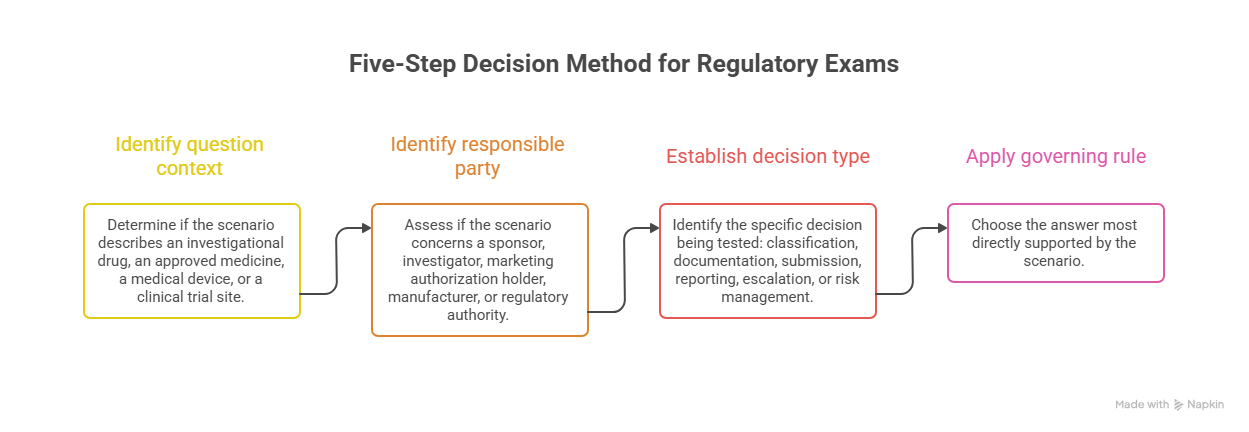
Use a structured five-step decision method
Begin by identifying the context of the question.
Is it describing an investigational drug, an approved medicine, a medical device, or a clinical trial site?
Next, identify the responsible party. The correct answer may depend on whether the scenario concerns a sponsor, investigator, marketing authorization holder, manufacturer, or regulatory authority.
Then establish the specific decision being tested: classification, documentation, submission, reporting, escalation, or risk management.
Apply the governing rule and choose the answer most directly supported by the scenario.
This approach mirrors the structured reasoning expected in regulatory compliance oversight and pharmacovigilance quality investigations.
Practice question 1: Unexpected serious adverse reaction
Scenario: A clinical trial investigator reports an unexpected, serious event in a participant receiving an investigational drug. The event requires hospitalization, and the investigator suspects a causal relationship.
What is the sponsor's most appropriate next step?
A. Automatically submit a seven-day fatal safety report
B. Assess the available evidence and determine whether expedited reporting criteria are met
C. Wait until the study concludes
D. Remove the event from the clinical database
Correct answer: B.
The sponsor must review the seriousness, expectedness, available causality evidence, and applicable regulatory reporting requirements.
Hospitalization alone does not establish the fatal or life-threatening category. The suspected relationship warrants appropriate medical and regulatory assessment.
This question tests the difference between investigator notification obligations and sponsor reporting decisions.
Revise clinical trial safety monitoring practices to strengthen this distinction.
Practice question 2: Regulatory development strategy
Scenario: A company plans to begin a first-in-human clinical investigation of a new investigational drug in the United States.
Which regulatory framework is most immediately relevant?
A. New Drug Application marketing approval
B. Investigational New Drug requirements, including any applicable exemptions
C. Postmarketing periodic safety reporting only
D. Commercial promotional labeling review only
Correct answer: B.
The IND framework generally governs investigational drug use in US clinical studies when an exemption does not apply.
Candidates should recognize the lifecycle stage before selecting a submission category.
An NDA concerns a different regulatory objective from authorization or regulatory compliance for conducting clinical investigations.
This distinction is fundamental to IND/NDA regulatory preparation.
Practice question 3: Validity of a safety report
Scenario: A healthcare professional reports that an identifiable adult patient developed a rash after receiving a named suspected medicine. The reporter provides no treatment outcome.
What is the most appropriate conclusion?
A. The case is invalid because treatment outcome is missing
B. The case may meet minimum validity criteria, and relevant follow-up is needed
C. The report must be classified as serious
D. The event is definitively caused by the medicine
Correct answer: B.
The report contains the four elements generally required for a valid ICSR: identifiable patient, identifiable reporter, suspected medicinal product, and suspected reaction.
Missing outcome information should be pursued where appropriate.
The missing detail affects completeness, while the available information may already establish minimum validity.
Practice question 4: Risk-based quality management
Scenario: A sponsor identifies repeated inconsistencies in a critical endpoint collected across several clinical trial sites.
Which approach best reflects risk-proportionate quality management?
A. Apply identical monitoring resources to every study activity
B. Investigate the critical endpoint risk, identify root causes, and introduce proportionate corrective actions
C. Ignore the issue until database lock
D. Replace recorded data without traceable authorization
Correct answer: B.
Quality management should prioritize issues that could affect participant protection or the reliability of important trial results.
The sponsor should assess the potential impact, investigate contributing factors, and implement an appropriately documented response.
This is consistent with the principles discussed in clinical research quality management and risk-based monitoring strategies.
Practice question 5: Statistical signal interpretation
Scenario: A spontaneous reporting database shows a disproportionately high Reporting Odds Ratio for a medicine-event combination.
What does this establish?
A. Definitive drug-event causality
B. The true clinical incidence of the event
C. A potential safety association requiring evaluation
D. Automatic withdrawal of the medicine
Correct answer: C.
A disproportionality statistic can suggest that a medicine-event combination deserves further scrutiny.
Reporting biases, incomplete exposure denominators, confounding, and duplicate records can affect interpretation.
Clinical evaluation and additional evidence are required before drawing causal conclusions.
How to control time without sacrificing accuracy
Calculate your initial time budget from the official examination duration and question count.
For the 2026 RAC format of 120 questions in 150 minutes, the overall average is 75 seconds per question.
A practical strategy is to allocate approximately 120 minutes to the initial pass and reserve 30 minutes for review. This is an illustrative plan that should be adjusted to the candidate's reading speed and examination conditions.
Move through straightforward recall questions efficiently. Allocate additional attention to complex application scenarios.
When the software permits flagging, identify questions requiring review rather than allowing one difficult item to consume time intended for several others.
Avoid changing answers purely because they feel uncertain. Reconsider when you discover a specific error in your interpretation or identify overlooked evidence.
5. Last-Minute Revision Strategy: What to Do During the Final 24 Hours and After the Exam
The final preparation period should focus on protecting knowledge retention, consolidating difficult distinctions, and ensuring practical readiness.
The night before: complete a targeted final review
Spend your main revision session on high-impact concepts already covered during preparation.
For regulatory affairs candidates, concentrate on applicable submission pathways, product lifecycle decisions, regulatory responsibilities, and examination blueprint topics.
For pharmacovigilance candidates, revise the four ICSR validity criteria, adverse event classifications, causality assessment, reporting clocks, safety signal interpretation, and major aggregate report types.
Use clinical safety reporting guidelines and global pharmacovigilance compliance to clarify recurring mistakes.
Review errors from practice assessments. Prioritize misunderstandings that caused multiple wrong answers instead of collecting additional study resources.
Three hours before: switch from learning to execution
Review your examination confirmation and required documents.
Confirm the testing location or remote check-in arrangements.
Eat a familiar meal, maintain normal hydration, and allow sufficient time for the necessary journey or remote setup.
Avoid experimenting with unfamiliar supplements, unusually large amounts of caffeine, or new study routines.
The objective is to begin the assessment in a stable, familiar condition.
During the exam: use a three-pass method
First pass: Answer questions where the governing principle and correct choice are clear.
Second pass: Return to application questions requiring several steps of reasoning.
Third pass: Check flagged items, unanswered questions, and possible interpretation errors.
For scenario questions, identify whether the problem involves investigator oversight, clinical data integrity, regulatory submissions, or safety reporting.
This classification helps narrow the relevant rules and reduces the temptation to choose an answer based on unrelated medical knowledge.
Follow the exam's permitted navigation and review features. Some assessments limit backtracking or use different submission procedures.
If an unfamiliar question appears
Identify the known facts and the precise decision being requested.
Determine which answer is most consistent with the applicable regulatory principle.
For questions involving safety or compliance, consider whether the proposed action preserves participant protection, reliable records, appropriate escalation, and documented accountability.
Do not assume every unfamiliar scenario has an obscure answer. Many test the application of a familiar principle in a new context.
After the examination
Follow the provider's instructions for results and any required post-exam procedures.
If the assessment includes provisional results, check whether they are final or subject to validation.
Where unsuccessful, use official score-domain feedback if offered and build a targeted revision plan for the next attempt.
Review the retake eligibility, fees, and rescheduling conditions before making arrangements.
Respect examination security and confidentiality rules. Reconstructing, distributing, or publishing protected examination questions may violate candidate agreements.
For candidates seeking career advancement, use the period following the examination to develop demonstrable skills in regulatory submission processes, drug safety operations, or clinical project management.
The most valuable preparation should strengthen professional decision-making beyond the examination itself.
6. FAQs: Regulatory Affairs & Pharmacovigilance Exam Day Checklist, Rules, and Preparation Tips
-
Bring the identification and appointment documentation required by your examination provider.
For RAC examinations, the candidate guide requires valid identification with a name matching the registration details. Follow the current instructions regarding confirmation documents, check-in time, and permitted items.
For other examinations, inspect the provider's policies separately. Remote-proctored assessments may require additional identity verification and equipment checks.
-
RAPS changed its RAC-Drugs and RAC-Devices examination format effective with the spring 2026 testing window.
The updated format contains 120 multiple-choice questions and allows 2.5 hours for completion.
Candidates should consult the current content outline because subject weights changed alongside the examination length.
Professionals preparing for drug regulations can strengthen their background using regulatory affairs submission guidance.
-
They cover overlapping regulatory and safety concepts but can assess different professional competencies.
Regulatory affairs examinations may emphasize product development, submission pathways, regulatory strategy, postauthorization obligations, and communication with authorities.
Pharmacovigilance assessments commonly focus on safety reporting, ICSR processing, MedDRA, causality, expectedness, signal detection, and aggregate safety evaluation.
Review pharmacovigilance regulatory compliance alongside your provider's exam blueprint.
-
Prioritize areas where errors could change case classification or regulatory reporting decisions.
These include seriousness versus severity, adverse events versus adverse reactions, ICSR validity, expectedness, suspected causality, reporting deadlines, and duplicate detection.
Also review MedDRA terminology and major safety reporting documents.
Use adverse-event reporting compliance to connect definitions with realistic workflows.
-
Permitted materials depend on the awarding organization and testing vendor.
Some examinations supply approved resources or allow specified comfort aids, while others prohibit personal notes, devices, and reference documents.
Check the current candidate guide before the examination. Follow the proctor's instructions if an approved material or accommodation requires clarification.
-
Follow the examination provider's official technical interruption procedure.
Use authorized communication channels to contact the proctor or support team.
Preserve the appointment details and relevant incident information for any required follow-up.
Avoid actions that could inadvertently violate examination security requirements, such as leaving the testing room or restarting software without authorization when instructions prohibit it.
