The Ultimate Guide to Getting Medical Monitor Certification in Europe: Everything You Need to Know in 2025
A Medical Monitor Certification in Europe is no longer optional if you're looking to work in high-level clinical trials or global pharmacovigilance projects. In 2025, medical monitors are not just protocol advisors—they’re core to ensuring patient safety, regulatory compliance, and successful trial execution. CROs and pharma sponsors across the EU are increasingly filtering candidates by certification, often making it a dealbreaker for roles that pay €85,000–€130,000+ annually.
This guide will walk you through exactly why this certification matters, what you'll learn, and how to choose the right provider—especially if you're aiming for fast-track promotions, global mobility, or breaking into sponsor-level roles. Whether you're a physician, a clinical research associate moving up, or a safety officer transitioning roles, a formal Medical Monitor Certification is your direct pathway to massive salary increases, permanent contracts, and European regulatory credibility.

What Is Medical Monitor Certification in Europe Exactly? Skills Required and Jobs Explained
The Medical Monitor Certification equips you with real-world, regulator-ready expertise to lead medical oversight in global clinical trials across Europe. You’re trained to not just understand protocols—but to medically manage patient safety, trial data, and adverse events in real-time.
What Skills Does a Certified Medical Monitor in Europe Actually Gain?
Analyze clinical trial data across all phases, track SAE/AE patterns, and identify protocol deviations with medical precision.
Detect emerging safety signals early, interpret real-time adverse event trends, and initiate escalation or mitigation processes.
Align trials with European regulations, including EMA, ICH-GCP, and Clinical Trials Regulation EU No 536/2014.
Review and contribute to protocols—especially dosing regimens, eligibility criteria, and safety monitoring plans.
Lead medical decisions during dose-limiting toxicities, SUSARs, or early termination risk scenarios.
Write medically sound safety narratives, prepare DSURs, and respond to regulatory and sponsor safety queries with clarity.
What Jobs Can You Apply for With Medical Monitor Certification in Europe?
Medical Monitor (Europe-based trials)
Clinical Safety Physician
Medical Affairs Liaison for CROs or Sponsors
Pharmacovigilance Lead or Signal Detection Officer
EMA-Facing Medical Reviewer or Trial Oversight Director

Why Should You Get Medical Monitor Certification to Work in Europe?
In Europe’s tightly regulated clinical research sector, uncertified professionals are rarely trusted with trial oversight or direct sponsor-level safety responsibilities. Without formal certification, most professionals are locked into support roles—reviewing data but not owning safety strategies or interacting with regulators. A Medical Monitor Certification positions you for critical decision-making authority, faster promotions, and eligibility for high-paying EU-based roles at major CROs, biotech firms, and pharma sponsors. It’s the key distinction between participating in safety discussions and leading them.
| Career Factor | Without Certification | With Certification |
|---|---|---|
| Role Access | Limited to associate-level safety or PV support roles | Eligible for full Medical Monitor and Safety Lead positions |
| Regulatory Involvement | No authority in safety responses or regulatory interactions | Direct engagement with EMA, ethics boards, and sponsors |
| Salary Range (EU) | €45,000–€70,000 annually | €90,000–€130,000+ annually |
| Promotion Speed | 5–7 years to reach strategic roles (if ever) | 1–2 years to reach global oversight roles |
| Trial Decision-Making Power | No input in SAE escalations or medical halts | Primary decision-maker during clinical crises |
| CV Visibility | Overlooked in sponsor-led hiring filters | Preferred in CROs and sponsor search algorithms |
Which Certification Should You Choose to Become Medical Medical Monitor in Europe?
Professionals who complete this certification are recognized across Europe as Certified Medical Science Liaisons (CMSLs) or Certified Medical Monitors (CMMs)—titles that instantly increase hiring visibility with CROs, biotech startups, and pharma sponsors. While there are a handful of short courses in the EU claiming to offer "monitor training," most lack depth, global regulatory alignment, or instructor accountability. Many are built as passive, outdated slide decks with no access to mentorship or real-world trial context.
Options like DIA, Barnett, and Coursera offer isolated modules on pharmacovigilance or clinical safety, but none provide a full-stack curriculum backed by practical oversight simulations, European regulation compliance, and active mentorship. That’s where CCRPS’s Medical Monitor Certification stands out—combining a transparent, expert-led program with live review sessions, real trial-based casework, flexible pace options, and 1-on-1 support. It’s not just certification—it’s conversion into real-world, decision-capable professionals.
| Feature | Typical Courses (Others) | CCRPS Medical Science Liaison & Monitor Certification |
|---|---|---|
| Accreditation | Usually unaccredited or only CPD-approved | Backed by CPD and CME accreditation with instant digital certificate + LinkedIn badge |
| Curriculum Depth | Basic pharmacovigilance or MSL overviews | 249+ advanced modules covering ICH-GCP, AE/SAE triage, KOL engagement, and more |
| Learning Format | Pre-recorded slides or PDFs only | Includes live webinars, simulation-based labs, and lifetime access to updates |
| Pace Flexibility | Fixed duration, no catch-up support | Self-paced + 4–16 week bootcamp option with optional mentorship add-on |
| Payment Plans | One-time payment only, no flexibility | Interest-free monthly payment plans available |
| Instructor Access | Generic or celebrity-led, no real interaction | Taught by real-world experts with transparent faculty and case-based guidance |
| Monitoring Strategies | Limited to GCP basics or outdated site visit formats | Teaches centralized, on-site, and risk-based monitoring across Phases 0–IV and post-marketing |
Why CCRPS Medical Monitor Certification Will Be a Game Changer for Your Career in Europe
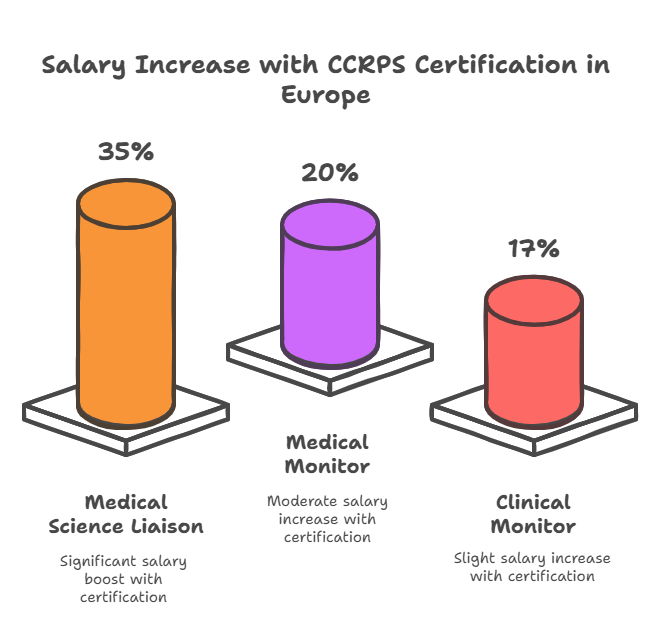
In Europe’s competitive clinical research landscape, professionals holding the CCRPS Medical Monitor Certification often experience significant salary advancements. This dual-role certification equips candidates with the regulatory fluency, therapeutic expertise, and medical decision-making power required to lead both sponsor-facing MSL initiatives and high-stakes trial oversight. As European pharma continues to scale safety operations across decentralized and post-marketing trials, certified experts are being prioritized in hiring pipelines at top CROs and biotech firms.
Across Germany, France, the Netherlands, and remote EU-based clinical teams, professionals completing CCRPS’s program have reported salary uplifts ranging from 25% to 44% within 6–12 months of certification. These outcomes are backed by job placement data from CCRPS alumni hired between 2023 and 2025 into roles spanning Medical Monitor, MSL, PV Lead, and Medical Affairs Manager—often at globally recognized organizations like IQVIA, Bayer, and Sanofi.
Summarizing All You Need to Know About Getting Your Medical Monitor Certification in Europe
Whether you're aiming to work with EU-based sponsors, CROs, or regulatory agencies, earning a Medical Monitor Certification in Europe is no longer optional—it’s a baseline requirement for medical decision-makers in clinical trials. The summary below captures everything you need to know in one place: from eligibility and accreditation to deliverables, salary uplift, and job placement outcomes.
| Category | Summary |
|---|---|
| Certification Name | CCRPS Medical Science Liaison & Monitor Certification |
| Who It's For | MDs, PhDs, PharmDs, and life sciences professionals pursuing roles in medical monitoring or liaison functions |
| Accreditation | CPD and CME-accredited; digital certificate + LinkedIn badge issued instantly upon passing |
| Program Structure | 249+ advanced modules, weekly live webinars, lifetime access, and simulation-based assessments |
| Skills Covered | ICH-GCP, AE/SAE triage, KOL engagement, safety narrative writing, centralized and risk-based monitoring |
| Career Outcomes | MSL, Medical Monitor, PV Lead, Clinical Research Physician, Medical Affairs Manager |
| Expected Salary Uplift | 17%–35% within 6–12 months post-certification based on EU placement data |
| Geographic Applicability | Valid across all EU nations for CROs, biotech firms, sponsors, and academic research hospitals |
| Completion Time | 4–16 weeks (self-paced with optional bootcamp and mentorship add-ons) |
Frequently Asked Questions
-
Yes. The certification is dual-role by design. A Medical Monitor oversees patient safety during trials—reviewing SAEs, protocol deviations, and making escalation decisions. A Medical Science Liaison (MSL) builds scientific relationships with KOLs, translates data for non-clinical stakeholders, and supports regulatory engagement. CCRPS’s program merges both domains through 249+ modules, preparing you to step into CRO or sponsor-based roles that require clinical fluency, strategic safety oversight, and therapeutic area expertise. Most courses cover just one path—this covers both without compromise.
-
The certification is recognized across the entire EU, as it follows ICH-GCP, EMA guidance, and pharmacovigilance frameworks relevant under EU Regulation No. 536/2014. CCRPS's CPD and CME accreditations meet professional development standards accepted in Germany, France, the Netherlands, Spain, Italy, and Nordic countries. It’s already helped learners land roles at IQVIA, Merck, and EU research hospitals, regardless of local language or job market. You won’t need to repeat certifications when relocating inside Europe, making it ideal for remote or multinational work.
-
The course is built for physicians (MDs), pharmacists (PharmDs), PhDs, and MSc-level professionals working in life sciences, safety, or research. It’s also suited for experienced CRAs and PV staff aiming to transition into oversight roles. You don’t need prior sponsor experience—but a working knowledge of clinical trials, adverse event terminology, or therapeutic areas is helpful. The curriculum is designed to upskill both entry-level monitors and experienced PV or clinical professionals looking to scale into strategy and decision-making roles.
-
Most professionals complete the course in 4 to 8 weeks part-time, or 2 to 3 weeks full-time. A fast-track bootcamp is also available. On average, graduates report role transitions within 3 to 5 months of completing the program, especially with resume support and mentorship add-ons. You’ll have lifetime access, so there’s no pressure to finish in one go. The curriculum includes full simulations, final exam prep, and project-based assessments—so by the end, you’ll be ready to apply directly to sponsor, CRO, or biotech positions.
-
Expect to complete MSL slide decks, clinical monitoring visit reports, stakeholder briefing documents, and AE escalation reports. You’ll run through full simulation tracks: pre-KOL call planning, scientific exchange, documentation, and escalation handling. You’ll also write SAE narratives, interpret risk trends, and build advisory board prep kits. These deliverables are directly modeled after sponsor-side templates and reviewed during live webinars. Unlike passive video courses, this certification is project-driven, not theory-based, making you job-ready with real, reviewable assets by graduation.
Sources: Glassdoor, Salary Expert
