
Clinical Research Coordinator Salary Guide 2025: Global Trends and Comparisons
The Clinical Research Coordinator (CRC) role has become one of the most in-demand entry-to-mid-level positions in the clinical research industry. In 2025, salaries for CRCs are rising worldwide, fueled by expanding trial activity, new therapeutic pipelines, and a shortage of qualified professionals. Understanding how much coordinators earn across regions is crucial for both job seekers negotiating offers and employers setting competitive compensation benchmarks. This guide delivers clear, data-driven insights into global CRC salary trends.
This report provides a comprehensive comparison of CRC salaries worldwide, from the U.S. and Europe to Asia-Pacific and the Middle East. It also examines the factors that influence CRC pay—education, certifications, seniority, and employer type—while comparing CRC salaries with other clinical research roles. Whether you’re starting your career or planning your next step, this salary guide outlines what to expect, where opportunities are strongest, and how credentials like the CCRPS CRC Certification can accelerate earning potential in today’s competitive market.

The Role of a Clinical Research Coordinator
Core Responsibilities at Trial Sites
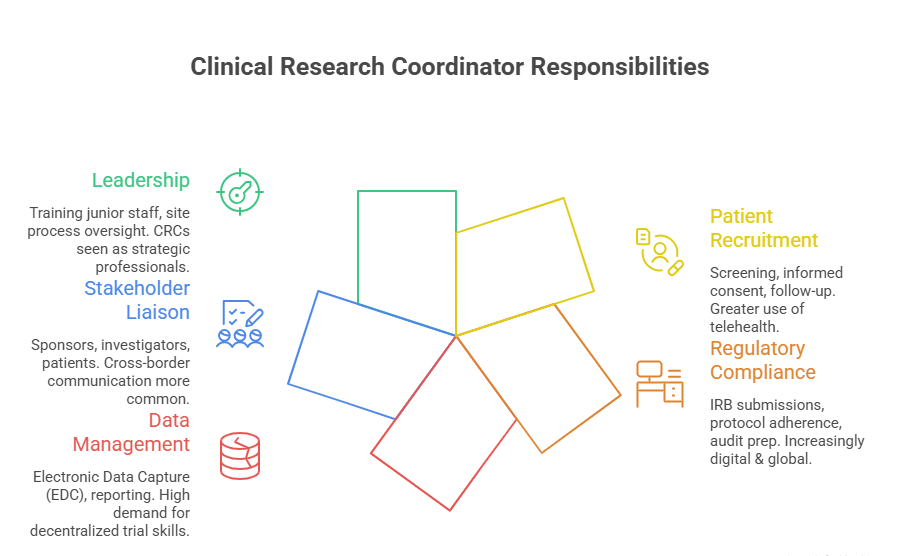
The Clinical Research Coordinator (CRC) is responsible for day-to-day trial operations at the site level. They manage patient recruitment, screen participants, and ensure informed consent is properly documented. CRCs maintain study files, verify protocol adherence, and track participant progress. In 2025, many coordinators also manage electronic systems for scheduling, documentation, and compliance tracking. This combination of administrative and patient-facing duties makes CRCs central to trial execution.
Patient Care and Regulatory Compliance
CRCs ensure trials run ethically and safely by monitoring adverse events and coordinating with investigators and ethics boards. They prepare Institutional Review Board (IRB) submissions, maintain regulatory binders, and facilitate audits or monitoring visits. Their role is essential for meeting Good Clinical Practice (GCP) requirements. With decentralized and hybrid trials, CRCs also oversee telehealth visits and remote data collection, expanding their responsibilities beyond traditional site-based work.
Liaison Between Stakeholders
Acting as the link between sponsors, investigators, and patients, CRCs coordinate communication across all trial stakeholders. They organize sponsor monitoring visits, relay queries, and ensure data is entered accurately into electronic capture systems. In multi-site trials, coordinators collaborate with colleagues across regions, requiring adaptability and strong organizational skills. This liaison role reduces operational delays and ensures sponsors have reliable, real-time trial updates.
Leadership and Career Impact
Beyond daily operations, CRCs often supervise junior staff, train research assistants, and standardize trial processes. Many work in multi-site networks where leadership skills are critical. In 2025, CRCs are increasingly viewed not as support staff but as strategic professionals shaping trial efficiency and compliance. Their position provides a gateway to higher-paying roles like CRA or Trial Manager, making the CRC role a cornerstone of clinical research career progression.
Global Salary Trends for CRCs
USA & Canada
In 2025, Clinical Research Coordinators (CRCs) in the U.S. earn between $55,000–$75,000 annually, with top-tier research hospitals and biotech hubs offering salaries exceeding $80,000. Major cities like Boston, San Francisco, and New York lead the pay scale due to higher living costs and dense trial activity. In Canada, CRCs earn CAD 60,000–75,000, slightly lower than the U.S. but with stronger benefits and work-life balance. Certification, particularly the CCRPS CRC Certification, adds 10–15% salary premiums, especially for coordinators managing decentralized trial operations. Growing demand for bilingual CRCs in regions like Quebec also pushes compensation upward. Overall, North America remains the benchmark for global CRC salaries.
Europe
European CRC salaries show significant variation depending on the country. In the United Kingdom, CRCs typically earn £35,000–£45,000, while Germany offers higher averages of €40,000–€55,000. Switzerland continues to lead, with CRCs earning CHF 70,000–90,000, reflecting its status as a global pharma hub. European CRCs are increasingly expected to handle regulatory documentation and multilingual trial sites, skills that influence pay. Demand is strong for coordinators in oncology and rare disease studies, with specialized CRCs earning 15–20% more than peers. Brexit has also shifted dynamics, with the UK market offering retention bonuses to maintain staff in a competitive environment. Europe’s diversity in regulation and trial growth makes CRC salaries highly country-specific.
Asia-Pacific
The Asia-Pacific region is experiencing rapid CRC salary growth in 2025. In India, CRCs average $20,000–$35,000, but annual growth rates exceed 10% as global CROs expand operations. China shows higher ranges, with CRCs earning $35,000–$50,000, while Singapore leads the region at $50,000–$70,000 due to strong government-backed R&D initiatives. Salaries are rising fastest for CRCs skilled in decentralized trial platforms and electronic data capture, which are in high demand. Multinational sponsors are increasingly standardizing pay closer to Western levels, especially for coordinators in major trial centers like Shanghai and Bangalore. Asia-Pacific offers strong career acceleration for CRCs, with certification providing a key advantage in achieving higher salaries.
Middle East & Africa
In the Middle East, CRC salaries are climbing as Gulf States invest heavily in healthcare research. In the UAE and Saudi Arabia, CRCs earn $45,000–$65,000, often supplemented with housing and tax-free benefits. South Africa leads Africa with salaries averaging $30,000–$40,000, while other African nations remain below $25,000 due to limited trial infrastructure. However, global sponsors are expanding into emerging African markets, raising demand for skilled CRCs. Bilingual coordinators and those with strong regulatory knowledge earn 15% higher salaries in these regions. Employers frequently use relocation incentives to attract international coordinators, making total compensation competitive despite lower base salaries. The Middle East and Africa are expected to see double-digit salary growth through 2030.
| Region | Average CRC Salary (2025) | Notes |
|---|---|---|
| USA & Canada | $55,000 – $75,000 (U.S.) CAD 60,000 – 75,000 (Canada) |
Top-paying region; higher in Boston, SF, Toronto |
| Europe | £35,000 – £45,000 (UK) €40,000 – €55,000 (Germany) CHF 70,000 – 90,000 (Switzerland) |
Switzerland leads; Brexit pushes UK retention incentives |
| Asia-Pacific | $20,000 – $35,000 (India) $35,000 – $50,000 (China) $50,000 – $70,000 (Singapore) |
Fastest YOY growth (10–20%); CRO expansion in major hubs |
| Middle East & Africa | $45,000 – $65,000 (UAE, Saudi) $30,000 – $40,000 (South Africa) |
Tax-free benefits & relocation packages boost totals |
Factors That Influence CRC Salaries
Education & Certification
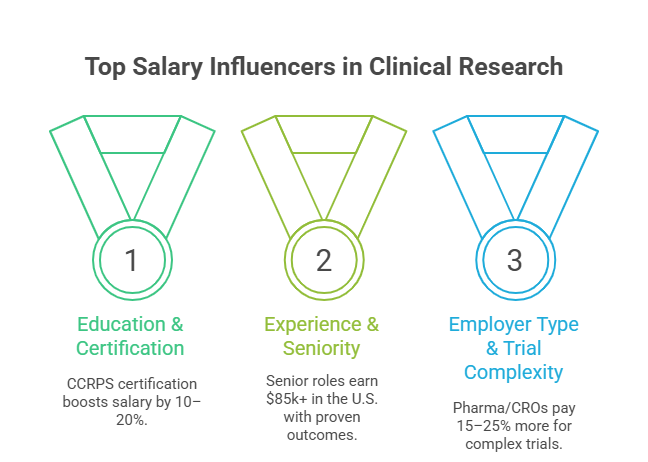
One of the strongest drivers of CRC salaries in 2025 is education and certification. A bachelor’s degree may qualify candidates for entry-level positions, but advanced degrees or credentials like the CCRPS CRC Certification consistently raise salaries by 10–20% above average. Employers view certification as proof of GCP knowledge, regulatory literacy, and readiness to manage decentralized trial systems. In regions like India and China, certification is often the differentiator that enables CRCs to secure positions with multinational CROs, offering salaries much closer to U.S. and European benchmarks.
Experience & Seniority
Experience remains the single most influential factor in salary growth for CRCs. Entry-level coordinators in the U.S. earn around $55,000–$60,000, while mid-level professionals with 5+ years of trial oversight can exceed $75,000–$85,000. Senior CRCs managing multi-site or multi-country projects often move into leadership roles, where compensation crosses $90,000. Employers reward longevity not only for trial continuity but also for reduced compliance risks. Coordinators who demonstrate measurable contributions—like higher patient retention or faster enrollment—see faster pay raises than peers.
Employer Type & Trial Complexity
Compensation also varies widely based on employer type and trial complexity. CRCs working at academic medical centers or non-profits earn modest salaries, but those employed by global CROs or pharmaceutical companies command higher ranges. Trial complexity is another driver: oncology, rare diseases, and gene therapy studies often pay 15–25% more than general therapeutic areas due to greater regulatory and patient safety demands. Coordinators managing decentralized or hybrid trial models also receive higher pay, as these roles require digital skills and adaptive monitoring experience.
Geography & Cost of Living
Finally, geography significantly influences CRC salaries. Coordinators in the U.S. and Switzerland earn the highest global wages, reflecting high trial density and cost of living. In contrast, CRCs in emerging markets like India or South Africa earn less in absolute terms but experience rapid annual growth as trial activity expands. Relocation packages, tax-free benefits, or housing allowances in regions like the Middle East help balance compensation. For CRCs considering global careers, geography remains a critical factor in determining overall earning potential.
Salary Comparisons: CRC vs. Other Research Roles
CRC vs. Clinical Research Associate (CRA)
The Clinical Research Associate (CRA) earns significantly more than a CRC due to their regional and global trial oversight responsibilities. In 2025, CRAs in the U.S. average $95,000–$115,000, compared to CRCs at $55,000–$75,000. The gap reflects the CRA’s travel, risk-based monitoring, and compliance management duties. However, CRCs with certifications and strong site performance can transition into CRA roles within 3–5 years, nearly doubling their salaries. For many professionals, the CRC role is the primary pathway into higher-paying CRA positions.
CRC vs. Clinical Trial Manager
Clinical Trial Managers lead site teams and coordinate with sponsors, making their responsibilities broader than CRCs. Salaries range from $115,000–$145,000 in the U.S., nearly double the CRC average. Trial Managers often supervise multiple CRCs, focusing on budgets, regulatory compliance, and timelines. For CRCs, advancing into trial management typically requires 5–7 years of experience plus credentials like the CCRPS CRC Certification. The jump in pay reflects the higher leadership responsibilities and strategic influence of managers on multi-country studies.
CRC vs. Biostatistician
The Biostatistician role is technical and data-driven, earning $105,000–$135,000 in the U.S.—far higher than CRC averages. While CRCs ensure protocol adherence and patient safety at trial sites, biostatisticians handle data design, analysis, and regulatory reporting. The gap is tied to advanced degrees in mathematics or statistics, which biostatisticians typically hold. However, CRCs with data management skills or training in electronic data capture (EDC) systems can transition into data roles over time, narrowing salary differences.
CRC vs. Data Manager
Data Managers now earn $95,000–$115,000 in the U.S., reflecting their central role in decentralized and hybrid trials. Their pay is substantially higher than CRC salaries but closer in range compared to CRAs and Trial Managers. CRCs with strong EDC expertise are often promoted into data management roles, especially in CROs that value site-level digital experience. For coordinators interested in technical advancement, the Data Manager role represents one of the most accessible career jumps in both pay and responsibility.
| Role | Average Salary (U.S., 2025) | Salary vs. CRC | Key Notes |
|---|---|---|---|
| Clinical Research Coordinator (CRC) | $55,000 – $75,000 | Baseline | Site-level operations, patient interaction |
| Clinical Research Associate (CRA) | $95,000 – $115,000 | ~+50% | Regional/global monitoring responsibilities |
| Clinical Trial Manager | $115,000 – $145,000 | ~+80–100% | Leadership of multi-site, multi-country trials |
| Biostatistician | $105,000 – $135,000 | ~+70% | Design, analysis, and regulatory data reporting |
| Data Manager | $95,000 – $115,000 | ~+50% | Oversees decentralized trial data integrity |
Future Outlook for CRC Compensation
The future outlook for Clinical Research Coordinator (CRC) compensation remains strongly positive through 2030. Rising demand for skilled coordinators is being fueled by expanding global clinical trials, particularly in oncology, rare diseases, and decentralized study models. Employers are already reporting shortages of qualified CRCs, driving salaries upward. While CRCs currently earn less than CRAs or Trial Managers, growth projections suggest steady increases of 5–8% annually in mature markets and double-digit growth in emerging regions.
Technology and Decentralized Trials
One of the largest factors influencing future CRC pay is the integration of digital trial models. Coordinators now manage telehealth visits, electronic informed consent, and remote patient monitoring, all of which require advanced technical skills. CRCs with proficiency in electronic data capture (EDC) platforms and decentralized trial oversight will see their salaries rise faster than peers. Employers are expected to pay premiums of 10–15% above median levels for CRCs who bring digital literacy to traditional site-based expertise.
Globalization and Regional Salary Alignment
The globalization of clinical research is also reshaping CRC compensation. Asia-Pacific and the Middle East are experiencing the fastest growth, with CRC salaries expected to rise 10–20% annually through 2030. By contrast, North America and Europe will see slower but steady growth as they already lead globally. Multinational CROs are beginning to standardize pay across regions, meaning CRCs in emerging markets may soon approach compensation levels previously reserved for Western counterparts.
Certification and Career Progression
Finally, certification will remain one of the strongest salary accelerators. The CCRPS CRC Certification ensures professionals stand out in competitive markets, with certified coordinators expected to earn 15–25% more and advance into CRA or Trial Manager roles faster. This upward mobility further enhances lifetime earning potential. In the long run, CRCs who combine certification, digital trial experience, and global mobility will command the highest compensation, securing their place as essential players in the evolving clinical research ecosystem.

How CCRPS CRC Certification Helps Boost Salaries in 2025
Why CCRPS Certification Matters
The CCRPS CRC Certification has become one of the most recognized credentials for coordinators in 2025. Employers consistently prioritize certified candidates because they bring proven knowledge of GCP, trial compliance, and decentralized study management. Salary data shows that CRCs with certification earn 15–25% more than non-certified peers, reflecting both employer demand and reduced training costs. For entry-level professionals, certification accelerates hiring decisions; for experienced CRCs, it strengthens leverage in salary negotiations and promotion discussions.
Career Mobility and Global Advantage
One of the strongest benefits of CCRPS certification is global recognition. Certified CRCs in India, China, or Brazil are more competitive for roles at multinational CROs and pharmaceutical companies, often securing salaries close to U.S. and European standards. Certification is also a key qualifier for CRCs seeking relocation opportunities, as sponsors increasingly align pay structures internationally. Employers recognize the certification as a guarantee of readiness to handle regulatory complexity, multilingual trials, and hybrid models, giving certified professionals an edge in cross-border mobility.
Certification as a Pathway to Advancement
The CCRPS CRC Certification is not just about boosting salary—it’s also a stepping stone into higher-paying roles. Many CRCs transition into CRA, Data Manager, or Trial Manager positions, nearly doubling their income within five years. Certification ensures candidates are prepared for these advanced responsibilities, making the career progression smoother and faster. In a market where employers are struggling to fill senior roles, certified CRCs stand out as future leaders. For professionals committed to long-term growth, CCRPS provides both immediate salary benefits and a structured pathway into six-figure positions.
Frequently Asked Questions
-
The average salary for a Clinical Research Coordinator (CRC) in 2025 varies by region. In the U.S., CRCs typically earn $55,000–$75,000 annually, with higher-paying roles in major research hubs like Boston and San Francisco. Canada offers comparable salaries at CAD 60,000–75,000, with better benefits. In Europe, the UK averages £35,000–£45,000, Germany €40,000–€55,000, and Switzerland leads with CHF 70,000–90,000. Asia-Pacific shows rapid growth: India averages $20,000–$35,000, China $35,000–$50,000, and Singapore $50,000–$70,000. The Middle East offers $45,000–$65,000, often supplemented with housing allowances. Overall, CRC salaries are climbing worldwide as demand for qualified coordinators continues to rise.
-
In 2025, the highest-paying countries for CRCs are Switzerland, the United States, and Singapore. Swiss CRCs earn CHF 70,000–90,000, reflecting the country’s concentration of global pharma companies. In the U.S., salaries reach $55,000–$75,000, with higher wages in biotech-heavy cities. Singapore’s CRCs average $50,000–$70,000, driven by government-backed clinical research expansion. Germany and Canada also pay competitive salaries, though slightly lower than Switzerland and the U.S. In emerging markets such as India, China, and Brazil, salaries remain lower in absolute terms but are experiencing 10–20% annual growth, narrowing the global gap. Certified CRCs often receive higher pay offers across all these regions.
-
Certification is one of the clearest salary boosters for CRCs in 2025. Employers value certified professionals because they reduce training costs and ensure compliance with regulatory standards. The CCRPS CRC Certification is especially recognized globally, with certified CRCs earning 15–25% more than non-certified peers. In the U.S., this can mean an additional $8,000–$12,000 annually. In Europe and Asia-Pacific, the certification often helps candidates secure roles with multinational CROs, where pay is aligned closer to Western benchmarks. Beyond base pay, certification strengthens promotion potential, giving CRCs a faster pathway to roles like CRA or Trial Manager, which carry six-figure salaries.
-
Yes, CRC salaries vary widely by geography. In North America, salaries are among the highest, averaging $55,000–$75,000 in the U.S. and CAD 60,000–75,000 in Canada. In Europe, Germany averages €40,000–€55,000, while Switzerland leads with CHF 70,000–90,000. Asia-Pacific remains lower but is growing fast: India averages $20,000–$35,000, China $35,000–$50,000, and Singapore $50,000–$70,000. The Middle East offers $45,000–$65,000, plus tax-free benefits, while Africa ranges from $25,000–$40,000 in research-active countries like South Africa. Regional disparities are narrowing, however, as global sponsors expand trials in emerging markets and standardize pay scales closer to Western levels.
-
CRCs generally earn less than mid-to-senior research roles but provide a strong entry point into the industry. In 2025, CRCs earn $55,000–$75,000 in the U.S., while CRAs earn $95,000–$115,000. Clinical Trial Managers average $115,000–$145,000, and Biostatisticians range $105,000–$135,000. Data Managers average $95,000–$115,000, reflecting their growing importance in decentralized trials. The CRC role remains the foundation, offering hands-on experience in site management and patient care. Many CRCs transition into CRA or Trial Manager positions within 3–7 years, nearly doubling their salaries. For new entrants, CRC positions are the most accessible, with strong long-term earning potential when combined with certification.
-
The biggest factors shaping CRC salaries in 2025 are education, certification, experience, trial complexity, and employer type. Entry-level CRCs with bachelor’s degrees start at the lower end of pay scales, while those with master’s degrees or certification earn 10–20% more. Experience adds significant value: mid-level CRCs earn $75,000+ in the U.S., compared to $55,000 for entry-level. Trial complexity also impacts pay, with oncology and rare disease studies paying 15–25% higher than general therapeutic areas. Employers matter as well: CROs and global pharma companies pay more than academic medical centers. Geography adds another layer, with U.S. and Swiss CRCs consistently at the top of the salary spectrum.
Conclusion
The Clinical Research Coordinator (CRC) salary landscape in 2025 reflects a profession that has grown from an entry-level role into a critical driver of trial success. Salaries continue to rise globally, with the U.S. and Switzerland leading benchmarks, while Asia-Pacific and the Middle East show the fastest year-over-year growth. Coordinators are no longer limited to basic site tasks; their involvement in decentralized trials, patient engagement, and regulatory compliance has made them indispensable.
For professionals, the CRC role is not only a reliable entry into clinical research but also a career with strong salary growth potential. Those who invest in the CCRPS CRC Certification gain a measurable advantage—earning 15–25% more and securing faster progression into roles like CRA or Trial Manager. Employers benefit by hiring certified CRCs who reduce compliance risks and bring immediate value to trial operations.
The future outlook is clear: CRCs who combine regulatory expertise, digital skills, and global mobility will continue to see rising salaries and expanded career opportunities. For graduates and experienced professionals alike, 2025 represents one of the strongest moments to enter or advance within this high-demand, globally rewarding field.
