
Why Clinical Trial Management is Essential for Pharma Companies?

In the ever-evolving pharmaceutical landscape, clinical trial management (CTM) stands as a cornerstone for successful drug development. As we navigate through 2025, the importance of CTM has amplified, ensuring that trials are not only efficient and compliant but also yield reliable results. This comprehensive guide delves into the critical aspects of CTM, highlighting its role in cost and time efficiency, regulatory compliance, risk management, and improving trial success rates.
Cost and Time Efficiency
Clinical trials are complex, resource-intensive processes. They often span years and require substantial investments—both financial and logistical. In fact, a single Phase III trial can cost anywhere from $12 million to over $50 million depending on the therapeutic area, geography, and number of participants involved. Delays or inefficiencies in trial execution not only inflate these costs but can also postpone a drug’s market entry, reducing its competitive advantage and potential revenue.
This is where Clinical Trial Management (CTM) becomes invaluable. A well-structured CTM system ensures that every phase of a trial is executed efficiently—controlling budgets, reducing waste, and keeping schedules tight. Let’s explore how CTM contributes to cost and time efficiency in more depth:
Key Strategies That Make CTM Cost-Effective and Time-Smart
1. Centralized Data Management
Modern CTM platforms offer centralized dashboards that consolidate all trial-related data—from patient recruitment and site performance to adverse event reporting and compliance tracking.
Why it matters: Traditionally, data collected from multiple sites had to be manually integrated, often leading to delays, inconsistencies, and higher labor costs.
How it helps: With centralized digital platforms (e.g., Clinical Trial Management Systems like Medidata or Veeva), stakeholders can access up-to-date information instantly, ensuring quicker decision-making and streamlined workflows.
2. Adaptive Trial Designs
Adaptive designs allow researchers to modify trial protocols mid-study based on interim data, without compromising the study’s integrity.
Why it matters: In traditional trials, sticking to a rigid protocol may lead to wasted time if a treatment arm is underperforming or unsafe.
How it helps: Adaptive trials can shorten timelines by:
Dropping ineffective treatment arms early
Adjusting sample sizes
Reallocating resources dynamically
Financial impact: According to the Tufts Center for the Study of Drug Development, adaptive trial designs can reduce development time by 3 to 6 months, potentially saving millions.
3. Automated Monitoring
Automation powered by artificial intelligence (AI) and machine learning (ML) is transforming how trials are monitored.
Why it matters: Traditional on-site monitoring is expensive and often reactive—problems are spotted after they’ve already occurred.
How it helps:
AI-powered systems can detect anomalies in real time
Predict patient dropouts or protocol deviations before they escalate
Prioritize site visits based on actual performance rather than routine scheduling
Efficiency boost: A report from Deloitte (2024) noted that AI-enabled monitoring systems reduced site-monitoring costs by 25-30% while improving overall data quality.

Regulatory Compliance
In clinical research, compliance isn’t just a checkbox—it’s the foundation. Adhering to international regulatory standards ensures that pharmaceutical companies not only protect patient safety but also uphold scientific integrity and preserve public trust. Non-compliance can lead to devastating consequences, including costly delays, rejected drug applications, legal penalties, and irreversible reputational damage.
Clinical Trial Management (CTM) plays a central role in navigating this complex regulatory landscape. By establishing standardized workflows, audit-ready documentation, and proactive risk identification, CTM ensures that trials meet or exceed the expectations of global regulatory authorities.
Essential Components of Regulatory Compliance in Clinical Trials
1. Understanding Regulatory Frameworks
Pharma companies must conduct their trials in accordance with the regulatory requirements of the regions in which they operate. These include:
FDA (Food and Drug Administration) – United States
EMA (European Medicines Agency) – European Union
MHRA (Medicines and Healthcare products Regulatory Agency) – United Kingdom
PMDA (Pharmaceuticals and Medical Devices Agency) – Japan
TGA (Therapeutic Goods Administration) – Australia
ICH-GCP (International Council for Harmonisation – Good Clinical Practice) – Global
Why this matters: Regulatory agencies often have overlapping yet distinct requirements. A trial that complies with FDA standards may still require protocol adaptations to meet EMA or PMDA expectations.
CTM ensures:
Regulatory submissions (INDs, CTAs, NDAs) are correctly prepared
Approval timelines are anticipated and aligned with site activation plans
Changes in guidelines (like FDA’s 2023 updates on decentralized trials) are implemented without disruption
2. Ethical Considerations
Beyond rules and paperwork, ethical conduct is a cornerstone of any compliant trial. CTM systems integrate ethical oversight throughout the trial lifecycle.
Declaration of Helsinki – A globally respected ethical guideline ensuring respect for human rights, including informed consent and the right to withdraw.
Informed Consent Management – CTM systems ensure that every participant receives clear, comprehensible, and timely information about the trial, with proper documentation stored.
Institutional Review Boards (IRBs) – CTM tools help track approvals, renewal deadlines, and communication with IRBs or ethics committees across trial sites.
Without proper ethical safeguards, trials risk suspension or loss of credibility—even if the data is scientifically sound.
3. Documentation and Reporting
Proper documentation isn’t optional; it’s mandated by law. Every clinical trial must have a robust paper trail that demonstrates compliance at every phase.
Key documents include:
Investigator Brochures
Case Report Forms (CRFs)
Site Monitoring Reports
Protocol Deviations and Amendments
Adverse Event (AE) and Serious Adverse Event (SAE) reports
Timely reporting is critical:
SAEs must be reported within 24–48 hours to sponsors and regulatory bodies
Protocol changes often require IRB and regulatory re-approvals
CTM systems help automate and validate these processes, minimizing human error and audit findings.

Technological Aids That Simplify Regulatory Compliance
1. Electronic Trial Master Files (eTMF)
An eTMF is a digital repository for all essential trial documents. Instead of managing paper-based files across multiple sites, everything is centralized, organized, and searchable.
Benefits:
Facilitates real-time remote audits
Ensures document version control and access logs
Reduces cost and labor associated with physical storage
2. Compliance Tracking Software
Modern CTM platforms come equipped with tools that:
Monitor changes in global regulatory policies (e.g., FDA guidance updates)
Provide alerts for deadline-driven activities like IRB renewals or safety reporting
Allow dynamic protocol management and amendment tracking
Example tools: Veeva Vault, MasterControl, Medidata Rave, and Florence eBinders
These tools are essential, especially in multi-country trials, where staying compliant with varying regulations can be overwhelming.

Risk Management
Clinical trials operate in a highly dynamic and uncertain environment. From delays in patient enrollment to unexpected adverse events or supply chain disruptions, a multitude of risks can impact trial timelines, budgets, data quality, and participant safety. Given that even a minor error can lead to regulatory setbacks or trial termination, proactive risk management within the Clinical Trial Management (CTM) framework is not optional—it’s essential.
Risk management in CTM isn't just about responding to problems—it’s about preventing them from occurring in the first place. It involves systematically identifying, evaluating, and mitigating risks throughout the trial lifecycle.
The Clinical Trial Risk Management Framework
A well-structured risk management plan follows a three-phase approach: Identification, Assessment, and Mitigation.
🔎 1. Risk Identification
This is the first and arguably most critical step. It involves a thorough review of the trial’s design, operations, data flow, and stakeholder roles to pinpoint potential vulnerabilities.
Common risks include:
Patient-related risks: Low recruitment rates, high dropout rates, non-compliance with protocol
Operational risks: Delays in site activation, budget overruns, staffing shortages
Data risks: Incomplete case report forms (CRFs), discrepancies in data entries, missing source documents
Regulatory risks: Failure to report adverse events on time, non-compliance with updated guidelines
CTM platforms assist by:
Tracking historical trial data to identify recurring issues
Utilizing AI models to predict potential disruptions
Creating centralized dashboards that highlight performance KPIs at risk
📊 2. Risk Assessment
Once identified, each risk must be evaluated for its likelihood (probability of occurrence) and impact (severity of consequences). This helps prioritize which risks require immediate action and which can be monitored over time.
Risk is typically classified into three levels:
High Risk: Likely to occur and can severely affect trial integrity (e.g., protocol deviations)
Medium Risk: May occur and can disrupt specific aspects of the trial (e.g., delayed lab results)
Low Risk: Unlikely but should be monitored (e.g., minor documentation errors)
CTM best practices:
Use risk scoring models or heat maps to visualize and rank risks
Align cross-functional teams (clinical, data, regulatory) for input in the assessment process
🛠️ 3. Mitigation Strategies
Once risks are assessed, CTM teams develop strategies to reduce their probability or minimize their impact. This is where contingency planning and corrective actions come into play.
Mitigation measures might include:
Backup vendors or investigators in case of performance issues
Protocol simplification to reduce patient burden and improve compliance
Early warning systems to flag data inconsistencies or enrollment delays
Regular training sessions for site staff to avoid procedural errors

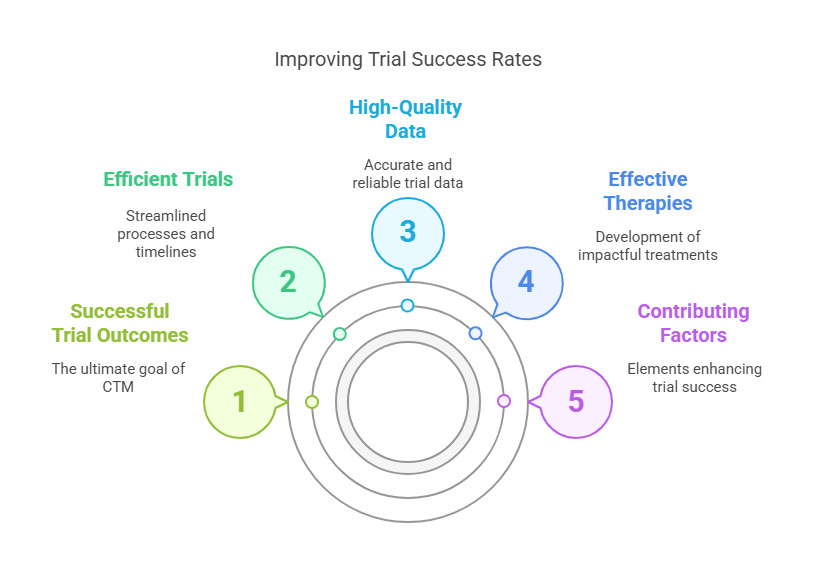
Improving Trial Success Rates
The ultimate goal of CTM is to increase the likelihood of successful trial outcomes. By integrating best practices and innovative methodologies, CTM contributes to higher success rates.
Contributing Factors:
Patient-Centric Approaches: Engaging participants through clear communication and support improves retention.
Data-Driven Decisions: Utilizing real-time data analytics to inform trial adjustments.
Collaborative Efforts: Encouraging cross-functional collaboration among stakeholders ensures cohesive trial execution.
Result: These practices lead to more efficient trials, higher-quality data, and expedited development of effective therapies.
10 Lesser-Known Facts About Clinical Trial Management
Virtual Trials: The rise of decentralized trials allows participants to engage remotely, increasing accessibility and diversity. (Source)
Wearable Technology: Devices like smartwatches enable continuous monitoring of patient vitals, enhancing data collection. (Source)
Blockchain Integration: Ensures secure and transparent data handling, reducing the risk of tampering. (Source)
Artificial Intelligence: AI algorithms assist in patient recruitment by identifying suitable candidates more efficiently.
Real-World Evidence (RWE): Incorporating RWE into trials provides insights into treatment effectiveness in everyday settings.
Patient Advocacy Groups: Collaborating with these groups can improve trial design and participant engagement.
Environmental Considerations: Sustainable practices in trial conduct are gaining attention, reducing the ecological footprint.
Regulatory Sandboxes: Some regions offer controlled environments to test innovative trial methods under regulatory supervision.
Gamification: Incorporating game elements into participant interactions can boost engagement and compliance.
Cultural Competency Training: Ensures that trial staff can effectively communicate with diverse participant populations.
Related Blogs
Key Challenges in Clinical Trial Data Management
How Clinical Trials and Data Management Impact Research Outcomes?
The Basics of Clinical Trial Data Management
Explore Courses for Clinical Research Career
Courses Available:
Conclusion
As the pharmaceutical industry continues to innovate, the significance of Clinical Trial Management cannot be overstated. By ensuring cost-effectiveness, regulatory compliance, proactive risk management, and improved success rates, CTM serves as the backbone of efficient and ethical clinical research. Organizations like CCRPS are at the forefront, providing the expertise and resources necessary to navigate the complexities of modern clinical trials.
Frequently Asked Questions (FAQs)
-
CTM streamlines patient recruitment by leveraging data analytics to identify eligible participants and implementing targeted outreach strategies.
-
By standardizing data collection processes and employing real-time monitoring tools, CTM ensures the accuracy and reliability of trial data.
-
Yes, CTM frameworks are designed to accommodate protocol amendments, ensuring flexibility and responsiveness to emerging data.
-
CTM ensures that all necessary documentation is accurately compiled and submitted in accordance with regulatory timelines and requirements.