
Medical monitoring certification exams test your ability to recognize clinical safety risks, evaluate adverse-event evidence, and make defensible decisions when patient safety and trial requirements intersect. A misunderstood SAE classification, missed liver toxicity signal, or incorrect escalation decision can expose serious knowledge gaps. Mastering clinical trial safety oversight, medical monitoring plans, adverse-event reporting, and ICH E6(R3) requirements helps you approach complex certification scenarios with the clinical judgment, regulatory knowledge, and documentation discipline expected of qualified medical monitors.

1. Understand the Core Medical Monitoring Responsibilities Tested on Certification Exams
Medical monitoring requires continuous evaluation of the clinical risks associated with investigational treatments. The medical monitor reviews emerging safety information, evaluates medically significant findings, advises on protocol-related medical questions, and supports the sponsor's ongoing assessment of participant safety.
These responsibilities connect closely with medical monitoring plan development, clinical-trial safety assessments, and pharmacovigilance compliance.
Distinguish the medical monitor from the investigator, CRA, and DSMB
A frequent examination challenge involves identifying who holds responsibility for a particular decision.
The medical monitor provides study-specific medical expertise, reviews safety findings, assesses potential risks, and communicates recommendations within assigned responsibilities.
The principal investigator retains responsibility for participant medical care and appropriate oversight at the site. A sponsor medical monitor may recommend further evaluation or discuss dosing criteria, while the treating investigator makes medical decisions within their responsibility and the applicable study requirements.
A clinical research associate (CRA) evaluates site conduct, documentation, and protocol compliance through assigned monitoring activities. Medical concerns identified during on-site or remote monitoring may require referral to the medical monitor for clinical interpretation.
An independent Data Monitoring Committee (DMC/DSMB) may periodically review accumulated trial information and recommend continuing, modifying, or stopping a study under its charter. Its independence and access to potentially unblinded data distinguish its function from routine sponsor medical review.
Understanding these boundaries strengthens your grasp of investigator GCP responsibilities, medical safety oversight, and clinical project governance.
Recognize what a medical monitoring plan controls
A Medical Monitoring Plan (MMP) establishes the practical framework for reviewing and escalating medical concerns.
It should identify which data require review, who evaluates them, relevant review timelines, the circumstances triggering escalation, and how significant decisions are documented.
For example, a trial investigating a potentially hepatotoxic medicine may require specific monitoring of ALT, AST, bilirubin, and clinical symptoms. The monitoring plan should align with protocol-defined laboratory criteria and specify the procedures for medical assessment and follow-up.
A vague instruction to review abnormal results creates inconsistent practices. Effective medical monitoring procedures define relevant triggers, required actions, decision ownership, and supporting documentation.
This approach also supports clinical-trial quality management and data-integrity requirements.
Apply ICH E6(R3) principles to medical oversight
ICH E6(R3) emphasizes risk-proportionate trial conduct, qualified personnel, sponsor oversight, quality by design, and reliable data governance.
A medical monitor should understand how these principles affect clinical safety review. Important risks deserve appropriate controls, while medical decisions require clear accountability and traceable evidence.
Examination scenarios may test whether a sponsor's delegation to a CRO removes its oversight responsibilities, whether critical safety findings require additional review, or how emerging risks should influence ongoing trial conduct.
Review ICH E6(R3) professional expectations, regulatory compliance for medical monitors, and risk-based clinical research oversight to connect these concepts to realistic cases.
| Medical Monitoring Certification Exam: 32-Concept Clinical Decision Matrix | |||
|---|---|---|---|
| Concept | What the Exam Tests | Common Failure Mode | Correct Decision Principle |
| 1. Medical monitor authority | Medical advice and assigned decision rights | Overriding investigator responsibilities | Follow documented authority and clinical escalation. |
| 2. Investigator accountability | Participant care and site oversight | Assuming sponsor review replaces site medical judgment | Preserve investigator responsibility for medical care. |
| 3. Sponsor oversight | Safety surveillance and delegated activities | Assuming CRO delegation eliminates accountability | Maintain sponsor oversight of allocated activities. |
| 4. Medical Monitoring Plan | Triggers, owners, timelines and evidence | Undefined review or escalation procedures | Use study-specific review and action criteria. |
| 5. Adverse event (AE) | Untoward medical occurrence classification | Requiring proven treatment causality | Record events under applicable AE definitions. |
| 6. Serious adverse event | Regulatory seriousness criteria | Confusing seriousness with symptom intensity | Apply death, life-threatening, hospitalization and other criteria. |
| 7. Severity grading | Intensity or CTCAE grade | Treating every severe event as serious | Evaluate severity separately from seriousness. |
| 8. Causality assessment | Evidence of possible treatment relationship | Relying on timing alone | Review chronology, alternatives, exposure and clinical evidence. |
| 9. Expectedness | Consistency with applicable reference safety information | Using general clinical familiarity as the standard | Apply the correct approved reference information. |
| 10. SUSAR | Serious, unexpected suspected adverse reaction | Misclassifying unrelated or expected events | Evaluate seriousness, suspected causality and expectedness. |
| 11. SAE notification | Site-to-sponsor reporting responsibilities | Waiting for confirmed causality | Meet applicable prompt notification requirements. |
| 12. IND safety reports | US sponsor expedited reporting obligations | Applying every deadline to every AE | Apply event-specific reporting criteria and deadlines. |
| 13. AESI | Protocol-defined targeted safety risks | Assuming AESI automatically means SAE | Follow specific AESI collection and escalation rules. |
| 14. MedDRA coding | Standardized event terminology | Changing clinical meaning through coding | Preserve reported information and appropriate coding accuracy. |
| 15. CTCAE grading | Graded toxicity intensity where applicable | Confusing grade with regulatory seriousness | Use the specified grading version and event criteria. |
| 16. Liver safety | ALT, AST, bilirubin and trend assessment | Ignoring possible drug-induced liver injury | Review patterns, clinical context and protocol triggers. |
| 17. Hy's law concern | Potential serious hepatotoxicity signal | Diagnosing DILI solely from thresholds | Assess qualifying findings and competing explanations urgently. |
| 18. ECG and QTc | Potential cardiac repolarization risk | Relying on isolated values without context | Check method, baseline, medicines, electrolytes and trends. |
| 19. Renal safety | Creatinine, eGFR and renal changes | Ignoring baseline function or acute changes | Apply protocol thresholds and clinical evaluation. |
| 20. Hematologic toxicity | Neutropenia, anemia and thrombocytopenia | Overlooking infection or bleeding risk | Review grade, symptoms and dose-modification criteria. |
| 21. Dose-limiting toxicity | Protocol-defined DLT criteria and evaluation window | Counting events outside defined rules | Apply the study-specific DLT definition. |
| 22. Dose interruption | Hold, reduction and restart conditions | Inventing dose thresholds | Follow protocol-authorized medical decisions. |
| 23. Stopping rules | Individual and trial-level safety triggers | Confusing a patient hold with study termination | Identify trigger, authority, action and restart conditions. |
| 24. Emergency unblinding | When treatment identity is medically necessary | Unnecessary disclosure of allocation | Use authorized procedures while protecting urgent care. |
| 25. DSMB/DMC review | Independent accumulated-data evaluation | Treating the committee as routine site monitoring | Follow charter, independence and recommendation pathways. |
| 26. Safety signal detection | Emerging patterns across cases and time | Reviewing cases without aggregate context | Assess frequency, severity, exposure and competing risks. |
| 27. Case narrative | Clinical chronology and medical interpretation | Copying raw listings without meaningful synthesis | Explain onset, evidence, treatment, outcome and uncertainties. |
| 28. Concomitant medication | Drug interactions and alternative causation | Ignoring recently introduced therapies | Reconcile medication timelines against the event. |
| 29. Pregnancy exposure | Exposure follow-up and safety obligations | Automatically classifying exposure itself as an SAE | Follow protocol-specific reporting and outcome tracking. |
| 30. Medical data reconciliation | Consistency across EDC, safety and vendor records | Conflicting onset, severity or outcome data | Investigate and resolve discrepancies with an audit trail. |
| 31. Safety-related deviation | Medical significance of eligibility or dosing errors | Recording deviation without clinical assessment | Assess participant risk, escalate and document follow-up. |
| 32. Inspection-ready review | Traceability of medical findings and decisions | Missing rationale, ownership or closure evidence | Preserve dated reviews, communications and dispositions. |
2. Master AE, SAE, SUSAR, Causality, and Safety Reporting Decisions
Safety-event classification is one of the most important medical monitoring competencies. Examiners can construct difficult questions by combining event severity, hospitalization, causality, expectedness, and reporting timelines.
Understanding the terminology behind adverse-event reporting, medical-monitor safety assessments, and pharmacovigilance certification topics gives you a framework for resolving these scenarios.
Adverse event versus serious adverse event
An adverse event (AE) is an untoward medical occurrence in a participant under the applicable clinical-trial definition. Establishing a causal relationship with the study treatment is generally unnecessary for initial AE identification.
A serious adverse event (SAE) satisfies one or more regulatory seriousness criteria, such as death, a life-threatening event, inpatient hospitalization or prolongation of hospitalization, persistent or significant incapacity, or a congenital anomaly or birth defect. Other medically important events can also qualify under the relevant requirements.
The distinction between severity and seriousness is fundamental.
A participant experiencing intense nausea may have a severe event without meeting SAE criteria. A comparatively mild symptom may be associated with a serious diagnosis requiring inpatient hospitalization.
Use the classification approach established in GCP adverse-event reporting guidance and practice applying it through pharmacovigilance examination questions.
Causality, expectedness, and SUSAR assessment
Causality assessment considers the evidence supporting a relationship between an investigational product and an event.
Important factors include temporal association, known pharmacology, competing illnesses, concomitant medicines, changes after stopping treatment, and clinically justified information about recurrence following re-exposure.
A positive dechallenge can support a causal hypothesis. Its interpretation depends on other explanations and the clinical context.
Expectedness involves comparing the reaction with the applicable reference safety information. A medical event being common in general clinical practice does not automatically make it expected for expedited safety reporting.
A SUSAR is a suspected unexpected serious adverse reaction under the relevant regulatory framework. Its classification requires careful consideration of seriousness, suspected causal relationship, and expectedness.
These distinctions are especially relevant to pharmacovigilance regulatory compliance, medical monitoring responsibilities, and drug safety career competencies.
Understand safety-reporting timelines without confusing responsibilities
The investigator's responsibility to report an SAE to the sponsor differs from the sponsor's responsibility to determine whether information requires expedited regulatory reporting.
Under applicable US IND safety reporting requirements, qualifying serious and unexpected suspected adverse reactions generally require sponsor reporting within 15 calendar days after the sponsor determines the information qualifies for reporting.
Qualifying unexpected fatal or life-threatening suspected adverse reactions require notification as soon as possible, within 7 calendar days after the sponsor initially receives the information.
These FDA requirements apply to specific reportable information. Other jurisdictions impose different timelines and procedures. The investigator's initial sponsor-notification deadline should be determined from the protocol, applicable regulations, and reporting instructions.
A useful practice scenario involves a participant hospitalized with suspected treatment-related pneumonitis. The medical monitor should evaluate available clinical information and support timely escalation, while pharmacovigilance and designated sponsor functions determine applicable regulatory reporting.
Review safety assessment techniques, medical monitoring plans, and regulatory compliance for medical monitors to understand how these responsibilities fit together.
Distinguish AESIs, severity grading, and medical coding
An adverse event of special interest (AESI) is an event specifically identified for targeted surveillance because of its potential importance to the product or program. An AESI can be serious or nonserious.
CTCAE grading, where applicable, provides standardized terminology and severity criteria for adverse events, particularly in oncology trials. The version specified for the study matters.
MedDRA provides standardized medical terminology for coding reported clinical events. Accurate coding supports aggregate safety analysis, while the underlying clinical information remains essential for interpreting what happened.
When preparing for pharmacovigilance certification examinations, learn how an event moves from initial documentation through medical assessment, coding, reconciliation, and potential reporting.
Medical monitors should understand where data quality controls and pharmacovigilance audit practices identify inconsistent event dates, outcomes, or classifications.
3. Interpret Laboratory Trends, Dose-Limiting Toxicities, and Emerging Safety Signals
Medical monitors must evaluate clinical findings in context. A laboratory result can appear acceptable in isolation while indicating a concerning pattern when compared with baseline values, treatment exposure, symptoms, and previous assessments.
Certification questions may require you to identify the information needed before a medical decision can be made. This is central to medical data review, clinical trial safety oversight, and medical monitoring plan implementation.
Detect possible drug-induced liver injury
Elevated ALT and AST may indicate hepatocellular injury. Bilirubin, alkaline phosphatase, symptoms, baseline liver function, and potential alternative causes help clarify the clinical picture.
Hy's law concerns potential serious drug-induced hepatotoxicity when substantial aminotransferase elevation occurs together with elevated bilirubin in a pattern suggesting hepatocellular injury, without a convincing alternative explanation.
A commonly used screening pattern includes ALT or AST above three times the upper limit of normal and total bilirubin above twice the upper limit of normal, with consideration of alkaline phosphatase and competing causes.
These thresholds identify findings requiring investigation. A complete assessment considers clinical history, viral hepatitis, biliary disease, concomitant medicines, underlying illness, and the timing of exposure.
If a participant develops progressively elevated ALT accompanied by increasing bilirubin, the medical monitor should prioritize urgent clinical review and the protocol's treatment-interruption and safety procedures.
Understanding medical safety assessments and clinical trial safety reporting helps you determine which findings require escalation and additional investigation.
Evaluate QTc, renal function, and hematologic abnormalities
For cardiac safety, review ECG findings with the correction formula, baseline QTc, changes over time, electrolyte concentrations, concomitant QT-prolonging medicines, and relevant clinical symptoms.
A QTc value exceeding a study-defined threshold may trigger repeat testing, specialist evaluation, or treatment interruption. Examine the specific protocol requirements rather than inventing a universal rule.
For renal safety, evaluate creatinine trends, estimated filtration measures, baseline renal function, hydration status, and possible nephrotoxic exposures.
For hematologic safety, distinguish laboratory abnormalities from their clinical consequences. Neutropenia may indicate infection risk; thrombocytopenia may affect bleeding risk; and anemia may require evaluation of symptoms and clinical stability.
A meaningful clinical safety review incorporates the participant's condition, protocol criteria, and qualified medical judgment.
These findings should also be reflected in medical monitoring procedures and clinical trial quality systems.
Understand dose-limiting toxicities and stopping rules
A dose-limiting toxicity (DLT) is defined according to the study protocol and is especially important in early-phase dose-escalation trials.
DLT definitions may depend on toxicity type, severity grade, duration, attribution, and a designated assessment window.
For example, severe neutropenia may qualify as a DLT under specified conditions in one oncology protocol, while another protocol may use different requirements.
Distinguish three decisions:
Individual dose modification: Whether a participant should have treatment withheld, reduced, discontinued, or restarted under applicable criteria.
Cohort or dose-escalation decision: Whether available toxicity findings permit escalation, expansion, or other protocol-defined action.
Study-level stopping decision: Whether emerging evidence requires enrollment suspension, additional review, amendment, or trial termination.
Each decision may involve different authorities and governance processes.
Review medical monitoring plans, investigator medical responsibilities, and clinical project oversight.
Recognize safety signals across multiple participants
A safety signal may emerge through repeated events, unexpected frequency, a pattern involving related medical conditions, or increasing severity with exposure.
Suppose several participants develop similar cardiac abnormalities after initiating an investigational product. Individual event assessments should be supplemented by an aggregate review considering treatment exposure, baseline risk, comparable participants, timing, and possible confounders.
The appropriate response may involve additional analysis, increased monitoring, an independent review, protocol amendments, or urgent protective action.
A single event may also justify immediate escalation when its medical implications are sufficiently serious.
This is why aggregate pharmacovigilance assessment, medical data review, and risk-based trial oversight deserve attention in certification preparation.
Which Medical Monitoring Concept Could Cost You the Most Exam Points?
Select your biggest weakness to reveal the most useful next preparation step.
Practice determining seriousness, severity, suspected causality, and expectedness separately. Then identify site-to-sponsor obligations and any sponsor regulatory reporting requirements. Use examples with hospitalization, unrelated events, and unexpected fatal reactions.
Practice reviewing ALT, AST, bilirubin, QTc, creatinine, and blood counts against baseline results, symptoms, concurrent medicines, and protocol criteria. Determine what requires urgent review, additional testing, or an authorized treatment decision.
Distinguish the investigator's participant-care responsibilities, the sponsor's safety oversight, the medical monitor's assigned medical review, and the DSMB's independent recommendations. Match each example to its documented decision-maker.
Compare event patterns across participants, account for exposure and baseline risk, then identify protocol-defined pause criteria, review responsibilities, escalation routes, and the evidence needed before restarting enrollment or treatment.
Identify the event, clinical risk, accountable decision-maker, immediate action, and documentation. Budget time for the first pass, flag uncertain questions when permitted, and revisit them after completing clearer cases.
4. Solve Medical Monitoring Certification Scenarios Using Clinical Reasoning
Certification-level questions often involve incomplete clinical information, overlapping risks, and several plausible actions. A structured reasoning approach helps identify the most appropriate response.
The strongest answers combine clinical safety assessment, protocol-based medical oversight, and GCP responsibilities.
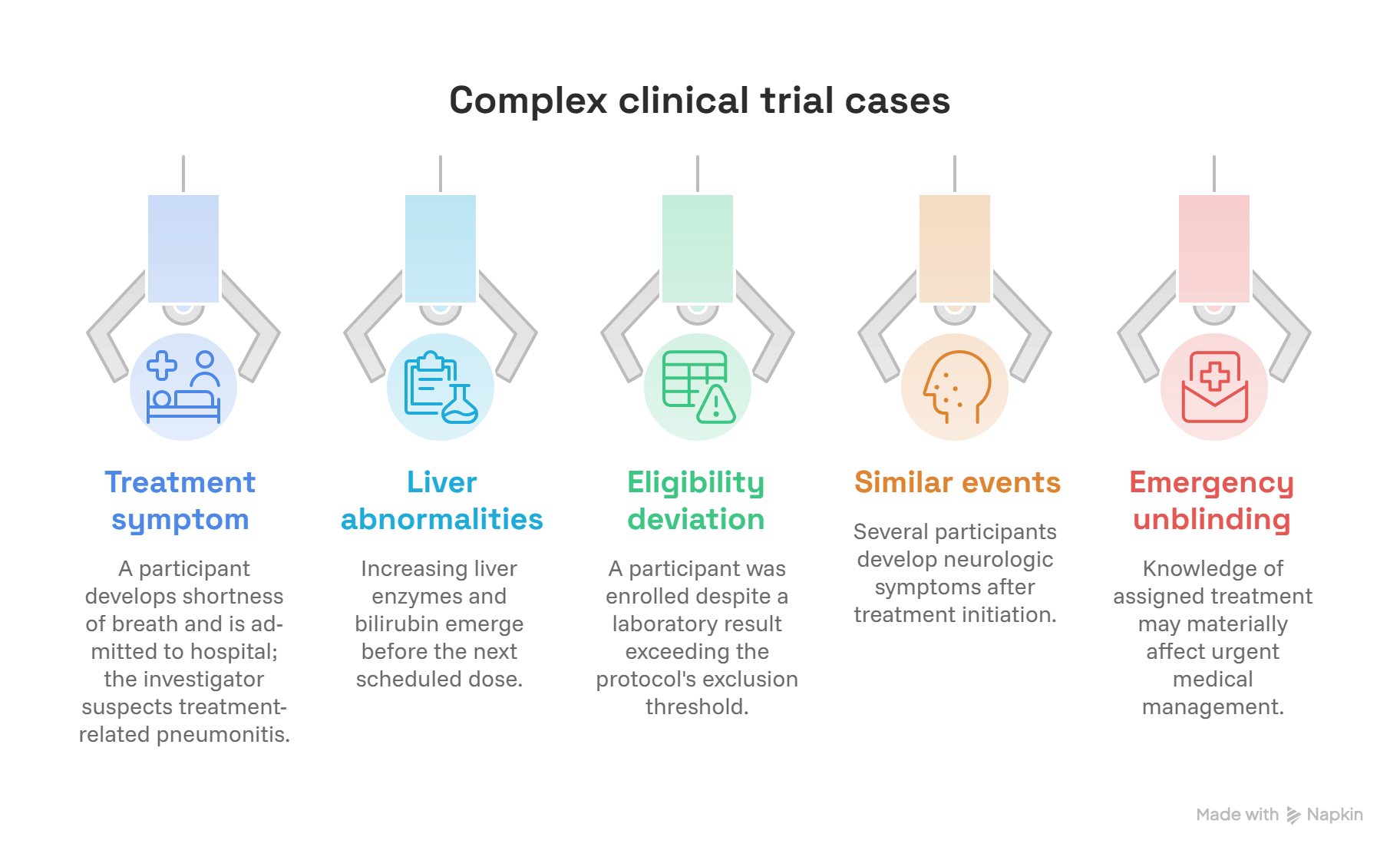
Case 1: Hospitalization following a new treatment-related symptom
A participant receiving an investigational oncology treatment develops shortness of breath and is admitted to hospital. The investigator suspects treatment-related pneumonitis.
How should the medical monitor approach this case?
First, establish the participant's clinical condition and ensure the appropriate treating team is managing the immediate medical concern.
Review the event chronology, treatment exposure, imaging, oxygen requirements, relevant laboratory data, and potential alternative explanations such as infection or disease progression.
Evaluate seriousness, available causality evidence, expectedness, and the need for further assessment. Confirm the event has entered the appropriate safety reporting and follow-up processes.
The medical monitor should coordinate assigned medical review responsibilities while respecting the investigator's clinical-care authority and the sponsor's applicable reporting obligations.
This scenario combines SAE reporting requirements, medical monitoring plans, and clinical-trial safety oversight.
Case 2: Laboratory abnormalities emerge before the next scheduled dose
A participant has increasing liver enzymes and bilirubin compared with baseline. The next dose is due later that day.
A strong examination response recognizes the potential clinical urgency and identifies the need for prompt qualified medical evaluation, relevant repeat or additional tests, and assessment against protocol-defined treatment criteria.
Determine whether treatment should be withheld under the approved protocol while the abnormality is investigated. Review potential causality, concurrent medications, underlying disease, and other available clinical findings.
The answer should also consider appropriate reporting and documentation, particularly if the event meets an SAE or other study-defined safety reporting criterion.
This requires understanding of clinical medical data review, investigator responsibilities, and medical monitoring escalation procedures.
Case 3: A clinically significant eligibility deviation is discovered
A participant was enrolled despite a laboratory result that exceeded the protocol's exclusion threshold.
The medical monitor should help evaluate the clinical significance and implications for ongoing treatment, while the investigator assesses participant safety and appropriate clinical care.
The study team should document the deviation, follow required reporting and corrective processes, and determine whether changes to participant management are necessary.
A weak response might focus exclusively on the eligibility form and overlook the participant's medical risk.
This scenario tests research protocol adherence, site medical oversight, and clinical research quality management.
Case 4: Several participants experience a similar unexpected event
Suppose multiple trial participants develop neurologic symptoms after treatment initiation.
Begin with event validation and clinical assessment. Examine event definitions, severity, seriousness, onset patterns, exposure, dose, study population, and alternative explanations.
Consider whether the combined evidence suggests a safety signal requiring additional investigation or sponsor-level escalation.
The response may involve enhanced surveillance, expert review, a protocol amendment, or another action justified by available evidence and the trial's safety governance.
The ability to evaluate accumulated information is a key competency in pharmacovigilance safety assessment, medical monitoring, and risk-based trial management.
Case 5: Emergency unblinding becomes clinically necessary
A blinded trial participant develops a serious condition, and knowledge of the assigned treatment may materially affect urgent medical management.
Determine whether treatment assignment is needed for safe clinical care, identify the protocol-defined unblinding procedure, and involve authorized personnel.
When urgent medical needs require action, participant safety remains paramount. The team should document the justification, authorized process, information disclosed, and relevant notifications.
Unblinding procedures should also protect trial integrity by limiting access to treatment assignments where possible.
This case links clinical trial ethics, investigator medical responsibilities, and medical safety monitoring plans.
A repeatable method for answering complex cases
For every scenario, identify the clinical finding, potential participant risk, responsible decision-maker, required immediate action, and documentation or follow-up obligation.
Then examine any protocol-specific factors that could alter the conclusion.
This reasoning method is especially valuable when practicing pharmacovigilance exam questions, reviewing medical monitoring techniques, or preparing for medical monitor regulatory compliance.
5. Build an Exam-Ready Medical Monitoring Study Plan and Avoid Common Mistakes
A productive certification study plan should reveal how well you can perform the key medical monitoring decisions under realistic conditions.
Start by grouping your practice questions into safety classification, medical interpretation, oversight responsibilities, protocol-based decisions, and documentation.
Use the detailed topic coverage in medical monitoring plans, clinical safety assessments, pharmacovigilance exam preparation, and medical monitor regulatory compliance.
Seven-day targeted revision schedule
Day 1: Rebuild the regulatory foundation. Review ICH E6(R3), investigator and sponsor responsibilities, medical monitor authority, and key safety oversight requirements. Pay particular attention to questions involving outsourced activities and decision ownership.
Use ICH E6(R3) career expectations, investigator GCP obligations, and clinical-trial quality management.
Day 2: Master safety-event classifications. Practice distinguishing AEs, SAEs, AESIs, expected reactions, suspected causality, and reportable SUSARs. Work through examples involving hospitalization, medical intervention, and serious unexpected reactions.
Review adverse-event reporting compliance, pharmacovigilance sample questions, and drug safety examination topics.
Day 3: Strengthen clinical data interpretation. Practice reading serial laboratory results, ECG findings, hematology trends, and treatment-exposure timelines. Identify when additional medical assessment is justified.
Focus on clinical data review methods, medical safety oversight, and data integrity controls.
Day 4: Practice protocol and dose decisions. Review eligibility violations, DLT definitions, dose interruption, restart criteria, emergency unblinding, and protocol-specific stopping rules.
Connect these topics with protocol adherence, medical monitoring procedures, and clinical project leadership.
Day 5: Focus on aggregate safety and documentation. Study adverse-event trends, exposure-adjusted comparisons, safety reconciliation, decision logs, and independent safety committee responsibilities.
Use pharmacovigilance audit techniques, trial data governance, and quality-management strategies.
Day 6: Complete a timed practice assessment. Use the examination format and time constraints specified by your provider. Include mixed-topic clinical scenarios and record why each incorrect answer failed.
Categorize errors according to safety assessment, reporting compliance, or medical monitor responsibilities.
Day 7: Review errors and verify exam readiness. Revisit weak concepts, confirm your official examination instructions, and prepare the required testing materials. Finish with short scenarios involving the areas where you have made repeated mistakes.
The final review should prioritize reliable interpretation and defensible clinical decisions.
Use a medical decision log during practice
A useful preparation technique is creating a simplified medical decision log with the event, evidence reviewed, risk assessment, responsible decision-maker, immediate action, and follow-up requirement.
For instance, a hypothetical case involving thrombocytopenia should include platelet trends, bleeding symptoms, relevant medicines, the protocol's dose-modification criteria, and the basis for escalation.
This mirrors the documentation expected in medical monitoring plans, clinical trial safety assessments, and quality-controlled research documentation.
Avoid examination answers that overlook important clinical context
Watch for responses that assign medical decisions to unauthorized personnel, rely on one laboratory value without reviewing a trend, assume all severe events are SAEs, or recommend safety reporting without applying the relevant criteria.
Another common weakness is identifying a safety concern without recognizing the required follow-up and documentation.
Use your knowledge of investigator responsibilities, safety reporting requirements, and risk-based oversight to evaluate whether the proposed action is complete and clinically appropriate.
6. Frequently Asked Questions About Medical Monitoring Certification Exams
-
Prioritize adverse-event classification, seriousness, severity, causality, expectedness, medical safety review, protocol-defined dose modifications, and regulatory reporting responsibilities.
You should also understand how medical monitors interact with investigators, sponsors, pharmacovigilance personnel, and independent safety committees.
Strengthen these topics through medical monitoring plan guidance, clinical trial safety oversight, pharmacovigilance examination practice, and ICH E6(R3) requirements.
Use your provider's official syllabus to determine the depth expected in each area.
-
An adverse event is an untoward medical occurrence recorded under applicable trial definitions.
An SAE meets seriousness criteria such as death, life-threatening circumstances, qualifying hospitalization, persistent incapacity, or another medically important condition.
A SUSAR is a suspected unexpected serious adverse reaction under the applicable regulatory framework. It involves evaluation of seriousness, causality, and expectedness.
These distinctions are central to adverse-event reporting compliance, pharmacovigilance certification topics, medical safety assessment, and safety oversight responsibilities.
-
A medical monitor may evaluate findings and recommend treatment interruption, additional testing, or other medical actions within assigned responsibilities.
The investigator remains responsible for appropriate participant medical care, while sponsor-level and study-level decisions follow the protocol and established governance processes.
A trial-wide enrollment pause may involve additional sponsor medical governance or independent committee recommendations.
Review investigator GCP duties, medical monitoring plan requirements, clinical-trial safety oversight, and clinical project management responsibilities.
-
Hy's law helps identify a concerning pattern of potential drug-induced liver injury involving substantial aminotransferase elevation and increased bilirubin.
The medical evaluation must consider other possible causes, such as biliary obstruction, underlying liver disease, viral hepatitis, and concomitant medications.
A concerning pattern may warrant urgent assessment, additional testing, treatment decisions, and appropriate safety reporting.
Understanding this concept strengthens medical data interpretation, trial safety management, medical monitoring procedures, and pharmacovigilance competence.
-
A medical monitor typically performs assigned ongoing medical review and safety oversight activities within the sponsor's clinical trial organization or its contracted services.
A Data and Safety Monitoring Board operates independently under a charter and may review accumulating safety, efficacy, and trial-conduct information to provide recommendations about trial continuation or modification.
The committee's independence can be particularly important when reviewing unblinded comparative information.
These relationships connect medical monitoring plans, clinical trial safety oversight, sponsor and CRO responsibilities, and clinical research quality management.
-
Important areas include qualified medical expertise, participant protection, risk-proportionate oversight, sponsor accountability, critical-to-quality factors, and reliable clinical data.
Candidates should understand how these principles influence safety review procedures, responsibilities, escalation decisions, and documentation.
Medical monitoring also requires coordination between sponsor functions, investigators, and safety personnel.
Review ICH E6(R3) expectations, investigator responsibilities, trial quality management, and medical-monitor regulatory compliance.
