
Preparing for the Medical Science Liaison (MSL) and Medical Monitor Certification Exam requires mastering two demanding areas: scientific communication and clinical trial safety oversight. Candidates must interpret clinical evidence, recognize regulatory risks, evaluate adverse events, and make defensible decisions when several answers appear correct.
This four-week study schedule organizes those competencies into manageable daily objectives, realistic case exercises, and measurable examination checkpoints. Whether your background is medicine, pharmacy, or clinical research, the plan helps you strengthen medical affairs compliance, medical monitoring skills, and practical certification readiness.

1. How to Structure Your 4-Week MSL and Medical Monitor Exam Preparation
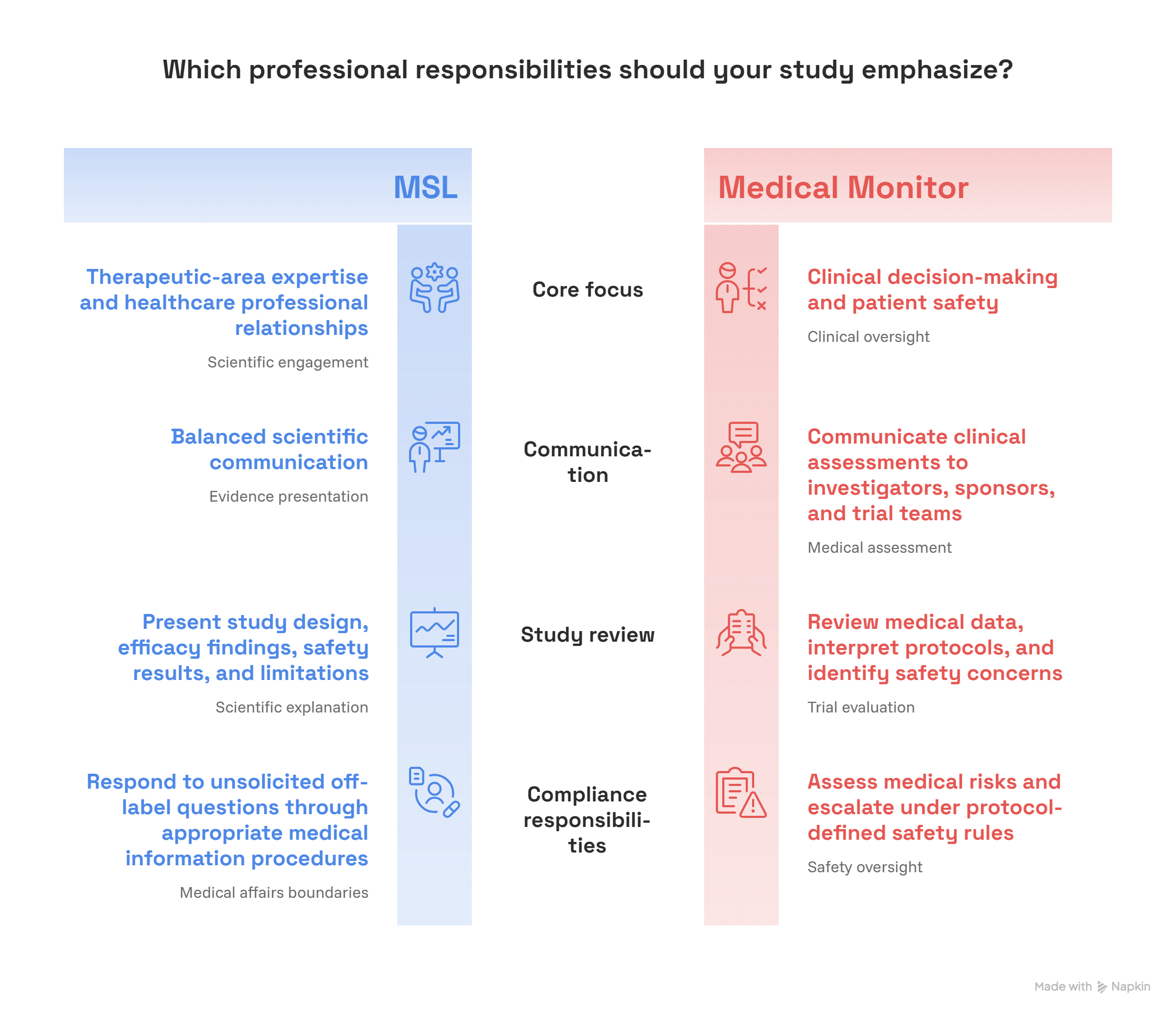
The biggest preparation mistake is treating the MSL and Medical Monitor disciplines as interchangeable. Both require strong scientific knowledge, but their practical responsibilities differ significantly.
Medical Science Liaisons concentrate on evidence-based scientific exchange, healthcare professional engagement, therapeutic-area expertise, medical insights, and compliant communication. Medical Monitors concentrate on clinical safety oversight, protocol interpretation, participant protection, and the medical evaluation of trial information.
Understanding these differences is especially important when studying Medical Monitor versus MSL responsibilities, regulatory compliance for both professions, and clinical trial safety oversight.
Establish your baseline before Day 1
Complete a diagnostic assessment of 30–40 unfamiliar questions covering ICH-GCP, clinical research methodology, pharmacovigilance, clinical data interpretation, scientific exchange, and medical monitoring.
For each question, record your selected answer, confidence level, time taken, and reason for uncertainty.
A candidate who scores 85% on scientific terminology but 40% on adverse event reporting should devote more time to safety assessment. Someone comfortable with medical monitoring plans but weak in MSL stakeholder engagement needs a different allocation.
Calculate your performance separately across six domains: GCP and ethics, trial methodology, medical safety, pharmacovigilance, scientific communication, and compliance.
Allocate approximately 10–14 hours per week
A practical starting schedule is 90–120 minutes on six days, with a lighter review session on the seventh day. Candidates with significant knowledge gaps may need additional time.
Divide a typical two-hour session into four activities:
20 minutes: Active recall of previously studied concepts.
40 minutes: New material from the relevant curriculum.
40 minutes: Scenario-based questions or a practical assignment.
20 minutes: Error analysis and spaced-repetition planning.
Use the Medical Science Liaison certification study guide and medical monitoring training resources to identify what requires additional attention.
Apply the 50-30-20 study allocation
For the first two weeks, a useful starting allocation is 50% core clinical research concepts, 30% role-specific competencies, and 20% practice assessments.
During the final two weeks, shift more time toward unfamiliar scenarios, timed assessments, and correcting errors.
The MSL track should emphasize clinical evidence interpretation, scientific communication compliance, and medical affairs career competencies.
The Medical Monitor track should emphasize GCP investigator responsibilities, clinical safety assessments, and medical monitoring plan development.
Create four examination-ready deliverables
By the end of the month, aim to produce a clinical evidence appraisal, a compliant scientific exchange briefing, a medical safety assessment, and a documented clinical monitoring decision.
These documents turn theoretical knowledge into observable competence.
They also expose gaps that ordinary multiple-choice practice may miss. A candidate might correctly define a serious adverse event but struggle to write a defensible safety assessment. Another might interpret a clinical trial correctly but fail to communicate its limitations during scientific exchange.
Use the results of these exercises to adjust your preparation rather than following a fixed schedule after your weaknesses become clear.
| MSL & Medical Monitor Certification: 30-Checkpoint Study Matrix | ||||
|---|---|---|---|---|
| Day | Core Study Priority | MSL Practice Task | Medical Monitor Practice Task | Completion Checkpoint |
| 1 | ICH E6(R3) foundations | Explain scientific exchange boundaries. | Identify participant protection obligations. | 10 principle-based questions. |
| 2 | Ethics and consent | Respond to an investigator's ethics question. | Assess a consent-related protocol deviation. | Explain two escalation decisions. |
| 3 | Sponsor and investigator roles | Map medical affairs versus commercial responsibilities. | Map investigator and sponsor safety duties. | Role-accountability chart. |
| 4 | Trial design and endpoints | Summarize an efficacy endpoint. | Evaluate an eligibility criterion. | One-page protocol summary. |
| 5 | Evidence and data integrity | Critique study limitations. | Investigate a source-data discrepancy. | Five error-identification drills. |
| 6 | Regulatory communication | Draft a response to an unsolicited off-label inquiry. | Evaluate a protocol clarification request. | Documented response rationale. |
| 7 | Week 1 assessment | 15 scientific and compliance questions. | 15 GCP and clinical questions. | 30-question diagnostic update. |
| 8 | AE versus SAE | Recognize reportable information from a KOL discussion. | Classify five safety events. | Correct classification with rationale. |
| 9 | Causality and expectedness | Interpret risk statements from clinical evidence. | Write a structured causality assessment. | Separate four safety classifications. |
| 10 | Pharmacovigilance systems | Practice adverse event intake and forwarding. | Trace investigator-to-sponsor reporting. | Safety reporting decision tree. |
| 11 | Medical monitoring plans | Extract important safety findings for HCP discussions. | Draft safety review triggers. | One-page monitoring outline. |
| 12 | Risk-based quality | Identify evidence gaps affecting communication. | Prioritize safety-critical signals. | Rank five clinical risks. |
| 13 | Safety audit readiness | Check scientific-exchange documentation. | Review missing safety evidence and CAPA. | Three documented findings. |
| 14 | Week 2 assessment | Present a balanced safety summary. | Complete a safety case simulation. | Timed 40-question test. |
| 15 | Therapeutic-area mastery | Build a disease-state evidence map. | Identify disease-specific safety concerns. | One-page therapeutic briefing. |
| 16 | Scientific exchange | Deliver a balanced three-minute evidence explanation. | Present a concise medical risk assessment. | Recorded or written presentation. |
| 17 | Stakeholder engagement | Prepare a KOL scientific meeting plan. | Prepare an investigator safety discussion. | Purpose, questions, and follow-up. |
| 18 | Research collaboration | Assess an unsolicited IIT inquiry. | Review medical feasibility and safety considerations. | Compliant escalation memo. |
| 19 | Evidence interpretation | Compare absolute and relative effect measures. | Analyze exposure-adjusted adverse event rates. | Two accurate clinical conclusions. |
| 20 | Compliance scenarios | Handle unsolicited off-label questions. | Handle protocol deviation and urgent escalation. | Five defensible written decisions. |
| 21 | Week 3 assessment | Complete a simulated KOL consultation. | Complete an investigator safety consultation. | Case-based oral or written test. |
| 22 | Mixed practice questions | Review science and compliance errors. | Review medical and safety errors. | Full diagnostic mock examination. |
| 23 | Weak-topic remediation | Correct scientific communication mistakes. | Correct safety judgment mistakes. | Five new questions per weak topic. |
| 24 | Integrated scenarios | Scientific data plus compliance case. | Safety trend plus protocol case. | Four complete case explanations. |
| 25 | Exam format verification | Confirm communication-related syllabus coverage. | Confirm medical oversight syllabus coverage. | Verified provider requirements. |
| 26 | Second mock examination | Apply timed scientific decision-making. | Apply timed clinical decision-making. | Compare domain scores and confidence. |
| 27 | Final targeted review | Revisit weak evidence and KOL scenarios. | Revisit safety and protocol scenarios. | Close high-priority knowledge gaps. |
| 28 | Final readiness review | Deliver a concise clinical evidence briefing. | Deliver a concise medical safety review. | Readiness decision and final checklist. |
| 29 | Cross-domain safeguard | Confirm balanced and compliant scientific messaging. | Confirm safety escalation and role boundaries. | Zero unresolved critical misconceptions. |
| 30 | Readiness benchmark | Explain all missed scientific questions. | Explain all missed clinical safety questions. | Documented final go/no-go assessment. |
2. Week 1: Master ICH-GCP, Clinical Trial Design, and Regulatory Foundations
Days 1–7 | Recommended study time: 10–14 hours
Week 1 builds the foundation required for both certification pathways. Candidates should understand clinical trial design, ethical research conduct, regulatory oversight, and the responsibilities of investigators, sponsors, and medical professionals.
These principles influence medical science liaison compliance, clinical safety monitoring, and principal investigator oversight.
Days 1–2: ICH-GCP principles, participant rights, and informed consent
Begin with the overarching ICH E6(R3) principles, including participant protection, scientific quality, informed consent, and appropriate trial oversight.
Study the relationship between ethical approval and investigator accountability. Understand why an approved study protocol cannot eliminate the obligation to respond appropriately to an immediate participant hazard.
MSL assignment: Prepare a short explanation of how GCP affects scientific discussions about ongoing clinical research. Focus on accurate descriptions of study findings, consent-related limitations, and regulatory boundaries.
Medical Monitor assignment: Evaluate a fictional scenario involving an outdated informed consent form and an urgent clinical concern. Identify the relevant clinical and regulatory actions and the documentation needed.
Use ethical conduct and patient safety guidance, GCP investigator responsibilities, clinical research ethics resources, and ICH E6(R3) competency guidance.
Days 3–4: Clinical trial phases, endpoints, and study methodology
Concentrate on the structure of Phase I–IV trials, randomization, blinding, allocation concealment, inclusion and exclusion criteria, and primary versus secondary endpoints.
Candidates must understand what trial results actually establish. A statistically significant result may have limited clinical importance, while an exploratory subgroup observation may lack sufficient evidence for a confident conclusion.
MSL assignment: Select a published randomized controlled trial and summarize its study population, comparator, primary endpoint, effect estimate, confidence interval, safety findings, and major limitations.
Medical Monitor assignment: Review a fictional protocol and identify eligibility requirements, potential medical risk factors, safety stopping rules, and the information required for clinical oversight.
Expand your preparation using clinical trial site oversight, investigator-initiated trial design, medical monitoring plans, and clinical data review techniques.
Days 5–6: Data integrity, regulatory responsibilities, and compliant communication
Study electronic clinical records, source documentation, audit trails, protocol deviations, sponsor oversight, and the principles of accurate scientific communication.
Distinguish the MSL's role in handling scientific inquiries from the Medical Monitor's role in evaluating clinical trial safety and protocol-related medical issues.
MSL assignment: Draft a response to an unsolicited healthcare professional question about an unapproved use of a medicine. Explain the need for medical information procedures, balanced evidence, applicable restrictions, and documentation.
Medical Monitor assignment: Evaluate an unexplained laboratory discrepancy affecting eligibility. Determine what further information is needed and which qualified professional should make the clinical decision.
These exercises connect regulatory compliance requirements, trial data integrity, protocol adherence, and quality management strategies.
Day 7: Complete the first weekly assessment
Attempt 30 unfamiliar questions covering Week 1.
Record your results separately for GCP, research methodology, evidence interpretation, and professional responsibilities.
For each missed question, identify whether the problem was missing knowledge, incorrect interpretation, or confusion about accountability.
Use the Medical Monitor and MSL practice question guide alongside clinical research training resources.
Week 1 completion target: Explain a trial protocol, interpret a clinical endpoint, describe the major GCP responsibilities, and recognize when a decision exceeds the authority of a particular professional.
3. Week 2: Master Pharmacovigilance, SAE Reporting, and Medical Safety Assessment
Days 8–14 | Recommended study time: 12–14 hours
Week 2 addresses one of the most consequential areas of clinical research certification: recognizing, interpreting, documenting, and escalating safety information.
For Medical Monitors, this includes medical assessment and benefit-risk evaluation. For MSLs, it includes recognizing potential adverse event information during scientific interactions and forwarding it through authorized pharmacovigilance channels.
Study pharmacovigilance examination topics, adverse event reporting compliance, medical monitor safety responsibilities, and medical safety data review.
Days 8–9: Distinguish AE, SAE, severity, expectedness, and causality
Develop precise definitions and apply them to realistic events.
An adverse event describes an untoward medical occurrence associated in time with treatment or study participation, without necessarily implying causation. Seriousness concerns defined clinical outcomes and circumstances, while severity describes intensity.
Causality assessment considers whether the event may be related to treatment. Expectedness considers whether the event is consistent with applicable reference safety information.
MSL assignment: Review five fictional healthcare professional conversations and identify information potentially requiring pharmacovigilance intake.
Medical Monitor assignment: Classify five fictional cases by seriousness, intensity, expectedness, and suspected causality. Explain the clinical evidence supporting each assessment.
Use adverse event reporting guidance, pharmacovigilance sample questions, medical safety assessment techniques, and clinical trial safety oversight.
Days 10–11: Learn reporting timelines and safety escalation pathways
Understand the difference between an investigator's duty to report an SAE to the sponsor and the sponsor's regulatory reporting obligations.
In US IND studies, qualifying serious and unexpected suspected adverse reactions generally require sponsor reporting within 15 calendar days after the sponsor determines the information qualifies. Unexpected fatal or life-threatening suspected adverse reactions have an expedited seven-calendar-day requirement, subject to the applicable regulatory provisions.
Learn the correct reporting clock, responsible party, and reporting destination for each scenario. Jurisdiction-specific requirements and study procedures must always be checked.
MSL assignment: Create an adverse-event intake workflow showing recognition, essential facts, authorized forwarding, and documentation.
Medical Monitor assignment: Develop a decision tree distinguishing SAE notification, medical assessment, and sponsor expedited regulatory reporting.
Connect this exercise to adverse event reporting compliance, pharmacovigilance audit preparation, medical monitoring plans, and investigator responsibilities.
Days 12–13: Recognize safety trends and practice benefit-risk reasoning
Work through aggregate safety data, abnormal laboratory trends, treatment interruptions, protocol-defined stopping criteria, and repeated events at multiple sites.
Consider the clinical context, background event rate, exposure duration, and quality of available evidence.
MSL assignment: Present a balanced summary of a treatment's safety profile, clearly distinguishing observed rates, identified risks, and limitations in the available clinical evidence.
Medical Monitor assignment: Assess a fictional cluster of elevated liver enzymes. Identify the medical questions, additional evidence, escalation pathway, and circumstances requiring urgent participant protection.
The goal is to defend your reasoning through evidence, consistent with clinical trial medical safety oversight, data review procedures, medical monitoring plan development, and clinical research quality management.
Day 14: Complete a safety-focused assessment
Attempt a 40-question practice assessment covering adverse event recognition, seriousness, causality, expectedness, medical oversight, and regulatory reporting.
Then complete one written clinical case.
Your case explanation should describe the known facts, remaining uncertainties, clinical significance, immediate action, reporting obligations, and documentation requirements.
Compare your performance with Week 1 and identify any recurring weaknesses.
Candidates needing extra practice can review the pharmacovigilance four-week preparation guide, medical monitor safety responsibilities, safety assessment techniques, and pharmacovigilance examination questions.
Week 2 completion target: Correctly distinguish major safety classifications, identify applicable escalation pathways, and explain how medical judgment and regulatory reporting responsibilities interact.
What's Your Biggest MSL & Medical Monitor Exam Challenge?
Select one answer to receive your personalized study strategy.
Submit
Practice five unfamiliar clinical situations daily. For each, identify the immediate risk, accountable professional, appropriate action, and documentation requirements.
Build separate decision trees for severity, seriousness, causality, expectedness, and reporting responsibilities. Practice with realistic adverse event cases.
Analyze one clinical study daily. Summarize the population, comparators, endpoints, absolute treatment effects, confidence intervals, safety findings, and limitations.
Create a responsibility matrix covering scientific exchange, medical information, eligibility assessment, safety reporting, and sponsor oversight.
Categorize incorrect answers by knowledge gaps, role confusion, misinterpretation, or decision sequencing. Retest weak concepts with unfamiliar scenarios.
4. Week 3: Strengthen MSL Scientific Exchange and Medical Monitor Clinical Judgment
Days 15–21 | Recommended study time: 12–14 hours
Week 3 should emphasize the responsibilities that distinguish the two professions.
MSL candidates should focus on therapeutic-area expertise, healthcare professional relationships, balanced scientific communication, and compliant medical affairs activities.
Medical Monitor candidates should concentrate on clinical decision-making, patient safety, medical data review, protocol interpretation, and medical oversight.
This division reflects the practical differences covered in MSL versus Medical Monitor career guidance, medical affairs compliance, and medical safety oversight.
Days 15–16: Develop therapeutic-area expertise and evidence presentation skills
Select one therapeutic area relevant to your intended career, such as oncology, cardiovascular medicine, neurology, or immunology.
Study disease mechanisms, current treatments, unmet medical needs, relevant biomarkers, treatment limitations, and important clinical outcomes.
MSL assignment: Create a three-minute scientific presentation explaining a recent clinical study to a specialist physician. Include study design, patient population, key efficacy findings, absolute treatment effects, safety results, and limitations.
Medical Monitor assignment: Examine the same study from a clinical oversight perspective. Identify high-risk patient characteristics, protocol-defined safety concerns, and factors requiring further medical evaluation.
Practice extracting clinically meaningful findings rather than repeating abstract conclusions.
Use medical science liaison career requirements, medical data review techniques, clinical trial medical monitoring, and MSL professional competencies.
Days 17–18: Practice KOL engagement, investigator communication, and research collaboration
MSLs must maintain credible scientific relationships with healthcare professionals and respond appropriately to their information needs.
Medical Monitors must communicate clinical assessments to investigators, sponsors, and relevant trial teams while preserving appropriate medical oversight.
MSL assignment: Prepare a simulated key opinion leader meeting with a clear scientific objective, three open-ended research questions, evidence materials, and a compliant follow-up plan.
Medical Monitor assignment: Prepare an investigator discussion about repeated abnormal safety findings. Identify the medical information required, appropriate clinical escalation, and the next review milestone.
Both exercises should use objective language, clear role boundaries, and accurate documentation.
Review MSL stakeholder engagement expectations, investigator-initiated research, medical monitor responsibilities, and clinical trial team communication.
Days 19–20: Apply evidence interpretation and compliance to complex cases
Practice interpreting relative risk, absolute risk difference, confidence intervals, subgroup findings, adverse event rates, and exposure-adjusted safety information.
A treatment producing a relative risk reduction of 20% may have very different absolute clinical effects depending on the control-group event rate. For example, reducing an event rate from 10% to 8% represents a two-percentage-point absolute reduction.
These distinctions matter when presenting research findings to clinicians and when evaluating trial outcomes.
MSL assignment: Explain a statistically significant endpoint without exaggerating clinical benefit. Discuss potential study limitations and respond to an unsolicited off-label question through appropriate medical information procedures.
Medical Monitor assignment: Evaluate a fictional safety dataset containing unequal treatment exposure and a cluster of medically important adverse events. Describe the additional evidence required before reaching a conclusion.
Both cases should distinguish observed evidence from interpretation and uncertainty.
Use medical safety data review guidance, medical affairs compliance principles, clinical trial quality management, and medical monitoring plan development.
Day 21: Complete an integrated professional simulation
Complete two original case exercises.
In the MSL case, a healthcare professional asks about an unapproved use following discussion of a new clinical study. Prepare a scientifically balanced response consistent with applicable law, company procedures, and the distinction between medical information and promotional activity.
In the Medical Monitor case, an investigator reports repeated laboratory abnormalities and requests guidance about continued participation under a protocol-defined safety rule. Assess the known information, protocol requirements, medical risks, and appropriate escalation.
Record your explanation of each decision and assess whether you clearly separated scientific evidence, medical judgment, regulatory responsibilities, and documentation requirements.
Additional practice is available through the top Medical Monitor and MSL certification questions, regulatory compliance guidance, medical monitor safety oversight, and clinical data review resources.
Week 3 completion target: Deliver a scientifically balanced medical discussion, recognize professional compliance boundaries, and explain a defensible medical safety assessment using the available evidence.
5. Week 4: Complete Mock Exams, Fix Weak Areas, and Validate Certification Readiness
Days 22–28 | Recommended study time: 10–14 hours
The final week should focus on demonstrating competence under realistic assessment conditions.
Candidates frequently lose marks because they misread a question's decision point, confuse professional responsibilities, or apply the correct rule at the wrong stage of a scenario.
Mock examination performance becomes more useful when every incorrect answer reveals a specific weakness.
Use the MSL certification study guide, Medical Monitor and MSL practice questions, GCP competency guidance, and safety assessment techniques.
Day 22: Complete the first full mock examination
Use your provider's current examination blueprint, question count, time allowance, and permitted materials.
If the exact format is unavailable, complete a practice set that covers the major domains represented in your course.
Record four metrics: total accuracy, accuracy by topic, time per question, and confidence calibration.
A correct guess should receive additional review. A wrong answer selected with high confidence deserves particularly close attention because it may reflect a firmly held misconception.
Pay special attention to clinical safety reporting, medical affairs compliance, clinical data integrity, and investigator accountability.
Day 23: Create an error register and prioritize remediation
For every missed or low-confidence question, record the topic, selected answer, correct principle, misleading detail, and next review action.
Classify errors into four categories:
Knowledge gap: You could not recall the underlying definition or regulatory requirement.
Role confusion: You assigned a responsibility to the wrong professional.
Interpretation error: You overlooked a decisive condition in the scenario.
Sequencing error: You selected an appropriate action that should happen later.
For example, a candidate might recognize that a serious adverse event requires documentation but overlook the need for immediate clinical assessment or sponsor notification.
Correct the underlying reasoning through safety reporting guidance, medical monitoring procedures, quality management techniques, and regulatory compliance resources.
Days 24–25: Practice advanced integrated clinical scenarios
These two days should concentrate on questions combining several responsibilities.
MSL scenario: A healthcare professional asks about an unapproved indication while discussing a recently published trial. Evaluate how the inquiry should be handled through authorized medical information processes, using accurate evidence and appropriate documentation.
Medical Monitor scenario: A trial participant experiences an unexpected hospitalization, and preliminary information raises concern about a possible product-related event. Identify the necessary medical review, investigator reporting, sponsor assessment, and any potentially applicable expedited reporting obligations.
Explain why the chosen actions are appropriate, what information remains uncertain, and which professional is accountable for each decision.
Support this practice with pharmacovigilance examination topics, medical safety oversight, medical affairs compliance, and clinical trial medical monitoring.
Day 26: Complete a second unfamiliar mock assessment
Repeat the assessment under comparable conditions using new questions.
Compare the results against Day 22. Look for improvement in high-priority weak areas and a reduction in high-confidence errors.
If a domain remains weak, revisit the governing principles and practice a different case involving the same concept.
Review MSL examination preparation strategies, Medical Monitor and MSL practice questions, clinical safety assessment techniques, and GCP monitoring guidance.
Day 27: Conduct a high-priority final review
Concentrate on regulatory distinctions, clinical reasoning errors, and concepts you still cannot explain confidently.
For MSL candidates, revisit scientific evidence limitations, compliant medical information responses, scientific exchange documentation, and stakeholder boundaries.
For Medical Monitor candidates, revisit SAE assessment, medical causality, eligibility questions, safety stopping criteria, and protocol-related medical decisions.
Use short retrieval exercises followed by explanations. This is more useful than attempting to reread every training module.
The strongest final review connects clinical trial safety oversight, medical compliance, pharmacovigilance responsibilities, and GCP principles.
Day 28: Make an evidence-based exam readiness decision
Review your mock examination results, weakest domains, confidence calibration, and ability to explain unfamiliar scenarios.
A useful personal target is consistently exceeding your provider's required passing standard during fresh practice assessments. The exact official standard must be verified with the provider.
For high-consequence subjects such as participant safety and regulatory reporting, ensure that remaining mistakes are understood and corrected before attempting the assessment.
Finish with one concise scientific briefing and one medical safety case explanation.
Review the MSL certification study guide, clinical safety responsibilities, data integrity requirements, and regulatory compliance guidance where uncertainties remain.
A strong final result is the ability to interpret evidence, identify accountable personnel, choose proportionate actions, and justify decisions through appropriate clinical and regulatory principles.
6. Frequently Asked Questions About the MSL and Medical Monitor Certification Study Schedule
-
Four weeks can provide a practical preparation period for professionals with relevant clinical, scientific, or pharmaceutical knowledge. Candidates entering unfamiliar therapeutic or regulatory areas may need additional study time.
CCRPS provides a combined Medical Science Liaison and Medical Monitor training curriculum covering GCP, clinical trial operations, safety reporting, monitoring, regulatory responsibilities, and related subjects. Candidates should compare this schedule against their current course syllabus and personal progress.
Prioritize MSL examination strategies, medical monitoring competencies, pharmacovigilance knowledge, and clinical research quality management.
Candidates should extend preparation if practice results reveal unresolved weaknesses in critical safety or compliance topics.
-
MSL preparation emphasizes scientific communication, therapeutic-area expertise, evidence interpretation, medical information responses, and professional stakeholder engagement.
Medical Monitor preparation emphasizes clinical trial safety oversight, protocol interpretation, medical assessment, and participant protection.
Both benefit from an understanding of GCP and clinical research methodology, but the application differs.
Candidates should review MSL versus Medical Monitor responsibilities, medical affairs compliance, clinical safety oversight, and medical monitoring plan development to understand the distinction.
-
A starting target of 90–120 minutes on six days per week is reasonable for candidates balancing preparation with professional responsibilities.
Divide sessions into retrieval practice, focused learning, applied scenarios, and error correction.
Candidates with limited clinical research experience may need longer sessions for trial terminology, safety classifications, and regulatory responsibilities.
Review the Medical Science Liaison certification guide, clinical research training resources, GCP responsibilities, and medical monitor safety topics.
Adjust study time according to actual mastery rather than completing a fixed number of hours.
-
Prioritize therapeutic-area expertise, clinical trial evidence interpretation, scientific exchange, medical information handling, non-promotional communication, KOL engagement, and adverse event recognition.
Practice delivering accurate and balanced clinical explanations to healthcare professionals. Include limitations, uncertainty, and relevant safety information.
Strengthen these competencies through MSL career requirements, medical affairs compliance, clinical evidence review, and MSL professional expectations.
A particularly valuable exercise is explaining the same clinical study accurately to audiences with different levels of scientific expertise.
-
Medical Monitor candidates should focus on participant safety, serious adverse event assessment, clinical causality, expectedness, protocol-defined stopping criteria, eligibility questions, medical oversight, and safety trend analysis.
Practice deciding what clinical information is missing, which medical risks require escalation, and how trial oversight responsibilities are allocated.
High-value resources include clinical trial medical safety oversight, medical monitoring plan development, data review and safety assessments, and GCP investigator responsibilities.
Medical monitoring decisions require appropriate medical qualifications, delegation, and professional judgment. Completing a certification course does not independently authorize clinical practice.
-
Practice distinguishing legitimate scientific exchange and authorized medical information responses from promotional activities.
When a healthcare professional independently requests information about an unapproved use, the response should follow applicable regulatory requirements and company procedures. Scientific communication should remain accurate, balanced, appropriately limited to the request, and properly documented.
Avoid assuming that every discussion involving an unapproved use is automatically permissible or prohibited. The context, purpose, applicable jurisdiction, and organizational controls matter.
Review MSL and Medical Monitor regulatory compliance, MSL certification examination strategies, clinical evidence assessment, and medical science liaison career guidance.
