
Clinical research project management certification exams demand more than memorizing definitions. Candidates must make defensible decisions when enrollment falls behind, vendor failures threaten data integrity, budgets deteriorate, and patient-safety concerns require immediate attention. This practice test examines the practical reasoning behind clinical trial project management, milestone management, and risk-based quality oversight.
The 15 original scenario questions include financial calculations, regulatory decisions, resource allocation, vendor escalation, and study close-out. Every answer explains the appropriate action, supporting evidence, and reasoning required to strengthen clinical research leadership.

1. Clinical Research Project Management Certification: Competencies and Exam Strategy
A strong candidate recognizes the distinction between managing trial activities and making decisions reserved for investigators, sponsors, medical monitors, or regulatory authorities. Questions about GCP investigator responsibilities, adverse event reporting, and clinical trial data integrity frequently require understanding both the operational problem and the appropriate decision-making authority.
This assessment contains three major competency areas:
Planning and financial control: Critical-path calculations, enrollment forecasts, schedule dependencies, earned value, and budget projections.
Regulatory compliance and quality: GCP accountability, protocol deviations, patient safety, vendor oversight, and corrective and preventive action.
Trial delivery and leadership: Stakeholder conflicts, monitoring allocation, amendment implementation, database lock, and close-out requirements.
For meaningful practice, allocate approximately 30 minutes to the 15 questions. Answer each question before checking its explanation, and record how confident you are in your choice.
A candidate who consistently guesses correctly may have weaker decision-making skills than the score suggests. Similarly, someone who makes a calculation error while correctly understanding clinical trial budget management requires different preparation from someone who misunderstands the entire forecasting process.
Use four principles when evaluating scenario-based questions:
Identify the highest-consequence risk. Participant safety, participant rights, and the reliability of critical trial data carry particular importance in risk-based quality management.
Determine the correct first action. Investigating a deviation, containing a safety problem, and escalating a governance decision may need to happen before a permanent corrective action is selected.
Identify the responsible decision-maker. Successful cross-functional trial leadership depends on clear authority and accountability.
Evaluate downstream consequences. A decision affecting clinical trial milestones may also change costs, staffing, vendor commitments, or regulatory obligations.
The questions are original educational scenarios. Specific certification requirements, examination formats, and passing thresholds vary by credentialing organization.
| Clinical Research PM Certification: 28-Competency Decision Matrix | |||
|---|---|---|---|
| Competency | Realistic Exam Scenario | Evidence to Examine | Best Decision Principle |
| 01. Project governance | Two sponsor representatives give conflicting instructions. | Governance charter, decision log, and approved authority structure. | Identify the accountable decision-maker and establish a documented resolution. |
| 02. Critical-path analysis | A startup activity slips by five days. | Dependencies, durations, available float, and milestone dates. | Determine whether the delay affects the controlling path before reallocating resources. |
| 03. Schedule variance | Reported progress differs from the baseline schedule. | Planned value, earned value, and updated activity forecasts. | Quantify performance and investigate the activities causing the variance. |
| 04. Site feasibility | A site promises unrealistic recruitment numbers. | Eligible patient population, competing trials, historical conversion rates. | Validate projected enrollment using operational evidence. |
| 05. Site activation | A site requests permission to begin trial procedures before approval. | Ethics approvals, regulatory prerequisites, training, and activation records. | Verify all applicable requirements before authorizing procedures. |
| 06. Enrollment forecasting | Recruitment is lower than projected despite high screening volume. | Screen-failure rate, randomization conversion, and site-level performance. | Forecast using actual conversion rather than screening volume alone. |
| 07. Participant retention | Missed visits and withdrawal rates increase. | Visit burden, participant feedback, adherence trends, and protocol flexibility. | Identify preventable barriers while maintaining protocol compliance. |
| 08. Budget baseline | Unplanned procedures increase operating expenses. | Approved budget, contracts, scope changes, and cost commitments. | Assess financial impact and obtain appropriate change authorization. |
| 09. Cost performance index | Earned project value is lower than actual expenditure. | Earned value and actual cost. | Calculate EV ÷ AC and investigate cost inefficiency. |
| 10. Estimate at completion | Leadership requests a projected final project cost. | Budget at completion, CPI, remaining work, and forecasting assumptions. | Choose an EAC method consistent with expected future performance. |
| 11. Resource management | CRA workload exceeds monitoring capacity. | Site risks, monitoring requirements, experience, and staff availability. | Allocate qualified resources according to risk and workload. |
| 12. Vendor oversight | An outsourced laboratory repeatedly misses deliverables. | Contractual obligations, performance trends, and affected trial activities. | Assess impact, require corrective action, and verify effectiveness. |
| 13. Risk assessment | Multiple risks compete for limited resources. | Impact, likelihood, detectability, criticality, and existing controls. | Prioritize participant protection and reliability of critical results. |
| 14. Protocol deviations | A site repeatedly misses required procedures. | Deviation records, causes, frequency, and participant impact. | Assess consequences and implement sustainable preventive controls. |
| 15. Informed consent | A participant receives a study procedure before consent. | Consent chronology, source records, and applicable requirements. | Protect participant rights, preserve evidence, and escalate appropriately. |
| 16. Serious adverse events | A potential SAE is reported outside normal business hours. | Awareness time, event information, and safety reporting procedures. | Activate the required safety escalation process promptly. |
| 17. Medical oversight | Operations disagrees with a medical assessment. | Protocol, medical review records, and delegated responsibilities. | Reserve clinical judgments for appropriately qualified personnel. |
| 18. Monitoring strategy | Sponsor requests uniform monitoring reductions. | Risk assessments, monitoring findings, and site performance. | Adapt monitoring intensity according to critical risks. |
| 19. Data integrity | Endpoint data differ between source and electronic records. | Original records, audit trails, queries, and reconciliation results. | Resolve discrepancies while preserving traceability. |
| 20. Blinding protection | Treatment allocations reach unauthorized study personnel. | Access records, recipient lists, and blinding procedures. | Contain disclosure and assess potential trial-integrity consequences. |
| 21. Change control | A protocol amendment changes laboratory assessments. | Approvals, operational impact, revised scope, and training status. | Implement changes through controlled, authorized deployment. |
| 22. CAPA management | An error returns after corrective training. | Root-cause analysis, controls, and effectiveness evidence. | Reassess the root cause and verify sustainable improvement. |
| 23. Stakeholder conflict | Operations and data management disagree about priorities. | Criticality of affected data, responsibilities, and issue deadlines. | Resolve priorities through evidence and clear accountability. |
| 24. Safety-data reconciliation | Safety database and EDC records do not match. | Case identifiers, records, discrepancies, and reconciliation logs. | Resolve critical differences before relevant downstream milestones. |
| 25. Database lock | The planned lock date approaches with unresolved critical queries. | Lock criteria, query status, reconciliation, and required approvals. | Make readiness decisions using documented acceptance criteria. |
| 26. Inspection readiness | Auditors request proof of oversight and historical decisions. | Essential records, audit trails, approval history, and oversight evidence. | Demonstrate traceable and contemporaneous compliance. |
| 27. Study close-out | Final participant visits are complete but essential tasks remain. | IP accountability, data transfers, vendor deliverables, and archives. | Verify outstanding obligations before formal closure. |
| 28. Lessons learned | The same startup failures recur across successive studies. | Historical deviations, recovery actions, causes, and outcome measures. | Convert verified findings into reusable preventive controls. |
2. Planning, Scheduling, and Financial Control: Practice Questions 1–5
Q1. A Site Is Ready to Recruit, but Ethics Approval Is Missing
A multicenter Phase III study is approaching its scheduled recruitment launch. One hospital has completed investigator training, signed the clinical trial agreement, and received investigational products. However, the required ethics committee approval for the current protocol is still pending.
The sponsor's operational team wants the site to start protocol-specific screening procedures immediately.
What should the project manager do?
A. Allow screening because training and contracts are complete.
B. Verify that all required approvals and activation prerequisites are satisfied before authorizing the procedures.
C. Ask the principal investigator to assume responsibility for beginning early.
D. Permit screening and document the missing approval as a deviation afterward.
Correct Answer: B
The project manager must confirm the applicable regulatory and ethics approvals, current approved documents, investigator readiness, and site authorization before proceeding.
The important distinction is between permissible preliminary feasibility activities and research-specific procedures requiring approval or consent. An investigator's willingness to proceed does not eliminate applicable requirements.
This scenario tests investigator responsibilities under GCP, ethical clinical trial conduct, site operations oversight, and clinical trial milestone management.
Why the other choices fail: Options A and C confuse operational readiness with regulatory authorization. Option D proposes recording a known compliance failure after deliberately allowing it.
Practical lesson: Effective project planning includes approval-dependent milestones, documented activation gates, and escalation procedures that identify regulatory delays before recruitment targets become threatened.
Q2. Calculate the Critical Path of a Clinical Trial Startup
A project manager is developing the startup schedule for a clinical trial.
The following activities must be completed:
Protocol package finalization: 12 days.
Ethics committee review: 18 days after finalization.
Contract execution: 10 days after finalization.
Site initiation: 4 days after both ethics approval and contract execution.
Ethics review and contracting can occur simultaneously.
What is the earliest possible completion time?
A. 44 days
B. 26 days
C. 34 days
D. 22 days
Correct Answer: C. 34 days
Two possible paths determine the timeline.
Path 1:
Protocol finalization → Ethics review → Site initiation
12 + 18 + 4 = 34 days
Path 2:
Protocol finalization → Contract execution → Site initiation
12 + 10 + 4 = 26 days
The longer path controls the earliest completion date, making ethics review the critical path.
Accelerating contracting by three days would provide no overall schedule benefit because the ethics pathway remains longer. A more effective milestone recovery strategy would investigate opportunities to reduce unnecessary administrative waiting within the controlling process while preserving required review procedures.
Candidates should understand dependencies, parallel activities, and float rather than simply memorizing the term critical path. These principles underpin clinical research project management, trial logistics coordination, and cross-functional team leadership.
Exam trap: Adding every activity duration incorrectly assumes all activities occur sequentially.
Q3. Calculate the Enrollment Forecast Using Screening Performance
Eight clinical trial sites each screen 12 potential participants monthly.
The average screening failure rate is 25%. The study must enroll another 216 randomized participants.
Assume screening volumes remain constant, there are no additional losses, and randomization can occur without material delay.
How many months are required?
A. 2.25 months
B. 3 months
C. 4 months
D. 6 months
Correct Answer: B. 3 months
First calculate total monthly screening activity.
8 sites × 12 candidates = 96 screened candidates.
A screening failure rate of 25% means 75% progress to randomization.
96 × 0.75 = 72 randomizations per month
The remaining recruitment period is:
216 ÷ 72 = 3 months
A strong project manager also understands the sensitivity of this forecast.
If screening failure increases to 40%, expected monthly randomization decreases to 57.6. Recruitment would then require approximately 3.75 months under the same simplified assumptions.
Therefore, strong clinical trial timeline forecasting includes conversion rates, competing studies, staffing capacity, and site-level performance.
Before opening additional locations, the manager should examine site operational constraints, research protocol requirements, and participant recruitment processes.
Exam trap: Using screening volume as though every screened patient becomes randomized.
Q4. Calculate CPI and SPI From Earned Value Data
A clinical trial project reports:
Planned Value (PV): $480,000
Earned Value (EV): $360,000
Actual Cost (AC): $450,000
Which statement correctly describes project performance?
A. CPI = 1.25 and SPI = 1.33
B. CPI = 0.80 and SPI = 0.75
C. CPI = 0.75 and SPI = 0.80
D. CPI = 1.00 and SPI = 0.75
Correct Answer: B
The Cost Performance Index measures earned value relative to actual spending.
\[ CPI=\frac{EV}{AC}=\frac{360,000}{450,000}=0.80 \]
The Schedule Performance Index measures earned value relative to planned value.
\[ SPI=\frac{EV}{PV}=\frac{360,000}{480,000}=0.75 \]
Both indicators are below 1.00, revealing unfavorable performance against the approved baselines.
The project is generating $0.80 of budgeted work value per dollar spent. Its earned-value progress also falls below the baseline schedule expectation.
However, CPI and SPI cannot identify the underlying operational failure. Effective clinical trial financial management requires reviewing actual spending, completed deliverables, contractual changes, and remaining commitments.
The project manager should also compare the financial indicators with trial milestone progress, vendor quality performance, and resource utilization.
Exam trap: Reversing EV and AC in the CPI formula or treating the indices as explanations of root cause.
Q5. Forecast the Final Cost of an Overrunning Clinical Trial
A clinical trial has the following financial performance:
Budget at Completion (BAC): $1,200,000
Earned Value (EV): $600,000
Actual Cost (AC): $750,000
The project manager expects the remaining activities to continue at the same cost efficiency.
What is the Estimate at Completion?
A. $1,350,000
B. $1,200,000
C. $1,500,000
D. $960,000
Correct Answer: C. $1,500,000
First calculate the Cost Performance Index.
\[ CPI=\frac{600,000}{750,000}=0.80 \]
When future cost efficiency is expected to remain consistent with observed performance:
\[ EAC=\frac{BAC}{CPI} \]
\[ EAC=\frac{1,200,000}{0.80}=\$1,500,000 \]
The projected overrun is $300,000.
This calculation is useful when current cost inefficiency is expected to continue. A different forecast may be appropriate when management can reliably estimate the remaining work separately.
Before requesting additional funding, the project manager should examine site budget obligations, remaining clinical trial milestones, vendor performance and quality risks, and team resource requirements.
Practical lesson: Financial forecasts become management tools when they connect numerical performance with actual operational causes and credible recovery options.
3. GCP Compliance, Patient Safety, and Vendor Management: Practice Questions 6–10
Q6. A Contract Research Vendor Misses a Critical Deliverable
A sponsor outsources central laboratory data management to a service provider.
During the study, the laboratory repeatedly delays critical data transfers. The failures begin affecting scheduled safety reviews.
The vendor argues that the sponsor should stop escalating the issue because the responsibility was contractually delegated.
What should the project manager do?
A. Accept that outsourced activities are exclusively the vendor's responsibility.
B. Replace the vendor immediately without investigating the failure.
C. Coordinate an impact assessment, documented remediation, and appropriate sponsor oversight.
D. Remove affected laboratory results from routine project reports.
Correct Answer: C
Contractual delegation does not eliminate the sponsor's responsibility to maintain appropriate oversight of transferred trial activities.
The immediate priorities are to determine which safety assessments, participants, data transfers, and reporting deadlines are affected.
The project manager should organize a documented recovery plan covering:
Scope and severity of the delivery failure.
Responsible vendor and sponsor personnel.
Missing or delayed critical data.
Immediate containment measures.
Recovery deadlines and acceptance criteria.
Verification that corrective actions address the underlying cause.
This requires understanding clinical trial quality management, medical safety data assessment, trial data integrity, and project leadership responsibilities.
Exam trap: Assuming outsourced operational responsibility removes the need for sponsor oversight.
Q7. A Serious Adverse Event Is Reported Late on Friday
A site informs the project manager at 4:45 PM on Friday that a trial participant has unexpectedly been hospitalized.
The designated safety contact is unavailable, and the site is uncertain whether additional documentation is required before escalating the event.
What is the best immediate response?
A. Wait until Monday when the full safety team returns.
B. Personally determine causality before initiating notification.
C. Activate the designated backup safety escalation pathway and ensure required reporting procedures begin promptly.
D. Ask the investigator to classify the event as non-serious until further information becomes available.
Correct Answer: C
Unexpected hospitalization may satisfy the definition of a serious adverse event, depending on the circumstances and applicable criteria.
The project manager should ensure the event reaches the appropriately responsible safety and medical personnel through the established reporting process.
Key information includes the date and time of awareness, participant and event identifiers handled through authorized systems, available clinical facts, and confirmation of the reporting handoff.
The project manager coordinates escalation while qualified personnel perform medical assessments and determine applicable reporting obligations.
The appropriate competencies include GCP adverse event reporting, medical monitor responsibilities, clinical safety data review, and investigator accountability.
Exam trap: Confusing event seriousness with severity, expectedness, or causality. These concepts have distinct regulatory and clinical meanings.
Q8. A Study Procedure Occurs Before Informed Consent
A monitoring visit reveals that a participant underwent a protocol-specific assessment before informed consent was documented.
The principal investigator confirms the chronology. The participant experienced no apparent injury.
What action is most appropriate?
A. Obtain consent afterward and modify the original procedure date.
B. Remove the affected participant's records from the study database.
C. Assess participant impact, preserve the accurate chronology, and initiate appropriate deviation escalation and corrective action.
D. Ignore the incident because no physical harm occurred.
Correct Answer: C
An informed consent failure can affect participant rights even when no injury is identified.
The team must assess the circumstances, involve the responsible investigator and sponsor functions, document the deviation accurately, and determine applicable reporting requirements.
Corrective actions should address the underlying process failure. Possible causes include poorly designed workflows, missing verification checkpoints, inadequate role assignment, or misunderstood consent requirements.
This scenario requires knowledge of ethical conduct in clinical research, protocol compliance, investigator GCP responsibilities, and clinical data integrity principles.
Why the alternatives fail: Retrospective consent cannot authorize an earlier procedure. Altering or deleting original documentation undermines traceability. Absence of apparent injury does not resolve the compliance concern.
Q9. An Outsourced Vendor Accidentally Discloses Treatment Allocations
During a blinded clinical trial, a service provider accidentally emails an unblinded treatment allocation file to multiple study personnel who should remain blinded.
Some recipients may already have opened the attachment.
What should the project manager prioritize?
A. Delete the file from the shared folder and avoid documenting the incident.
B. Contain additional disclosure, preserve evidence, and coordinate a formal impact assessment.
C. Distribute the treatment allocations to all investigators to ensure consistent information.
D. Continue normal operations because the incident originated with an external vendor.
Correct Answer: B
The project manager should coordinate containment while maintaining the evidence necessary to understand the incident.
The assessment should establish who received the information, who accessed it, which participants or assignments were exposed, and whether the disclosure could affect study conduct or analysis.
Appropriate blinded and unblinded personnel must evaluate the consequences through established governance procedures.
This scenario connects clinical trial data integrity, risk-based quality management, cross-functional communication, and clinical trial project management.
Exam trap: Deleting the exposed file without preserving required evidence can create additional audit-trail and investigation problems.
Q10. A CAPA Is Closed, but the Same Quality Problem Returns
Three clinical trial sites repeatedly enter incorrect visit dates into their electronic data capture system.
The study team introduces corrective training. Error rates temporarily decline, and the CAPA is closed.
One month later, the same errors return.
What is the strongest management response?
A. Repeat the original training without further investigation.
B. Accept the existing CAPA because attendance was documented.
C. Reassess root causes, revise the preventive controls, and verify their effectiveness.
D. Remove date-validation requirements from data review.
Correct Answer: C
Repeated errors suggest the initial intervention failed to resolve one or more underlying causes.
The team should investigate whether the problem originates from system configuration, ambiguous visit definitions, inconsistent date formats, workflow design, or inadequate verification controls.
A stronger CAPA may require system changes, revised instructions, automated validation, or improved process ownership.
Its effectiveness should be measured using predefined criteria, such as recurrence rates over a meaningful follow-up period.
This reflects the practical application of clinical research quality management, GCP monitoring procedures, protocol adherence, and data integrity management.
Practical lesson: CAPA completion and CAPA effectiveness require different evidence. Training attendance demonstrates an activity occurred; sustained performance improvement provides stronger evidence that the underlying issue was addressed.
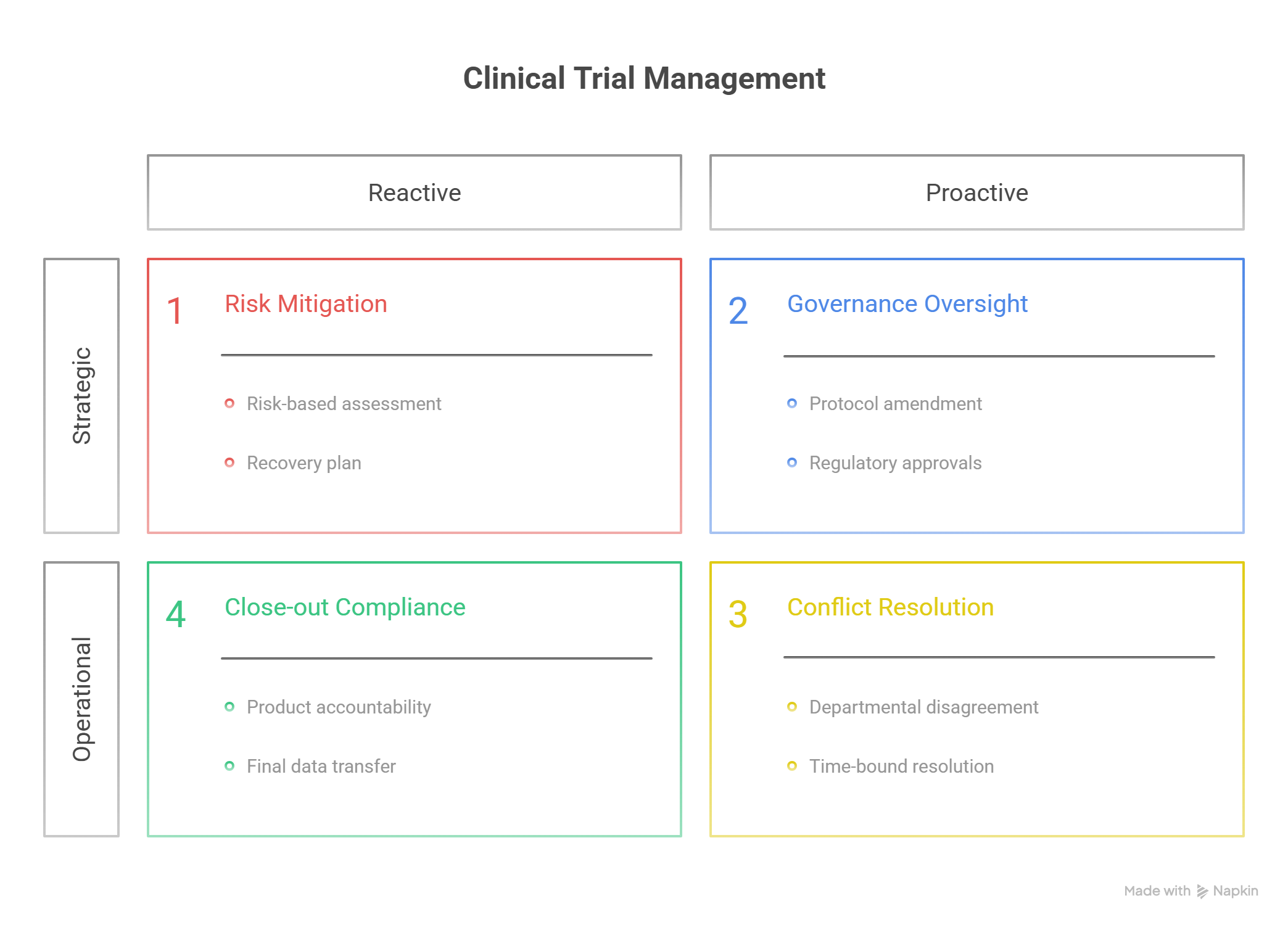
4. Clinical Trial Leadership, Change Control, and Close-Out: Practice Questions 11–15
Q11. The Sponsor Wants to Reduce Monitoring Costs by 30%
A sponsor is facing financial pressure and proposes reducing monitoring activities by 30% across all clinical trial sites.
Most locations have strong compliance histories, but two sites have unresolved safety-documentation findings and repeated protocol deviations.
What should the project manager recommend?
A. Reduce monitoring uniformly to satisfy the sponsor's financial target.
B. Maintain every existing monitoring activity regardless of site risk.
C. Conduct a documented risk-based assessment and develop differentiated monitoring coverage.
D. Discontinue monitoring at the two problematic sites until corrective action is complete.
Correct Answer: C
Monitoring intensity should reflect the risks associated with individual sites, activities, and critical study data.
Sites with strong performance and effective controls may support a modified monitoring approach. Sites with repeated significant findings may need additional oversight.
The project manager should evaluate:
Critical safety and data-integrity risks.
The seriousness and recurrence of existing findings.
The effectiveness of previous corrective actions.
Monitoring methods available to detect important problems.
The impact of proposed changes on study oversight.
The revised approach must follow applicable governance and approved monitoring procedures.
This scenario applies on-site and remote GCP monitoring, risk-based quality management, clinical trial budget control, and team resource allocation.
Exam trap: Equating financial efficiency with uniform resource reductions instead of examining differences in risk.
Q12. Clinical Operations and Data Management Disagree About Priorities
A study's clinical operations department considers a database issue low priority because enrollment remains on schedule.
The data management department argues that the unresolved issue could affect primary endpoint dates.
Both teams expect the project manager to support their position.
What is the best initial response?
A. Prioritize clinical operations because recruitment targets are being achieved.
B. Escalate the disagreement immediately without examining the issue.
C. Assess the impact on critical data, identify responsible personnel, and coordinate a time-bound resolution.
D. Wait until final database cleaning to determine whether the problem persists.
Correct Answer: C
The project manager should prioritize according to trial impact and supporting evidence rather than department preference.
Primary endpoint errors can compromise the reliability of a study even when operational performance indicators look favorable.
The appropriate first step is to determine how many records are affected, whether the issue threatens analysis quality, and which functional lead has responsibility for investigation and resolution.
The PM should then establish deadlines and escalation criteria.
This demonstrates clinical trial data integrity management, cross-functional communication, clinical research quality management, and project leadership.
Practical lesson: Departmental disagreement becomes manageable when the team establishes a shared definition of risk, accountable ownership, and measurable resolution criteria.
Q13. A Protocol Amendment Changes Multiple Trial Workstreams
A sponsor authorizes a protocol amendment introducing additional laboratory assessments and revised visit schedules.
The operational team wants every active site to begin implementing the changes immediately.
What must the project manager coordinate before implementation?
A. Only an updated recruitment dashboard.
B. Required approvals and controlled operational implementation across affected functions.
C. Independent implementation decisions by each site without centralized tracking.
D. Immediate implementation followed by budget revisions at the next quarterly review.
Correct Answer: B
A protocol amendment may affect far more than clinical procedures.
The project manager should coordinate an impact assessment covering:
Applicable regulatory and ethics committee approvals.
Revised informed consent materials, when required.
Investigator and site-staff training.
Laboratory and sample-shipping capacity.
EDC and other trial-system updates.
Updated contracts and financial commitments.
Enrollment assumptions and revised project milestones.
Site-specific implementation readiness.
The amendment should be deployed in accordance with applicable approval requirements and authorized implementation procedures.
This requires expertise in research protocol adherence, trial logistics coordination, milestone management, investigator responsibilities, and clinical trial budgeting.
Exam trap: Assuming sponsor authorization means every site already has the approvals, resources, and training necessary to implement the amendment.
Q14. Database Lock Is Approaching With Critical Queries Unresolved
A clinical trial is seven days away from its scheduled database lock.
Three sites have unresolved critical safety-data queries. An external service provider has also failed to complete a required safety-data reconciliation.
The sponsor wants to preserve the original milestone date.
What should the project manager do?
A. Proceed with database lock and resolve the issues afterward.
B. Exclude the unresolved records from the final dataset.
C. Coordinate a documented lock-readiness assessment, develop a recovery plan, and escalate the milestone decision to authorized stakeholders.
D. Accept the service provider's verbal assurance that the reconciliation will eventually be completed.
Correct Answer: C
Database lock should reflect documented readiness against the study's approved data management and quality requirements.
The project manager should establish the status and impact of outstanding critical queries, medical and safety reviews, reconciliations, and required approvals.
A recovery plan should identify owners, dependencies, outstanding evidence, and realistic completion dates.
Appropriate functional leads must determine whether lock criteria have been satisfied and whether a date change or authorized exception is justified.
The decision should integrate trial data integrity requirements, safety-data assessment procedures, clinical trial timeline management, and project close-out planning.
Exam trap: Treating a scheduled milestone as sufficient evidence that its required deliverables are complete.
Q15. The Study Has Finished Patient Visits, but Close-Out Requirements Remain
A multicenter trial has completed all scheduled participant visits.
The sponsor wants to declare the study operationally closed. However, one site has unresolved investigational product accountability records, and the central laboratory has not completed its final data transfer.
What is the best response?
A. Close the study because participant visits are complete.
B. Archive the available documents and disregard the outstanding items.
C. Maintain a controlled close-out plan until required obligations are completed or managed through an authorized exception process.
D. Transfer responsibility for all outstanding work to the finance department.
Correct Answer: C
Completion of participant visits is one major milestone within clinical trial execution. Formal close-out also depends on completion of relevant operational, regulatory, financial, and documentation requirements.
The project manager should verify:
Investigational product accountability and disposition.
Outstanding vendor deliveries and reconciliations.
Final data transfers and required documentation.
Essential record completeness and archiving arrangements.
Contractual and financial obligations.
Completion evidence and authorized outstanding-item decisions.
Any permitted exceptions should have documented approval, assigned ownership, and a defined resolution plan.
This applies clinical trial project close-out procedures, principal investigator site oversight, clinical data integrity, and research quality management.
Practical lesson: Every milestone should have explicit acceptance criteria. A deliverable becomes complete when its required evidence and approvals are available.
5. Practice Test Scoring, Mistake Analysis, and a Seven-Day Improvement Plan
A useful practice-test result should reveal how accurately a candidate makes decisions and which competencies need further attention.
For this 15-question assessment, award one point for every correct response.
Score 13–15: Strong diagnostic performance. The candidate demonstrates good judgment across the scenarios presented. Further preparation should focus on unfamiliar, more complex questions combining trial financial controls, GCP responsibilities, and risk-based quality management.
Score 10–12: Useful foundation with identifiable gaps. Most core concepts are understood, but certain types of scenario require additional work. Review wrong answers by competency and practice unfamiliar project management scenarios.
Score 7–9: Significant application gaps. Several decisions or calculations need improvement. Rebuild weak concepts through worked examples covering trial milestones, financial management, and safety reporting.
Score 0–6: Foundational preparation required. Focus on core concepts, responsibilities, and structured decision-making before attempting additional timed assessments. Begin with clinical research PM exam topics and essential clinical research training resources.
These ranges are educational diagnostic categories rather than official certification passing standards.
Identify the reason behind each incorrect answer
Assign each missed question one primary error category.
Concept error: A fundamental principle was misunderstood. Confusing CPI with SPI, for example, indicates a weakness in budget and performance measurement.
Sequencing error: The candidate identified a reasonable eventual intervention but selected the wrong first action. These errors commonly appear in site activation, deviation investigations, and timeline recovery.
Authority error: A clinical, regulatory, or investigator responsibility was assigned to the wrong role. Review investigator GCP obligations and medical monitor responsibilities.
Risk-prioritization error: Cost or schedule pressures were allowed to overshadow critical safety or data-integrity risks. Study ethical GCP principles and quality management strategies.
Evidence error: The selected response depended on assumptions, verbal assurances, or incomplete information. Strengthen data integrity evaluation and research documentation practices.
Seven-day preparation plan
Day 1: Diagnose weaknesses. Review every missed question. For each answer, document the relevant management principle, overlooked fact, and best alternative action. Consult clinical research PM examination topics.
Day 2: Master calculations. Complete five earned-value problems, five enrollment forecasts, and three critical-path scenarios. Explain what each calculation means for project scheduling and financial performance.
Day 3: Build a responsibility map. Separate decisions belonging to sponsors, investigators, project managers, medical monitors, and external vendors. Review GCP accountability and clinical safety oversight.
Day 4: Practice quality and safety scenarios. Work through three deviations, two potential serious adverse events, and two vendor failures. For each, identify the risk, required escalation, responsible owner, and documentation. Strengthen adverse event reporting and quality management.
Day 5: Create a project recovery plan. Build a hypothetical trial schedule with a missed milestone, limited resources, and conflicting stakeholder priorities. Develop corrective actions using milestone management and leadership techniques.
Day 6: Complete an unfamiliar timed assessment. Record each answer and confidence level before reviewing explanations. Prioritize confidently incorrect responses, which frequently expose misunderstood decision principles.
Day 7: Retest and explain your reasoning. Attempt new scenarios covering the weakest competencies. Explain why the selected answer is correct, why alternatives fail, and what evidence would change the decision. Reinforce preparation using clinical trial project management resources.
A strong readiness indicator is consistent performance across unfamiliar scenarios, supported by accurate reasoning and clear recognition of decision-making authority. Persistent mistakes involving participant safety or clinical data integrity warrant focused remediation regardless of the overall score.
6. FAQs: Clinical Research Project Management Certification Practice Tests
-
This practice test focuses on clinical research project management, including site operations, GCP compliance, vendor oversight, clinical data, and trial delivery.
Candidates preparing for PMI's PMP examination should also study the official PMP examination content outline and its broader coverage of people, processes, and business environments.
For clinical research professionals, these scenarios strengthen industry-specific judgment involving project scheduling, clinical trial leadership, quality management, and study close-out procedures.
-
The most useful calculations include critical-path duration, available float, enrollment conversion, Cost Performance Index, Schedule Performance Index, cost variance, schedule variance, and Estimate at Completion.
Candidates should understand the assumptions behind each calculation and the operational decisions its results support.
For example, a weak CPI may indicate the need to investigate spending or scope changes, while an enrollment forecast can expose unrealistic trial milestones.
Build practical competence through trial budget management, resource planning, and project management exam preparation.
-
The difficulty comes from competing priorities and answers that appear reasonable under different circumstances.
A financially attractive decision may weaken patient-safety oversight. An operationally convenient shortcut may violate approval requirements. An aggressive milestone recovery plan may create serious data-quality problems.
Successful candidates identify the governing responsibility, highest-consequence risk, and best immediate action.
Preparation should include clinical trial quality management, investigator oversight, medical safety responsibilities, and cross-functional communication.
-
Yes. Clinical research coordinators commonly develop relevant skills in participant scheduling, documentation, protocol adherence, recruitment management, and communication.
Advancement into clinical trial project management requires broader competence in budgets, vendor performance, multisite coordination, risk management, and sponsor-level governance.
Professionals considering a CRC-to-clinical-trial-manager career transition should identify the responsibilities they have already performed and the management competencies they still need to develop.
The same approach benefits professionals pursuing a CRA-to-clinical-trial-manager transition, particularly when combined with project management training and leadership development.
-
ICH E6(R3) emphasizes quality by design, proportionate risk management, participant protection, reliable trial results, and appropriate oversight of trial activities.
These principles influence how project managers approach vendor failures, monitoring allocation, protocol deviations, critical data, and quality-control decisions.
Candidates should be able to apply these principles through GCP monitoring practices, investigator oversight, clinical quality management, and patient safety procedures.
Understanding how a principle changes an actual management decision is particularly valuable when answering realistic scenarios.
-
An appropriate practice-question target depends on the examination blueprint, professional experience, difficulty of the question bank, and performance across individual competency areas.
Repeatedly answering familiar questions can inflate scores through recognition rather than genuine understanding.
Use new scenarios, timed assessments, error analysis, and written explanations to evaluate progress.
Candidates should demonstrate reliable performance in trial schedule management, financial control, regulatory accountability, and project close-out decisions.
For further preparation, use the clinical research PM exam topic guide alongside free clinical research training resources, selecting additional practice based on demonstrated weaknesses.
