
Passing a clinical research project manager exam requires more than remembering terminology. You need to interpret operational risks, choose the correct escalation, and manage the clock while several answers look reasonable. Candidates with full-time trial responsibilities face an additional challenge: limited study hours and uneven familiarity with budgets, quality systems, and regulatory decisions. The most effective preparation measures both accuracy and decision speed. This guide shows how to build a focused schedule, handle complicated scenarios, recover lost minutes, and identify weaknesses before they affect your examination performance.

1. Build Your Study Plan Around Decisions the Exam Can Test
Start with the current candidate handbook for your specific certification. Record the tested domains, question formats, time limit, passing rules, permitted breaks, and whether you can revisit questions. Clinical research project management certifications vary in their format and scope. Your clinical research PM topic checklist should support that official blueprint.
Translate each domain into a practical decision: identify the risk, name the accountable person, select the defensible first action, and explain the required record. This connects trial milestone planning, quality oversight, and cross-functional leadership to the judgment expected in an applied examination.
Run a diagnostic before allocating study hours
Complete 25–40 unfamiliar practice questions. Record four variables for every question: accuracy, response time, confidence, and reason for error.
Classify mistakes using five codes: K for missing knowledge, S for incorrect decision sequence, O for misunderstanding ownership, R for overlooking risk, and T for excessive time.
A candidate familiar with investigator obligations but uncertain about sponsor escalation has an ownership problem. Someone who delays safety reporting while planning corrective action has a sequencing problem. Different weaknesses require different interventions.
Use this prioritization formula:
Study priority = Official domain emphasis × Personal error rate × Time penalty
This is a study-planning heuristic, rather than an official scoring formula.
Suppose budget variance analysis consistently takes twice as long as routine site oversight questions and produces more incorrect answers. Financial reasoning deserves additional practice. Weaknesses involving participant protection or data integrity also deserve early attention because the underlying principles influence several decision categories.
Allocate study sessions by expected improvement
With ten weekly study hours, a useful starting allocation is three hours of unfamiliar scenarios, two and a half hours of weak-domain remediation, two hours of timed mixed sets, one and a half hours of active recall, and one hour of assessment and planning.
Reserve longer sessions for critical-path calculations and quality investigations. Use shorter sessions for recalling protocol compliance principles, staff training requirements, and trial close-out obligations.
Every session needs a measurable deliverable: an improved score, a corrected rule, or a complex management scenario that you can explain without notes.
| Clinical Research PM Exam: 30 High-Value Time Management and Decision Scenarios | ||||
|---|---|---|---|---|
| Exam Scenario | Pressure Signal | Best First Action | Time-Wasting Mistake | Fast Decision Rule |
| 1. Blueprint mismatch | Practice topics differ from tested domains | Map materials to the official handbook | Studying unrelated competencies | Validate exam scope |
| 2. Weak-topic overload | Several domains produce low scores | Rank by weight, error rate and time | Giving every weakness equal hours | Improve expected score |
| 3. Safety notification | Potentially reportable serious event | Ensure appropriate urgent escalation and reporting | Waiting for routine status review | Safety obligations first |
| 4. Consent deficiency | Participant rights may be affected | Protect participants, assess and escalate | Treating it only as missing paperwork | Rights before administration |
| 5. Repeated protocol deviations | Same failures occur at several sites | Assess impact and investigate shared causes | Automatic retraining without analysis | Cause before systemic CAPA |
| 6. Critical-path delay | A dependency threatens final delivery | Determine downstream schedule impact | Accelerating noncritical activities | Find the dependency |
| 7. Laboratory vendor delay | Results may miss a lock deadline | Verify delivery forecast and recovery options | Accepting an unsupported commitment | Evidence before reforecast |
| 8. Site activation backlog | Planned enrollment date approaches | Check approvals, training and readiness | Activating before required conditions | Readiness is a gate |
| 9. Enrollment underperformance | Recruitment trajectory misses forecast | Analyze funnel, site capacity and barriers | Demanding higher targets without evidence | Diagnose bottlenecks |
| 10. Screen failure spike | Many candidates fail eligibility | Analyze documented exclusion reasons | Informally relaxing criteria | Protect protocol requirements |
| 11. Monitoring backlog | Important findings remain unresolved | Prioritize oversight by participant and data risk | Scheduling solely by queue age | Risk outweighs convenience |
| 12. Overdue CAPA | Recurring problem remains open | Check ownership, root cause and deadlines | Closing without effectiveness checks | Verify correction |
| 13. TMF documentation gaps | Critical records are missing | Determine criticality, owners and recovery plan | Bulk uploads without quality checks | Completeness with traceability |
| 14. EDC query backlog | Data-cleaning milestones are threatened | Segment by criticality, site and owner | Closing easy queries while critical data remain | Critical data first |
| 15. Database lock pressure | Required reconciliations remain open | Verify formal readiness criteria | Locking solely to meet a date | Readiness before lock |
| 16. Budget overrun | Forecast exceeds approved baseline | Identify drivers and estimate cost to complete | Cutting essential oversight activities | Forecast before adjustment |
| 17. Resource bottleneck | Multiple critical tasks need one specialist | Assess capacity, dependency and qualified backups | Assigning unqualified personnel | Capacity plus competence |
| 18. Vendor disagreement | Contractual obligations are disputed | Review deliverables, evidence and escalation route | Making unapproved commitments | Confirm authority |
| 19. Protocol amendment | Changes affect visits, forms and training | Map approvals and implementation dependencies | Rolling out changes before authorization | Controlled change |
| 20. Staff training deficiency | Unqualified team member assigned duties | Verify required training and delegation | Equating familiarity with qualification | Qualify before assigning |
| 21. Sponsor escalation | Leadership needs a decision quickly | Present impact, options, recommendation and owner | Sending an activity report without decision needs | Decision-ready reporting |
| 22. Data integrity concern | Records appear inconsistent or unreliable | Preserve audit trails and investigate | Altering records without traceability | Protect evidence |
| 23. Safety reconciliation delay | Safety and clinical databases disagree | Identify discrepancies and accountable reviewers | Closing differences without verification | Reconcile before closure |
| 24. Medical monitoring concern | An emerging clinical safety pattern is suspected | Escalate to qualified safety and medical oversight | PM making independent clinical judgments | Respect clinical authority |
| 25. Quality tolerance breach | Important quality limit is exceeded | Evaluate the signal and required actions | Treating the signal as routine reporting | Investigate threshold breaches |
| 26. Inspection preparation | Inspectors request critical evidence | Retrieve controlled, verified and complete records | Generating unsupported documentation | Evidence and traceability |
| 27. Cross-team conflict | Functions disagree on responsibility | Clarify ownership and decision governance | Escalating without defining the dispute | Owner, evidence, decision |
| 28. Project close-out | Last patient visit is completed | Verify site, vendor, finance and records closure | Assuming study completion equals close-out | Reconcile all obligations |
| 29. Difficult exam question | Two answers remain plausible | Compare sequence, authority and question qualifier | Rereading without isolating the difference | Match the decision stage |
| 30. Exam time crisis | One item consumes several minutes | Apply the practiced flagging or answer rule | Sacrificing several questions for one | Protect total score opportunity |
2. Convert Every Study Hour Into Faster, More Accurate Responses
A productive study session creates evidence of learning. Use a 45-minute decision sprint: five minutes to define a weakness, ten to review the governing principle, fifteen to answer unfamiliar questions, ten to analyze incorrect alternatives, and five to retrieve the rule from memory.
For example, devote one sprint to risk-based monitoring decisions and quality issue escalation. Use another to distinguish financial variance assessment from schedule recovery approval.
Narrow, defined objectives prevent time from being consumed by passive reading.
Practice the decision before evaluating answer choices
Read the last sentence of a scenario first. Determine whether the examiner asks for the first action, best preventive control, most likely consequence, or appropriate decision owner.
Then identify four details: triggering event, affected process, governing requirement, and requested action.
This is particularly useful when investigator responsibilities, medical oversight, and regulatory compliance appear in the same question.
Formulate a short expected answer before considering the options. Candidates who can describe the required action in one sentence often recognize distractors faster.
Turn each incorrect response into an if–then decision rule.
For example:
If a protocol amendment affects participant procedures, check required approvals and implementation controls before scheduling changes.
If clinical data reliability is questioned, preserve the audit trail and investigate the discrepancy.
Retest these rules using fresh questions after one, three, and seven days. This spaced-retrieval schedule is a practical starting point that can be adjusted according to performance.
Mix clinical PM domains after establishing foundations
Initially, group similar problems so you understand the governing logic. During later practice, mix site performance, project close-out, corrective actions, safety reporting, and stakeholder conflicts.
Mixed scenarios force you to identify the governing principle without relying on the chapter heading.
Consider a delayed laboratory result and an urgent safety notification. Both can disrupt the study timeline, but participant protection and clinical safety assessment follow obligations that require different immediate actions.
End every session by recording the percentage correct, median response time, slowest question, and most important corrective rule. Retest weak categories using unseen questions until you can explain why the preferred action is appropriate for the risk, decision stage, and accountable role.
3. Use a Five-Step Clinical PM Decision Filter for Difficult Scenarios
Complex clinical project management questions often contain urgent facts mixed with background details. A consistent decision filter reduces the mental effort required to identify what matters.
This is especially useful when trial schedule pressure, quality signals, data integrity, and sponsor expectations appear together.
Step 1: Identify the highest-consequence risk
Classify the central problem as participant safety, compliance, data credibility, schedule, financial exposure, or communication.
When a possible serious safety event occurs alongside a milestone delay, assess urgent participant-protection and reporting requirements first. In a routine operational problem, determine whether the real obstacle is a critical-path dependency or financial constraint.
This distinction prevents a candidate from selecting an answer that resolves a minor symptom while leaving the governing risk untreated.
Step 2: Identify the accountable decision-maker
Clinical project managers coordinate sponsors, investigators, CRO teams, vendors, and medical professionals. Each has defined responsibilities.
Questions involving investigator obligations require appropriate investigator accountability. Questions about medical oversight may require qualified clinical judgment. Questions involving cross-functional governance may require sponsor approval.
Be cautious with an answer that assigns independent medical or regulatory decisions to a project manager whose role is to coordinate the responsible parties.
Step 3: Select the correct decision sequence
For routine operational disruption, use this sequence:
Establish facts → Assess impact → Compare controlled alternatives → Obtain approval → Implement and verify
Different sequences apply when immediate protective actions or reporting timelines are triggered.
Compare root-cause investigations, adverse-event escalation, protocol change control, and inspection corrective actions.
A proposed action may be valid but premature. The correct answer should align with the stage of the problem described.
Step 4: Eliminate options that compromise required controls
Question writers may include choices that promise faster project execution through risky shortcuts.
Examples include bypassing informed-consent requirements, changing source records without traceability, assigning trial duties without appropriate training or delegation, or informally changing eligibility criteria.
For delayed monitoring activities, consider documented, risk-proportionate alternatives when permitted by the monitoring plan and applicable procedures.
Prioritize responses that preserve appropriate protections, authorization, and evidence.
Step 5: Answer the specific wording of the question
The words first, next, most appropriate, and best prevention define different decision points.
For trial close-out, completion of the last patient visit does not demonstrate that all documentation, vendor, and financial obligations have been reconciled. For a budget overrun, calculating the variance is an earlier stage than implementing an approved financial recovery plan.
Use the mental shortcut Trigger → Owner → Stage → Action.
Worked scenario: Laboratory results threaten database lock
A central laboratory reports that results will arrive ten days late. Database lock is scheduled twelve days from now, and the sponsor requests an immediate solution.
Start by verifying which datasets, reconciliations, and release activities depend on the laboratory results. Confirm whether the revised delivery forecast is credible and identify activities that can safely proceed in parallel.
Then determine the effect on downstream milestones, data-cleaning readiness, and resource or financial commitments.
Prepare recovery options with evidence, projected consequences, and required approvals. This preserves decision quality while minimizing unnecessary delays.
Worked scenario: Repeated consent deficiencies across three sites
Three sites report similar informed-consent deficiencies while recruitment is falling behind schedule.
Prioritize protection of affected participants, assessment of the deficiencies, and reporting through required pathways. Investigate shared causes, coordinate corrective and preventive actions, verify staff competency, and confirm that corrective measures are effective.
The response must respect participant rights and investigator accountability.
The fastest reliable way to answer is to recognize the correct obligation sequence.
Choose one. Your answer reveals a practical way to improve.
Submit
Instant self-assessment. Answers remain in your browser and are not submitted or stored.
4. Control Exam-Day Pacing With a Two-Pass Question Strategy
Your question-time budget should come from the official examination instructions. Calculate:
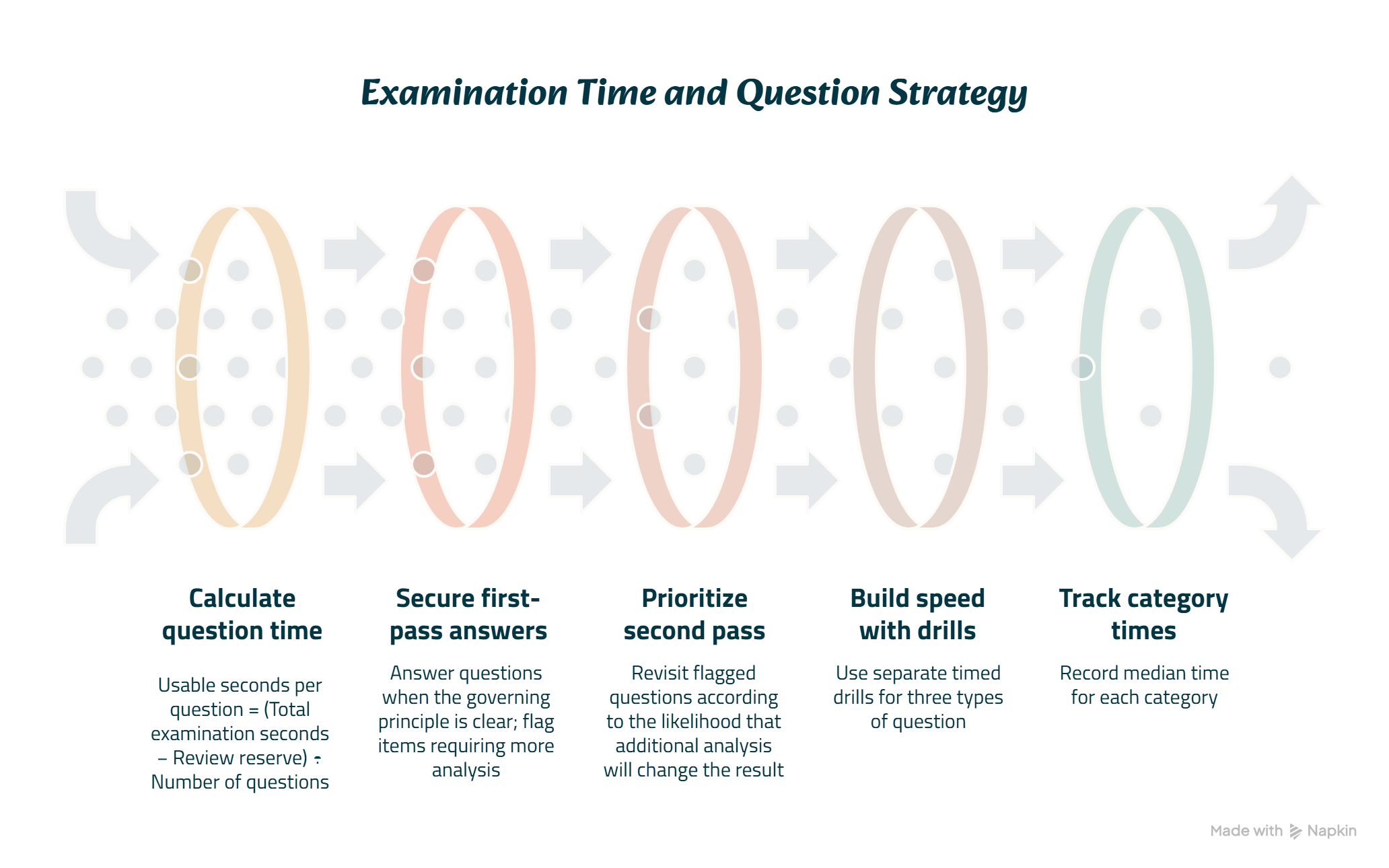
Usable seconds per question = (Total examination seconds − Review reserve) ÷ Number of questions
For illustration, a hypothetical 120-minute examination containing 100 questions with ten minutes reserved for review provides 66 seconds per question.
Actual certifications may have different timings, sections, breaks, navigation rules, and scoring methods. Verify them against your provider's instructions and the relevant clinical research PM preparation topics.
First pass: Secure efficiently answerable questions
Answer questions when the governing principle is clear and you can justify the selected action. Flag items requiring more analysis when the examination platform permits it.
A familiar site readiness question may require less time than a complex financial forecast variance. The time saved on familiar concepts becomes available for more demanding questions.
Avoid spending several minutes debating two choices while leaving straightforward protocol compliance or milestone management questions unanswered.
Use three categories during practice:
A — Clear: You understand the governing principle and can justify the response.
B — Two plausible answers: Identify the specific requirement or decision stage that distinguishes them.
C — High uncertainty: The problem requires further calculation, interpretation, or unavailable knowledge.
For B questions, compare the alternatives using the scenario's most important qualifier. For C questions, apply a predetermined time threshold and return later when permitted.
Some examinations restrict navigation. In those cases, a disciplined best-answer strategy must replace revisiting questions.
Second pass: Prioritize questions you can realistically resolve
Revisit flagged questions according to the likelihood that additional analysis will change the result.
A CAPA investigation requiring clarification of the decision stage may be easier to resolve than a specialized fact you cannot recall.
For adverse event reporting, identify whether the question concerns initial notification, formal reporting, follow-up assessment, or subsequent corrective action.
For monitoring responsibilities, distinguish routine oversight from escalation triggered by a potential critical finding.
Track three indicators during mock examinations: completion rate, accuracy on the first pass, and accuracy gained or lost during second-pass review.
If second-pass changes frequently turn correct answers into incorrect ones, require a concrete rationale before changing your choice. If the first pass is too fast and inaccurate, spend additional seconds verifying accountability, participant protection, and documentation requirements.
The objective is reliable accuracy within the available time.
Build speed through targeted question drills
Use separate timed drills for three types of question.
Decision-sequence drills focus on regulatory escalation, safety reporting, and quality remediation. Your goal is to recognize what must happen before other appropriate actions.
Numerical and dependency drills cover budget forecasts, trial scheduling, and resource allocation. Your goal is to extract the relevant numerical assumptions quickly and identify the calculation actually required.
Responsibility drills involve investigator obligations, medical safety oversight, and project leadership. Your goal is to distinguish coordination, authorization, and specialized professional judgment.
Record median time for each category rather than relying on one overall average. A candidate might answer responsibility questions rapidly but spend twice as long on critical-path calculations. Category-specific data makes preparation more efficient.
5. Diagnose Mock-Exam Failures and Build a Reliable Final-Week Plan
A single mock-exam percentage conceals important information. Two candidates can achieve identical scores while facing completely different readiness problems.
One candidate might understand clinical trial project management but struggle to finish lengthy schedule recovery scenarios. Another might finish early while misunderstanding quality management responsibilities and medical safety decisions.
Both need interventions tailored to their actual weaknesses.
Audit your slowest 20% of questions
Identify the five slowest responses in every 25-question practice set. Determine whether delays resulted from rereading, unfamiliar terminology, calculations, uncertainty about decision ownership, or difficulty comparing alternatives.
Slow budget questions may indicate weak numerical skills. Slow quality management scenarios may reveal confusion between detecting a problem, investigating causes, implementing CAPA, and evaluating effectiveness.
Repeated delays involving stakeholder management may indicate uncertainty about responsibility and escalation authority.
Use an error log containing four fields: incorrect assumption, governing principle, corrective exercise, and retest outcome.
For a data integrity error, practice reconstructing an audit-trail investigation. For project close-out, sequence outstanding site, vendor, documentation, and financial obligations. For inspection remediation, distinguish containment, root-cause analysis, corrective action, and effectiveness verification.
Connect these exercises to protocol compliance and investigator accountability so you can apply the same principles in unfamiliar scenarios.
Follow a structured final seven-day revision plan
Day 7: Full diagnostic simulation. Complete a representative timed mock. Classify errors by domain, decision sequence, confidence, and response time.
Day 6: Repair two major weaknesses. Use relevant project management exam competencies to rebuild your understanding, then practice unfamiliar scenarios.
Day 5: Integrated operational problems. Practice questions connecting schedule dependencies, cost control, and stakeholder decisions. Focus on how a problem in one function affects another.
Day 4: High-consequence GCP scenarios. Review participant protection, safety reporting, monitoring oversight, and quality remediation.
Day 3: Last demanding timed assessment. Complete a realistic simulation early enough to evaluate and correct mistakes. Compare performance with previous results.
Day 2: Weakness consolidation. Retest recurring errors. Condense important decision sequences into a single review sheet.
Day 1: Final preparation. Use short retrieval exercises, verify exam logistics, and protect adequate rest.
This schedule assumes foundational preparation is substantially complete. Candidates with unresolved knowledge gaps should extend their preparation window where possible.
Measure readiness using five indicators
Track fresh-question accuracy, completion rate, response-time consistency, repeated errors, and high-confidence incorrect answers.
High-confidence errors deserve particular attention because candidates are less likely to flag those questions during the real examination.
For example, a candidate who consistently misidentifies the responsible party in GCP investigator scenarios may answer quickly while remaining wrong. Another who misunderstands quality escalation might select a later-stage corrective action before the required assessment.
Revisit applicable ICH E6(R3) competency expectations and verify the regulatory version and jurisdiction covered by your examination.
A stable practice score becomes more meaningful when performance remains consistent across unfamiliar questions and the complete tested syllabus.
6. Frequently Asked Questions About Clinical Research PM Exam Time Management
-
Begin with the hours you can consistently protect and use a diagnostic assessment to estimate how much improvement is required.
Ten focused weekly hours may deliver stronger results than twenty hours of passive reading when the sessions combine clinical PM competencies, scenario practice, and timed retrieval.
Candidates experienced in site operations may need additional preparation in financial management or risk-based quality systems. New candidates may need a longer foundational phase.
Reassess study needs weekly using actual performance.
-
Identify the specific decision stage requested by the question.
The correct first action in a quality management event may involve assessing the problem, while an alternative describing complete corrective action belongs later.
In a medical oversight scenario, clinical judgment may belong to a qualified medical professional, while the project manager coordinates escalation.
Compare role responsibilities and regulatory requirements to determine which option fits the question.
-
Start with the regulatory requirements and standards identified in your official examination blueprint. Then practice applying them.
Memorization alone will not explain whether a protocol deviation requires immediate action, who handles a safety notification, or how data integrity must be preserved.
Build responsibility maps using ethical requirements and GCP obligations. Follow each map with unfamiliar scenarios that require selecting the appropriate management action.
-
Use four short weekday sessions for active recall and one longer weekend block for timed questions.
Assign one competency to each session, such as monitoring techniques, milestone planning, research communication, or project closure.
Connect relevant workplace experience with general examination principles while protecting confidential study and participant information.
When your professional schedule becomes unpredictable, maintain a brief retrieval routine and move demanding scenario analysis to a more reliable study window.
-
Analyze your response-time distribution rather than reviewing accuracy alone.
Determine whether slow responses cluster around numerical problems, decision ownership, or clinical safety interpretation.
Practice a two-pass strategy where permitted by examination rules. Set a review reserve and apply a predetermined question-time threshold.
Measure how pacing changes affect accuracy. Increasing speed becomes useful when it improves the number of correctly answered questions within the available time.
-
Build separate decision maps for immediate actions, responsible personnel, required documentation, and preventive controls.
Compare adverse event reporting, medical monitoring, participant protection, and quality management.
A schedule disruption may allow structured recovery planning. An urgent participant-safety concern may activate immediate protective and reporting obligations.
Review ICH E6(R3) skills and expectations against the version and requirements specified by your certification provider.
