
Clinical research employers are entering 2027 with growing demand for professionals who can combine regulatory judgment, digital fluency, patient safety, and operational efficiency. AI-assisted trial workflows, ICH E6(R3), decentralized study models, and increasingly complex clinical data are changing what sponsors, CROs, and research sites need from their teams. This 2027–2028 skills gap report examines the strongest workforce signals available through 2026, identifies 30 high-priority capabilities, and explains which skills clinical research professionals should develop to remain competitive across the next two years.

1. Clinical Research Skills Gap 2027–2028: What the Workforce Evidence Actually Shows
The clinical research workforce enters 2027 with a difficult combination of staffing pressure, increasing technological complexity, and evolving regulatory expectations. Employers need people who can manage sophisticated clinical trials while maintaining participant protection, reliable data, and appropriate oversight.
The Association of Clinical Research Professionals' 2025 workforce survey gathered responses from more than 735 professionals across the clinical research enterprise. 52% reported that hiring and retaining research staff had worsened compared with five to ten years earlier. Only 33% considered trial operations efficient industry-wide, while 31% believed study budgets were sufficient to support good operations.
These findings reveal an important challenge: organizations need better execution capabilities even when staffing and financial resources remain constrained.
For professionals considering clinical research associate career paths, clinical research certification, clinical project management, or medical monitoring responsibilities, the implication is significant.
Employers will increasingly value professionals who can demonstrate measurable improvements in study conduct, data quality, oversight, and patient experience.
Three workforce signals shaping the 2027–2028 outlook
1. Research workforce shortages remain a practical constraint.
ACRP's findings and Advarra's 2025 workforce development research describe persistent staffing challenges at clinical research sites. Study complexity, restrictive eligibility criteria, additional digital systems, and growing administrative demands increase the capabilities required of individual team members.
A clinical research coordinator who can independently manage trial logistics, protocol adherence, patient communication, and accurate electronic records provides broader operational value.
2. AI and digital skills are expanding across life sciences.
The World Economic Forum's 2025 Future of Jobs Report estimated that 39% of workers' existing skill sets would change or become outdated between 2025 and 2030 across the industries it surveyed. This is a global, cross-industry projection rather than a clinical research-specific percentage.
The United Kingdom's October 2026 life sciences skills assessment identifies demand for technical AI capabilities, data engineering, responsible AI governance, cross-functional communication, and hybrid science-and-technology expertise.
For clinical research professionals, this supports growing emphasis on clinical trial data integrity, advanced medical data assessment, technology-enabled monitoring, and AI-related clinical research career changes.
3. Regulatory modernization is changing expectations for trial execution.
ICH E6(R3) strengthened the emphasis on quality by design, proportionality, participant protection, data governance, and documented accountability.
Its Principles and Annex 1 became effective in the European Union in July 2025. Annex 2, addressing additional considerations for decentralized and pragmatic trials and real-world data sources, is scheduled to become effective in the EU on January 15, 2027. Implementation varies by jurisdiction.
Professionals who understand ICH E6(R3) workplace competencies, risk-based clinical monitoring, clinical quality management, and investigator responsibilities are better positioned to implement these expectations.
How this report ranks skills for 2027–2028
The skill priorities below represent an evidence-informed outlook prepared in November 2026. They combine published workforce findings, regulatory developments, technology adoption trends, and recurring operational needs across sponsors, CROs, and research sites.
The ratings Very High, High, and Emerging indicate editorial assessments of anticipated strategic importance during 2027–2028. They are not measured vacancy counts or statistically validated rankings.
Each skill includes a practical capability demonstration because employers ultimately need evidence that a professional can apply knowledge.
For example, a candidate claiming clinical trial project management expertise should be able to explain a risk-based recovery plan. A professional claiming medical safety expertise should be able to interpret a safety trend and document an appropriate escalation.
That distinction is central to identifying meaningful skills gaps.
| Clinical Research Skills Gap Matrix: 30 Priority Skills for 2027–2028 | |||
|---|---|---|---|
| Skill and Outlook | Relevant Clinical Research Roles | Why Demand Is Expected | Evidence of Competence |
| 1. ICH E6(R3) application — Very High | CRA, CRC, QA, regulatory, clinical operations | Updated expectations for oversight, quality, and data governance. | Completed gap assessment with role-specific corrective actions. |
| 2. Risk-based quality management — Very High | QA, project manager, CRA, sponsor operations | Greater emphasis on critical-to-quality factors and proactive controls. | Risk register identifying critical factors, indicators, and responses. |
| 3. Centralized monitoring analytics — Very High | CRA, central monitor, data manager | Need to prioritize sites and data using meaningful risk signals. | Dashboard identifying outliers and documented follow-up decisions. |
| 4. Clinical data governance — Very High | Data manager, QA, site data lead, CRA | Connected systems require traceable and reliable data lifecycle controls. | Audit-trail review and discrepancy investigation. |
| 5. AI output verification — Very High | Clinical operations, medical writing, data, QA | AI-assisted workflows increase demand for informed human review. | Validated AI-assisted workflow with a documented error assessment. |
| 6. Safety signal interpretation — Very High | Medical monitor, safety scientist, PV specialist | Complex multimodal data require clinical context and aggregate analysis. | Signal assessment containing cases, denominators, and rationale. |
| 7. SAE and SUSAR assessment — Very High | PV, medical monitor, investigators, CRCs | Accurate classification and timely reporting remain foundational. | Correctly classified case scenarios with regulatory decision logs. |
| 8. Protocol deviation and CAPA analysis — Very High | CRA, CRC, QA, project manager | Organizations need effective root-cause and prevention capabilities. | CAPA record with cause analysis and effectiveness verification. |
| 9. Informed-consent oversight — Very High | CRC, investigator, CRA, QA | Participant protection extends into digital and hybrid consent models. | Consent-process audit and correction plan. |
| 10. Cross-functional decision-making — Very High | Project manager, clinical lead, CRA, site manager | Interdependent teams need accurate escalation and accountability. | Decision record showing owner, risk, options, and resolution. |
| 11. EDC and eSource operations — High | CRC, data manager, CRA, site systems lead | More digital documentation increases system and reconciliation work. | Completed data-entry, query, and source reconciliation exercise. |
| 12. eTMF and inspection readiness — High | TMF specialist, regulatory associate, QA | Automated filing increases the value of criticality-based quality checks. | Inspection-ready file index and missing-record remediation. |
| 13. eCOA and ePRO operations — High | CRC, data manager, digital trial lead | Electronic patient assessments require usability and data-quality controls. | Device or instrument workflow and missing-data resolution. |
| 14. Wearable and digital endpoint validation — Emerging | Digital biomarker lead, clinical scientist, data lead | Remote technologies create new measurement and context-of-use challenges. | Endpoint feasibility and data-quality validation plan. |
| 15. AI model governance — High | Clinical data, biostatistics, QA, AI product owner | Regulated AI use requires context-of-use and credibility assessment. | Model inventory, risk assessment, monitoring and human oversight plan. |
| 16. SQL and analytical querying — High | Data manager, central monitor, RWE analyst | Structured data review and automated reconciliation support oversight. | Queries identifying missing values, duplicates, and risk outliers. |
| 17. CDISC data standards — High | Statistical programmer, data standards specialist | Standardized clinical datasets support analysis and submissions. | Documented SDTM mapping or ADaM derivation exercise. |
| 18. Real-world evidence methods — Emerging | Epidemiologist, RWE analyst, clinical scientist | Alternative data sources require suitability and bias assessment. | Study design with confounding and provenance analysis. |
| 19. Data privacy and cybersecurity awareness — Very High | All roles handling participant or trial systems | Digital trials require secure access and sensitive-data handling. | Access review and documented incident-escalation exercise. |
| 20. Decentralized trial coordination — High | CRC, CRA, site manager, project manager | Hybrid activities require control across locations and vendors. | Remote visit plan documenting consent, logistics, and safety oversight. |
| 21. Patient recruitment analytics — High | Recruitment lead, CRC, site manager | Enrollment challenges require stronger funnel and barrier analysis. | Screening-to-enrollment dashboard and targeted improvement plan. |
| 22. Retention and patient communication — Very High | CRC, patient engagement lead, site manager | Participant burden and follow-up quality affect study completion. | Participant journey map with measurable retention interventions. |
| 23. Inclusive recruitment design — High | Recruitment, feasibility, CRC, study design | Broader participation requires accessible communication and site selection. | Recruitment plan identifying and addressing access barriers. |
| 24. Site feasibility assessment — High | Site activation, CRA, clinical operations | Enrollment forecasting requires stronger validation of site capability. | Feasibility scorecard using verified population and staffing data. |
| 25. Trial budget forecasting — High | Project manager, site manager, contracts lead | Cost constraints increase the value of financial visibility. | Budget-to-actual variance analysis and recovery forecast. |
| 26. Vendor performance management — High | Project manager, sponsor operations, QA | Distributed service models require documented oversight. | Vendor scorecard with escalations and corrective actions. |
| 27. Adaptive trial design literacy — Emerging | Clinical scientist, biostatistician, medical monitor | Complex trial designs require prespecified operational decisions. | Illustrated adaptation rule and decision-governance review. |
| 28. Regulatory change management — Very High | Regulatory affairs, QA, clinical operations | New guidance and regional differences require controlled transitions. | Regulatory impact assessment and SOP implementation plan. |
| 29. Training and competency verification — High | Training lead, site manager, QA, project manager | Complex systems and evolving duties require evidence of capability. | Role-specific training matrix and observed competency assessment. |
| 30. Scientific communication and leadership — Very High | CRA, MSL, project manager, medical monitor, site lead | Clinical decisions must be explained clearly across specialized teams. | Concise issue–impact–decision briefing with documented outcomes. |
2. The 10 Most In-Demand Clinical Research Skills for 2027–2028
The strongest capabilities combine established GCP responsibilities with modern digital, analytical, and management skills. The ten areas below are prioritized for their broad relevance across clinical research roles and the operational problems they can solve.
1. ICH E6(R3) implementation and risk-proportionate quality management
Professionals will need to translate updated GCP principles into daily trial procedures. Practical competencies include identifying critical-to-quality factors, defining proportionate oversight, documenting responsibilities, and verifying that computerized systems are fit for purpose.
For example, a CRA might find recurring missing endpoint assessments across multiple sites. An effective response requires evaluating the risk to trial conclusions, identifying underlying causes, and adjusting oversight appropriately.
Learn through ICH E6(R3) career expectations, clinical trial quality management, on-site and remote monitoring, and investigator GCP obligations.
Career evidence: Produce a sample risk assessment linking critical data, identified risks, monitoring controls, and escalation thresholds.
2. AI literacy with validated human oversight
AI-assisted workflows may help with document review, discrepancy detection, literature screening, feasibility analysis, and preliminary reporting.
The key professional skill is evaluating whether outputs are accurate and appropriate for their intended use.
The FDA and EMA's January 2026 principles for good AI practice in drug development emphasize human-centric design, risk-based oversight, and a defined context of use.
A clinical researcher should be able to identify hallucinated references, missing records, biased outputs, and inappropriate access to sensitive data.
Consider AI-driven clinical research changes, clinical data integrity, quality management systems, and medical safety data review.
Career evidence: Evaluate an AI-assisted document workflow using a controlled example dataset, record its errors, and describe the human verification steps.
3. Centralized monitoring and data-driven risk detection
Central monitoring teams increasingly need professionals who can distinguish meaningful risk indicators from ordinary operational variation.
A dashboard showing delayed queries, missing assessments, consent deficiencies, and inconsistent data patterns can help prioritize monitoring resources. The skill lies in choosing appropriate thresholds and interpreting the results.
For example, a site with a high query count may have a complex patient population. Another site with unusually few queries may require investigation into whether expected review processes are functioning.
Study clinical research associate monitoring skills, risk-based GCP monitoring, clinical trial data integrity, and quality oversight.
Career evidence: Build a monitoring dashboard using fictional site data and explain the rationale for your three highest-priority interventions.
4. Clinical data governance and system interoperability
Clinical research increasingly uses connected EDC, eSource, ePRO, safety, laboratory, and trial-management systems.
Professionals need to understand where data originate, how they move, which metadata matter, and how corrections remain attributable.
A missing SAE in the pharmacovigilance database despite its presence in EDC represents a potential reconciliation and reporting problem. It requires coordinated investigation across systems.
Practical preparation includes clinical trial data integrity, medical data reconciliation, monitoring verification, and quality compliance.
Career evidence: Document a sample discrepancy investigation showing source verification, system ownership, correction history, and final reconciliation.
5. Pharmacovigilance and clinical safety signal interpretation
Safety professionals need accurate classification and medical reasoning as automated case-processing tools evolve.
Skills include interpreting seriousness, severity, expectedness, relatedness, exposure patterns, and relevant alternative explanations.
A cluster of neurological adverse events requires examination of case definitions, exposure, denominators, patient characteristics, and appropriate comparator information before reaching a conclusion.
Develop these competencies through pharmacovigilance exam topics, medical monitoring responsibilities, adverse event reporting, and clinical safety assessment methods.
Career evidence: Prepare a de-identified educational safety signal evaluation showing the evidence considered, uncertainty, and recommended escalation.
6. Decentralized trial operations and digital participant engagement
Hybrid clinical trials can involve remote visits, electronic consent, home health activities, local laboratories, and digital data collection.
Managing these activities requires effective coordination and knowledge of who remains accountable for participant safety and trial conduct.
A remote blood pressure device generating inconsistent measurements may require an assessment of device suitability, participant technique, data quality, and appropriate clinical follow-up.
Review research participant communication, trial logistics, protocol adherence, and clinical site operations.
Career evidence: Create a fictional hybrid visit workflow covering consent, participant instructions, safety escalation, device support, and data reconciliation.
7. Patient recruitment, retention, and accessible communication
Recruitment problems frequently arise from eligibility restrictions, limited site capacity, participant burden, communication failures, and inaccurate assumptions about available patients.
A useful professional understands each stage of the enrollment funnel, including pre-screening, screening, eligibility confirmation, randomization, and retention.
If 100 patients are referred but only eight enroll, the solution requires understanding where and why candidates leave the process.
Learn through patient education materials, site oversight responsibilities, research team communication, and ethical trial conduct.
Career evidence: Build a recruitment funnel showing exclusion reasons, participant barriers, and realistic corrective interventions.
8. Clinical project management and vendor oversight
Increasing operational complexity creates demand for professionals who can manage milestones, budgets, resource conflicts, service providers, and risk escalation.
A project manager overseeing delayed central laboratory results must identify downstream dependencies, verify recovery options, assess financial effects, and communicate decisions to the correct stakeholders.
The most useful skill is converting incomplete operational information into a defensible action plan.
Develop this capability through clinical project management competencies, milestone management, research project budgeting, and clinical trial leadership.
Career evidence: Prepare a milestone recovery plan containing dependencies, risk assessment, alternatives, decision owners, and revised forecasts.
9. Corrective and preventive action with inspection readiness
Clinical research organizations need staff who can investigate recurring deficiencies and verify that corrective measures resolve underlying problems.
A cluster of informed-consent errors across sites may reveal inconsistent training, confusing documents, insufficient investigator oversight, or flawed workflows.
Appropriate CAPA requires investigation, defined ownership, evidence, and effectiveness checks.
Review clinical research quality management, inspection preparation techniques, GCP ethical responsibilities, and clinical trial close-out.
Career evidence: Document a simulated CAPA case including root cause, remediation, responsible personnel, deadlines, and effectiveness testing.
10. Cross-functional communication and accountable leadership
The strongest technical specialist may struggle when clinical, regulatory, data, and operational teams interpret the same problem differently.
Clinical research leaders need to communicate risk, clarify ownership, challenge weak assumptions, and guide decisions without losing sight of participant protection.
For example, a medical safety concern may involve investigators, pharmacovigilance specialists, medical monitors, and sponsor clinical operations simultaneously.
Study clinical research team leadership, medical monitoring governance, research assistant communication, and regulatory compliance.
Career evidence: Present a one-page issue brief containing the problem, potential impact, evidence, recommended decision, accountable owner, and completion date.
3. Which Clinical Research Roles Will Face the Biggest Skills Gaps in 2027 and 2028?
The effect of these changes will vary by role. Some professionals will need deeper technological knowledge, while others will face growing expectations for judgment, coordination, and complex clinical decisions.
The following are role-specific forecasts based on existing responsibilities and emerging workforce requirements, rather than verified rankings of 2027–2028 vacancies.
Clinical Research Coordinators: Digital operations and participant retention
Clinical research coordinators increasingly manage several platforms alongside direct participant responsibilities. Skills in EDC, eSource, eConsent, protocol adherence, and patient communication are particularly valuable.
The difficult part is maintaining accurate records and safe study conduct while managing competing visits, data queries, and recruitment responsibilities.
A CRC should be able to investigate missed assessments, identify eligibility issues, communicate participant concerns, and escalate significant findings.
For career preparation, prioritize research assistant training requirements, trial logistics coordination, research protocol adherence, and clinical site oversight.
2027–2028 priority: Digital workflow proficiency combined with patient-centered study coordination.
Clinical Research Associates: Risk-based monitoring and data interpretation
CRA responsibilities increasingly require sophisticated interpretation of site performance, data quality, and operational risks.
An experienced CRA should be able to distinguish a routine documentation discrepancy from a finding that threatens participant rights or primary endpoint reliability.
Additional skills in centralized monitoring, electronic source review, quality indicators, and cross-functional escalation can strengthen professional value.
Review CRA career skills, remote and on-site monitoring methods, data integrity responsibilities, and clinical quality management.
2027–2028 priority: Risk identification, centralized monitoring interpretation, and effective site remediation.
Clinical Data Managers: Automation oversight and data standards
Data managers are likely to encounter growing demand for reconciliation, metadata understanding, data standards, and automated review workflows.
SQL, structured querying, EDC configuration knowledge, and CDISC familiarity may be particularly valuable depending on the role.
The professional must understand how data quality affects downstream medical review, statistical analysis, and regulatory submissions.
Connect clinical trial data governance, medical data assessment, monitoring procedures, and quality management.
2027–2028 priority: Data lineage, cross-system reconciliation, automation validation, and reliable analytical datasets.
Pharmacovigilance Specialists: Aggregate safety reasoning and AI governance
Safety case processing may incorporate more automated triage, duplicate detection, and document preparation. This increases the importance of reviewing uncertain outputs and recognizing medically important exceptions.
Professionals need strong judgment in seriousness classification, causality, expectedness, coding, expedited reporting, and emerging signal assessment.
Training should combine pharmacovigilance certification competencies, adverse event reporting requirements, safety audit preparation, and clinical data review.
2027–2028 priority: Complex case evaluation, safety signal interpretation, and validated automation oversight.
Clinical Project Managers: Financial judgment and integrated risk management
Project management roles increasingly require the ability to connect timelines, data dependencies, vendor performance, financial exposure, and compliance obligations.
A delayed study activation may affect enrollment projections, staff allocation, vendor costs, and contractual milestones simultaneously.
The project manager must communicate options supported by defensible evidence.
Focus on clinical research PM competencies, milestone management, budget forecasting, and clinical research leadership.
2027–2028 priority: Cross-functional decision-making, risk-based resource planning, and measurable delivery performance.
Medical Monitors and Clinical Safety Scientists: Evidence synthesis and benefit-risk judgment
Medical monitors need to integrate clinical abnormalities, emerging adverse event patterns, treatment exposure, relevant medical history, and protocol safety rules.
AI-assisted safety review may improve information retrieval, but medically accountable interpretation remains essential.
Professionals should practice explaining how case-level and aggregate evidence influence further investigation, dose modification, or sponsor safety decisions.
Develop expertise through medical monitoring plans, clinical safety oversight, data review and safety assessments, and pharmacovigilance assessment.
2027–2028 priority: Complex medical interpretation, safety signal governance, and clear clinical escalation.
Regulatory Affairs and Quality Assurance: Change management and inspection evidence
Regulatory professionals need to interpret evolving guidance and translate it into controlled operational changes.
QA professionals must determine whether revised procedures, computerized systems, vendor arrangements, and training records support compliant study conduct.
For 2027, E6(R3) implementation and jurisdiction-specific requirements represent particularly relevant areas of preparation.
Explore clinical research regulatory compliance, GCP guideline expectations, clinical trial quality strategies, and inspection preparation.
2027–2028 priority: Regulatory impact assessments, computerized system oversight, effective CAPA, and inspection-ready documentation.
Choose your biggest gap and get a practical upskilling plan.
Submit
Instant self-assessment. Selections are processed locally and are not submitted or stored.
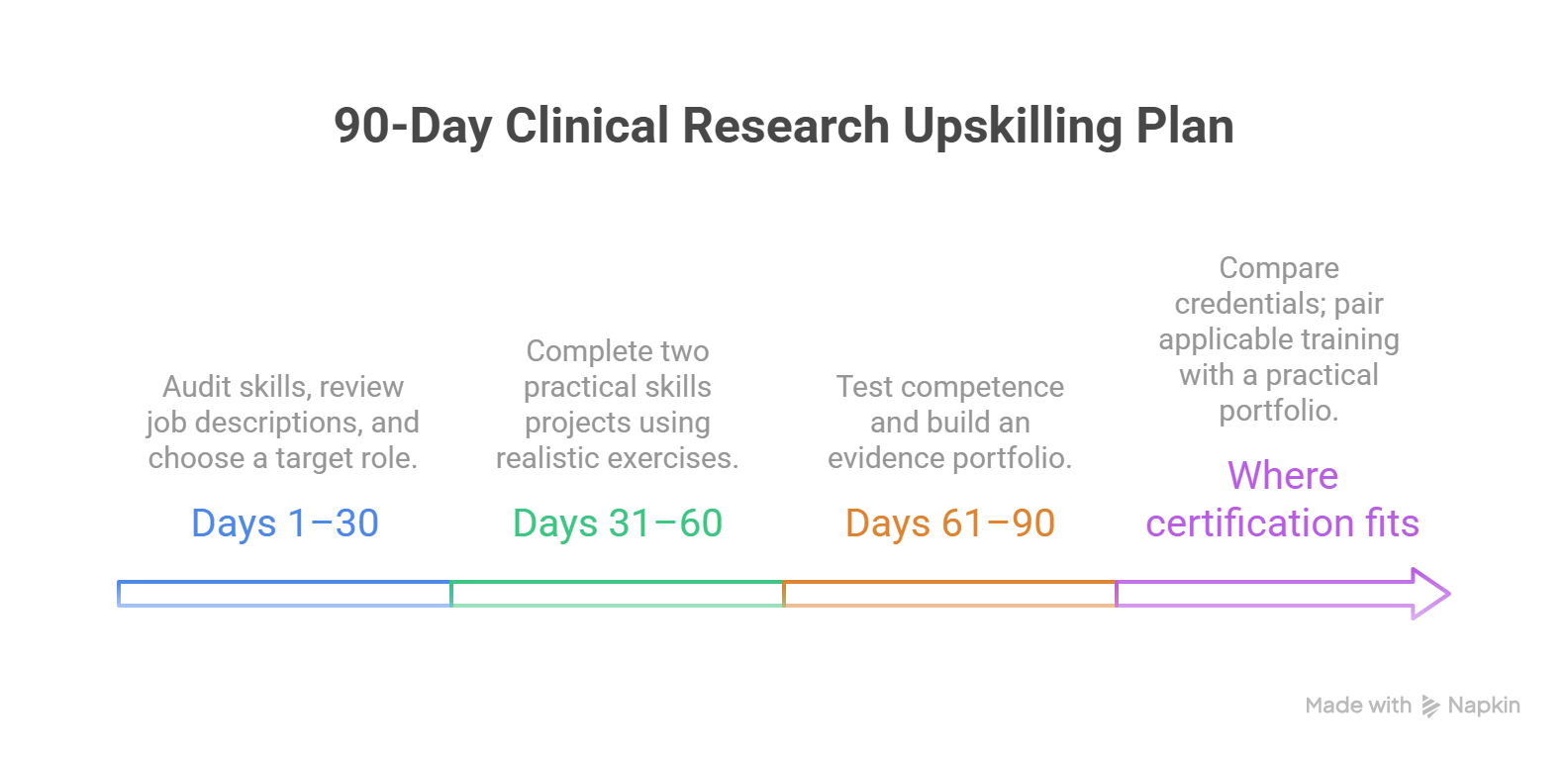
4. How to Close Your Clinical Research Skills Gap in 90 Days
A useful upskilling plan should connect new knowledge to the work employers expect you to perform. The strongest approach combines structured learning, realistic practice, and evidence of competence.
Days 1–30: Audit your current skills and choose a target role
Start by reviewing ten to fifteen job descriptions for the role you want. Use the same region, seniority level, and employment setting wherever possible.
Separate requirements into four categories: regulatory knowledge, technical capabilities, operational judgment, and interpersonal competencies.
For example, an aspiring CRA might repeatedly encounter requirements related to GCP, monitoring, investigator-site communication, electronic systems, and documentation.
An aspiring clinical project manager might see greater emphasis on timelines, budgets, risk assessment, vendor relationships, and stakeholder management.
Compare these requirements with your experience and study relevant CRA career competencies, GCP certification expectations, clinical project management skills, and medical monitoring responsibilities.
Rate your ability to demonstrate each skill:
Level 0: Unfamiliar with the concept.
Level 1: Can explain the terminology.
Level 2: Can complete a realistic supervised exercise.
Level 3: Can independently solve a representative case and justify the result.
Level 4: Can identify exceptions, improve the process, and train others.
These levels are a practical self-assessment framework created for this report.
Prioritize the two competencies most relevant to your target role where your current ability is weakest.
Days 31–60: Complete two practical skills projects
Select projects that resemble actual clinical research work.
For a CRC, create a fictional participant visit schedule, missed-assessment investigation, and query-resolution record. For a CRA, prepare a risk-based monitoring report identifying site problems and follow-up actions.
For a clinical data manager, build a synthetic dataset containing missing values, duplicate records, inconsistent dates, and unresolved queries. Use spreadsheet formulas or SQL to identify discrepancies.
For a medical monitor, develop a fictional aggregate safety review illustrating event frequencies, medical context, uncertainty, and escalation recommendations.
For a project manager, construct a study milestone recovery plan with resource and cost implications.
Use clinical trial logistics guidance, data review techniques, monitoring competencies, and clinical trial financial management to design realistic exercises.
Use synthetic or properly authorized data. Confidential participant information, sponsor documents, and restricted trial records should remain within approved environments.
Days 61–90: Test competence and build an evidence portfolio
Ask an experienced colleague, mentor, or qualified reviewer to evaluate your work against clear criteria.
For example, a sample monitoring report should identify critical issues, distinguish evidence from assumptions, define responsible personnel, and specify appropriate follow-up.
A safety review should explain clinical relevance, uncertainty, and the basis for recommended action.
A regulatory gap assessment should identify the applicable requirement and the controlled procedure needed to address it.
Use clinical research quality principles, medical monitoring procedures, GCP investigator requirements, and clinical data integrity standards to guide your review criteria.
Your final portfolio might include a risk register, monitoring dashboard, corrected query log, mock CAPA, or medical safety case assessment.
Each example should explain the problem, the action taken, the governing principle, and the measurable or verifiable outcome.
Where certification fits into the upskilling process
Certification can support structured learning and demonstrate commitment to professional development. Its employment value depends on the credential, target role, employer, and required experience.
Candidates should compare clinical research certification outcomes, certification versus practical experience, and GCP credential recognition.
A candidate with applicable training and a credible practical portfolio can explain their capabilities more convincingly than someone relying exclusively on completed course titles.
5. What Employers Should Change in Hiring and Workforce Training for 2027–2028
Clinical research organizations face two connected challenges: developing existing personnel and identifying candidates who can operate effectively in increasingly complex environments.
The ACRP workforce findings suggest that hiring, retention, operational efficiency, and adequate resources remain areas of concern. These pressures make deliberate workforce planning important.
Replace generic training inventories with competency-based assessment
Training records can show that a professional completed a course. Employers also need to establish whether the individual can apply the knowledge to relevant tasks.
For example, an employee may have completed GCP training while still struggling to identify a critical consent deficiency, interpret a data integrity risk, or recognize the proper escalation pathway.
A competency-based program should combine foundational knowledge checks with realistic scenarios and supervised assessments.
For research assistant responsibilities, this may involve protocol procedures and documentation. For clinical monitoring roles, it may involve risk classification and site follow-up.
For pharmacovigilance specialists, assessment should include seriousness, causality, and reporting decisions. For medical monitors, it should include medically meaningful safety interpretation.
Use a measurable clinical research skills gap score
Organizations can assess each competency against two simple dimensions: importance to the role and the employee's demonstrated proficiency.
A practical formula is:
Skills gap priority = Role importance × (Target proficiency − Demonstrated proficiency)
For example, rate importance from one to five and proficiency from zero to four.
If a skill has importance five, target proficiency four, and demonstrated proficiency two, its gap priority score is ten.
If another skill has importance two, target proficiency three, and demonstrated proficiency two, its score is two.
This formula is an internal prioritization tool. It is neither an industry benchmark nor a validated hiring model.
Use the results to decide where to invest in quality management training, clinical research leadership development, protocol compliance skills, and regulatory competency development.
Treat responsible AI as a workforce competency
Clinical research teams should understand how an AI-enabled workflow is intended to function, what could go wrong, and who is responsible for reviewing its outputs.
For a document-classification tool, evaluation might include false positives, missed critical documents, inappropriate classification, and the effect of errors on inspection readiness.
For AI-assisted site feasibility, teams should assess whether source data are reliable and whether predictions disadvantage particular sites or patient populations.
For safety workflows, escalation and human medical review remain particularly important.
The FDA's January 2025 draft AI guidance discusses model credibility within a defined context of use. The FDA and EMA's January 2026 good AI practice principles further support risk-based oversight and responsible deployment.
This trend strengthens the relevance of clinical research AI literacy, clinical data governance, medical safety oversight, and quality management.
Evaluate training through actual operational outcomes
Employers should connect competency development to measurable indicators appropriate for the specific role.
Potential measures include time to resolve important data queries, recurrence of major deviations, overdue safety escalations, monitoring finding resolution, training effectiveness, and participant retention.
A CRA training program might aim to improve the quality and timeliness of critical finding escalation. A CRC development program might focus on reducing missed visits and documentation corrections.
A project management program might improve recovery forecasting and decision ownership. A medical monitoring program might strengthen the quality of aggregate safety assessments.
These examples should be evaluated against appropriate baselines. Changes in trial complexity, staffing, and participant populations can affect outcomes independently of training.
The 2028 outlook: Skills likely to gain importance and where uncertainty remains
By 2028, professionals who combine clinical research expertise with analytical capabilities, appropriate AI use, regulatory judgment, and strong communication are likely to be well positioned for complex roles.
Several uncertainties could affect the pace of change: technology adoption costs, regulatory developments, sponsor investment, automation performance, and differences between regions and organizations.
A smaller research site may prioritize hiring versatile coordinators with strong participant communication and digital documentation skills. A large sponsor may invest more heavily in centralized monitoring analysts, data standards specialists, or AI governance capabilities.
The strategic lesson is to prepare for hybrid clinical research competencies while preserving specialized expertise.
A professional developing GCP oversight knowledge, clinical trial data skills, medical review judgment, and project leadership will have a wider range of options for responding to future workforce changes.
6. Frequently Asked Questions About Clinical Research Skills Gaps in 2027–2028
-
The strongest projected skills include ICH E6(R3) implementation, risk-based quality management, clinical data governance, AI-assisted workflow evaluation, centralized monitoring, pharmacovigilance, and patient-centered trial coordination.
These priorities reflect regulatory developments and workforce trends visible through 2026.
Professionals can strengthen their preparation through GCP competency development, clinical trial monitoring techniques, clinical data integrity training, and quality management skills.
-
Clinical research coordinator, clinical research associate, clinical data management, pharmacovigilance, regulatory affairs, and specialized clinical operations roles are important areas to monitor.
ACRP's 2025 survey documented concerns about hiring and retention across the clinical research workforce. The precise occupations experiencing the largest shortages in 2028 will depend on location, trial volume, investment, and organizational needs.
Explore CRA career requirements, research coordinator competencies, medical monitor roles, and clinical project management for role-specific preparation.
-
AI is likely to automate or assist with selected administrative, analytical, and documentation tasks. The extent of automation will vary across organizations and job functions.
Clinical judgment, participant communication, regulatory accountability, quality investigation, and medical oversight remain important human capabilities.
Professionals should develop competence in checking AI-generated outputs, understanding appropriate use cases, and evaluating risks.
Review AI-related clinical research career trends, clinical data governance, medical safety assessment, and quality oversight.
-
ICH E6(R3) is an important area of professional development because it addresses modern clinical trial conduct, including quality by design, risk-proportionate oversight, participant protection, and data governance.
Applicable requirements depend on jurisdiction, study type, and organizational responsibilities.
Professionals working in GCP monitoring, investigator oversight, clinical research quality management, and protocol compliance should understand how the guideline affects their assigned activities.
-
Clinical research coordinators should prioritize electronic data capture, electronic source documentation, query management, digital consent workflows, participant scheduling, and accurate study records.
Basic spreadsheet analysis can help identify missed assessments, overdue queries, and recruitment bottlenecks.
Relevant foundational skills include trial logistics coordination, protocol adherence, clinical data integrity, and patient communication.
-
Risk assessment, project forecasting, vendor oversight, budget management, escalation, and cross-functional communication are especially valuable.
Managers must understand how staffing, data readiness, protocol deviations, and operational decisions affect study milestones and participant protection.
Build competence through clinical project management preparation, trial timeline management, research budgeting, and team leadership strategies.
