
Clinical research professionals face a difficult career trade-off: meaningful work, competitive advancement opportunities, and increasing pressure from travel, study deadlines, staffing shortages, and regulatory responsibilities. For clinical research coordinators, clinical research associates, and trial managers, job satisfaction increasingly depends on workload predictability, management support, and sustainable career progression.
This 2027–2028 industry survey framework examines the factors that should determine future work-life balance benchmarks, combining role-specific analysis, measurable indicators, and practical strategies for professionals and employers.

1. The 2027–2028 Clinical Research Work-Life Balance Survey: Scope, Methodology, and Key Questions
Survey status: Prospective 2027–2028 industry study. As of November 2026, responses for the proposed survey period have not been collected or analyzed. Accordingly, the following framework presents research questions, measurement standards, and evidence-informed workplace assessments rather than unpublished findings or projected survey percentages.
An effective industry survey should examine the actual working conditions behind claims of flexibility, career satisfaction, and employee well-being.
A professional working 40 predictable hours may experience a different quality of life from someone with the same contracted schedule who regularly answers urgent queries on evenings, weekends, and holidays.
The comparison becomes more complicated when examining CRA travel requirements, site-level workload pressures, pharmacovigilance responsibilities, and clinical project management deadlines.
What the survey should measure
The survey should investigate six major dimensions:
Workload intensity: Actual working hours, overtime frequency, administrative burden, and staffing adequacy.
Schedule control: Predictable hours, flexibility, on-call expectations, and the ability to disconnect.
Travel and recovery: Overnight trips, time-zone changes, travel planning, and rest between assignments.
Management effectiveness: Escalation support, workload allocation, role clarity, and response to employee concerns.
Career sustainability: Compensation, advancement, professional development, and willingness to remain in the field.
Operational quality: Whether workload conditions contribute to avoidable errors, missed deadlines, or weakened oversight.
These dimensions matter because clinical trial quality management, investigator supervision, and patient safety responsibilities depend on appropriately qualified personnel having sufficient resources to perform their duties.
Who should participate?
A useful dataset would include clinical research coordinators, research assistants, CRAs, clinical trial managers, clinical project managers, data managers, pharmacovigilance professionals, regulatory specialists, medical monitors, and medical science liaisons.
Responses should be separated by employer type, including research sites, hospitals, academic institutions, contract research organizations (CROs), sponsors, and specialized service providers.
Geography, seniority, therapeutic area, employment arrangement, and organizational size should also be recorded.
These distinctions are particularly important when comparing CRO versus sponsor CRA employment, site versus CRO career paths, and clinical research compensation.
| Clinical Research Work-Life Balance Survey 2027–2028: 30-Indicator Measurement Matrix | |||
|---|---|---|---|
| Survey Indicator | Question to Ask Professionals | How to Measure It | Why It Matters |
| 01. Actual weekly working hours | How many hours did you work per week over the last four weeks? | Average hours per week | Reveals workload beyond contracted schedules. |
| 02. Unplanned overtime | How frequently were you required to work beyond your expected schedule? | Overtime hours and frequency | Measures workload unpredictability. |
| 03. After-hours communications | How often did work communications require action outside scheduled hours? | Action-required contacts per week | Identifies pressure to remain available. |
| 04. Weekend work | How many weekends included mandatory work activities? | Weekends worked per quarter | Measures intrusion into recovery time. |
| 05. Schedule predictability | How much advance notice do you receive about schedule changes? | Median notice period | Indicates personal planning control. |
| 06. Workload control | Can you reasonably influence task sequencing and deadlines? | Five-point control scale | Separates autonomy from nominal flexibility. |
| 07. CRA overnight travel | How many nights were spent away from home for work? | Overnight stays per month | Measures household and recovery disruption. |
| 08. Travel booking notice | How far in advance are monitoring trips typically confirmed? | Median days of advance notice | Identifies avoidable travel uncertainty. |
| 09. Travel recovery | Are recovery periods available after demanding travel assignments? | Frequency of adequate recovery | Highlights cumulative fatigue exposure. |
| 10. Monitoring report burden | How much time is spent completing reports outside scheduled hours? | Report hours after normal work | Measures hidden CRA administrative work. |
| 11. Active study workload | How many studies require active weekly involvement? | Active protocols per employee | Provides contextual workload information. |
| 12. Study complexity | How many protocols require intensive visits, procedures, or coordination? | Complexity-adjusted study mix | Prevents misleading raw study-count comparisons. |
| 13. Participant-visit pressure | How frequently do scheduled visits exceed available staff capacity? | Overcapacity days per month | Identifies site scheduling bottlenecks. |
| 14. Recruitment pressure | How frequently are enrollment targets difficult to reconcile with available resources? | Frequency scale and reason codes | Connects targets with feasible execution. |
| 15. Documentation backlog | How many documentation tasks remained overdue at the end of the last week? | Outstanding tasks by risk and age | Measures administrative capacity problems. |
| 16. Quality-related rework | How much working time was spent correcting preventable process errors? | Estimated rework hours per week | Identifies process inefficiency. |
| 17. Staffing adequacy | Does your team have enough qualified staff for its assigned workload? | Five-point staffing assessment | Measures perceived resourcing gaps. |
| 18. Backfill coverage | Who handles responsibilities during staff absences? | Coverage availability and adequacy | Tests resilience during absences. |
| 19. Manager response time | How quickly are workload or safety-related escalations acknowledged? | Response time by escalation category | Assesses access to management support. |
| 20. Psychological safety | Can employees raise workload or quality concerns without fear of retaliation? | Anonymous agreement scale | Measures openness around operational risk. |
| 21. Paid leave utilization | How much earned leave have you been able to use? | Leave taken versus entitlement | Reveals practical access to time off. |
| 22. Leave interruptions | How often were you contacted for work during approved leave? | Interruptions per leave period | Measures actual disconnection. |
| 23. Remote-work flexibility | Which responsibilities can you perform remotely under your role's requirements? | Eligible tasks and actual remote days | Separates job feasibility from policy. |
| 24. Caregiving compatibility | How manageable is your schedule alongside personal or caregiving responsibilities? | Optional confidential rating | Identifies accessibility barriers. |
| 25. Compensation satisfaction | Does compensation reasonably reflect responsibility, time, and travel demands? | Satisfaction scale and compensation band | Examines perceived reward fairness. |
| 26. Career progression | Are advancement criteria and development opportunities clear? | Clarity and opportunity ratings | Measures long-term career viability. |
| 27. Work-related exhaustion | How frequently did you finish work feeling emotionally or physically exhausted? | Frequency over four weeks | Tracks a relevant well-being indicator. |
| 28. Job satisfaction | How satisfied are you with your current clinical research role? | Five-point satisfaction scale | Measures overall experience. |
| 29. Intention to leave | How likely are you to leave your current employer within twelve months? | Five-point likelihood scale | Provides an early retention indicator. |
| 30. Long-term career intention | How likely are you to remain in clinical research over the next three years? | Five-point likelihood scale | Separates employer turnover from industry exit. |
2. Work-Life Balance by Clinical Research Career: Which Roles Face the Biggest Trade-Offs?
A meaningful comparison starts with the work itself. The number of hours, location requirements, responsibility for urgent issues, and degree of schedule control differ considerably between clinical research positions.
Clinical Research Coordinators: Predictable Locations, Unpredictable Workloads
Clinical research coordinators typically work close to investigators and participants. Their days can include recruitment, informed consent coordination, scheduling, source documentation, adverse event follow-up, and sponsor communication.
The biggest challenge is task concurrency. A coordinator may have several participant visits scheduled while handling an urgent laboratory result, answering monitor queries, and preparing documentation for an upcoming audit.
This creates a form of workload pressure that ordinary study counts cannot capture.
A coordinator supporting three highly complex oncology protocols may face greater operational demands than someone managing six low-intervention studies.
When evaluating CRC career opportunities, candidates should investigate actual participant volume, protocol complexity, support staffing, and the division of investigator oversight responsibilities.
Better trial logistics coordination and research-team communication can reduce avoidable interruptions and administrative rework.
Clinical Research Associates: Travel Becomes the Defining Variable
For traveling CRAs, monitoring visits represent only part of the workload.
Preparing for visits, traveling between sites, reviewing documentation, completing monitoring reports, following up on findings, and coordinating with sponsors can create long and fragmented working weeks.
Candidates comparing CRA compensation in 2026 should evaluate the time costs associated with travel alongside salary.
Consider two hypothetical CRA offers:
Offer A: Higher base compensation, frequent overnight travel, and tight report deadlines.
Offer B: Moderately lower compensation, regional site assignments, and clearly defined recovery time.
The financially preferable option depends on total compensation, reimbursed expenses, travel time, workload, personal priorities, and employment conditions.
Professionals considering CRO versus sponsor CRA positions should ask about actual travel patterns, site geography, monitoring expectations, and how GCP monitoring activities are allocated.
The question of whether CRA travel is worth the career upside depends heavily on these operational details.
Clinical Trial Managers and Project Managers: Responsibility Beyond Office Hours
Clinical trial managers often exchange frequent site travel for wider accountability across studies, teams, vendors, budgets, and milestones.
A clinical trial manager may need to respond when recruitment falls behind, an important vendor misses a deliverable, or an amendment threatens the implementation timeline.
The resulting pressure can be less visible because much of the work takes place through meetings, dashboards, and communication systems.
For professionals considering CRA-to-CTM progression or CRC-to-CTM career paths, work-life balance should form part of the promotion decision.
Effective clinical trial milestone management, team leadership, and quality-risk prioritization can reduce preventable escalation cycles.
Pharmacovigilance and Drug Safety: Desk-Based Work With Deadline Pressure
Pharmacovigilance roles can offer more location flexibility than travel-intensive monitoring positions. However, case processing, medical review, safety reconciliation, and applicable reporting deadlines introduce different pressures.
Workload may fluctuate with safety case volume, product portfolios, staffing arrangements, and reporting responsibilities.
Candidates exploring pharmacovigilance careers should investigate queue management, weekend coverage, escalation support, and the distribution of high-priority cases.
The changing influence of automation also deserves attention. AI in pharmacovigilance may alter routine processing responsibilities while increasing the importance of exception handling, quality review, and specialized expertise.
Strong pharmacovigilance audit preparation and safety reporting processes help clarify priorities during demanding periods.
Medical Science Liaisons, Medical Monitors, and Data Specialists
MSLs may experience substantial regional travel, external stakeholder commitments, and scientific preparation demands. Medical monitors often carry high-consequence clinical oversight responsibilities, including review of important safety information.
Data management and regulatory roles may have fewer travel obligations but experience concentrated workload around database lock, submission milestones, inspections, and system changes.
Professionals comparing MSL career opportunities, MSL compensation and field expectations, and medical monitor versus MSL roles should assess the distinct scheduling and responsibility demands of each position.
Similarly, clinical data integrity responsibilities and medical safety assessments can require sustained attention during critical trial milestones.
3. How the 2027–2028 Survey Should Measure Burnout, Flexibility, and Employee Retention
A rigorous industry survey needs consistent definitions and a transparent analytical approach.
Separate working hours from workload intensity
Someone working 42 hours with predictable responsibilities may report a better experience than a professional working 38 hours amid repeated interruptions and unpredictable demands.
The survey should therefore measure actual hours alongside schedule volatility, workload control, after-hours contact, and the ability to recover from demanding periods.
A practical measurement model includes:
Actual workload = scheduled work + additional required work + work completed outside scheduled hours.
Travel should be recorded separately, with clear treatment of travel time to avoid counting the same hours twice.
These measures help distinguish conditions associated with CRA travel demands, clinical research site operations, and clinical project management.
Use consistent reporting periods
The survey should define a four-week recall period for recent workload, overtime, schedule changes, and exhaustion.
A longer period, such as twelve months, is more appropriate for annual leave usage, job changes, or sustained career-development opportunities.
Using different recall periods without identifying them clearly can distort comparisons.
For instance, a respondent describing one unusually intense database-lock week should be distinguishable from someone who regularly experiences the same workload pattern.
This distinction also matters when assessing clinical trial close-out procedures, project milestone pressure, and pharmacovigilance inspection preparation.
Protect survey confidentiality
An industry survey asking about exhaustion, management conduct, unpaid work, or intention to resign should minimize identifying information.
Results for small demographic or organizational groups should be suppressed or combined when disclosure could expose individual respondents.
Participation should be voluntary, with a clear statement of how responses will be used.
Questions about caregiving, health, and personal circumstances should remain optional, with analysis focused on workplace conditions rather than identifying respondents.
Prevent misleading comparisons
The survey should report sample sizes and respondent composition for each role, employer type, region, and seniority group.
Results from experienced CRAs at international CROs should be distinguished from those of early-career site staff.
Likewise, differences between respondents may reflect workload, experience, employer policies, or geographic labor conditions.
A high-quality analysis should avoid presenting correlations as proof of causation.
When results become available, the report should disclose recruitment methods, response rates where calculable, weighting decisions, exclusions, and limitations.
These safeguards are consistent with the broader emphasis on defensible evidence in clinical research quality management, clinical data integrity, and research ethics.
4. Practical Solutions for Clinical Research Burnout: What Employers and Professionals Can Change
Improving work-life balance requires identifying which workplace conditions create unnecessary pressure and deciding who can change them.
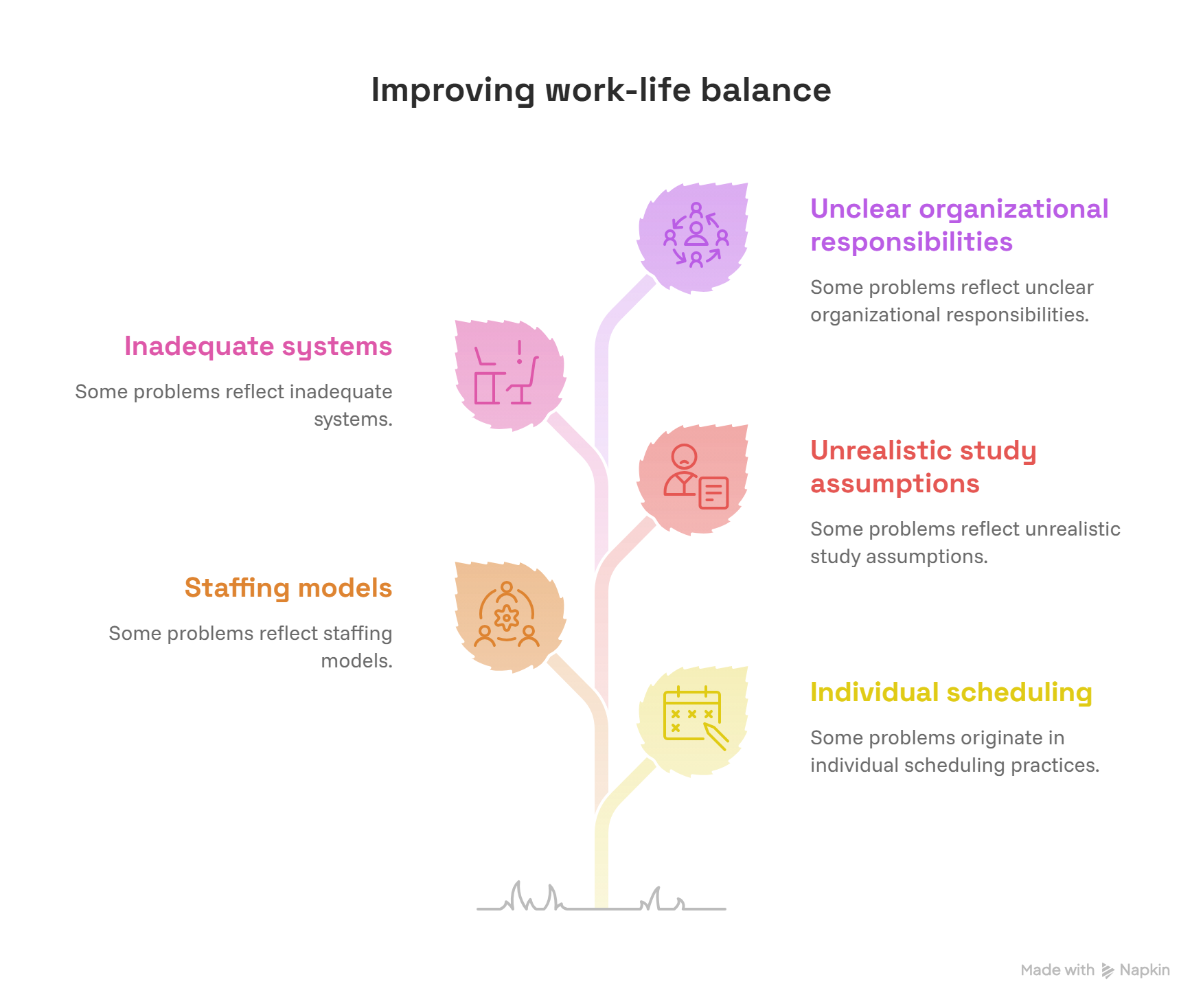
Some problems originate in individual scheduling practices. Others reflect staffing models, unrealistic study assumptions, inadequate systems, or unclear organizational responsibilities.
Solution 1: Measure workload using complexity-adjusted capacity
Counting the number of protocols assigned to an employee provides limited information about the time required to manage them.
A more useful workload assessment considers participant visits, protocol complexity, active enrollment, data entry, safety follow-up, and administrative obligations.
Site managers should identify which activities require clinical expertise, which can be delegated appropriately, and which can be supported through standardized processes.
This strengthens clinical trial site oversight, research assistant task allocation, investigator supervision, and quality management.
A practical capacity review should produce documented workload assumptions and an escalation threshold for conditions that exceed available resources.
Solution 2: Reduce preventable CRA travel
CROs and sponsors can evaluate opportunities to group geographically nearby monitoring visits, improve scheduling lead times, and match monitoring methods to trial-specific risks.
The appropriate mix of on-site, remote, and centralized monitoring should be determined through the study's approved oversight strategy.
Unnecessary duplication of monitoring activity can increase the workload of both CRAs and sites.
Reviewing on-site and remote monitoring techniques, risk-based trial quality, and CRA travel expectations can help organizations identify appropriate changes.
Success should be assessed using travel demand, report timeliness, monitoring quality, and employee feedback together.
Solution 3: Establish defined after-hours escalation coverage
Clinical trials can involve urgent safety responsibilities that require timely action outside normal office hours.
Organizations should distinguish those responsibilities from routine administrative questions.
A practical escalation policy should specify who receives urgent communications, who provides backup coverage, which events require immediate notification, and how handoffs are documented.
This allows teams to support adverse event reporting, medical monitoring responsibilities, and patient safety requirements without expecting every employee to remain continuously available.
Solution 4: Eliminate administrative rework at its source
Recurring queries, repeated documentation corrections, duplicated data entry, and poorly coordinated approvals consume time that could support higher-value research activities.
Employers should investigate the systems and workflows creating these problems.
Potential interventions include clearer standard operating procedures, verified system interfaces, consistent documentation templates, and defined task ownership.
When problems recur, apply root-cause investigation and CAPA principles rather than repeatedly assigning refresher training.
Improving clinical data integrity processes, research protocol adherence, and team communication can reduce both rework and operational uncertainty.
Solution 5: Make retention a management performance indicator
Organizations should examine retention alongside workload distribution, employee development, safety culture, and the completion of essential trial responsibilities.
A team that meets every immediate milestone while repeatedly losing experienced personnel may face substantial continuity risks.
Retention reviews should examine departure reasons, time to fill vacancies, training capacity, and the workload transferred to remaining employees.
These measures can inform clinical research leadership practices, project staffing decisions, and site operating strategies.
5. How to Find Clinical Research Jobs With Better Work-Life Balance in 2027–2028
Job seekers can perform a practical workload audit before accepting an offer.
The objective is to understand what the organization expects during ordinary weeks, peak study periods, staff absences, and urgent operational events.
Ask questions that reveal the actual working conditions
During interviews, prioritize specific operational questions:
What were the team's typical working hours over the last month? Ask how frequently overtime occurred and what caused it.
How are active studies and workload complexity distributed? Clarify how assignments change when protocols become more demanding.
What happens during staff absences? Ask about backfill coverage, cross-training, and escalation ownership.
Which responsibilities require after-hours availability? Request examples of routine versus urgent communications.
What are the actual travel expectations? For CRA and MSL positions, ask about overnight stays, regional coverage, and scheduling notice.
How are workload concerns addressed? Look for an established process and practical examples of changes made following employee feedback.
For entry-level clinical research candidates, these questions can clarify the distinction between research assistant, CTA, and CRC roles.
Experienced professionals should connect their questions to specific responsibilities, including CRA monitoring assignments, clinical project leadership, or pharmacovigilance case management.
Calculate compensation against realistic working time
Comparing salaries without considering actual working hours can misrepresent the financial value of an offer.
Consider a hypothetical annual salary of $90,000.
At 40 hours per week over 50 working weeks, the implied gross hourly equivalent is:
$90,000 ÷ 2,000 = $45 per hour.
At 50 hours per week over the same period:
$90,000 ÷ 2,500 = $36 per hour.
These examples are illustrative calculations, assuming the same salary and working weeks. Actual compensation comparisons should account for benefits, bonuses, paid leave, overtime eligibility, employment law, and reimbursed travel expenses.
When evaluating CRA salaries, pharmacovigilance compensation, and MSL pay expectations, the actual time and responsibility involved provide important context.
Evaluate career transitions for sustainability
A promotion may increase compensation while introducing more travel, people-management responsibilities, or unpredictable deadlines.
Professionals should compare career options against their priorities for flexibility, income, specialization, and long-term progression.
For example, a site coordinator considering a CRO position should examine how the change affects location requirements, training support, working hours, and future mobility.
A CRA moving into clinical trial management should assess the shift from monitoring execution to wider project accountability.
The most relevant comparisons include site versus CRO versus sponsor careers, CRA-to-CTM progression, CRC-to-CTM alternatives, and pharmacovigilance career development.
What the 2027–2028 survey should ultimately reveal
Once the proposed survey has collected sufficient responses, the most useful findings would identify differences in workload predictability, travel burden, staffing adequacy, after-hours expectations, and retention intentions across comparable groups.
The report should also examine which workplace practices are associated with better reported balance after accounting for role, employer type, location, and seniority.
These findings could support more informed recruitment, workforce planning, career decisions, and operational improvements.
Until verified survey data become available, the 30 indicators above provide a practical framework for evaluating clinical research careers, professional development opportunities, and clinical research workplace expectations.
6. FAQs: Clinical Research Work-Life Balance and the 2027–2028 Industry Survey
-
Work-life balance varies substantially by role, employer, study complexity, travel requirements, and team resources.
Site coordinators may experience unpredictable participant schedules, while CRAs may face demanding travel and reporting responsibilities. Data management and regulatory positions can have more consistent locations but periodic workload peaks.
Candidates should assess actual working conditions when comparing CRC careers, travel-intensive CRA positions, and pharmacovigilance employment.
-
Roles with predictable schedules, limited travel, adequate staffing, and clear after-hours escalation arrangements may offer more manageable working conditions.
Some clinical data, regulatory operations, research administration, and pharmacovigilance positions can provide these features, depending on the employer and responsibilities.
Professionals should evaluate site versus CRO employment, remote-work opportunities in pharmacovigilance, and clinical research career options using specific workload and flexibility criteria.
-
For some professionals, CRA positions provide valuable clinical research experience, compensation opportunities, and progression into trial management or sponsor roles.
The trade-off depends on overnight travel, site assignments, reporting deadlines, management support, and personal circumstances.
Before accepting a position, compare CRA salary expectations, CRO versus sponsor working conditions, and CRA travel-related career trade-offs.
-
Potential contributors include high protocol complexity, inadequate staffing, recruitment pressure, participant scheduling conflicts, documentation backlogs, and insufficient management support.
The underlying causes should be evaluated using workload records, operational metrics, and employee feedback rather than assumptions about individual resilience.
Employers can examine clinical trial site oversight, research assistant logistics, protocol adherence workload, and clinical research quality management to identify actionable improvements.
-
AI-enabled tools may reduce time spent on selected administrative, data-processing, documentation, and review tasks.
The actual benefit will depend on system reliability, validation, workflow integration, oversight requirements, and whether efficiency gains translate into reduced employee workload.
Automation can also create new responsibilities involving exception review and data verification.
Professionals should monitor AI exposure across clinical research jobs, AI developments in pharmacovigilance, and clinical data integrity requirements.
-
The 2027–2028 period is prospective as of November 2026. This article establishes a proposed survey framework and provides a 30-indicator measurement matrix. Verified results from the future survey period are currently unavailable.
Any subsequent results should be published with sample sizes, recruitment methods, collection dates, limitations, and appropriate role-level comparisons.
Professionals seeking career context can also consult clinical research salary comparisons, clinical research professional associations, and clinical research career opportunity resources.
