
The final evening before your clinical research certification exam can determine whether you walk into the examination prepared or waste valuable energy fighting anxiety, forgotten documents, and last-minute confusion. Candidates often make the mistake of cramming GCP regulations, memorizing unfamiliar terminology, or taking exhausting practice tests when their attention should shift toward readiness. Your remaining hours are best spent reinforcing high-value concepts, securing exam logistics, and protecting mental performance. This guide provides a practical night-before checklist covering clinical research knowledge, exam-day preparation, remote proctoring, and common mistakes that undermine otherwise well-prepared candidates.
1. Know Exactly What to Do in the Final 12 Hours Before Your Clinical Research Certification Exam
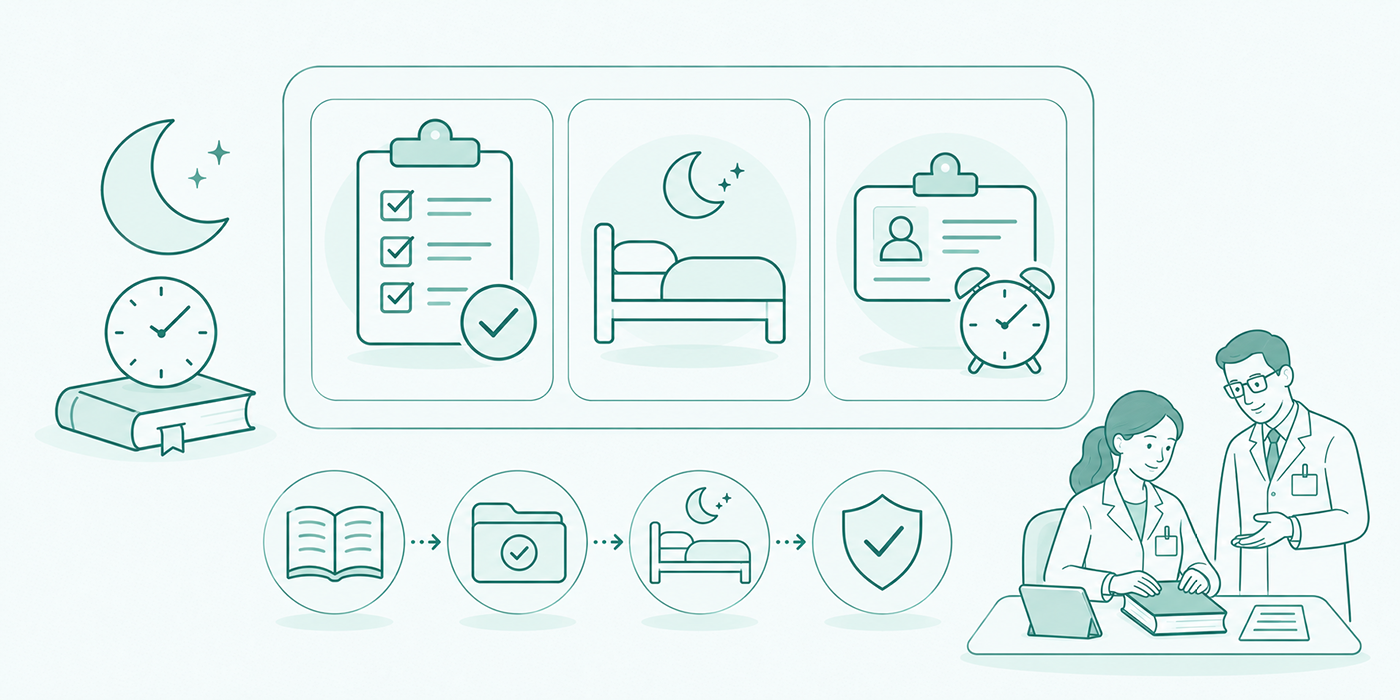
The night before a clinical research certification exam requires a different strategy from ordinary preparation. Earlier study sessions should build understanding, correct knowledge gaps, and improve performance. Your final evening should concentrate on retrieving familiar information, correcting a small number of recurring mistakes, and removing avoidable exam-day obstacles.
Someone preparing for a clinical research project manager certification faces different questions from someone studying pharmacovigilance certification topics. Similarly, candidates responsible for clinical trial safety oversight need a different final review from those preparing for research assistant responsibilities.
Your preparation must reflect the exact certification you are taking.
Do: Replace broad revision with a high-priority knowledge check
Select three categories from your most recent practice assessment:
High-confidence mistakes: Questions you answered incorrectly despite feeling certain.
Recurring mistakes: Concepts you misunderstood across multiple practice sessions.
Slow decisions: Questions you eventually answered correctly but spent excessive time interpreting.
Suppose your previous mock examinations revealed repeated mistakes involving investigator responsibilities under GCP, adverse event reporting, and clinical trial data integrity.
Review the governing principle behind each mistake. Then answer one or two unfamiliar questions to confirm that you can apply it correctly.
A targeted review is especially valuable when you struggle to distinguish sponsor and investigator obligations or confuse the sequence of clinical trial quality management decisions.
Stop revising a concept once you can explain the rule, identify the accountable party, and apply it correctly to a fresh example.
Do: Confirm exactly which guidelines your examination covers
Clinical research candidates sometimes prepare from multiple regulatory versions without checking which one their examination provider assesses.
For example, ICH E6(R3) competency expectations emphasize quality by design, proportionate oversight, reliable results, and clear accountability. However, the guideline version and specific regulatory references included in an examination depend on its current blueprint.
Check the provider's official handbook rather than assuming every GCP certification examination follows the same syllabus.
If you discover a guideline-version difference the evening before your exam, identify the most important affected concepts. Focus on understanding how the differences influence protocol adherence, participant protection, and risk-based monitoring decisions.
Do: Set a firm stopping time for studying
Establish a final study cutoff that allows enough time for logistics, personal preparation, and adequate sleep.
A practical example is a 45-minute focused revision followed by a 15-minute exam logistics check. Candidates needing longer preparation can adjust the schedule, but endless studying without clear goals creates diminishing returns.
After your final session, close your clinical research study materials. Resist reopening pharmacovigilance practice questions or rereading entire medical monitoring plans simply because you remember a topic you could study further.
Your final revision should have an ending. A defined cutoff protects the attention you will need for unfamiliar questions the following day.
| Clinical Research Certification: 30-Point Night-Before Exam Checklist | |||
|---|---|---|---|
| Priority Check | Do This Tonight | Avoid This Mistake | Ready When... |
| 1. Official exam blueprint | Confirm tested domains and guideline versions. | Relying on outdated third-party topic lists. | You know the exact syllabus. |
| 2. Appointment date and time | Check confirmation and local time zone. | Assuming the booking follows your device's time zone. | The appointment is in your calendar correctly. |
| 3. Candidate name | Compare registration details with accepted ID. | Ignoring spelling or surname differences. | Your details meet the provider's identity rules. |
| 4. Identification validity | Check expiry, photo, signature and document type. | Bringing an ID the provider rejects. | Accepted identification is packed. |
| 5. Admission details | Save the confirmation and required credentials securely. | Searching email for access details at check-in. | You can retrieve the appointment information. |
| 6. Arrival or login window | Verify required early arrival or check-in timing. | Arriving at the official start time. | A realistic check-in buffer is scheduled. |
| 7. Test center route | Confirm venue, entrance, parking and travel conditions. | Trusting an unverified address or branch. | Your route includes contingency time. |
| 8. Remote exam device | Run the official compatibility check on the intended computer. | Testing a different device from the one you will use. | The provider's system test passes. |
| 9. Camera and microphone | Check permissions and approved hardware. | Assuming video-call performance guarantees proctor compatibility. | Both work within the testing software. |
| 10. Internet connection | Check connection stability and provider requirements. | Depending on an unreliable network without planning. | The required test succeeds on your network. |
| 11. Remote exam room | Prepare a quiet room and remove prohibited materials. | Leaving notes, screens or unauthorized devices nearby. | The workspace meets room-scan rules. |
| 12. Household interruptions | Arrange a private, interruption-free exam period. | Assuming family members can briefly enter the room. | Others understand the restricted time window. |
| 13. Permitted materials | Check rules for water, breaks, scratch paper and calculators. | Using items permitted on another certification exam. | Your setup contains only allowed items. |
| 14. GCP principles | Recall participant protection, ethics approval and accountability. | Rereading the entire regulation without testing recall. | You can explain each principle through a scenario. |
| 15. Informed consent | Review consent process, understanding and exceptions. | Treating a signature as the entire consent process. | You recognize consent-related violations. |
| 16. AE versus SAE | Rehearse seriousness criteria independently of severity. | Calling all severe events serious. | You can classify unfamiliar cases confidently. |
| 17. Safety reporting | Review responsibilities and the deadlines within your syllabus. | Applying one universal reporting deadline. | You know the relevant triggers and pathways. |
| 18. Protocol deviations | Practice assessment, escalation, documentation and remediation. | Automatically treating every deviation identically. | You can identify the correct first action. |
| 19. Sponsor versus investigator | Review responsibilities and appropriate delegation. | Assuming outsourcing transfers all accountability. | You identify the correct decision owner. |
| 20. Critical-to-quality factors | Review participant and data risks that materially affect trial quality. | Assigning every process the same oversight priority. | You can justify proportionate controls. |
| 21. Monitoring strategy | Rehearse risk-based on-site, remote and centralized oversight. | Assuming more visits always mean better monitoring. | You match oversight to actual risk. |
| 22. Data integrity | Review source records, audit trails and attributable corrections. | Replacing original information without traceability. | You recognize data-governance violations. |
| 23. Role-specific competency | Review one weak domain relevant to your certification. | Spending your final hour on unrelated specializations. | The weakness is retested using fresh questions. |
| 24. Exam navigation | Confirm whether flagging and revisiting are supported. | Planning a second pass when backward navigation is blocked. | Your pacing method matches the actual interface. |
| 25. Question-time budget | Calculate available time and a review reserve. | Using several minutes on one uncertain question. | You know when to commit or move on. |
| 26. Final practice limit | Use a short, familiar review set if needed. | Beginning a full-length mock near bedtime. | Revision ends at a planned cutoff. |
| 27. Food and hydration | Prepare familiar meals and normal fluids. | Testing unusual foods or overusing caffeine. | Your evening routine is comfortable. |
| 28. Sleep opportunity | Protect enough time for your normal sleep needs. | Trading most of the night for extra memorization. | You have a realistic bedtime and wake time. |
| 29. Morning essentials | Prepare clothing, transport and approved documents. | Searching for essentials immediately before leaving. | Everything is ready in one place. |
| 30. Unexpected disruption | Save provider support and technical-issue instructions. | Improvising when check-in or connectivity fails. | You know the escalation and documentation process. |
2. Revise These High-Value Clinical Research Concepts Before Bed
Your final academic review should target concepts that influence several question categories. The goal is to refresh decision-making pathways and strengthen the accuracy of information you already understand.
Candidates preparing for clinical research assistant certification may prioritize participant interactions and documentation. Those studying clinical trial project management should prioritize operational dependencies, oversight, and escalation. Candidates focusing on medical monitoring or pharmacovigilance need additional safety classification practice.
Review 1: Participant rights and informed consent
Consider this scenario: A participant signs a consent form but later demonstrates a serious misunderstanding about a significant trial risk.
The central question concerns whether the informed-consent process adequately supported understanding and voluntary participation. A signature alone does not resolve the concern.
Review the relevant ethical conduct requirements, investigator responsibilities, patient education resources, and protocol adherence procedures.
The exam-ready decision sequence is: Protect the participant → Assess the deficiency → Follow required escalation → Document corrective action.
Review 2: Adverse event classifications and reporting
A severe adverse event and a serious adverse event represent different concepts. Severity concerns intensity, while seriousness concerns defined outcomes or medically important circumstances.
For example, a severe outpatient headache may remain nonserious. An event requiring qualifying inpatient hospitalization may be serious even when investigational treatment causality remains uncertain.
Study the distinctions within adverse event reporting, pharmacovigilance examination questions, medical safety assessments, and clinical trial safety oversight.
Check which reporting deadlines apply to the jurisdiction and event classification tested in your examination.
Review 3: Risk-based monitoring and quality by design
Imagine a sponsor identifies recurring missing primary endpoint assessments at several sites. Appropriate action involves examining the risk to reliable results, identifying the cause, and establishing effective controls.
The ICH E6(R3) approach emphasizes critical-to-quality factors and proportionate oversight.
Strengthen your understanding through quality management strategies, on-site and remote monitoring, and clinical trial data integrity.
Ask: What is critical to participant protection or reliable results? Which risk has materialized? What should be assessed before selecting a corrective measure?
Review 4: Sponsor, investigator, and delegated responsibilities
A CRO misses a monitoring obligation after the sponsor transfers monitoring activities to that service provider.
An exam question may test the sponsor's continuing overall responsibility for appropriate oversight of transferred sponsor activities. Another question may focus on the investigator's responsibility for supervising delegated site tasks.
Reinforce these boundaries using investigator GCP obligations, site operations oversight, clinical trial leadership, and research team coordination.
Memory trigger: Who performs the task? Who remains accountable? Who has authority to approve the decision?
Review 5: Data documentation and protocol deviations
A coordinator changes a source record without preserving an attributable correction history. The resulting value may be accurate, yet the process creates a traceability concern.
Review data integrity responsibilities, protocol compliance requirements, quality management controls, and inspection readiness.
A strong answer preserves available evidence, assesses the impact, identifies the responsible party, and ensures appropriate correction and prevention.
Complete a five-question active-recall check
Without opening your study notes, answer these questions aloud:
Which facts distinguish a serious adverse event from a severe nonserious event?
Who is responsible for appropriate oversight after sponsor activities are transferred?
What should happen when informed-consent deficiencies may affect participant rights?
How should monitoring intensity relate to participant and data risks?
What makes an electronic data correction attributable and traceable?
If you struggle with one answer, review the specific concept for a few minutes and attempt a fresh scenario. Avoid allowing a single weak topic to consume the entire evening.
The best final review strengthens several common examination decisions without introducing unnecessary study fatigue.
3. Prepare Your Exam Logistics Before They Become an Emergency
A candidate can be academically prepared and still lose an examination attempt because identification is rejected, a remote proctoring system fails, or a check-in deadline is missed.
Administrative readiness deserves the same attention you give to research protocol compliance and clinical trial documentation standards: verify requirements, identify potential failures, and resolve preventable issues before the deadline.
Do: Verify the examination provider's current admission rules
Open your confirmation email and current candidate handbook. Confirm the appointment date, location, start time, time zone, check-in window, identification requirements, and access credentials.
Pay particular attention to the name printed on your admission documents. A mismatch with your government-issued identification may prevent entry.
Some certification providers require an admission letter, specific forms of identification, or a minimum early-arrival period. These rules vary across examination organizations and delivery platforms.
For candidates preparing for GCP certification, clinical research certification, or pharmacovigilance certification, the applicable provider's examination instructions control admission.
Save the necessary documents in an accessible location, and confirm whether electronic or printed confirmations are required.
Do: Test the actual device and environment for remote proctoring
A successful video call provides limited assurance that specialized proctoring software will work correctly.
If your examination is remotely proctored, complete the official compatibility test using the same computer, internet connection, and room intended for the examination.
Check these potential failure points:
Operating system and browser compatibility.
Camera and microphone permissions.
Required proctoring application installation.
Security software, firewall, or VPN restrictions.
Internet stability and permitted connectivity arrangements.
Multiple monitors or unauthorized peripheral devices.
Room-scanning requirements and restricted materials.
A candidate studying clinical data governance or research technology workflows may be comfortable with complex software and still encounter restrictions within a secure examination environment.
Check the official instructions for closing applications, positioning the camera, and clearing the workspace.
Important: Some remote proctoring providers prohibit phones, headphones, additional monitors, paper, or certain background materials. Follow the exact rules of your testing platform.
Do: Build a realistic arrival plan for testing centers
Confirm the testing center's complete address, building entrance, transport arrangements, parking availability, and arrival requirement.
A venue located inside an office complex may take longer to enter than the navigation application's estimated travel time suggests.
Plan for traffic disruption and the additional time required to locate the correct room. Prepare accepted identification and admission materials together.
Candidates familiar with clinical trial logistics coordination, project milestone management, and operational contingency planning can apply the same dependency-based reasoning to examination arrival.
Your arrival plan should include a margin for uncertainty. A route that works only when every connection occurs perfectly is fragile.
Do: Know what happens when something goes wrong
Locate the examination provider's support contact and technical-incident procedure.
Check how to report a failed launch, disconnection, identification problem, or proctoring interruption. Understand whether you should remain in the testing interface, contact support, or follow another specified process.
Avoid independently restarting or leaving an active examination session contrary to the provider's rules.
Keep booking details and support instructions accessible outside the restricted testing environment, in a manner consistent with proctoring policies.
This preparedness mirrors the documentation and escalation principles applied in clinical research quality investigations, regulatory compliance, and clinical project coordination.
Select your biggest concern to get a focused night-before action plan.
Submit
Instant self-assessment. Responses are not transmitted or stored.
4. Avoid These Night-Before Mistakes That Can Undermine Your Exam Performance
The most damaging night-before mistakes usually come from uncertainty about preparation. Candidates attempt to compensate by studying longer, changing their routines, or exposing themselves to unfamiliar questions.
These decisions can increase fatigue and make it harder to retrieve previously learned information.
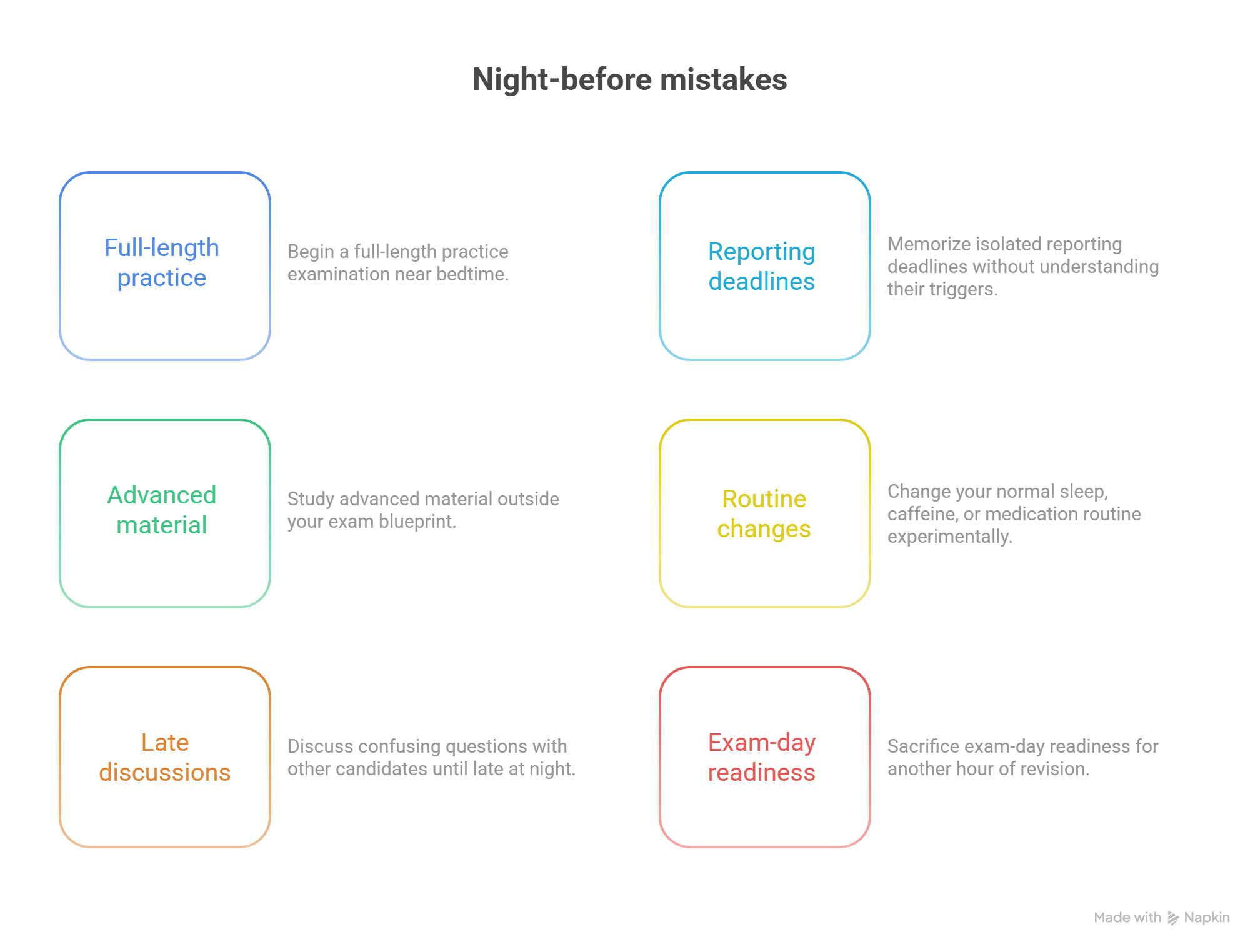
Don't: Begin a full-length practice examination near bedtime
A full-length mock may uncover weaknesses that you have insufficient time to address meaningfully.
Consider a candidate preparing for pharmacovigilance certification who discovers several unfamiliar questions involving complex safety signal analysis at midnight. The candidate may spend hours searching through pharmacovigilance practice materials, sacrificing sleep without achieving dependable mastery.
Use your existing performance record instead.
If previous attempts revealed mistakes involving medical monitoring plans, adverse event reporting, or clinical research quality controls, conduct a brief review of those topics.
Complete longer simulations earlier in your preparation schedule, when there is sufficient time to learn from the results.
Don't: Memorize isolated reporting deadlines without understanding their triggers
Regulatory questions often test whether candidates understand when a reporting requirement applies.
For example, a serious adverse event may require investigator-to-sponsor notification, while an expedited sponsor regulatory report depends on additional applicable criteria. Requirements differ by jurisdiction and event category.
Memorizing a number without knowing the underlying classification can produce confidently incorrect answers.
Review the distinctions between SAE reporting, pharmacovigilance case assessment, medical safety oversight, and investigator obligations.
Use this mental sequence: Classify the event → Assess the applicable reporting criteria → Identify the responsible party → Apply the correct deadline.
Don't: Study advanced material outside your exam blueprint
An entry-level research assistant preparing for an examination may become distracted by advanced topics involving medical safety signal assessments or principal investigator budgeting.
These may be important professional competencies, but their relevance to a particular examination depends on its official syllabus.
A candidate preparing for research assistant certification may benefit more from reinforcing trial logistics, research team communication, and protocol adherence.
Use the official exam blueprint as your final boundary for study priorities.
Don't: Change your normal sleep, caffeine, or medication routine experimentally
Avoid using excessive caffeine to extend revision into the night. Late caffeine consumption may interfere with sleep, with effects varying by individual, dose, and timing.
Similarly, avoid experimenting with unfamiliar sleep aids, supplements, or medications solely to manage examination anxiety.
Maintain your usual prescribed medication schedule unless a qualified clinician has advised otherwise.
Prepare a comfortable sleep environment, reduce unnecessary interruptions, and allow adequate time in bed. Adults generally need seven or more hours of sleep, although individual needs vary.
A single difficult night does not determine the outcome of an examination. The practical priority is to preserve the best possible opportunity for rest rather than creating additional pressure to sleep perfectly.
Don't: Discuss confusing questions with other candidates until late at night
Online discussions can be useful during long-term preparation, especially when comparing clinical research certification pathways or reviewing GCP credential expectations.
The night before your examination, speculative answers and conflicting opinions can introduce avoidable uncertainty.
For technical disagreements involving clinical ethics, clinical trial data integrity, or GCP monitoring, rely on authoritative training materials and the syllabus rather than an unverified last-minute discussion.
Also respect examination confidentiality and security policies when discussing assessment content.
Don't: Sacrifice exam-day readiness for another hour of revision
One more hour of studying may provide limited benefit if it causes you to overlook accepted identification, technical requirements, or transport arrangements.
Apply the same thinking used in clinical project risk management and clinical trial milestone planning: identify a potential failure before it becomes irreversible.
An unresolved identity or access issue can prevent an otherwise well-prepared candidate from sitting the examination.
Schedule a short final logistics verification before ending your evening.
5. Follow This Final 60-Minute Preparation Routine and Exam-Morning Strategy
The following routine is designed for candidates who have already completed the core study program. It limits final revision to defined activities, then shifts attention toward examination readiness.
Minutes 0–15: Review your three most expensive mistakes
Choose three errors from your practice history. Prioritize mistakes that appeared repeatedly or involved an important clinical or regulatory obligation.
For example:
Confusing seriousness and severity in adverse event assessment.
Misidentifying the responsible party in investigator oversight.
Selecting an inappropriate response to clinical trial data integrity concerns.
For each error, write one sentence explaining the correct principle and one explaining why your previous choice failed.
Minutes 15–30: Complete five high-yield scenario questions
Select five previously unseen questions representing your examination's tested competencies.
Candidates preparing for medical monitor roles may use medical safety assessments and trial safety oversight. Project-management candidates may select trial timelines and quality oversight.
Answer each question by identifying the risk, accountable party, decision stage, and most appropriate action.
Minutes 30–45: Complete your admission and logistics audit
Check your examination confirmation, identity documents, check-in time, and delivery-specific instructions.
For remote examinations, confirm the official system test has passed and the room is ready. For testing-center appointments, verify transport and entry arrangements.
Pack only the items permitted by your provider.
Minutes 45–60: Establish your exam-morning plan
Calculate your time-per-question budget if the examination duration and question count are known.
For example, a hypothetical 100-question examination lasting 120 minutes provides an average of 72 seconds per question before reserving review time. With a ten-minute review reserve, the working average becomes 66 seconds.
Use this as a practice calculation. Your actual clinical research examination format and navigation rules may differ.
Select a practical strategy for handling uncertain questions.
Where the examination permits revisiting questions, answer clear items efficiently and flag those needing deeper consideration. Where backward navigation is restricted, determine the strongest defensible answer within your time budget.
Finish by setting out identification, clothing, and other permitted essentials.
What to do on exam morning
Wake with sufficient time for your normal routine and required travel or check-in.
Eat a familiar meal if that is part of your routine, hydrate normally, and avoid introducing unfamiliar food or excessive caffeine.
Before beginning, recall three principles:
1. Read the requested action carefully. A question asking for the first action may have a different answer from one asking for the best preventive control.
2. Respect clinical and regulatory priorities. If a scenario involves participant safety, required reporting, or protocol compliance, determine the applicable obligation before assessing operational convenience.
3. Protect your overall examination time. Avoid allowing one unfamiliar question to consume time needed for several others.
You can apply the same disciplined reasoning used in clinical research leadership, quality risk management, and site oversight to the way you manage the examination itself.
6. Frequently Asked Questions About the Night Before a Clinical Research Certification Exam
-
A short, targeted revision session can reinforce previously learned information. Focus on concepts that caused repeated mistakes in practice assessments.
For example, review GCP investigator responsibilities, adverse event classifications, protocol adherence, and data integrity principles if those topics remain weak.
Use active recall and a small number of unfamiliar scenarios. Set a defined stopping time to preserve your normal evening routine and adequate sleep opportunity.
-
Prioritize participant rights and informed consent, investigator and sponsor responsibilities, adverse event reporting, protocol deviations, risk-based quality management, and reliable clinical trial records.
Review the applicable ICH E6(R3) competencies, participant protection requirements, monitoring principles, and clinical trial quality strategies.
Confirm the exact GCP guideline version tested by your provider.
-
A full-length assessment is generally more useful earlier in the study schedule, when there is time to analyze mistakes and complete remedial learning.
The final evening is better suited to a short, targeted set of unfamiliar questions covering your weakest competencies.
For example, pharmacovigilance practice questions can reinforce safety classification, while medical monitoring techniques can strengthen clinical decision-making.
A brief assessment should end with a clear corrective rule rather than hours of additional searching.
-
Identify whether the concern comes from a specific knowledge gap, inconsistent mock scores, unfamiliar logistics, or general examination anxiety.
For a genuine knowledge gap, select one or two high-priority concepts from your exam blueprint. Use a focused exercise and check whether you can apply the correct rule.
Candidates with weaknesses in clinical research project management may benefit from decision-sequencing practice. Those struggling with medical monitor responsibilities may need to revisit safety escalation and medical accountability.
Protect sufficient time for sleep and examination logistics.
-
Check the official candidate handbook for the accepted identification types, admission letter or confirmation requirements, access credentials, and permitted materials.
Confirm that your registered name satisfies the provider's identification-matching requirements. Check document expiration dates and required signatures where applicable.
Requirements may differ between clinical research certification pathways, GCP certification programs, and individual testing organizations.
Prepare the documents before bedtime so admission problems can be identified early.
-
Run the official system compatibility test on the computer and network you intend to use.
Confirm the operating system, camera, microphone, permitted browser, examination software, and room requirements.
Remove restricted materials, prepare a quiet environment, and verify the check-in procedure. Understand the provider's rules for breaks, unauthorized devices, technical disconnections, and support requests.
Candidates accustomed to remote clinical research monitoring and clinical data systems should still complete the official examination-specific system check.
