
Clinical research exams expose a frustrating problem: you recognize a GCP concept while studying, then struggle to recall it when a question presents an unfamiliar situation. Candidates memorize adverse event definitions, investigator responsibilities, and protocol requirements yet lose marks when those concepts overlap. Effective clinical research exam preparation requires memory techniques that strengthen both recall and judgment.
This guide explains how to memorize ICH E6(R3) principles, retain safety reporting requirements, and apply clinical research knowledge confidently under exam pressure.

1. Why Clinical Research Exam Candidates Forget What They Study
The biggest memory problem begins with familiarity. Reading the same GCP chapter several times makes its terminology increasingly recognizable. That familiarity can create confidence even when the learner cannot independently explain the principle or select the correct response in a clinical situation.
Research on learning techniques consistently identifies practice testing and spaced practice as particularly useful approaches for durable retention. Interleaving, elaboration, and concrete examples can strengthen learning when applied appropriately. Mnemonics are useful for selected facts, while more complex decisions require repeated application.
For clinical research candidates, the distinction matters because GCP certification questions may combine investigator responsibilities, patient safety, and protocol compliance within one scenario.
Use the three-layer memory framework
Every important clinical research topic should be learned at three levels.
Layer 1: Factual recall. Remember the definition, key distinction, responsibility, or procedural requirement.
For example, explain the difference between an adverse event (AE) and a serious adverse event (SAE) without referring to your notes.
Layer 2: Decision recall. Identify what action follows when the concept appears in practice.
For example, a participant reports an unexpected hospitalization. Determine what information should be documented, who should be notified, and how the approved safety reporting pathway should be activated.
Layer 3: Context transfer. Apply the same principle when the circumstances change.
For example, consider what happens when the report arrives outside normal working hours, medical information is incomplete, or the designated safety contact is unavailable.
This approach helps candidates prepare for pharmacovigilance exam questions, research assistant certification assessments, and clinical trial management scenarios.
Prioritize by risk, confusion, and examination relevance
Before memorizing a topic, assign it a priority using three questions:
Consequence: Could misunderstanding this concept affect participant rights, safety, or critical trial data?
Confusability: Is it easily confused with another definition, responsibility, or procedure?
Relevance: Does the topic appear in your certification provider's official examination syllabus?
A candidate who repeatedly confuses severity with seriousness should prioritize that distinction over a definition they can already explain accurately.
High-value topics commonly include informed consent, investigator oversight, clinical data integrity, and risk-based monitoring.
| Clinical Research Exam Memorization Matrix: 28 High-Value Recall Techniques | |||
|---|---|---|---|
| Concept to Memorize | Best Memory Technique | Exact Recall Exercise | Mastery Check |
| 01. Informed consent chronology | Event-sequence reconstruction | Arrange approval, consent, and protocol procedures in the correct order. | Identify the problem when a procedure precedes required consent. |
| 02. Voluntary participation | Teach-back practice | Explain withdrawal rights in plain language without notes. | Respond to a participant concerned about losing routine care. |
| 03. Updated consent information | Before-and-after comparison | Compare a prior and revised consent process. | Recognize when new information requires authorized review. |
| 04. IRB/IEC oversight | Authority flashcards | Identify the function responsible for ethics review and approval. | Distinguish sponsor authorization from ethics approval. |
| 05. Investigator accountability | Responsibility mapping | Map medical decisions, participant care, and investigator oversight. | Identify the responsible decision-maker in a clinical scenario. |
| 06. Delegation and supervision | Paired-concept cards | Explain delegated tasks and continuing oversight responsibilities. | Identify a supervision gap despite documented delegation. |
| 07. Sponsor and CRO responsibilities | Two-column responsibility reconstruction | Separate transferred activities from sponsor oversight obligations. | Resolve a hypothetical vendor failure. |
| 08. AE versus SAE | Contrastive retrieval | Classify six events and explain seriousness criteria. | Identify which cases require SAE escalation. |
| 09. Severity versus seriousness | Paired example comparison | Compare symptom intensity with regulatory seriousness criteria. | Explain why a severe event may be non-serious. |
| 10. Causality and expectedness | Four-factor classification | Evaluate seriousness, severity, causality, and expectedness separately. | Avoid combining distinct medical and regulatory judgments. |
| 11. Safety escalation | Decision-path rehearsal | Reconstruct awareness, notification, medical review, and follow-up. | Select the first action when safety information is incomplete. |
| 12. Protocol visit windows | Worked calendar examples | Calculate permitted visit dates using a fictional protocol. | Recognize and document an out-of-window visit. |
| 13. Inclusion and exclusion criteria | Eligibility decision trees | Assess fictional candidates against stated protocol criteria. | Identify missing evidence before eligibility confirmation. |
| 14. Protocol amendments | Dependency mapping | Link approvals, training, consent updates, and system changes. | Determine when new procedures may be implemented. |
| 15. Investigational product accountability | Inventory flow reconstruction | Trace receipt, storage, dispensing, return, and disposition. | Identify an unexplained accountability discrepancy. |
| 16. Specimen chain of custody | Visual timeline | Reconstruct collection, labeling, storage, and shipment. | Recognize a break in identification or traceability. |
| 17. Temperature excursions | Condition-action flashcards | Recall evidence needed before specimen disposition. | Escalate an excursion without assuming sample suitability. |
| 18. Source data and EDC | Source-to-system mapping | Trace a fictional assessment from source to database. | Resolve a conflicting entry using verified evidence. |
| 19. Audit trails | Who-what-when-why retrieval | Explain the information needed for traceable corrections. | Identify an unsupported change to a trial record. |
| 20. ALCOA+ principles | Mnemonic plus concrete examples | Recall each attribute and provide a corresponding example. | Identify the data-integrity principle affected by an error. |
| 21. Computerized-system access | Error-spotting practice | Identify weaknesses in fictional access and audit records. | Explain why shared credentials damage attribution. |
| 22. Risk-based monitoring | Interleaved scenarios | Compare low-risk and high-risk site monitoring needs. | Select proportionate oversight for unfamiliar site conditions. |
| 23. Critical-to-quality factors | Cause-and-effect mapping | Connect trial endpoints to procedures and potential failures. | Prioritize factors affecting safety or result reliability. |
| 24. CAPA effectiveness | Root-cause reconstruction | Match repeated deviations with causes and preventive controls. | Distinguish activity completion from effectiveness evidence. |
| 25. Data queries | Explain-the-correction cards | Describe how to investigate a discrepancy before responding. | Reject unsupported or guessed corrections. |
| 26. Site activation readiness | Checklist reconstruction | Recall approvals, training, supplies, and authorizations. | Identify a missing prerequisite before site activation. |
| 27. Essential records | Trial-lifecycle memory map | Place key records within startup, conduct, and close-out. | Explain what evidence is needed to reconstruct trial conduct. |
| 28. Study close-out | Reverse-process recall | Work backward from completed close-out to required deliverables. | Identify unresolved records or responsibilities before closure. |
2. Six Memorization Techniques That Work for Clinical Research Exams
Technique 1: Active Recall — Retrieve Information Before Reviewing It
Active recall requires learners to produce information from memory. The simplest method is to close the material and answer a specific question without assistance.
For example, after studying GCP investigator responsibilities, close the guideline and answer:
Who maintains responsibility for supervising appropriately delegated trial activities?
Then ask:
What evidence would demonstrate that oversight occurred?
The first question retrieves a principle. The second tests its practical meaning.
For research assistant certification preparation, create flashcards with one distinct decision per card. Complex questions should be divided into smaller prompts to make errors easier to identify.
Weak flashcard: Explain everything about adverse events.
Stronger flashcards:
What distinguishes seriousness from severity?
What should an assistant document after receiving a potential safety report?
Who performs the required medical evaluation?
Which information should be escalated when details are incomplete?
Use these prompts when reviewing adverse event reporting, medical safety oversight, and pharmacovigilance examination concepts.
After answering, check the source and correct missing qualifications. Revisit incorrect cards until you can explain the concept without the original wording.
Technique 2: Spaced Repetition — Review Before Knowledge Becomes Inaccessible
Spaced repetition distributes study sessions across multiple days rather than concentrating all review into one sitting.
A practical starting schedule is:
Day 0: Learn and immediately retrieve the concept.
Day 1: Retrieve it again without notes.
Day 3: Answer a fresh question testing the same principle.
Day 7: Apply the concept in a more complex scenario.
Day 14: Complete a final retrieval check.
These intervals are a flexible starting template. Difficult concepts may need earlier repetition, while reliably recalled material can receive longer intervals.
For example, a candidate studying informed consent requirements could begin with a definition, progress to a delayed-consent case, and later solve a protocol-amendment scenario involving updated participant information.
The same approach works for clinical monitoring procedures, site operations, and data-integrity principles.
Practical rule: Schedule another attempt after a failed retrieval. Lengthen the interval when a concept is recalled accurately and explained confidently.
Technique 3: Interleaving — Mix Concepts That Are Easy to Confuse
Interleaving involves practicing different question types together. It is particularly useful when the examination requires identifying which principle governs an unfamiliar scenario.
Consider a mixed set of five questions involving:
Informed consent timing.
Investigator delegation.
SAE escalation.
EDC correction.
Vendor oversight.
The candidate must identify the relevant domain before applying the rule.
This strengthens discrimination between ethical research obligations, investigator accountability, safety reporting requirements, and trial quality oversight.
Begin with focused practice when the material is unfamiliar. Introduce mixed questions after establishing the core definitions.
A useful progression is six questions on one topic, six questions on a related topic, followed by twelve mixed questions using both.
Technique 4: Dual Coding — Connect Words With Simple Visual Structures
Dual coding combines verbal explanations with meaningful visual representations.
For clinical trial logistics, draw a specimen pathway:
Collection → Identification → Processing → Storage → Shipment → Receipt
Under each stage, add the evidence required to establish what happened.
For clinical data integrity, create a second map:
Source assessment → Authorized entry → Data review → Query → Traceable resolution
Then erase the labels and reconstruct them from memory.
The visual structure clarifies dependencies, while retrieval establishes whether the sequence is remembered.
Use diagrams for protocol visit workflows, site activation requirements, and clinical trial close-out.
Avoid elaborate diagrams that take longer to decorate than to understand. A useful diagram should make a decision sequence, responsibility boundary, or dependency easier to reconstruct.
Technique 5: Elaboration — Explain Why Each Requirement Exists
Elaboration strengthens understanding by connecting new information to causes, consequences, and existing knowledge.
After memorizing a requirement, ask three questions:
Why does this requirement exist? What could happen if it fails? Which evidence would demonstrate compliance?
For example, when studying audit trails and source-data integrity, explain why individually attributable entries matter, how shared credentials impair traceability, and what records help reconstruct a correction.
For GCP monitoring, explain why oversight intensity may vary according to the risks of trial activities and critical data.
For CAPA effectiveness, explain why completed retraining may fail to prevent recurring protocol deviations.
Elaboration makes it easier to answer questions that test consequences rather than definitions.
Technique 6: Mnemonics and Memory Palaces — Use Them for Specific Recall Problems
Mnemonics can help organize sequences, lists, and terminology.
The familiar ALCOA mnemonic supports recall of five data-integrity attributes: Attributable, Legible, Contemporaneous, Original, and Accurate. ALCOA+ adds commonly recognized attributes including Complete, Consistent, Enduring, and Available.
For each attribute, construct a realistic clinical research documentation example.
For a memory palace, associate distinct locations in a familiar room with separate concepts. A doorway might represent consent, a desk might represent source records, and a filing cabinet might represent essential documentation.
Retrieve each concept by mentally revisiting the location.
This approach can help with bounded lists encountered in research assistant training and clinical research ethics preparation.
Verify the actual definitions and requirements after mnemonic recall. The mnemonic supplies a memory cue, while scenario practice develops appropriate judgment.
3. How to Memorize GCP Scenarios, Reporting Rules, and Role Responsibilities
Clinical research examinations become difficult when several concepts appear simultaneously. A reliable approach is to transform each topic into a decision sequence and practice retrieving that sequence under changing circumstances.
Build four-part decision cards
Each card should contain:
Trigger: What happened?
Risk: Which participant right, safety concern, or data-quality issue may be affected?
Authority: Who is responsible for assessing or deciding?
Action: What should happen first?
Consider a fictional study participant who undergoes a protocol-specific blood draw before documented informed consent.
The trigger is the procedure chronology. The risk concerns participant rights and compliance. The investigator and other designated personnel must assess the circumstances. The appropriate initial response includes preserving accurate records and escalating promptly.
This exercise combines informed consent ethics, GCP investigator duties, protocol deviation management, and source-data integrity.
Create one card for the original situation and another for a changed circumstance, such as discovering the error during monitoring.
Use contrast pairs for frequently confused concepts
AE versus SAE: Compare the definition of an adverse event with regulatory seriousness criteria. A medically serious event may require an immediate reporting pathway even when its relationship to the investigational product remains under assessment.
Seriousness versus severity: Seriousness concerns specified outcomes or medically important circumstances. Severity describes intensity. Practice classifying both dimensions independently using GCP safety reporting examples.
Investigator versus sponsor: Identify oversight, medical, operational, and quality responsibilities in a delegated trial activity. Use investigator guidance and clinical project leadership scenarios.
Monitoring versus auditing: Compare ongoing trial oversight with independent evaluations of compliance. Review monitoring methods and inspection-readiness practices.
Correction versus CAPA: A correction addresses an identified problem. Corrective and preventive action processes investigate causes and introduce controls intended to reduce recurrence. Practice explaining both through clinical trial quality management.
Avoid memorizing universal reporting deadlines
Clinical research involves multiple reporting obligations with different triggers, responsible parties, and jurisdiction-specific timeframes.
For a pharmacovigilance examination, separate investigator-to-sponsor reporting, sponsor regulatory reporting, urgent medical notification, and required follow-up.
Record the specific rule from the examination's applicable regulation or source material. Study its trigger, recipient, responsible function, and deadline together.
For example, a fictional protocol might require a particular event notification within a stated interval. Build questions around that exact condition rather than treating the interval as universal.
This also improves preparation for medical monitor assessments and safety oversight questions.
Practice scenario mutation
After answering a question correctly, change one detail and solve it again.
Start with a participant reporting hospitalization. Then change the scenario to an emergency department visit without admission, an event with missing medical details, or an after-hours report.
For an EDC discrepancy, change the circumstances from an incorrect transcription to conflicting source records or an unauthorized system correction.
This exercise reveals whether you understand the decision principle behind patient safety requirements, data verification, and GCP monitoring findings.
4. A 14-Day Clinical Research Memorization Schedule With Daily Recall Targets
The following schedule combines spaced retrieval, concept discrimination, and practical decision-making. It can supplement an ICH-GCP two-week study plan or support candidates preparing for research assistant certification, pharmacovigilance certification, and clinical project management assessments.
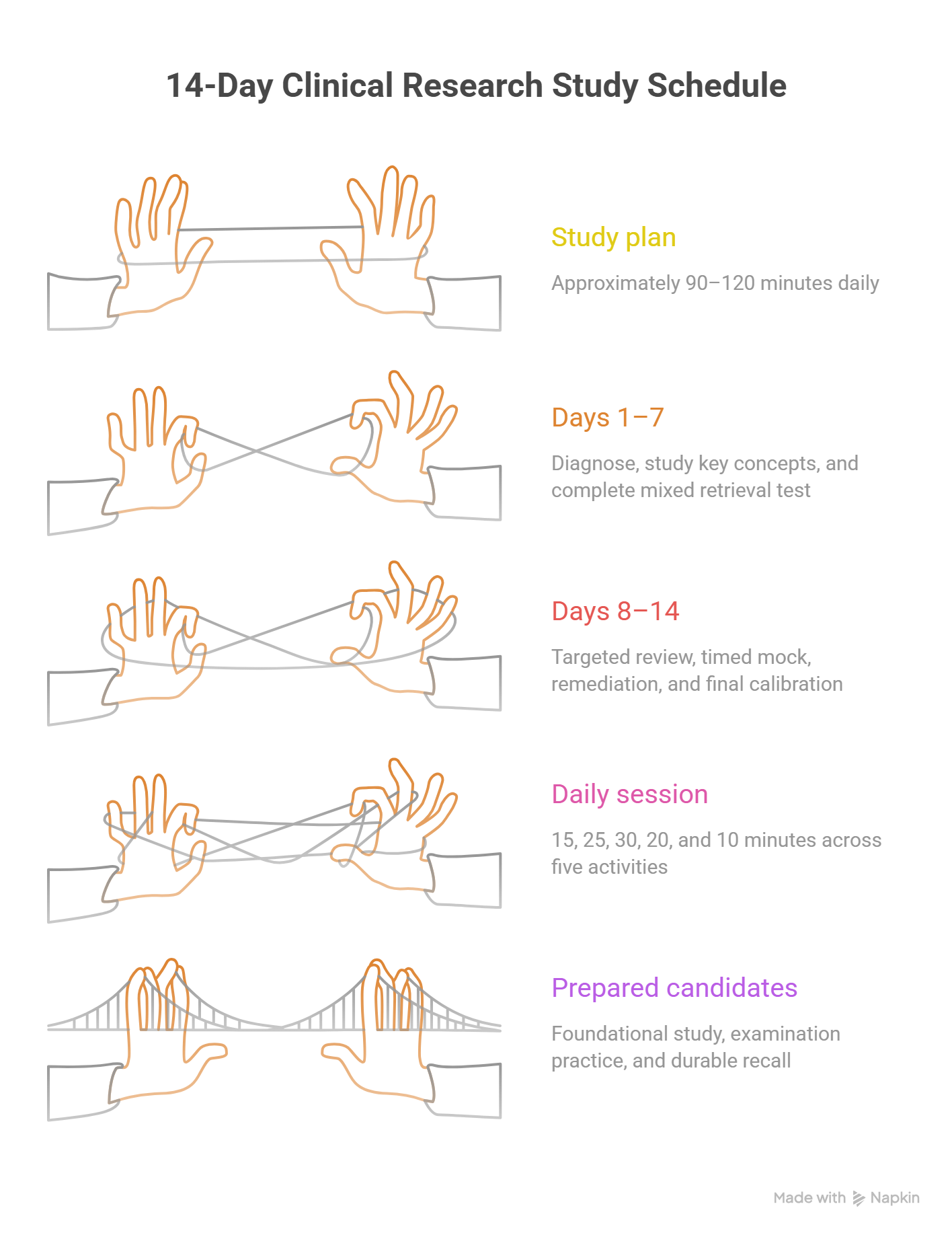
Plan for approximately 90–120 minutes daily, adapting the content to your examination blueprint.
Day 1 — Diagnose and prioritize. Complete 20 unfamiliar questions. Classify mistakes as knowledge, authority, sequencing, or evidence errors. Select 20 high-priority concepts for retrieval cards.
Day 2 — Ethics and consent. Create 15 cards involving participant rights, consent timing, withdrawal, and approved documentation. Practice five consent scenarios without notes.
Day 3 — Investigator and sponsor roles. Draw a responsibility map covering investigator supervision, sponsor oversight, medical decisions, and transferred activities. Test it against GCP investigator responsibilities and trial leadership concepts.
Day 4 — Safety terminology. Review AE, SAE, seriousness, severity, causality, and expectedness. Classify 12 hypothetical events using adverse event reporting principles and medical safety oversight.
Day 5 — Protocol and site execution. Reconstruct eligibility, visit-window, and amendment decision paths. Complete six scenarios based on protocol adherence and site operational requirements.
Day 6 — Data integrity. Memorize ALCOA+ attributes using one real-world-style example per attribute. Resolve eight fictional source-to-EDC discrepancies and identify the records required for traceable correction.
Day 7 — Mixed retrieval test. Complete 35 questions covering Days 1–6. Revisit incorrect and low-confidence answers. Use research exam practice materials appropriate to your role.
Day 8 — Targeted review. Revisit all missed concepts at shorter intervals. Replace vague flashcards with questions that request one clear fact, distinction, or decision.
Day 9 — Monitoring and quality. Create comparison cards for on-site, remote, and centralized GCP monitoring. Explain risk-based oversight and quality management without referring to notes.
Day 10 — Safety and authority integration. Practice eight scenarios combining participant safety, investigator responsibility, sponsor reporting, and medical monitoring.
Day 11 — Complex decision recall. Work through scenarios involving protocol amendments, vendor failures, data corrections, and clinical trial logistics. For every answer, explain why the alternatives are weaker.
Day 12 — Timed mock assessment. Complete 40 unseen mixed questions. Compare accuracy in familiar versus unfamiliar situations and identify whether time pressure affects reasoning.
Day 13 — Remediate persistent errors. Focus on the five most frequently missed concepts. Use explanation-based recall, contrast cards, and new scenarios. Review safety reporting, data integrity, and ethical conduct if errors involve high-consequence responsibilities.
Day 14 — Final calibration. Answer 25 unfamiliar questions. Review only unresolved gaps and essential distinctions. Confirm the examination's approved study resources, format, and practical requirements.
The 100-minute daily study session
Use a repeatable allocation:
15 minutes: Closed-book retrieval of previously studied concepts.
25 minutes: Learn or clarify one priority topic.
30 minutes: Answer unfamiliar practice questions.
20 minutes: Explain mistakes and update recall cards.
10 minutes: Schedule future reviews and record weak areas.
This format makes space for foundational study, examination practice, and durable recall. Candidates with limited availability can shorten each component while preserving all five activities.
For additional preparation, combine the schedule with free clinical research training resources and the clinical research certification requirements relevant to your target position.
5. How to Measure Memory Retention and Fix Common Study Mistakes
A useful study metric measures whether knowledge survives a delay and transfers to an unfamiliar problem.
Track three results separately.
Delayed recall accuracy: The percentage of concepts you can explain correctly 24 hours or more after studying them.
Scenario accuracy: Your percentage of correct responses to unfamiliar applications of those concepts.
Confidence calibration: Whether your confidence matches your actual performance.
For example, consider a candidate who recalls 18 of 20 safety definitions but answers only five of ten new safety scenarios correctly. The next improvement should emphasize safety reporting decisions, medical monitor responsibilities, and investigator accountability.
Four mistakes that quietly reduce exam performance
Mistake 1: Reviewing only what feels difficult. Candidates sometimes avoid unfamiliar topics because wrong answers are discouraging. Prioritize repeated errors, particularly those involving participant rights or critical trial data.
Mistake 2: Reviewing answers immediately after seeing the question. Familiarity with the displayed solution can mask weak recall. Delay the explanation until after committing to an answer and documenting your reasoning.
Mistake 3: Memorizing outdated or unsupported rules. Certification providers may differ in the guideline version and jurisdiction covered. Verify source material, particularly for ICH E6(R3) expectations and GCP credential requirements.
Mistake 4: Repeating identical practice questions. Familiar wording allows recognition to replace reasoning. Change the circumstances, authority, sequence, and available evidence in each scenario.
The final readiness test
Select ten high-priority concepts and complete three tasks for each:
Explain the principle from memory.
Apply it to an unfamiliar clinical research scenario.
Identify an exception, limitation, or circumstance requiring additional information.
A candidate who can perform all three demonstrates deeper understanding of research protocol requirements, clinical trial quality management, and participant safety obligations.
When preparing for an examination with an official passing standard, compare results against the provider's requirements. Consistent success on unfamiliar questions provides more useful evidence than repeatedly answering a memorized question bank.
6. FAQs: Memorization Techniques for Clinical Research Exams
-
Active recall combined with spaced repetition provides a strong foundation for retaining clinical research knowledge. Candidates retrieve definitions and principles without notes, then revisit them across multiple days.
Scenario-based practice should accompany this process because exams may require decisions involving GCP compliance, adverse event reporting, and clinical trial documentation.
A particularly useful approach is to create separate cards for definitions, responsible decision-makers, and realistic applications of each concept.
-
Organize the guideline into manageable domains: participant protection, informed consent, investigator responsibilities, sponsor oversight, safety reporting, data governance, and risk-based quality management.
Study one domain at a time, retrieve its main principles, and connect it to other domains through case-based questions.
Use the ICH-GCP two-week preparation schedule, ethical clinical research guidance, GCP monitoring techniques, and clinical trial quality principles to build a structured study sequence.
-
Begin with an immediate retrieval attempt, followed by reviews approximately one, three, seven, and fourteen days later.
Adjust intervals according to actual performance. Incorrect answers deserve earlier review, while consistently correct answers can be spaced further apart.
Flashcards are especially useful for GCP definitions, pharmacovigilance terminology, research assistant responsibilities, and clinical data-integrity principles.
-
Create a contrast card for each concept and practice classifying fictional clinical events.
An adverse event concerns an untoward medical occurrence. Seriousness involves defined outcomes or medically important circumstances. Severity describes intensity. Causality concerns the assessed relationship to a product or procedure.
Keep these judgments separate while practicing adverse event reporting, medical safety assessment, and pharmacovigilance examination questions.
-
Mnemonics can help with factual lists, terminology, sequences, and memory cues such as ALCOA+.
ICH E6(R3) also requires understanding how principles apply to ethical oversight, trial quality, delegated responsibilities, data governance, and proportionate risk management.
Use mnemonics alongside investigator responsibility scenarios, GCP monitoring exercises, risk-based quality questions, and clinical research ethics cases.
-
Identify whether the problem involves delayed recall, confusion between similar concepts, or difficulty applying knowledge.
Use shorter review intervals for forgotten definitions, contrast cards for confused concepts, and unfamiliar scenarios for application problems.
Track performance through repeated retrieval rather than time spent reading.
Candidates can strengthen weak areas through research assistant training resources, protocol adherence practice, clinical research safety preparation, and free clinical research learning resources.
