
Creating the Perfect Clinical Research Certification Study Environment
Your environment is not neutral — it either accelerates your learning or bleeds away focus and recall. When preparing for a high-stakes exam like the Clinical Research Certification by CCRPS, the quality of your study environment is just as important as the content you’re reviewing. A cluttered desk, distracting noise, or poor ergonomics doesn’t just feel uncomfortable — it actively impairs working memory and increases cognitive fatigue.
This guide isn’t about aesthetics or minimalism trends. It’s about building a scientifically structured environment that supports sustained attention, reduces decision friction, and primes your brain for recall. By the end, you’ll have a blueprint to turn any space — home office, library corner, or clinical workspace — into a performance-driven study zone.

Why Your Environment Impacts Cognitive Retention
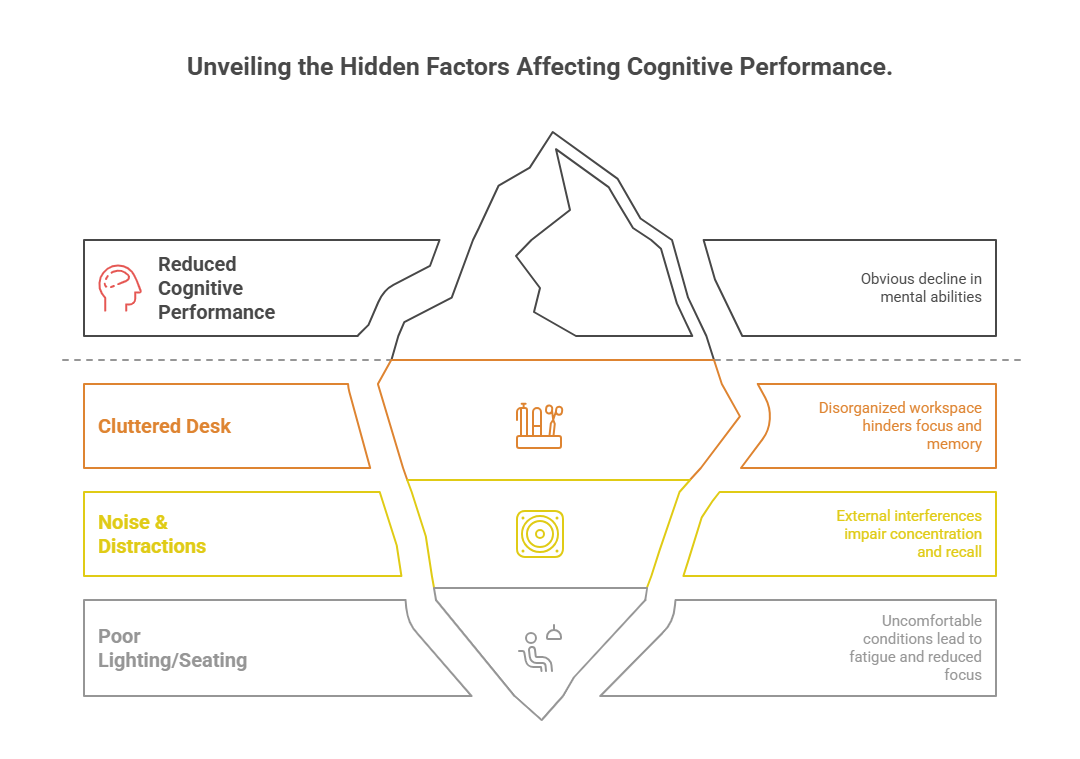
Your study environment is not background noise — it is a direct input into how your brain encodes and retrieves information. For candidates preparing for the Clinical Research Certification by CCRPS, ignoring environment means stacking odds against your recall before the exam even begins. Memory and focus aren’t just about discipline; they’re about cognitive conditions shaped by your space.
Cognitive Load Theory and Space Setup
According to cognitive load theory, your brain has limited working memory. Every distraction — clutter, poor lighting, uncomfortable seating — consumes cognitive resources that should be used for encoding exam-critical knowledge. When your environment forces your mind to multitask (adjust posture, search for materials, tolerate noise), you erode retention efficiency.
Optimal setups reduce extraneous load by:
Keeping only active resources within reach (notes, guidelines, laptop)
Using neutral, consistent lighting that prevents eye strain
Positioning seating to maintain posture for long sessions without fatigue
A structured space lowers mental “noise,” leaving your brain free to chunk complex frameworks like ICH-GCP principles or SAE reporting timelines into long-term memory.
Auditory and Visual Distractions
The brain cannot filter background input as well as we assume. Even low-level auditory or visual noise increases error rates by up to 25% in recall-heavy tasks. For exam prep, this means:
Conversations in adjacent rooms lower reading comprehension
Movement within your visual periphery reduces deep focus
Random phone vibrations reset attention cycles, costing minutes each time
For clinical research exams, which test layered compliance decisions, attention interruptions are fatal. Protect focus by:
Using noise-cancelling headphones or white noise apps
Keeping study space facing a blank wall or static background
Setting devices on “Do Not Disturb” during blocks
Your recall strength rises in proportion to how undisturbed your study windows remain.
Crafting a Focused Study Area at Home
Home-based prep can be powerful — or destructive — depending on how deliberately you set up the space. Preparing for the Clinical Research Certification by CCRPS requires more than a desk and a laptop. You need an environment engineered to support recall, reduce fatigue, and block interruptions.
Choosing the Right Lighting and Seating
Lighting shapes alertness. Dim or yellow light signals relaxation, while bright, cool-toned light stimulates wakefulness. For exam prep:
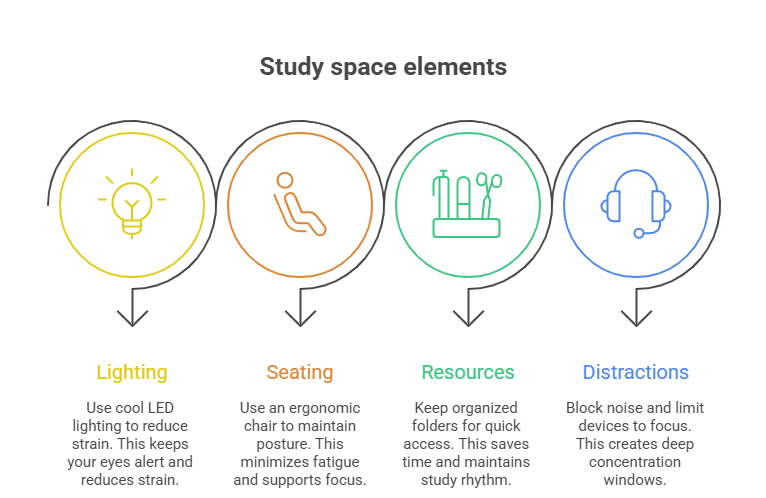
Use LED lighting with 4000–5000K temperature to sustain focus
Avoid overhead glare that strains the eyes after long sessions
Position lighting to eliminate screen reflections
Seating matters equally. Poor ergonomics causes subtle pain that drains attention. Choose:
An adjustable chair with lumbar support
Desk height aligned with elbow level
A posture setup that allows 90-degree knee and hip alignment
The goal: remove physical fatigue as a distraction, so your cognitive energy is directed toward high-yield recall.
Organizing Resources for Fast Retrieval
A cluttered workspace forces your brain into micro-decisions: Where’s that guideline? Did I save that protocol flow? Each moment of searching fractures focus.
Instead:
Keep only current notes and textbooks visible
Use labeled folders (digital and physical) for ICH, SAE, consent, GCP frameworks
Place key references within arm’s reach to maintain study rhythm
Fast retrieval systems mimic exam conditions, where hesitation or confusion can cost pacing.
Blocking Noise and Notifications
Noise and device interruptions are silent killers of exam prep. Even one text alert can reset your focus loop.
Mitigate this by:
Studying in a door-closed room away from foot traffic
Using browser extensions that block non-study sites
Enabling airplane mode or Do Not Disturb on all devices during blocks
Creating silence trains your brain to build deep concentration windows — the same focus you’ll need when tackling compliance-heavy case questions under time pressure.
Study Space Upgrades That Matter Most
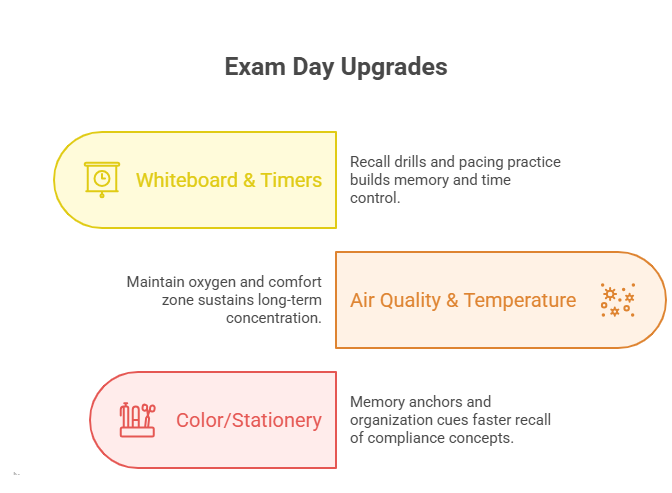
Once the basics of lighting, seating, and organization are set, incremental upgrades can dramatically improve recall, focus, and stamina. For clinical research exam prep, these tools act as cognitive amplifiers — training your brain to handle structured recall and reducing environment-induced fatigue during long study blocks.
Whiteboards and Timers for Recall Drills
Whiteboards transform passive review into active recall training. Writing forces your brain to reconstruct concepts rather than re-read them. Use it for:
Mapping ICH-GCP principles in flow diagrams
Summarizing SAE reporting timelines from memory
Drilling informed consent clauses in bullet form
Pair this with timers:
Set 25–40 minute work sprints followed by 5-minute breaks
Use countdowns for recall sprints (e.g., list SAE classification in 2 minutes)
These tools build exam pacing fluency, mimicking the timed environment of certification tests.
Air Quality, Temperature, and Ergonomics
Cognitive performance drops sharply in poor air and improper temperature. For high-stakes studying:
Maintain room temperature between 68–72°F (20–22°C)
Use fans, air purifiers, or ventilation for oxygen-rich airflow
Keep posture neutral to prevent musculoskeletal strain
Clinical research exams require mental endurance. Proper air and ergonomics maintain alertness for extended prep windows without early fatigue.
Color Psychology and Stationery Hacks
Subtle design choices prime focus. Blue tones calm, while greens promote balance and long-term concentration.
Practical uses:
Use blue or green sticky notes for key compliance reminders
Assign color codes for domains: red = SAE, yellow = consent, blue = ICH-GCP
Keep stationery minimal to reduce clutter-driven distractions
Color cues act as memory anchors, helping your brain connect frameworks faster under exam pressure.
Mobile vs. Desktop vs. Paper-Based Prep
Not all study mediums deliver the same retention value. For candidates targeting the Clinical Research Certification by CCRPS, the right platform depends on the type of content you’re reviewing. Each medium has strengths — and knowing when to deploy them is what separates efficient prep from wasted hours.
Pros and Cons of Each Medium
Mobile: Excellent for micro-reviews, flashcards, and on-the-go quiz practice. But small screens limit deep reading and increase distraction risk.
Desktop: Ideal for compliance-heavy documents like ICH-GCP and SAE reporting guidelines. Large screens help with multitasking (notes + references). Downsides: fatigue from prolonged screen exposure.
Paper: Best for deep retention. Writing by hand boosts encoding strength by 20–30% compared to typing. Drawback: limited portability and difficulty in updating notes.
The key: assign each medium a role rather than forcing one format for everything.
When to Use Mixed-Mode Learning
Mixed-mode blends the benefits:
Use desktop for long sessions (GCP frameworks, regulatory protocols)
Switch to paper for recall drills and flowchart sketches
Leverage mobile for downtime review (flashcards, question banks)
This rotation:
Prevents fatigue from single-format studying
Reinforces knowledge through multi-channel encoding
Keeps prep aligned with both retention and convenience
Strategic mixing ensures knowledge sticks and recall sharpens under test conditions.
| Medium | Strengths | Limitations |
|---|---|---|
| Mobile | Convenient, great for flashcards & micro-reviews | Small screen, prone to distractions |
| Desktop | Large view, ideal for guidelines & PDFs | Screen fatigue over long sessions |
| Paper | Boosts recall through handwriting | Harder to update, less portable |
Your Daily Environment Optimization Checklist
A perfect study space isn’t a one-time setup — it’s a system you reset every day. For candidates pursuing the Clinical Research Certification by CCRPS, consistency of environment is as critical as consistency of content. Small lapses — clutter creeping back, phone left on desk, chair angle drifting — all accumulate into cognitive drag. A daily checklist locks your environment into high-performance mode.
Before, During, and After Each Study Block
Before: Clear desk of all unrelated items, prep only the resources needed for that session (ICH guidelines, SAE notes, practice bank). Run a 2-minute breathing reset.
During: Keep a timer visible, disable notifications, and track distractions in a side notebook to address later. Maintain posture and hydration.
After: Log progress: what worked, what didn’t, and what needs immediate review next session. Reset space to neutral — don’t leave it messy for tomorrow.
This cycle reduces decision friction, primes the brain for recall, and conditions study sessions into predictable, high-focus routines.
Maintaining Space Discipline Over Weeks
Short-term environment control is easy. Long-term discipline is rare — but essential.
To maintain it:
Do a weekly “space audit” — lighting, chair, noise, temperature
Replace worn-out tools (markers, notebooks, sticky notes) immediately
Rotate small environmental cues (a new color scheme, adjusted seating) to refresh motivation without adding clutter
Sustained discipline ensures your study area remains a reliable cognitive anchor, helping you enter focus mode faster and stay there longer.
| Phase | Actions | Outcome |
|---|---|---|
| Before Study Block | Clear clutter, prep only needed materials, silence devices | Lower cognitive load, smoother start |
| During Block | Timer visible, posture check, no interruptions | Sustained concentration, efficient pacing |
| After Block | Log progress, reset space, audit distractions | Cognitive closure, readiness for next session |
How the CCRPS Certification Study Method Supports Your Environment
The Clinical Research Certification by CCRPS doesn’t just deliver content — it is intentionally structured to integrate with an optimized study environment. Many candidates underestimate how closely study methods and study spaces interact. A systemized curriculum like CCRPS amplifies this connection by aligning learning tasks with the way your environment influences focus, recall, and performance.
First, CCRPS modules are self-paced and modular, allowing candidates to schedule study blocks around peak focus hours. This means you can design your environment to support high-intensity sprints — whether that’s early mornings with quiet, or structured evening sessions with whiteboard drills. The flexibility encourages consistent use of your optimized setup, rather than sporadic, unfocused review.
Second, each section of the program is application-heavy, requiring scenario-based problem solving. A controlled environment helps here: writing out responses on whiteboards, using color-coded notes for compliance categories, and working in distraction-free spaces mimic the way you’ll need to retrieve information under exam pressure. Because CCRPS tests aren’t rote memorization, an environment designed for active engagement rather than passive reading becomes a performance multiplier.
Third, CCRPS assessments include timed evaluations. A properly crafted study environment — equipped with timers, minimal clutter, and clear visibility of resources — allows you to simulate real exam conditions. This creates stress inoculation: the space itself becomes associated with performance readiness. When you later face the real exam, the environment’s memory cues kick in, making the experience feel familiar rather than threatening.
Fourth, CCRPS materials encourage multi-format learning. Candidates who set up study spaces with both digital and paper-based tools — for example, using desktops for regulations, paper for recall sketches, and mobile devices for flashcards — benefit most. The program’s structure complements this mixed-mode approach, making your environment a hub for seamless transitions.
Frequently Asked Questions
-
Your study environment directly influences cognitive retention, focus, and stress levels. Disorganized or noisy spaces increase cognitive load, meaning your brain wastes energy on distractions instead of memory encoding. For candidates preparing for the Clinical Research Certification by CCRPS, this is critical — the exam tests applied decision-making under pressure, which requires deep, uninterrupted focus. A well-structured environment reduces extraneous noise, stabilizes recall, and primes your mind for retrieval. Think of it as a protocol-controlled setting: the fewer variables, the more reliable the results. An optimized space ensures knowledge isn’t just studied — it’s retrievable under exam pressure.
-
Lighting shapes both mood and neural efficiency. Research shows that cool-toned lighting (4000–5000K) improves alertness, while dim or warm light signals relaxation, lowering focus. Poor lighting strains your eyes, causes fatigue, and reduces comprehension by up to 20%. For exam prep, especially with regulatory content like ICH-GCP frameworks or SAE reporting guidelines, clarity is essential. Place lighting behind or above your workspace to avoid glare, and consider daylight bulbs if natural light is inconsistent. Correct lighting isn’t cosmetic — it’s a cognitive tool. When your visual system isn’t straining, your working memory can fully engage with complex material, boosting exam-day performance and recall speed.
-
Seating and ergonomics are often overlooked but directly impact focus endurance. Poor posture leads to muscle strain and micro-discomforts that fragment concentration. Over a 2-hour session — the length of many certification exams — this can cost dozens of minutes of productive recall. For the Clinical Research Certification by CCRPS, stamina matters as much as content mastery. Choose a chair with lumbar support, align desk height with elbows, and keep hips and knees at 90 degrees. Ergonomic setups reduce mental “noise” from discomfort, allowing you to sustain concentration longer. When your body is supported, your mind has the bandwidth to process complex exam scenarios effectively.
-
The answer depends on your brain’s auditory filtering capacity. Low-level instrumental music may help mask distracting noise, but lyrical or fluctuating sounds compete for working memory and decrease retention. Studies show background conversations reduce comprehension scores by up to 25%. For clinical research exam prep, where applied compliance judgment is required, clarity trumps ambience. If noise is unavoidable, opt for white noise, brown noise, or noise-cancelling headphones to stabilize focus. Silence is ideal, but if your mind wanders, structured soundscapes (steady rhythms, non-vocal tracks) can help. The key: your environment should eliminate auditory competition, not introduce it.
-
Organization eliminates friction. Every time you hunt for a protocol chart or misplaced SAE guideline, your brain shifts context — costing several minutes of lost focus per interruption. Create a dedicated system: digital folders labeled by domain (ICH, SAE, informed consent, trial design) and physical binders divided by color codes. Keep only relevant notes on your desk for the current session. Use quick-access tabs or sticky flags for high-yield areas. For the Clinical Research Certification by CCRPS, this mirrors exam conditions: quick retrieval under time pressure. An organized space builds mental clarity, ensuring you practice recall, not search-and-rescue operations.
-
Three upgrades consistently deliver the highest ROI for exam prep: whiteboards, timers, and air quality control. Whiteboards promote active recall by forcing you to reconstruct knowledge (ICH principles, SAE timelines) instead of re-reading. Timers train you to respect exam pacing, simulating the one-minute-per-question rhythm. Air quality — often ignored — is critical; poor ventilation reduces oxygenation and increases fatigue. Keeping your room between 68–72°F (20–22°C) and using a fan or purifier boosts mental clarity. These upgrades turn a basic desk into a performance lab, making prep sessions more reflective of exam-day demands and reducing mid-session fatigue.
The Take Away
The quality of your study environment is not a side detail — it is a core performance variable. Preparing for the Clinical Research Certification by CCRPS requires more than memorizing guidelines. It requires engineering a space that maximizes recall, reduces fatigue, and eliminates distractions. From lighting and ergonomics to air quality and noise control, every environmental factor shapes how well you absorb and retrieve knowledge under exam conditions.
When your study area becomes predictable, controlled, and optimized, your brain learns to associate that space with focus and retention. Pairing this with CCRPS’s structured, scenario-based curriculum creates a cycle of reinforcement: you don’t just study — you train your mind to execute under pressure. The right environment is your hidden advantage.
