
How to Overcome Exam Anxiety Clinical Research Certification Edition
If your heart races the moment you see a countdown timer on your exam screen, you're not alone. Anxiety doesn’t just make exams uncomfortable — it destroys recall, focus, and execution. In the context of high-stakes healthcare roles, especially for those pursuing the Clinical Research Certification by CCRPS, exam anxiety isn't a minor inconvenience — it's a career bottleneck. Clinical researchers often operate in regulated, precision-demanding environments. But that same mindset — perfectionism, risk aversion, compliance pressure — makes exam settings psychologically volatile. If you're prepping well but still underperforming during testing, your problem isn't knowledge. It’s unmanaged mental overload.
This blog is a zero-fluff guide to beating that overload. You’ll get tested tools to regain control, recalibrate focus, and eliminate performance hesitation under exam pressure. Whether you’re a new candidate or a returning test-taker, you’ll leave with field-proven frameworks that remove anxiety from your prep and your path.

What Exam Anxiety Looks Like for Clinical Researchers
Exam anxiety doesn’t always show up as panic — especially in high-functioning professionals. In clinical research, it often hides behind mental blank-outs, shaky confidence, or second-guessing every choice. Recognizing the specific ways anxiety manifests is critical, especially when preparing for a precision-heavy exam like the Clinical Research Certification by CCRPS.
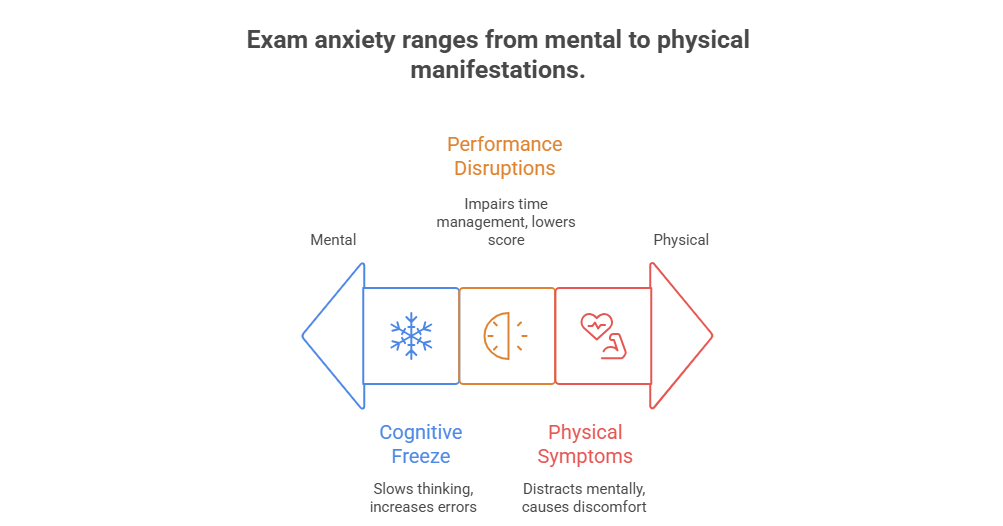
Cognitive Impairment During Test Situations
When stress chemicals spike, working memory collapses. Clinical professionals accustomed to structured SOPs suddenly freeze in dynamic, timed settings. This isn’t about intelligence — it’s neurological.
What it looks like:
Struggling to recall familiar concepts mid-question
Misreading question stems despite knowing the material
Looping over one answer for too long while ignoring pacing
Why it happens:
Stress overloads the prefrontal cortex, delaying response time
Fight-or-flight response prioritizes safety over recall logic
Pressure to “get it right” disables test fluidity
Clinical researchers often pride themselves on control. Exams remove that control — and that loss of structure is what scrambles their cognition, not the content itself.
Somatic and Performance-Based Symptoms
Exam anxiety is physical. Many candidates report:
Dry mouth, racing heart, shallow breathing
Sweaty palms, lightheadedness, muscle tightness
A need to reread questions multiple times due to fog
But in clinical research professionals, these symptoms also lead to performance spirals:
Obsessively double-checking answers
Rushing through questions out of panic
Freezing after one difficult section, even when others are easier
The body’s stress response creates a loop: physical tension → mental distraction → mistakes → more tension. If you don’t interrupt it early, it snowballs.
Recognizing these patterns — and not just labeling them as "nerves" — is the first step toward dismantling them.
Understanding the Root Causes of Exam Stress
Clinical researchers face exam anxiety not because they’re unprepared, but because their environment conditions them to equate testing with failure, scrutiny, or risk. Understanding the root causes of this anxiety reveals why traditional study methods don’t help — and why strategic psychological shifts are required instead.
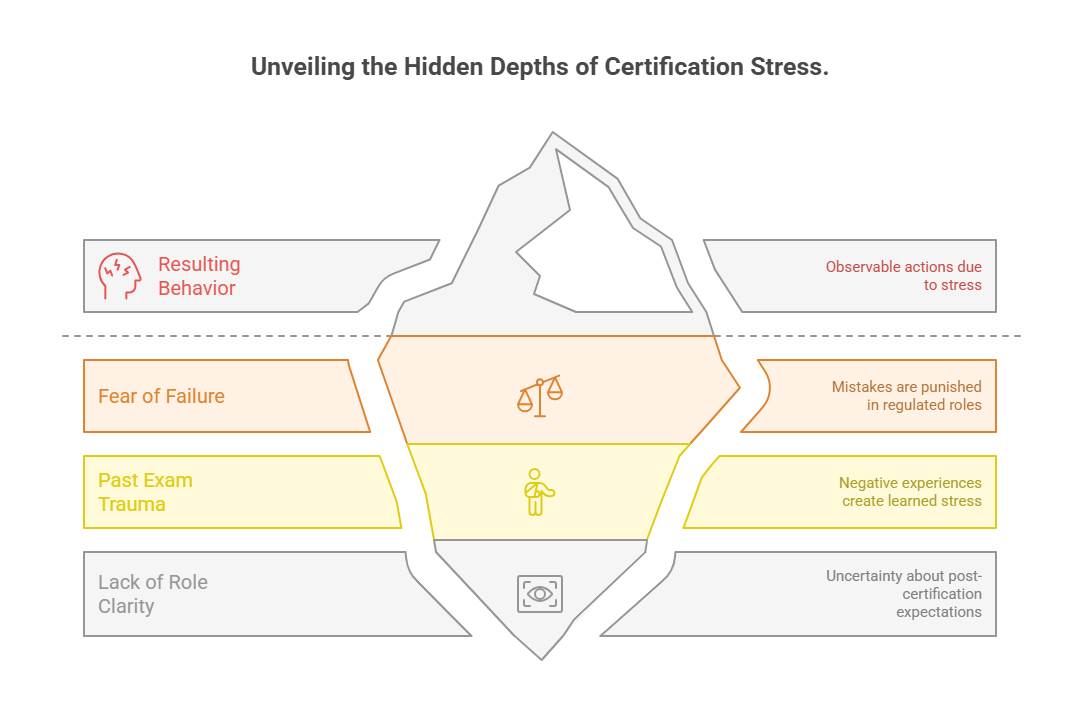
Fear of Failure in Regulated Fields
In clinical research, mistakes aren’t just frowned upon — they can lead to compliance violations, audits, or patient safety risks. This culture trains professionals to:
Avoid risk-taking
Overvalue perfection
Equate any slip with systemic failure
When this mindset enters an exam, even one misread question can trigger disproportionate panic. The candidate thinks: “If I missed this, what else did I miss?” — leading to doubt-driven performance paralysis.
Certifications like the Clinical Research Certification by CCRPS come with the added weight of career impact. That perceived finality creates cognitive rigidity, which ruins pacing and adaptability mid-exam. The solution isn’t to “try harder” — it’s to rewire how you perceive errors during the test.
Past Testing Experiences
Many professionals carry emotional baggage from past failures. If you’ve failed a certification or high-stakes test before, your brain remembers — and recreates the stress pattern in advance, even if you're better prepared this time.
Common effects:
Pre-test insomnia
Hyper-vigilance to “trick” questions
Second-guessing correct answers due to past overconfidence
This learned trauma reduces self-trust. You may know the material, but your belief in your ability to access it on command is fragile. Every past testing misstep becomes a present-day threat.
To reset, you need exposure therapy — low-stakes, high-frequency testing simulations that deprogram the trauma loop.
Lack of Role Clarity During Prep
Many candidates don’t know what role they're stepping into post-certification — and that ambiguity fuels anxiety. You’re not just preparing for an exam; you’re crossing into a new identity.
Symptoms of role confusion:
Studying broadly instead of tactically
Measuring readiness based on score volume, not scenario fluency
Feeling like an impostor, even when your prep is solid
When you don’t have role alignment, you can’t calibrate what to ignore. And that opens the floodgates to overstudy, panic, and self-sabotage.
Before you optimize your study — you must define your clinical identity.
Proven Pre-Exam Anxiety Management Tactics
You don’t fix exam anxiety by trying to "relax" or "calm down." You fix it by training your nervous system to operate under pressure without short-circuiting. For clinical researchers preparing for the Clinical Research Certification by CCRPS, pre-exam tactics must be tactical — not vague affirmations or passive meditation apps.
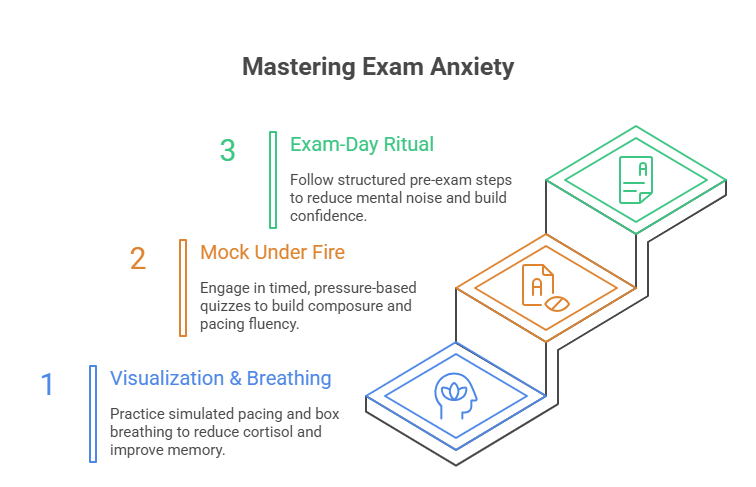
Visualization and Breathing Techniques
These aren’t soft skills — they’re biochemical rewiring tools. Used correctly, they lower cortisol, stabilize focus, and simulate control under chaos.
How to apply them:
Visualize the exam room with specificity: screen interface, timer, question format, review flow
Preload confidence scripts: mentally rehearse reading a hard question, breathing, and confidently selecting the best-fit answer
Use box breathing: inhale 4 seconds → hold 4 → exhale 4 → hold 4. Repeat for 2–3 minutes pre-exam
Benefits:
Regulates heart rate variability, which sharpens cognitive access
Interrupts stress hormone loops that cloud decision-making
Builds mental muscle memory for recovery mid-exam
Visualization isn’t about optimism. It’s scenario rehearsal, and it changes how your brain processes live stress.
“Mock Under Fire” Simulation
Most test anxiety isn’t from content — it’s from uncertainty about how you’ll respond under timed pressure. So build that pressure into your prep.
Here’s how:
Take 15–20 timed questions with a visible countdown, strict silence, and no pausing
After each session, journal how you felt during difficult sections — and how you responded
Gradually increase length to full-length mocks under test conditions
What this trains:
Time pacing discipline
Emotional regulation under false-alarm panic
Adaptation to mental dips without spiraling
Simulation creates stress familiarity. When your body’s been through the chaos, it stops reacting like it’s new.
Exam-Day Ritual Design
Certainty reduces anxiety. Build a repeatable, hour-by-hour plan for test day:
Wake-up time
Review window (no more than 30 minutes)
Nutrition (low-glycemic, no excess caffeine)
Arrival or login protocol
Final breathing + visualization round
This ritual creates cognitive predictability, which counteracts the brain’s fear of randomness. Candidates who follow rituals report 30–40% less perceived anxiety, not because the test changed — but because their internal system felt pre-programmed.
Long-Term Confidence Building
Most candidates treat anxiety like a short-term spike. But exam fear — especially in regulated fields — is often a chronic result of career conditioning. To break free, you don’t just need test tricks. You need a confidence engine that runs before, during, and after the exam. That means mindset reengineering.
Establishing a Mastery-Based Learning Mindset
If your prep is driven by "Will I pass?" — you’re building anxiety by design. The better approach is mastery-based learning: focusing on fluency, not just outcomes.
How to shift:
Measure success by how well you can teach or apply concepts, not by quiz scores
Focus your review on high-yield, role-aligned content — not the desire to cover "everything"
Set depth goals, not volume goals. Ask: “Can I answer this question under pressure and in context?”
Why it works:
It rewires your brain to focus on internal benchmarks, not pass/fail outcomes
Mastery builds internal certainty, which reduces reactionary stress under fire
It aligns you with how professionals grow — through iteration, not perfection
This mindset doesn’t just help you pass. It prepares you for post-certification success.
Reframing Failure as Feedback
Anxiety thrives where failure feels fatal. But in clinical research, even regulatory bodies see deviation as feedback. Your prep needs that same flexibility.
Here’s how to implement it:
After every mock or quiz, do a “failure report”: What triggered hesitation? What caused second-guessing?
Track patterns — are you repeatedly missing compliance nuance, terminology traps, or misreading stems?
Shift from “I missed this” to “My process missed this — now I adjust it.”
The key? Treat every error as a diagnostic insight, not a judgment. Candidates who reframe failure this way experience fewer pre-test spikes and stronger post-test recovery — even if the real exam includes curveballs.
In regulated roles, resilience is more valuable than raw score. Train like it.
| Strategy | What It Does | Why It Reduces Anxiety |
|---|---|---|
| Mastery-Based Learning | Focuses on depth, not speed or volume | Replaces outcome fear with internal certainty |
| Failure Reframing | Views errors as system feedback, not personal flaw | Prevents panic spiral after missed questions |
How Scheduling Impacts Mental Clarity
Anxiety often masquerades as a psychological problem when it’s really a physiological failure of scheduling. For clinical research professionals preparing for the Clinical Research Certification by CCRPS, mental clarity doesn’t come from last-minute review — it comes from the way you structure the days leading up to the test. Poor planning distorts memory, reduces focus, and compounds anxiety. Strategic scheduling, on the other hand, rewires how your brain shows up on exam day.
Sleep Cycles Before Exam Day
Sleep is not recovery — it’s active neural calibration. The two nights before your exam are more important than the exam day itself.
Here’s what happens with proper sleep:
Your brain consolidates short-term learning into long-term retrieval networks
Memory indexing improves, allowing faster recall
Emotional reactivity declines, improving decision-making under pressure
Best practices:
Go to bed and wake up at the same time for 3–4 days pre-exam
No screens 1 hour before sleep
Avoid sleep compensation — do not try to “catch up” the night before
Most candidates don’t fail because they forgot facts. They fail because exhaustion disables cognitive retrieval. You can’t out-study poor sleep.
Avoiding “Burnout Crunching” the Night Before
Cramming doesn’t build readiness — it destroys it. The night before your certification exam should be a cool-down cycle, not a study sprint.
Why burnout crunching fails:
It floods your system with cortisol and adrenaline
It prevents restful sleep, creating mental noise the next day
It tricks your brain into thinking “I’m not ready unless I’m reviewing now”
Instead, reframe the night before as your pre-performance ritual:
Light review of key anchors only (compliance triggers, trial design flow)
Breathing exercise
No new information
Mental rehearsal of exam pacing
This isn’t laziness — it’s mental tapering, just like elite performers use before high-stakes execution. You don’t walk into a clinical trial after a 12-hour study binge — treat your exam the same way.
| Schedule Factor | Impact on Cognitive Performance | Correction Strategy |
|---|---|---|
| Sleep Cycles | Affects memory consolidation and focus | Stabilize 3–4 days before exam; avoid oversleeping |
| Last-Minute Cramming | Overloads working memory, increases anxiety | Light review only; introduce full pre-exam ritual |
How the CCRPS Clinical Research Certification Prepares You Confidently
Passing a clinical research exam is hard — but feeling unprepared during it is what triggers anxiety spirals. The Clinical Research Certification by CCRPS is one of the few programs designed not just to teach — but to train you for performance under pressure.
What makes this certification different?
Scenario-driven learning: The curriculum doesn’t focus on abstract theory. It mirrors real-world clinical decision-making — the kind of problem-solving you're expected to perform under regulatory oversight. You don’t just memorize — you learn to analyze, apply, and justify.
Compliance-first framing: Anxiety often stems from vague understanding of what’s “safe” to do or say. This program embeds regulatory nuance into every module, so you’re never caught off guard by tricky phrasing or gray-area scenarios on the test.
Structured mastery flow: Rather than dumping a library of content, CCRPS uses step-wise progression. You start with foundations, build up to trial design, data interpretation, and protocol execution — each with built-in knowledge checks that reduce the guesswork around readiness.
Self-paced with strategic checkpoints: Candidates can schedule study windows around their own work/life rhythms. That flexibility reduces time-based anxiety — while still keeping accountability through module gating and scenario review.
What does this mean for your confidence?
You go into the exam knowing exactly what question structures to expect
You’ve been repeatedly exposed to compliance-heavy decision branches that build judgment
Your prep includes realistic pacing drills, not just content bingeing
You’re tested on what you’ll actually do in the role — not on trivia
More importantly, CCRPS doesn’t treat the exam as the end goal. The entire program trains you to operate fluently in your future role. And that’s the fastest path to confidence — knowing your prep isn’t just helping you pass, but preparing you to perform after you do.
This alignment between curriculum and reality eliminates the biggest anxiety driver of all: uncertainty.
Frequently Asked Questions
-
The most effective way is to build a pre-exam ritual that’s standardized, calming, and brain-friendly. This includes waking up at a fixed time, a short anchor review (not full notes), hydration, light movement, and box breathing before login. Avoid caffeine overload or last-minute cramming — both spike cortisol. Use visualization techniques in the final hour: imagine yourself calmly reading, flagging, and pacing. Your brain doesn't need motivation on test day — it needs predictability and familiarity. Run at 85% mental output, not 100%. This keeps your system alert but stable. Rehearse this ritual 2–3 times with practice tests so it becomes second nature under stress.
-
Blanking out is a neurological response to stress, not a knowledge failure. During exams, if your anxiety spikes, working memory becomes inaccessible — especially if you're used to precision-based roles like clinical research. You’re not forgetting — your brain is prioritizing survival over recall. Combat this by training under simulation: use 20–40 minute timed question blocks with no pauses, followed by recovery journaling. Build recovery pathways like re-reading calmly, skipping when frozen, and looping back without panic. With repetition, your mind learns that the test environment isn’t a threat — and performance returns. The fix isn’t studying harder — it’s stress adaptation.
-
Box breathing is clinically proven to calm nerves in high-stakes environments. Here’s how it works:
Inhale for 4 seconds
Hold for 4 seconds
Exhale for 4 seconds
Hold for 4 seconds
Repeat for 2–3 minutes. This slows your heart rate, stabilizes your vagus nerve, and restores oxygen to the prefrontal cortex — your decision-making zone. Practice this during study sessions so your nervous system recognizes the pattern on exam day. Pair it with a mental cue like “slow is smooth.” It’s not about relaxing — it’s about recovering your cognitive access under tension. Most high-performing candidates use this at least once during a live exam window.
-
Yes — previous failures often create anticipatory anxiety loops. Even if you're better prepared, your brain associates the upcoming exam with past shame, disappointment, or unpredictability. This isn’t psychological weakness — it’s learned stress conditioning. The fix? Use exposure therapy through small, controlled test simulations. Each successful timed session sends a new message to your brain: “This is safe. I can handle it.” Don’t avoid the test environment — immerse in it often, but low-stakes. Track what improved and why. By reframing failure as diagnostic — not final — you rebuild trust in your system, which is key for long-term test resilience.
-
Last-minute panic is usually the result of poor tapering — the failure to downshift brain activity before the exam. If you study intensely the night before, your nervous system doesn’t transition from input to execution mode. This leads to mental fog, fatigue, and reactive thinking during the test. You’ve overloaded your cognitive circuit board. The fix is to create a cool-down window the night before: light review only, no new material, and a hard stop at least 90 minutes before bed. This signals the brain to consolidate what it knows — not scramble for more. Strategic calm equals exam-day clarity.
-
Yes — clinical research professionals are more prone to performance anxiety because their career environments normalize high scrutiny, perfection, and low error tolerance. These traits are excellent in the workplace but devastating under exam conditions, where you must operate with partial information and quick decisions. Many candidates from regulated industries experience false alarms during testing: mistaking uncertainty for danger. What helps is shifting into execution mode — treating the exam like a protocol run, not a career referendum. Use mock testing under time constraints and design mental scripts for question pacing, flagging, and recovery. It’s not emotional — it’s operational.
-
The CCRPS Clinical Research Certification reduces anxiety through its performance-aligned structure. It’s not built for rote learning — it’s built to train your application fluency under pressure. Scenario-driven modules expose you to the exact formats and phrasing styles you'll encounter on the exam, so you’re rarely surprised. Built-in checkpoints assess mastery, not just completion. This gives you a clear signal: “I’m ready” — not “I hope.” The certification also integrates compliance-heavy logic throughout, eliminating the second-guessing that causes mid-exam spiral. Most importantly, its role-relevant content reinforces confidence in your identity as a future clinical researcher — which rewires test psychology.
Our Verdict
Overcoming exam anxiety as a clinical researcher isn’t about being “brave” or “trying harder.” It’s about rewiring your preparation, your mindset, and your test-day system. The pressure you feel is real — because your career rewards precision, not speed. But exams, especially for credentials like the Clinical Research Certification by CCRPS, reward a very different skill: resilient clarity under timed decision-making.
You can’t eliminate stress — but you can control its impact. With simulation training, structured recovery, and identity-aligned study practices, anxiety becomes background noise, not a barrier. And when your brain trusts your system, performance becomes automatic.
If you’ve made it through this guide, you’re not just preparing to pass — you’re building the mental OS of a clinical researcher who leads under pressure.
