
The ICH E6(R3) revision has changed what meaningful Good Clinical Practice knowledge looks like. GCP exam candidates must understand risk-proportionate oversight, quality by design, data governance, and clear accountability across clinical trials. Memorizing older E6(R2) terminology can leave you vulnerable to scenario questions involving electronic consent, decentralized activities, critical-to-quality factors, and sponsor oversight. This guide breaks down the updated principles, maps high-value examination scenarios to the correct requirements, and provides a practical study system for applying E6(R3) confidently to real clinical research decisions.

1. Understand the ICH E6(R3) Structure and the 11 Principles That Drive Exam Questions
The revised International Council for Harmonisation Good Clinical Practice guideline was finalized at ICH Step 4 on January 6, 2025. The FDA issued its final E6(R3) guidance in September 2025, and the European Union's Principles and Annex 1 became effective on July 23, 2025.
Its structure separates overarching ethical and scientific principles from operational implementation guidance. That distinction matters because a GCP exam may test the underlying obligation through a scenario rather than ask you to recall a heading.
Use the GCP certification preparation framework, ICH E6(R3) career competency guide, and clinical research ethics resources to connect the framework with actual research responsibilities.
Learn the three structural components first
Principles: Eleven overarching requirements covering participant protection, consent, ethics review, scientific quality, personnel qualifications, quality by design, proportionality, protocols, reliable results, accountability, and investigational products.
Annex 1: Practical provisions covering IRB/IEC responsibilities, investigators, sponsors, data governance, and supporting appendices. Its contents provide the operational detail behind questions on investigator oversight, clinical trial monitoring, safety reporting, and clinical data integrity.
Annex 2: Additional considerations for trials incorporating decentralized or pragmatic elements and real-world data sources. ICH adopted Annex 2 at Step 4 in June 2026. The EU has scheduled its effectiveness for January 15, 2027, while the FDA's separately published Annex 2 guidance remains labeled draft. Verify your exam provider's specified version and jurisdiction before studying detailed implementation requirements.
Memorize the 11 principles by their decision purpose
The following summaries are study aids rather than quotations from the guideline.
1. Ethical conduct and participant protection: Participant rights, safety, and well-being take precedence over scientific and societal interests. Apply this through patient safety principles.
2. Informed consent: Participation must be voluntary and based on a meaningful consent process. Study the investigator's consent responsibilities.
3. Independent ethics review: Trials require appropriate IRB/IEC review and must follow an approved protocol, subject to applicable exceptions and regulations. Connect this with research compliance requirements.
4. Scientific soundness: Study design must reflect adequate and current scientific knowledge. This influences investigator-initiated trial planning.
5. Qualified personnel: People performing trial activities require appropriate education, training, and experience. Review research staff training expectations.
6. Quality by design: Critical-to-quality factors should be identified prospectively. Apply risk-based clinical trial quality management.
7. Proportionality: Trial processes should reflect participant risks and the importance of the data collected. This informs on-site and remote monitoring strategies.
8. Operationally feasible protocol: Protocols must be scientifically sound, clear, and practical to execute. Review protocol adherence principles.
9. Reliable results: Data systems, records, and trial processes must support trustworthy conclusions. Study data integrity responsibilities.
10. Clear responsibilities: Tasks may be delegated or transferred with appropriate documentation and oversight, while the sponsor or investigator retains overall responsibility for their respective activities. Review clinical trial leadership.
11. Investigational product control: Products require appropriate manufacture, handling, accountability, storage, and use. Connect this with clinical trial site operations oversight.
Understand the biggest examination trap in E6(R3)
Many candidates interpret risk-based as permission to reduce oversight indiscriminately. The guideline requires proportionate decisions informed by what matters to participant protection and reliable results.
For example, a monitoring strategy may reduce routine verification of low-risk information while maintaining stronger controls over informed consent, eligibility, critical safety data, and primary endpoints.
The appropriate approach depends on the trial's risks, the criticality of the data, and justified oversight measures. Study these distinctions through clinical monitoring techniques, clinical trial quality strategies, and protocol compliance responsibilities.
| ICH E6(R3) GCP Exam: 30-Scenario Decision Matrix | ||||
|---|---|---|---|---|
| Exam Trigger | Relevant Requirement | Correct Decision | Common Mistake | Memory Cue |
| 1. Participant protection | Principle 1 | Act promptly on emerging participant safety risks. | Prioritizing recruitment over participant protection. | Protection first |
| 2. Informed consent | Principle 2; Annex 1 §2.8 | Verify voluntary, meaningful consent and required documentation before participation. | Assuming a signature alone proves valid consent. | Process before signature |
| 3. Ethics approval | Principle 3; Annex 1 §1 | Obtain necessary IRB/IEC review and approval before applicable trial procedures. | Substituting sponsor permission for independent review. | Independent review |
| 4. Scientific validity | Principle 4 | Assess whether emerging scientific evidence affects trial design or continuation. | Ignoring important new evidence after initial approval. | Sound science |
| 5. Personnel qualifications | Principle 5 | Confirm education, training, experience, and competency. | Assigning trial duties based solely on availability. | Qualified personnel |
| 6. Critical-to-quality factors | Principle 6 | Identify factors essential to participant protection and reliable results. | Treating all operational activities as equally critical. | Quality by design |
| 7. Risk-proportionate monitoring | Principle 7; Annex 1 §3.11 | Choose monitoring intensity according to criticality and risk. | Applying identical verification to every site and data field. | Proportionality |
| 8. Protocol feasibility | Principle 8 | Ensure procedures are clear, scientifically justified, and operationally feasible. | Allowing sites to improvise inconsistent procedures. | Practical protocol |
| 9. Reliable results | Principle 9 | Protect critical data and address factors threatening result reliability. | Focusing on cosmetic data completeness over critical missingness. | Reliable conclusions |
| 10. Transferred sponsor duties | Principle 10; Annex 1 §3.3 | Document assigned activities and oversee service providers. | Assuming outsourcing removes sponsor accountability. | Oversight remains |
| 11. Investigational product | Principle 11 | Ensure suitable storage, handling, dispensing, and accountability. | Dispensing product following an unevaluated temperature excursion. | Product integrity |
| 12. Electronic informed consent | Annex 1 §2.8 | Assess comprehension, suitability, privacy, and documentation. | Assuming electronic signatures eliminate consent obligations. | Meaningful consent |
| 13. Difficult consent language | Principle 2 | Provide understandable information and allow questions. | Using complex legal language without supporting understanding. | Clear communication |
| 14. Serious adverse event | Annex 1 §2.7.2 | Ensure timely assessment, notification, and required reporting. | Waiting until the next scheduled monitoring visit. | Timely escalation |
| 15. Emerging safety information | Principles 1 and 2 | Evaluate whether participants need new information and re-consent. | Assuming original consent covers every new risk. | Ongoing informed choice |
| 16. Repeated protocol deviations | Annex 1 §3.12 | Determine impact, investigate causes, and verify corrective actions. | Repeating training without identifying systemic causes. | Root cause first |
| 17. Missing audit-trail information | Annex 1 data governance | Investigate traceability and reliability of affected data. | Overwriting records to conceal inconsistencies. | Preserve history |
| 18. Electronic data correction | Annex 1 data governance | Maintain attributable, justified, traceable corrections. | Replacing original entries without change history. | Traceable corrections |
| 19. Computerized system validation | Annex 1 data governance | Apply validation proportionate to intended use and risk. | Using the same validation effort for every system. | Fitness for purpose |
| 20. Emergency unblinding | Annex 1 investigator and sponsor responsibilities | Use authorized procedures while protecting masking where appropriate. | Disclosing treatment allocation unnecessarily. | Controlled access |
| 21. Essential records | Appendix C | Maintain relevant and accessible evidence of trial conduct. | Assuming excessive paperwork automatically improves compliance. | Essential evidence |
| 22. Medical oversight | Principle 1; Annex 1 investigator responsibilities | Ensure qualified medical personnel handle clinical judgments. | Assigning medical decisions to unqualified staff. | Clinical authority |
| 23. Quality tolerance breach | Annex 1 §3.10 | Assess the signal and initiate proportionate corrective measures. | Ignoring significant thresholds as routine KPIs. | Investigate signals |
| 24. Monitoring backlog | Annex 1 §3.11 | Prioritize by criticality and unresolved risk. | Scheduling visits only by request date. | Risk-based priorities |
| 25. Database lock readiness | Annex 1 data governance | Verify data review, reconciliation, and required controls. | Locking incomplete datasets to meet a deadline. | Readiness first |
| 26. Inspection findings | Annex 1 monitoring and noncompliance | Preserve records, assess deficiencies, and verify remediation. | Reconstructing missing evidence inaccurately. | Integrity of evidence |
| 27. Decentralized trial activities | E6(R3) Principles; Annex 2 | Maintain participant protection, data quality, and appropriate oversight. | Assuming remote trial activities eliminate accountability. | Oversight follows work |
| 28. Real-world data sources | E6(R3) Principles; Annex 2 | Evaluate provenance, completeness, and fitness for intended use. | Assuming accessible data are inherently reliable. | Fit-for-purpose data |
| 29. Premature site activity | Principles 3, 5, and 10 | Confirm required approvals, responsibilities, and staff competency. | Starting regulated procedures to protect recruitment targets. | Authorization first |
| 30. Two plausible exam answers | Applicable E6(R3) principle and Annex 1 | Identify governing risk, accountable party, and required decision stage. | Selecting a valid action that belongs later in the process. | Risk → Owner → Action |
2. Master the E6(R3) Concepts That Replace Outdated GCP Exam Shortcuts
One of the most valuable ways to prepare is to identify where older, simplified training rules can lead to the wrong conclusion. E6(R3) retains essential GCP protections while giving greater emphasis to thoughtful implementation, trial quality, and proportionate controls.
Quality by design starts before the first participant enrolls
Quality by design (QbD) requires identifying critical-to-quality factors during trial planning. These are the factors fundamental to participant protection, the reliability and interpretability of results, and decisions based on those results.
Suppose a multicenter trial measures a primary outcome using patient-reported assessments. Critical factors may include the assessment schedule, participant comprehension, instrument suitability, missing-data risks, and consistency of collection.
A strong clinical trial quality strategy identifies these concerns early, while trial milestone planning ensures operational dependencies are realistic. Research protocol adherence then supports consistent execution.
Exam distinction: Quality by design prevents avoidable weaknesses through thoughtful design. Quality control detects problems during trial execution. Corrective and preventive action responds to identified problems and their causes.
A question asking what should happen during study development may favor prospective risk identification. A question involving repeated defects may require investigation and corrective action.
Risk-based monitoring requires justification
Monitoring methods should reflect participant risks, data importance, and trial characteristics. Oversight may involve centralized review, remote activities, on-site visits, or a combination.
For example, several sites reporting the same critical eligibility error may warrant targeted investigation and increased oversight. A small number of immaterial transcription discrepancies might be managed differently, depending on the trial's monitoring plan and risk assessment.
Use on-site and remote GCP monitoring guidance, quality management techniques, site operations oversight, and data integrity responsibilities to understand how oversight intensity follows the risk.
Exam distinction: A justified reduction in low-value verification may be appropriate. Eliminating essential monitoring controls without assessing the risk is not.
Sponsor oversight continues after activities are transferred
E6(R3) explicitly emphasizes documented responsibility and oversight. Sponsors can transfer activities to service providers, and investigators can delegate appropriate tasks, while each retains overall responsibility for their respective activities.
Imagine a CRO manages monitoring visits and a separate vendor handles electronic data capture. The sponsor remains responsible for overseeing transferred sponsor activities and ensuring appropriate quality and data integrity.
Similarly, an investigator who delegates trial duties must maintain appropriate oversight of the delegated work.
Study clinical research leadership, investigator GCP responsibilities, research staff training, and clinical site oversight.
Exam distinction: Delegation concerns who performs the work. Accountability concerns who remains responsible for its appropriate conduct and oversight.
Data governance covers the entire data lifecycle
Annex 1 includes a dedicated section on data governance for investigators and sponsors. Candidates should understand capture, relevant metadata, audit trails, data review, corrections, transfers, finalization, retention, access, and destruction.
For computerized systems, know the role of fitness for purpose, risk-based validation, access management, security, training, system failures, and data traceability.
Consider an electronic data capture system that permits a user to overwrite an entered assessment without preserving an attributable history. Such a deficiency creates a data integrity concern.
A defensible response includes investigating the affected records, preserving available evidence, assessing system controls, and implementing appropriate remediation.
Learn these applications through clinical trial data integrity guidance, data review techniques, GCP monitoring processes, and clinical research quality management.
Exam distinction: System validation should be appropriate to intended use and risk. Audit trails should support appropriate reconstruction and review of relevant data changes.
3. Practice High-Difficulty ICH E6(R3) Questions With Detailed Decision Explanations
The strongest way to test E6(R3) knowledge is to answer questions where several actions appear reasonable. The correct response depends on the exact requirement, the level of risk, and the order in which decisions must occur.
Use these worked examples alongside clinical research compliance resources, GCP training expectations, investigator obligations, and clinical trial quality principles.
Scenario 1: A sponsor wants to reduce monitoring costs
A sponsor identifies a large number of low-impact administrative discrepancies across trial sites. There are no emerging critical safety or primary endpoint concerns. Management proposes reducing some routine verification activities.
What is the most appropriate action?
A. Maintain every existing verification activity because GCP requires uniform oversight.
B. Eliminate all on-site monitoring because low-risk discrepancies have been identified.
C. Reassess critical-to-quality factors and implement justified, risk-proportionate monitoring controls.
D. Delegate monitoring entirely to the CRO and eliminate sponsor review.
Correct answer: C.
E6(R3) supports risk-proportionate oversight. The sponsor should assess the importance of the affected data and processes, evaluate the potential consequences of reduced verification, and document an appropriate monitoring approach.
Option A assumes uniform oversight is always necessary. Option B removes monitoring without adequate risk assessment. Option D overlooks continuing sponsor responsibility for transferred activities.
Review risk-based monitoring, sponsor oversight principles, clinical trial quality management, and site monitoring responsibilities.
Exam memory rule: Justification and criticality determine oversight intensity.
Scenario 2: An electronic consent system records a signature but creates a comprehension concern
A site uses an electronic informed-consent system. A participant signs successfully but subsequently demonstrates a major misunderstanding of a trial risk. The site argues that a timestamped signature proves consent was obtained correctly.
What is the best response?
A. Accept the electronic signature as sufficient evidence.
B. Evaluate the consent process, address the participant's understanding and protection, and investigate the deficiency.
C. Replace electronic consent with paper forms across every trial.
D. Ask the participant to sign again without discussing the misunderstood information.
Correct answer: B.
E6(R3) emphasizes informed consent as an ongoing communication process supporting voluntary, informed participation. Appropriate documentation matters, but meaningful comprehension and participant protection remain essential.
The site should assess what occurred, ensure an appropriate explanation, evaluate participant impact, and follow required reporting or corrective procedures.
The correct reasoning comes from ethical GCP conduct, investigator responsibilities, patient education resources, and research protocol compliance.
Exam memory rule: Consent validity involves the process, participant understanding, and required documentation.
Scenario 3: A CRO fails to escalate critical protocol deviations
A sponsor has transferred monitoring activities to a CRO. An audit identifies several important protocol deviations that remained unresolved without appropriate sponsor notification.
The CRO states that monitoring was fully outsourced and that it alone is responsible.
What is the correct interpretation?
A. The sponsor has no responsibility once monitoring activities are transferred.
B. Only investigators can be responsible for oversight failures.
C. The CRO is responsible for its assigned activities, while the sponsor retains overall responsibility for oversight of transferred sponsor activities.
D. The sponsor can retroactively remove its responsibility by revising the contract.
Correct answer: C.
E6(R3) distinguishes performance of assigned activities from continuing accountability. The sponsor needs appropriate oversight mechanisms and should respond to deficiencies in transferred services.
The response may include reviewing contractual obligations, assessing affected participants and data, investigating the escalation breakdown, and implementing corrective measures.
Connect leadership and team management, GCP monitoring practices, quality remediation, and investigator accountability.
Exam memory rule: Activities may transfer. The sponsor's overall responsibility for transferred sponsor activities remains.
Scenario 4: A data correction removes the original value
During routine data review, a monitor discovers that an investigator-site employee replaced an incorrect electronic entry without preserving a visible change history.
The employee explains that the final value is accurate.
What should happen next?
A. Accept the entry because the corrected value is accurate.
B. Delete the entire participant record.
C. Evaluate data integrity impact, preserve available evidence, and investigate system and process controls.
D. Ask the employee to remember the original value and enter it in a separate comment.
Correct answer: C.
Data integrity includes attribution, traceability, appropriate metadata, and reliable reconstruction of relevant activities. An accurate final value cannot independently establish that the correction process met applicable requirements.
The investigation should evaluate audit-trail capabilities, access permissions, the scope of affected records, and necessary remediation.
Study clinical trial data integrity, monitoring verification, quality management systems, and trial data review.
Exam memory rule: Data accuracy and trustworthy data history are both important.
Scenario 5: A serious safety concern appears before a scheduled review meeting
A participant experiences a potentially serious adverse event. The investigator's team plans to discuss it during a routine meeting three days later. The project manager is concerned about interrupting recruitment.
What is the appropriate response?
A. Continue recruitment and wait for the meeting.
B. Promptly ensure participant care and appropriate assessment, escalation, and reporting under applicable requirements.
C. Wait until medical causality is conclusively established before taking any action.
D. Record the incident only in the next monitoring report.
Correct answer: B.
Participant protection and applicable safety obligations determine the response. Reporting requirements vary by event category, regulatory jurisdiction, protocol, and sponsor procedures. Candidates must distinguish reporting of adverse events from regulatory expedited reporting obligations.
Review adverse event reporting rules, medical monitoring responsibilities, data and safety assessments, and participant protection principles.
Exam memory rule: Immediate protective and reporting obligations take priority when triggered.
The method behind these five questions
For every scenario, identify the risk, accountable role, governing E6(R3) requirement, and correct decision stage.
Then explain why the other options are wrong. An alternative may represent a valid later action, assign responsibility incorrectly, or create an unacceptable compliance risk.
This approach is valuable for project manager examination scenarios, clinical ethics questions, regulatory compliance applications, and quality management decisions.
Choose one. Reveal your fastest targeted fix.
Submit
Local interactive self-assessment. Answers are not transmitted or stored.
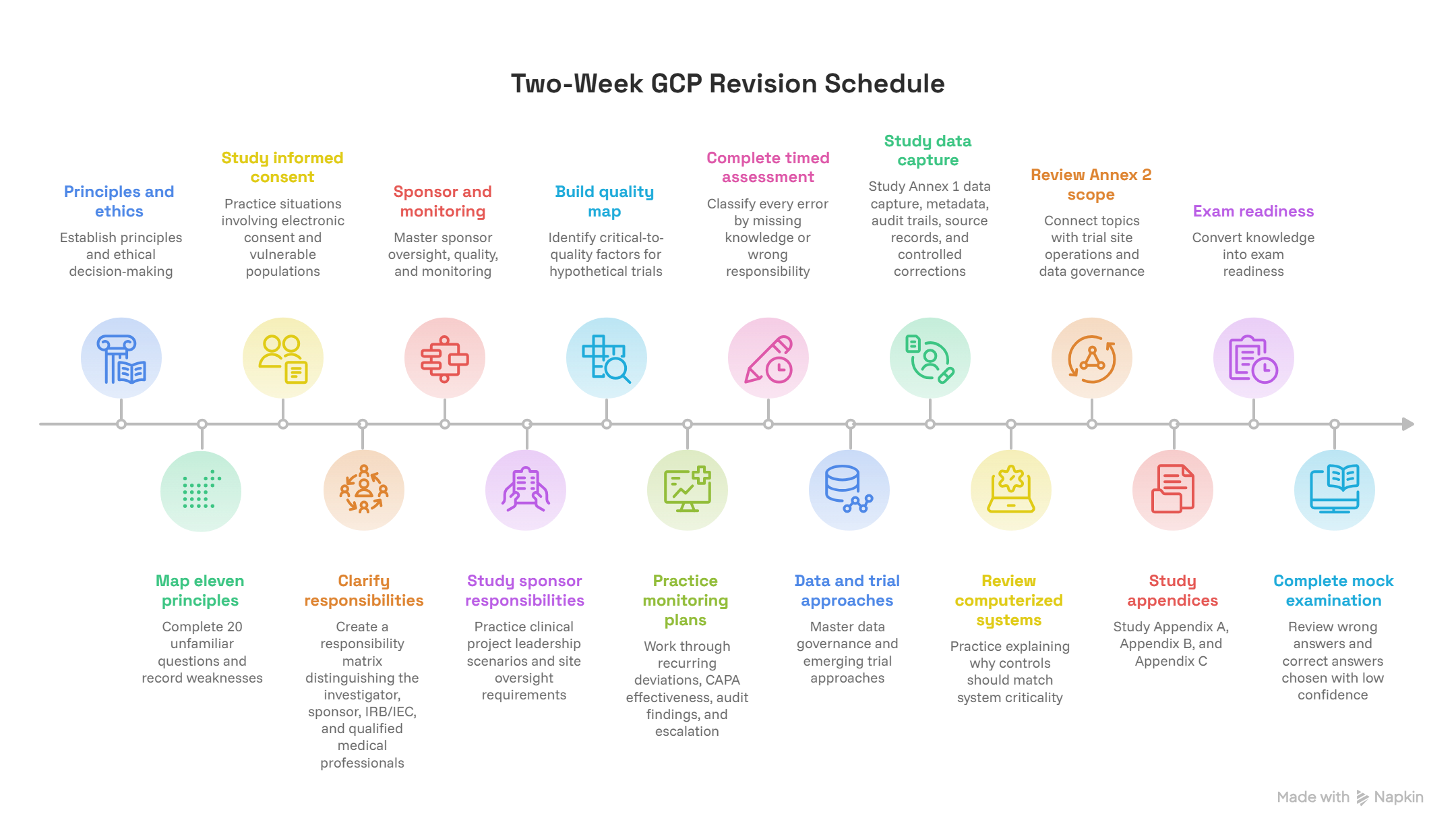
4. Follow a 14-Day ICH E6(R3) Study Plan Built Around Exam Performance
A two-week intensive revision schedule works best for candidates who have already completed foundational GCP training. Candidates encountering the material for the first time should allow additional preparation time.
Use the official exam blueprint to confirm the assessed content. Then combine a GCP certification preparation overview, ICH E6(R3) competency guidance, ethics and compliance resources, and GCP monitoring materials.
Days 1–3: Establish principles and ethical decision-making
Day 1: Map all eleven principles. Identify which ones govern participant protection, consent, trial quality, reliable results, and documented responsibility.
Complete 20 unfamiliar questions and record weaknesses. Use GCP investigator responsibilities, research ethics, and quality management to clarify incorrect responses.
Day 2: Study informed consent, IRB/IEC review, confidentiality, and participant withdrawal. Practice situations involving electronic consent, emerging safety information, legally acceptable representatives, and vulnerable populations.
Connect patient education, protocol adherence, investigator duties, and participant safety.
Day 3: Focus on ethics approval, protocol compliance, medical care, and investigational product management. Create a responsibility matrix distinguishing the investigator, sponsor, IRB/IEC, and qualified medical professionals.
Days 4–7: Master sponsor oversight, quality, and monitoring
Day 4: Study sponsor responsibilities, service providers, documented transfer of activities, and accountability. Practice clinical project leadership scenarios, site oversight requirements, and research coordination processes.
Day 5: Build a quality-by-design map. Identify critical-to-quality factors for hypothetical oncology, cardiovascular, or infectious disease trials. Define the risk, potential consequences, preventive control, monitoring indicator, and response threshold.
Use clinical trial quality management, monitoring techniques, trial data integrity, and protocol planning.
Day 6: Practice monitoring-plan scenarios, recurring deviations, CAPA effectiveness, audit findings, and escalation. Work through pharmacovigilance inspection techniques, GCP site monitoring, safety reporting requirements, and quality oversight.
Day 7: Complete a mixed timed assessment. Classify every error by missing knowledge, wrong responsibility, wrong decision sequence, missed risk, or question misinterpretation.
Days 8–11: Master data governance and emerging trial approaches
Day 8: Study Annex 1 data capture, metadata, audit trails, source records, and controlled corrections. Work through clinical data integrity, medical data review, and site monitoring verification.
Day 9: Focus on computerized systems, risk-based validation, access rights, security, data transfer, system failures, and data-set finalization. Practice explaining why controls should match system criticality.
Day 10: Review Annex 2's scope and the considerations relevant to decentralized, pragmatic, and real-world-data-based trial approaches, according to the syllabus applicable to your exam. Connect these topics with trial site operations, participant education, clinical trial compliance, and data governance.
Day 11: Study Appendix A on the Investigator's Brochure, Appendix B on the clinical trial protocol, and Appendix C on essential records. Use investigator trial management, protocol implementation, site oversight, and trial close-out for applied review.
Days 12–14: Convert knowledge into exam readiness
Day 12: Complete a full-length mock examination using the official timing and question format where a representative practice test is available. Review wrong answers and correct answers chosen with low confidence.
Day 13: Revisit your three weakest competencies. Retest using fresh clinical research GCP scenarios, regulatory knowledge, participant safety examples, and monitoring decisions.
Day 14: Review your eleven-principle map, accountability matrix, data-governance flow, and error log. Confirm examination logistics and preserve adequate rest.
Your goal is to answer unfamiliar questions by recognizing governing principles, responsible people, and defensible actions. That is more useful than recalling the same practice questions repeatedly.
5. Avoid E6(R3) Exam Traps and Build a Final-Review Decision Checklist
Most difficult GCP questions exploit the gap between recognizing a regulatory term and understanding its practical consequences.
Candidates who memorize outdated absolutes may struggle with E6(R3)'s emphasis on proportionality, technology, quality by design, and accountability. Use the E6(R3) skills guide, GCP credential expectations, research compliance resources, and clinical quality guidance to strengthen these distinctions.
Trap 1: Treating every trial process as equally critical
E6(R3) emphasizes focusing controls on factors that matter to participant protection and reliable conclusions. This requires understanding the significance of specific data and operational risks.
When reviewing monitoring requirements, data integrity, and site oversight, ask what could materially compromise the study and which control addresses that risk.
Trap 2: Confusing preventive quality management with corrective action
Quality by design identifies potential weaknesses while the trial is being designed. CAPA addresses identified problems and aims to prevent recurrence.
A protocol that creates unnecessary participant visits may require better prospective design. Repeated missed assessments during trial execution may require investigation of scheduling, workload, training, or process failures.
Combine quality management principles, trial logistics, protocol adherence, and site operations oversight to identify the right intervention.
Trap 3: Assuming electronic systems automatically satisfy GCP
Technology must be suitable for its intended purpose and supported by appropriate processes and controls.
An electronic consent platform must support a valid consent process. An electronic data capture platform must support reliable records, appropriate access, and traceability. A remote monitoring approach must provide adequate oversight.
Review clinical data integrity, patient education resources, remote GCP monitoring, and ethical trial requirements.
Trap 4: Misunderstanding the difference between regional implementation and ICH adoption
ICH Step 4 adoption establishes a harmonized guideline for regulatory regions to adopt. Regional authorities determine implementation within their own regulatory frameworks.
For examination purposes, distinguish these milestones:
January 6, 2025: ICH adopted the E6(R3) Principles and Annex 1 at Step 4.
July 23, 2025: Principles and Annex 1 became effective in the European Union.
September 2025: The FDA published final E6(R3) GCP guidance.
June 3, 2026: ICH adopted Annex 2 at Step 4.
January 15, 2027: Annex 2 is scheduled to become effective in the European Union.
The FDA's Annex 2 guidance page remains identified as draft as of November 2026. FDA guidance is also generally nonbinding, and applicable regulations continue to govern.
Understanding the difference helps you avoid assuming every region follows the same implementation timetable. Review ICH E6(R3) career developments, GCP certification recognition, and regulatory compliance guidance.
Trap 5: Selecting the right action at the wrong time
The wording first, next, most appropriate, or best preventive approach changes the expected response.
For a possible serious safety issue, immediate protective and reporting obligations may come first. For a recurring quality problem, investigating its cause may precede an effective long-term solution.
For trial data integrity problems, preserving evidence and evaluating the concern may precede system remediation. For investigator responsibilities, confirm who has authority before deciding what action they should take.
Before selecting any answer, ask yourself four questions: What is the governing risk? Who owns the decision? What must happen first? Which option protects participants and reliable results while meeting applicable requirements?
6. Frequently Asked Questions About the ICH E6(R3) GCP Exam
-
E6(R3) provides a revised structure and strengthens the emphasis on quality by design, proportionate risk management, flexible trial approaches, data governance, and clear accountability.
Candidates should especially understand critical-to-quality factors, appropriate monitoring methods, and computerized system controls.
Use ICH E6(R3) competency guidance, clinical trial quality management, risk-based monitoring techniques, and data integrity requirements to study how these principles affect operational decisions.
-
You should be able to identify all eleven principles and apply their requirements through realistic scenarios.
The most valuable technique is to connect each principle with a decision. For example, the participant protection principle governs safety priorities, while the accountability principle helps determine responsibility after delegation or transfer.
Practice using investigator responsibilities, ethical conduct, clinical research training, and trial quality management.
-
Quality by design involves identifying factors critical to trial quality prospectively and designing processes that protect them.
For example, a study may identify informed consent, critical safety assessments, and primary outcome collection as areas requiring particular controls.
Study clinical trial quality strategies, protocol adherence, clinical data integrity, and investigator oversight to understand how QbD becomes practical.
-
The guideline reinforces meaningful communication, voluntary participation, appropriate documentation, and the suitability of consent processes for participants and trial circumstances.
It also addresses technology-enabled consent and situations where emerging information may affect a participant's willingness to continue.
Candidates should study ethical conduct in GCP, investigator consent responsibilities, patient education tools, and regulatory compliance resources.
-
E6(R3) emphasizes monitoring approaches that are proportionate to trial risks and the importance of the information collected. The appropriate extent and methods of verification depend on the trial's characteristics and justified monitoring strategy.
Candidates should understand how risk assessment affects monitoring intensity, especially for critical safety data and primary endpoints.
Review GCP monitoring strategies, clinical trial quality oversight, clinical data integrity, and site management responsibilities.
-
Annex 1 provides operational guidance for applying the overarching GCP principles to interventional clinical trials, including investigators, sponsors, ethics committees, data governance, and essential records.
Annex 2 adds considerations relevant to certain non-traditional interventional trial elements, including decentralized and pragmatic approaches and the use of real-world data.
Check the version tested by your certification provider and the relevant jurisdiction's adoption status. Use ICH E6(R3) learning topics, regulatory compliance resources, and clinical data oversight guidance for preparation.
