
Preparing for an ICH-GCP certification exam in 14 days requires disciplined prioritization. Candidates often waste valuable study hours memorizing definitions while struggling with informed consent violations, safety reporting, investigator responsibilities, and risk-based oversight. This intensive schedule transforms GCP certification preparation into a structured daily process built around ICH E6(R3) expectations.
Each day combines targeted reading, active recall, realistic scenarios, and measurable progress checks. The goal is to develop the practical judgment required for ethical clinical research, protocol compliance, and confident examination performance.
1. How to Structure Your 14-Day ICH-GCP Exam Preparation
A two-week preparation schedule works best when study time follows the regulatory significance and complexity of each topic. Candidates should dedicate approximately 2.5–3 hours daily, creating 35–42 hours of focused preparation. Professionals balancing study with full-time clinical research responsibilities can divide this into shorter morning and evening sessions.
Start by identifying the actual examination requirements. A course-completion assessment, institution-specific GCP examination, and professional certification exam may test different material. Check the syllabus, permitted reference materials, examination duration, passing standard, and the guideline version assessed.
As of November 2026, ICH E6(R3) provides the current international framework for GCP preparation. Its Principles and Annex 1 address core clinical trial responsibilities. Annex 2 introduces considerations for decentralized, pragmatic, and real-world-data trial designs. Regulatory implementation varies across jurisdictions, and the consolidated guideline is scheduled to take effect in the European Union on January 15, 2027.
A candidate studying current GCP certification requirements should therefore verify the specific examination blueprint rather than assume every provider assesses Annex 2.
Use three activities in every study session:
Learn: Read the relevant guideline material and connect it to practical clinical research responsibilities.
Apply: Work through a situation involving participant protection, documentation, monitoring, or safety decisions.
Retrieve: Close the reference material and explain the correct action from memory.
Reserve approximately 40% of daily study time for reading and concept development, 40% for scenario practice, and 20% for reviewing errors and testing recall. Adjust these proportions as your understanding improves.
Before Day 1, complete a 20-question diagnostic assessment. Record correct answers, incorrect answers, and guesses separately. This baseline helps distinguish weaknesses in GCP monitoring, adverse event reporting, and clinical trial quality management.
Create a study notebook with four fields: topic, rule or principle, realistic example, and the mistake you are most likely to make. This turns passive reading into an increasingly useful collection of exam-specific decisions.
| ICH-GCP Exam: 14-Day Intensive Study Matrix (28 Sessions) | ||||
|---|---|---|---|---|
| Session | Core Study Topic | Practical Study Task | Evidence of Mastery | Time |
| Day 1 AM | ICH E6(R3) framework | Map the Principles, Annex 1, and applicable Annex 2 topics. | Explain the guideline structure and scope. | 75 min |
| Day 1 PM | Diagnostic and exam blueprint | Complete 20 baseline questions and classify missed concepts. | Document three priority weaknesses. | 75 min |
| Day 2 AM | Participant rights and ethics | Study participant protection, scientific validity, and ethical oversight. | Explain how safety concerns change decisions. | 80 min |
| Day 2 PM | Informed consent | Solve consent timing, comprehension, reconsent, and vulnerability cases. | Answer eight consent scenarios. | 70 min |
| Day 3 AM | Protocol and investigator's brochure | Connect eligibility, visit procedures, risk information, and study requirements. | Identify protocol-critical requirements. | 75 min |
| Day 3 PM | IRB/IEC oversight | Practice approval, amendment, continuing review, and reporting decisions. | Distinguish approval from operational readiness. | 75 min |
| Day 4 AM | Investigator responsibilities | Study qualifications, delegation, supervision, and participant care. | Build an investigator responsibility map. | 80 min |
| Day 4 PM | Site readiness and compliance | Review activation gates, training, investigational product, and deviations. | Resolve six site-compliance cases. | 70 min |
| Day 5 AM | Sponsor responsibilities | Study oversight, responsibilities, trial management, and service providers. | Explain sponsor accountability after outsourcing. | 75 min |
| Day 5 PM | Vendor and CRO oversight | Practice delegated-task, vendor-failure, and escalation scenarios. | Identify decision owners and corrective evidence. | 75 min |
| Day 6 AM | Safety terminology | Separate AE, SAE, severity, seriousness, causality, and expectedness. | Classify 12 example events. | 80 min |
| Day 6 PM | Safety reporting pathways | Practice investigator notification and sponsor safety escalation. | Select appropriate reporting actions. | 70 min |
| Day 7 AM | Monitoring and oversight | Compare on-site, remote, and centralized monitoring methods. | Choose monitoring approaches by risk. | 75 min |
| Day 7 PM | First-week assessment | Complete 35 mixed questions under timed conditions. | Classify every incorrect answer. | 75 min |
| Day 8 AM | Source data and traceability | Practice contemporaneous records, corrections, and attributable data. | Identify unacceptable data changes. | 75 min |
| Day 8 PM | Computerized systems | Study access control, audit trails, validation, and data transfers. | Resolve six electronic-data cases. | 75 min |
| Day 9 AM | Essential records | Map records needed to reconstruct trial conduct and decisions. | Identify missing inspection evidence. | 75 min |
| Day 9 PM | Deviations and documentation | Practice deviation classification, root-cause analysis, and CAPA. | Write two effective corrective plans. | 75 min |
| Day 10 AM | Quality by design | Identify critical-to-quality factors in a hypothetical trial. | Rank risks by participant and data impact. | 80 min |
| Day 10 PM | Risk-proportionate controls | Build a risk assessment with prevention and detection measures. | Justify controls for five study risks. | 70 min |
| Day 11 AM | Modern trial designs | Review decentralized, pragmatic, and real-world-data considerations as applicable. | Explain oversight of remote trial activities. | 75 min |
| Day 11 PM | Complex ethics scenarios | Practice remote consent, digital records, and safety escalation. | Defend eight decisions with evidence. | 75 min |
| Day 12 AM | Mixed scenario examination | Complete 40 unseen questions across the full syllabus. | Calculate accuracy by competency area. | 70 min |
| Day 12 PM | Targeted error correction | Explain all wrong and guessed answers without looking at notes. | Resolve the five most serious weaknesses. | 80 min |
| Day 13 AM | Full practice examination | Complete 60 unseen questions under a timed simulation. | Measure performance and confidence. | 100 min |
| Day 13 PM | High-risk weakness review | Revisit consent, safety, authority, and data-integrity mistakes. | Explain the correct first action in each case. | 60 min |
| Day 14 AM | Final rapid assessment | Complete 25 unfamiliar questions and review core distinctions. | Demonstrate consistent decision accuracy. | 75 min |
| Day 14 PM | Exam readiness and logistics | Review remaining weaknesses, access requirements, and examination instructions. | Finish with a verified readiness checklist. | 45 min |
2. Days 1–4: Master GCP Principles, Ethics, Informed Consent, and Investigator Responsibilities
The first four days establish the foundation for nearly every later scenario. Prioritize the relationship between participant rights, scientific validity, regulatory approvals, and accountability.
Day 1: Understand the structure and purpose of ICH E6(R3).
Study the overarching principles and identify why GCP requires both participant protection and reliable trial results. Examine the relationship between the protocol, investigator's brochure, sponsor oversight, ethics review, and essential documentation.
Create a one-page concept map connecting clinical research ethics, trial quality management, clinical data integrity, and GCP monitoring responsibilities.
Then complete the baseline assessment. Prioritize confidently incorrect answers because they expose misunderstood concepts that may persist through ordinary memorization.
Day 2: Make informed consent your strongest competency.
Study how consent is obtained, documented, updated, and maintained throughout trial participation. Pay particular attention to understandable information, voluntary participation, withdrawal rights, vulnerable participants, and circumstances requiring revised consent.
Practice this scenario:
A participant signs an outdated consent form after an important new risk has been added to the approved version. The participant has already undergone a study procedure.
The best response requires assessing participant impact, verifying the applicable approved consent version, involving the investigator, and following the required deviation and corrective-action process. Reconsent requirements must be determined from the circumstances and applicable approvals.
Connect this decision to ethical conduct and patient safety, investigator oversight, protocol adherence, and patient education resources.
Day 3: Learn approval authority and protocol governance.
Distinguish the responsibilities of the investigator, sponsor, and institutional review board or independent ethics committee (IRB/IEC). Understand which protocol changes require approval before implementation and the applicable exceptions for eliminating immediate hazards to participants.
Study how the investigator's brochure supports clinical risk awareness, how protocol amendments affect site procedures, and why site operations oversight depends on reliable regulatory documentation.
A useful practice question is:
A sponsor approves a protocol amendment introducing additional blood collection. The site has completed training, but the applicable ethics approval is pending. Can the site implement the new procedure immediately?
Ordinarily, implementation must await the required approval. Distinguish internal sponsor authorization from applicable ethics and regulatory permission.
Review clinical protocol adherence, research assistant training requirements, and investigator responsibilities under GCP.
Day 4: Understand investigator accountability and delegation.
Study investigator qualifications, adequate resources, supervision of delegated activities, medical care, investigational product accountability, and accurate records.
A delegation log can document assigned tasks, but evidence of effective supervision remains important. Practice identifying the difference between delegating an activity and retaining accountability.
For example, when an inadequately trained team member performs an important trial procedure, assess qualification, delegation, supervision, participant impact, and corrective action.
Use site oversight guidance, trial logistics responsibilities, research-team communication strategies, and GCP investigator requirements to test these distinctions.
By the end of Day 4, you should be able to explain the correct first action for an informed consent error, missing ethics approval, unauthorized procedure, or delegation failure.
3. Days 5–9: Sponsor Oversight, Safety Reporting, Monitoring, and Data Integrity
The middle phase develops practical competence in issues that can significantly affect trial participants and data reliability. These subjects frequently require selecting an appropriate escalation pathway instead of simply recalling a definition.
Day 5: Learn sponsor responsibilities and service-provider oversight.
Focus on trial governance, appropriately qualified personnel, quality systems, monitoring arrangements, risk management, and transferred activities.
Scenario: A central laboratory repeatedly delivers safety-critical results late. The vendor argues that the sponsor has transferred responsibility through the contract.
The correct management approach includes evaluating the impact, defining remedial responsibilities, coordinating appropriate clinical review, and maintaining sponsor oversight.
Build a responsibility matrix for the sponsor, investigator, CRO, service provider, and medical monitor. Use clinical quality management, medical monitoring plans, trial safety oversight, and clinical trial leadership to understand these relationships.
Day 6: Master adverse events and safety escalation.
Create separate definitions for adverse event (AE), serious adverse event (SAE), adverse reaction, severity, seriousness, causality, and expectedness. Understand the meaning of suspected unexpected serious adverse reaction (SUSAR) where applicable.
Avoid assuming that every serious event automatically meets the same expedited regulatory reporting criteria.
Practice this case:
A participant is unexpectedly hospitalized over the weekend. The site reports the event, but the designated safety contact is unavailable.
The proper response involves activating the established safety escalation pathway, preserving awareness timing, and ensuring responsible medical and safety personnel receive the available information.
Study adverse event reporting requirements, medical monitor responsibilities, clinical safety assessment techniques, and pharmacovigilance inspection practices.
Day 7: Understand risk-based monitoring.
Compare on-site monitoring, remote monitoring, centralized review, and targeted oversight based on the risks of trial activities and data.
Scenario: The sponsor wants to reduce monitoring costs uniformly across all sites, although two locations have repeated significant deviations.
Choose a documented, risk-proportionate approach that accounts for the importance of existing findings and the effectiveness of controls.
Review GCP monitoring techniques, trial quality management strategies, site oversight methods, and clinical data integrity responsibilities.
Finish Day 7 with 35 mixed questions. Calculate performance by topic, identify the highest-risk mistakes, and revise the second-week schedule accordingly.
Day 8: Understand source records and computerized systems.
Examine data attribution, legibility, contemporaneous recording, accurate corrections, access controls, audit trails, computerized system suitability, and data-transfer integrity.
The commonly used ALCOA+ data-integrity framework can support recall, while the applicable guideline language and requirements should govern your answers.
Scenario: An EDC administrator changes original visit dates without an appropriate traceable explanation.
The appropriate response includes preserving evidence, investigating the discrepancy, assessing the affected data, and following the applicable correction and oversight process.
Strengthen clinical trial data integrity knowledge, quality oversight, GCP monitoring competence, and medical safety data review.
Day 9: Study essential records, deviations, and CAPA.
Learn which records allow responsible personnel to reconstruct trial conduct, demonstrate appropriate oversight, and verify important decisions.
Understand the relationship between deviation identification, impact assessment, root-cause investigation, corrective action, preventive action, and effectiveness checking.
A repeated documentation error after retraining may indicate a weakness in workflow design, system configuration, or supervision.
Use protocol compliance guidance, research ethics resources, quality management strategies, and clinical trial data documentation.
Your Day 9 target is to explain how an error was detected, why it occurred, what must be corrected, and which evidence will demonstrate that the preventive measure works.
4. Days 10–12: Apply ICH E6(R3), Risk-Based Quality Management, and Modern Trial Principles
The fourth phase tests your ability to integrate GCP concepts. Examinations that include realistic situations may require you to evaluate several competing priorities while identifying the action that best protects participants and trial reliability.
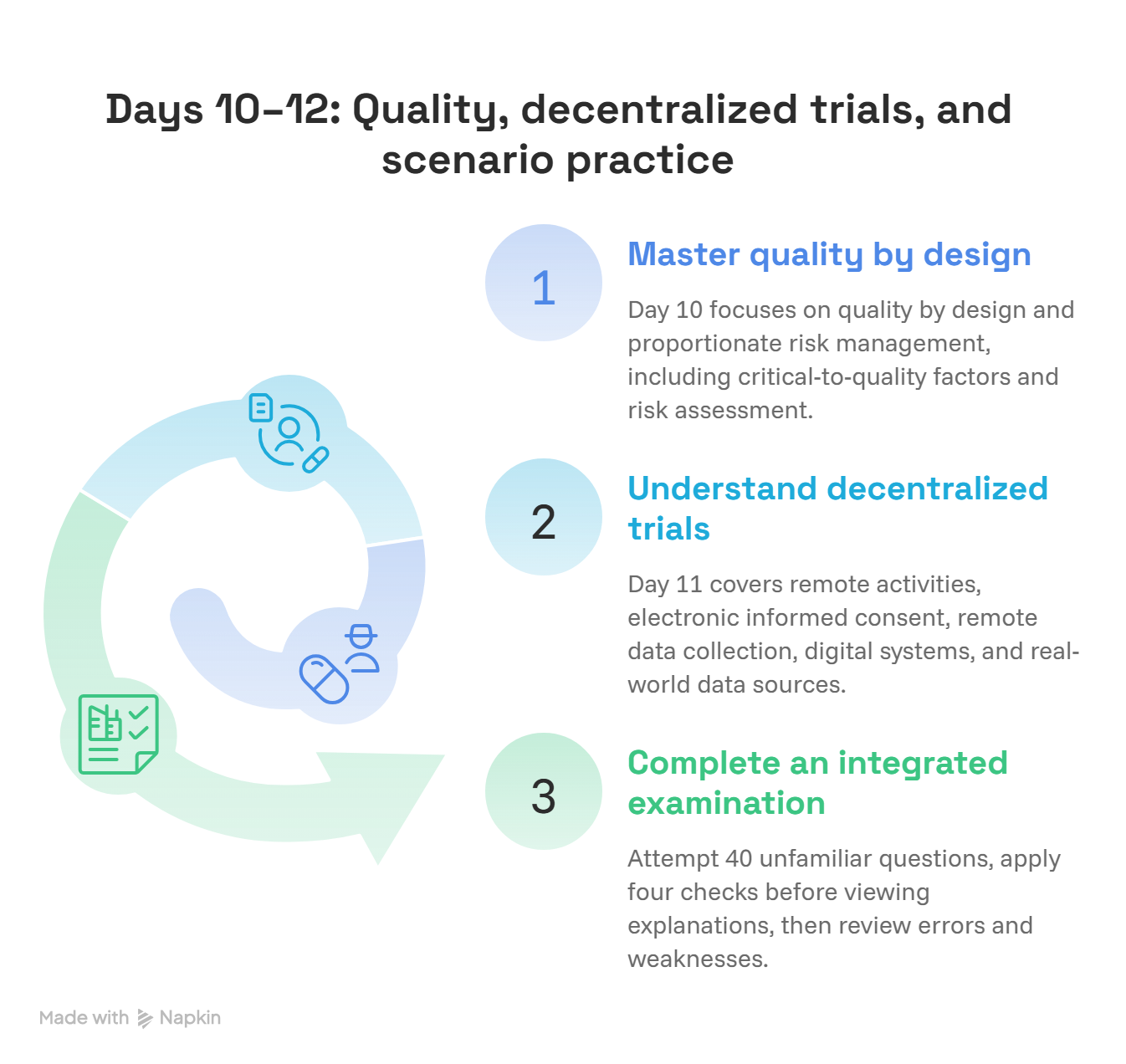
Day 10: Master quality by design and proportionate risk management.
ICH E6(R3) builds on quality-by-design concepts, emphasizing proactive identification of factors critical to trial quality.
Consider a study in which its primary endpoint depends on accurately measuring blood pressure at specified intervals.
Critical-to-quality factors may include proper measurement procedures, qualified personnel, appropriately maintained equipment, and reliable recording of measurements.
A reasonable risk assessment should examine the likelihood and significance of measurement failures, existing safeguards, and how promptly errors can be detected.
Practice identifying which risks justify additional controls and which routine activities can be managed through simpler approaches.
Review clinical trial quality management, protocol adherence requirements, site operations oversight, and critical clinical data integrity.
Day 11: Understand decentralized and technology-enabled trials.
Study applicable considerations for remote activities, electronic informed consent, remote data collection, digital systems, and the use of real-world data sources.
Annex 2 of ICH E6(R3) is particularly relevant to trial designs incorporating decentralized elements, pragmatic approaches, or real-world data. Its examination relevance depends on the testing provider's curriculum and applicable implementation requirements.
Scenario: A study uses remote informed consent, home health visits, and electronic patient-reported outcomes. The sponsor assumes that transferring these activities to digital vendors removes the need for investigator oversight.
Identify the delegated activities, required controls, participant safeguards, data responsibilities, and responsible oversight functions.
Connect these principles to ethical GCP requirements, investigator supervision, remote monitoring techniques, and clinical research data governance.
Day 12: Complete an integrated scenario examination.
Attempt 40 unfamiliar questions covering informed consent, ethics review, safety reporting, sponsor responsibilities, monitoring, computerized systems, and quality management.
For every question, write the following four items before viewing the explanation:
The most important risk.
The governing GCP principle.
The responsible decision-maker.
The best immediate action.
These four checks help prevent a common problem: selecting an attractive operational solution without considering its effect on participant safety or reliable trial results.
After scoring, separate concept errors from sequencing errors, authority errors, and incomplete evidence evaluation.
Give additional attention to weaknesses involving adverse event reporting, investigator responsibilities, clinical research quality management, and GCP monitoring.
The Day 12 objective is the ability to defend each decision using a relevant principle and specific facts from the scenario.
5. Days 13–14: Mock Exams, Weakness Correction, and Final Readiness
The final two days should measure whether your understanding transfers to unfamiliar examination questions. Concentrate on decision accuracy, reasoning, and reliable recall under timed conditions.
Day 13: Complete a full-length practice simulation.
Use a mock assessment that matches your provider's examination blueprint and question style as closely as possible. For this study schedule, a 60-question, 100-minute simulation provides a useful practice exercise. This is a preparation format rather than a claim about any specific provider's official exam.
Record each answer and mark confidence as high, medium, or low.
After finishing, calculate overall accuracy and results within individual areas such as ethical trial conduct, safety reporting, monitoring and oversight, and data integrity.
An 85% practice score can serve as a demanding personal target. Official passing standards remain specific to the examination provider. Strong performance should also be consistent across core safety and compliance areas.
Review every incorrect answer and every correct answer that resulted from guessing.
Day 14: Consolidate knowledge and verify examination readiness.
Complete 25 unfamiliar questions, followed by a targeted review of the most important remaining weaknesses.
Prioritize these distinctions:
AE versus SAE, including severity versus seriousness.
Investigator accountability versus delegated trial activities.
Sponsor responsibility versus outsourced vendor performance.
Ethics approval versus operational site readiness.
Corrective-action completion versus verified effectiveness.
Original data correction versus inappropriate record alteration.
Risk-proportionate monitoring versus uniform oversight.
Current guideline requirements versus provider-specific exam content.
Use investigator GCP guidance, safety reporting requirements, quality management principles, and clinical data integrity responsibilities for focused correction.
Verify the practical requirements for your examination: identity documents, login credentials, platform compatibility, test-center instructions, scheduling, and any remote-proctoring rules.
If you fall behind, use a structured recovery strategy.
When only seven days remain, prioritize ethics and informed consent, investigator and sponsor responsibilities, safety reporting, monitoring, data governance, and a mixed mock assessment. Reduce supplementary reading before removing practice on critical responsibilities.
When only three days remain, concentrate on your three weakest high-consequence subjects, complete one timed assessment, and review the explanations for all missed questions.
Use free clinical research training resources to fill specific knowledge gaps and current GCP credential guidance to verify that your course is appropriate for your employer or target role.
Finish the final evening with concise notes and adequate rest. The strongest evidence of readiness is the ability to explain why a decision is correct, identify the accountable role, and recognize when participant protection or data reliability requires escalation.
6. FAQs: ICH-GCP Exam Preparation in Two Weeks
-
Two weeks can provide enough preparation time for many foundational GCP course assessments, particularly when candidates already possess relevant healthcare or clinical research knowledge. The appropriate timeline depends on the provider's examination scope, previous experience, and available study hours.
A candidate with limited research experience should allocate more time to investigator responsibilities, informed consent and ethics, adverse event reporting, and trial documentation. Experienced personnel may need more concentrated review of E6(R3) changes and role-specific weaknesses.
-
Begin with the scope and principles of the relevant guideline, then study participant rights, informed consent, ethics approvals, and investigator responsibilities. These topics influence decisions throughout clinical trial conduct.
Next, develop competence in sponsor oversight, medical safety reporting, clinical trial monitoring, and data integrity.
Study complex modern-trial scenarios after establishing these foundations, unless your specific examination gives them greater weight.
-
This schedule includes a 20-question diagnostic, 35-question first-week assessment, 40-question integrated assessment, 60-question full simulation, and 25-question final review, in addition to shorter daily exercises.
That provides at least 180 questions across the major assessments, with additional scenario practice throughout the plan.
The value comes from reviewing your reasoning and understanding why alternatives fail. Questions involving patient safety, GCP compliance, trial quality management, and investigator accountability deserve particular attention when incorrect answers reveal conceptual gaps.
-
Key areas include quality by design, critical-to-quality factors, proportionate risk management, appropriate oversight, data governance, computerized systems, and flexibility across modern clinical trial designs.
Annex 2 adds considerations for decentralized and pragmatic approaches and trials using real-world data sources. Check whether those topics appear on your particular exam syllabus.
Preparation should connect these concepts to risk-based monitoring, clinical research quality management, trial data integrity, and current GCP training expectations.
-
Informed consent errors, delayed safety escalation, unauthorized protocol procedures, investigator delegation, sponsor oversight of vendors, source-data corrections, and repeated deviations are especially valuable practice areas.
These situations require reasoning about participants, decision-making authority, timing, and supporting evidence.
Use adverse event reporting guidance, investigator responsibilities, protocol adherence principles, and GCP monitoring procedures to develop accurate decision-making rather than relying on memorized response patterns.
-
Completing appropriate GCP training provides evidence of foundational regulatory knowledge. Employers also evaluate education, role-specific skills, practical experience, and the ability to perform assigned research responsibilities.
Entry-level candidates can strengthen their applications through research assistant training, clinical trial logistics knowledge, clinical research communication skills, and credible evidence of practical competence.
Before selecting a provider, verify employer recognition of GCP certificates and choose training appropriate to your intended clinical research responsibilities.
