
The Clinical Research Assistant certification exam tests whether candidates can apply Good Clinical Practice (GCP), protect participant information, maintain accurate trial documentation, and recognize situations requiring immediate escalation. Many candidates understand clinical research terminology but struggle when questions combine consent requirements, protocol deviations, source records, and patient scheduling. Knowing the exam structure helps, but success depends on understanding the decisions a research assistant can safely make. This guide covers CCRPS exam requirements, essential competencies, realistic practice scenarios, common mistakes, and a preparation strategy designed to improve first-attempt performance.

1. Clinical Research Assistant Certification Exam Format: Questions, Passing Score, and Requirements
The CCRPS Advanced Clinical Research Assistant Certification program prepares candidates for entry-level clinical trial support responsibilities involving documentation, recruitment coordination, research data management, participant scheduling, and regulatory procedures.
The published CCRPS certification overview describes a 50-question multiple-choice final assessment, a 70% passing threshold, and two examination attempts. The course catalog also contains an older or differently labeled 25-question competency exam listing, so candidates should confirm the assessment shown in their active learning portal before scheduling their final attempt.
Clinical Research Assistant exam requirements
Exam format: Multiple-choice competency assessment.
Published final assessment: 50 questions.
Passing score: 70% or higher.
Attempts included: Two.
Assessment delivery: Online through the CCRPS learning environment.
Exam duration: Confirm the current time allowance in the assessment portal.
Question navigation and negative marking: Follow the instructions displayed before starting.
Certification: Awarded after successful completion of the program requirements.
For a 50-question examination with equal weighting, 35 correct answers represent 70%. Candidates should target at least 40–43 correct answers during practice, creating a margin above the passing threshold.
That 80–86% practice target is a recommended preparation benchmark.
What makes research assistant questions challenging?
Clinical research assistant questions frequently involve ordinary administrative tasks with important ethical or regulatory consequences.
Consider a patient who arrives for a study visit while the investigator is unavailable. The assistant discovers that the current consent document has not been signed.
The tempting response may involve starting routine assessments to avoid disrupting the patient's schedule. The appropriate action depends on the study requirements and consent status, with research-specific procedures requiring valid consent before they occur.
This situation combines research protocol adherence, investigator GCP responsibilities, ethical participant protection, and clinical research team communication.
Another question might describe a laboratory specimen collected correctly but labeled with an incorrect participant identification number. Candidates must recognize the implications for specimen traceability, data reliability, and escalation.
The correct response involves following the approved specimen-handling procedure, preserving traceability, and involving the appropriate supervisor. Unverified relabeling can compromise clinical trial data integrity.
These situations illustrate why candidates should prepare through clinical research assistant training requirements, trial logistics coordination, GCP monitoring principles, and research ethics resources.
The most useful preparation question is simple: What should the assistant do first, who has authority to decide, and what evidence must be preserved?
| Competency | What Questions May Test | Correct Decision Principle | Common Failure | Preparation Resources |
|---|---|---|---|---|
| 1. GCP fundamentals | Participant protection, quality, and reliable trial results | Follow approved procedures and escalate significant concerns | Memorizing principles without applying them | GCP training and ICH E6(R3) |
| 2. Research ethics | Autonomy, welfare, and fair participant selection | Recognize potential harm and protect participant rights | Prioritizing recruitment targets over ethics | Ethical conduct and ethics directory |
| 3. Informed consent | Consent timing, documentation, and participant questions | Confirm valid consent before research-specific procedures | Assuming scheduled attendance equals consent | Investigator responsibilities and participant protection |
| 4. IRB/IEC oversight | Ethics approval and approved recruitment materials | Verify required approval status before use | Distributing unapproved advertisements | Regulatory resources and protocol adherence |
| 5. Delegation of duties | Tasks requiring training, authorization, or clinical authority | Operate within documented responsibilities | Making unauthorized eligibility decisions | Investigator oversight and team coordination |
| 6. Screening logs | Screening status, eligibility workflows, and traceability | Record approved screening information accurately | Mixing prescreening with formal enrollment | Site operations and trial logistics |
| 7. Eligibility criteria | Inclusion/exclusion documentation and escalation | Flag uncertain criteria for qualified review | Independently approving exceptions | Protocol requirements and investigator authority |
| 8. Visit windows | Required timing and permitted scheduling flexibility | Calculate windows from protocol-defined reference dates | Using appointment dates instead of protocol anchors | Visit coordination and protocol compliance |
| 9. Source documentation | Attributable, legible, contemporaneous, original, accurate records | Preserve original entries and maintain traceability | Backdating or silently replacing records | Data integrity and RA documentation training |
| 10. CRF/eCRF entry | Transfer of source information into trial databases | Enter verifiable data through authorized systems | Guessing values to complete missing fields | Record reliability and data review |
| 11. Data queries | Discrepancies, missing values, and clarification requests | Resolve against verified source information | Changing source records to match the database | Query traceability and query communication |
| 12. Audit trails | Electronic changes, attribution, and timestamps | Maintain accountable and reviewable changes | Sharing system credentials | Electronic data integrity and compliance resources |
| 13. Confidentiality | Participant identifiers and secure information handling | Use approved access and disclosure procedures | Sending identifiable data through unapproved channels | Privacy ethics and regulatory controls |
| 14. AE recognition | New or worsening medical occurrences | Capture and escalate potential events promptly | Discarding symptoms believed unrelated to treatment | AE reporting and safety oversight |
| 15. SAE escalation | Seriousness criteria and reporting pathways | Notify designated personnel without avoidable delay | Waiting for causality confirmation before escalation | SAE reporting and medical monitoring plans |
| 16. Protocol deviations | Missed procedures, incorrect timing, and departures | Document facts and follow escalation procedures | Concealing errors to protect site metrics | Deviation controls and quality management |
| 17. Specimen handling | Labeling, processing windows, and temperature control | Verify specimen identity and handling requirements | Relabeling compromised samples without authorization | Specimen logistics and traceability |
| 18. Investigational product | Accountability, storage deviations, and delegated tasks | Escalate discrepancies to authorized study personnel | Dispensing or adjusting treatment without authorization | Investigator oversight and GCP safeguards |
| 19. Essential documents | Version control, completeness, and filing | Verify current versions and appropriate signatures | Filing outdated approvals as current | Document reconciliation and documentation skills |
| 20. Monitoring support | Finding preparation, document retrieval, and follow-up | Provide traceable records through authorized workflows | Editing records solely to satisfy the monitor | Monitoring methods and CRA communication |
| 21. CAPA support | Corrections, root causes, and effectiveness checks | Support documented actions and verification | Treating repeated retraining as proof of resolution | CAPA principles and inspection techniques |
| 22. Retention management | Missed appointments and participant withdrawals | Follow approved contact and withdrawal processes | Pressuring participants to stay enrolled | Patient education and retention logistics |
| 23. Vulnerable populations | Additional protections for eligible study populations | Check approved protections and consent arrangements | Assuming one consent process suits every group | Research ethics and ethics guidance |
| 24. Trial supplies | Inventory, expiration dates, and accountability | Escalate shortages and identify approved alternatives | Using expired or unapproved materials | Supply logistics and site oversight |
| 25. Inspection readiness | Complete, consistent, and retrievable records | Locate evidence and report unresolved gaps | Recreating records without a traceable explanation | Inspection preparation and record integrity |
| 26. Communication | Clear handoffs, documented actions, and escalation | Report facts to the appropriate responsible person | Assuming a verbal message closes an issue | RA communication and team accountability |
| 27. Close-out activities | Outstanding queries, materials, and record archiving | Complete assigned reconciliation and documentation | Discarding documents before required retention expires | Close-out controls and record retention |
| 28. Professional boundaries | Recognizing limits of delegated research assistant duties | Escalate clinical and regulatory decisions requiring authority | Confusing assistant duties with investigator or CRA duties | RA versus CTA versus CRC and investigator responsibilities |
2. Clinical Research Assistant Exam Topics: What You Actually Need to Master
Clinical research assistants work at the intersection of patient coordination, study documentation, and operational compliance. Their effectiveness depends on recognizing when routine tasks have consequences for participant safety, protocol compliance, or research data quality.
The 28 competencies above form a practical preparation framework. The actual distribution of questions across these subjects should be confirmed through the current CCRPS course materials.
GCP, informed consent, and participant protection
GCP-related questions may present a situation in which an assistant must recognize a departure from approved study procedures.
Consider an electronic consent form signed after a research-specific blood sample was collected. The candidate should identify the timing discrepancy, preserve the record, and escalate for appropriate evaluation rather than attempting to alter timestamps.
A strong understanding of clinical research ethics, investigator GCP requirements, ICH E6(R3) expectations, and research protocol adherence helps candidates recognize the appropriate response.
Questions may also involve participants with limited decision-making capacity, language barriers, or additional safeguards. Consent arrangements should reflect the approved protocol and applicable requirements.
Source documents, eCRFs, and data integrity
Research assistant examinations may assess whether candidates understand how source records support information entered into case report forms and electronic data capture systems.
Suppose a source document records a participant's blood pressure as 128/82 mmHg, while the eCRF contains 182/82 mmHg.
The appropriate action involves verifying the source, determining whether the discrepancy is a transcription error, and making any authorized correction through the system's traceable workflow.
Candidates should understand ALCOA+ principles, including data that are attributable, legible, contemporaneous, original, accurate, complete, consistent, enduring, and available.
This knowledge supports clinical data integrity, monitoring and data verification, research assistant documentation training, and clinical trial quality management.
Candidates should also distinguish missing information from an actual zero value, a negative finding, or a procedure that was never performed.
Visit scheduling and protocol windows
Scheduling questions can combine simple date calculations with protocol-specific requirements.
Consider a study requiring a follow-up visit on Day 28, with an allowed window of plus or minus three days. Using the protocol's defined Day 1 as the reference point, the permitted visit window is study Days 25 through 31.
The assistant should verify the protocol's day-counting convention and ensure the appointment falls within the correct window.
A visit outside the permitted window may require escalation and appropriate deviation documentation.
Candidates should practice trial logistics coordination, protocol compliance, site scheduling oversight, and effective study team communication.
The important skill is identifying the correct reference date, applying the allowed window, and recognizing when an exception requires review.
Adverse events, protocol deviations, and escalation
Research assistants may be among the first staff members to hear about symptoms, hospitalizations, or changes in a participant's medical condition.
They must recognize potential safety information and communicate it promptly according to the protocol and site procedures.
For example, a participant reports being hospitalized after a study visit. The assistant should relay this information through the designated safety reporting pathway and preserve the details needed for qualified assessment.
The assistant should understand the difference between an adverse event, a serious adverse event, event severity, and investigator-assessed causality.
These distinctions are central to adverse event reporting, medical safety oversight, medical monitoring plans, and protocol deviation management.
The highest-value preparation involves understanding how an assistant should respond when the information is incomplete, the investigator is temporarily unavailable, or the event occurs close to a reporting deadline.
3. Clinical Research Assistant Certification Practice Questions With Detailed Explanations
The following original questions simulate practical research assistant decisions. They are designed for preparation and are separate from the official CCRPS examination question bank.
Practice Question 1: Missing informed consent documentation
A participant arrives for a scheduled study assessment. The research assistant discovers that the informed consent form in the participant's file belongs to a previous protocol version. The current amendment requires renewed consent before the assessment.
What is the most appropriate action?
A. Proceed because the participant signed the previous version.
B. Obtain a signature on the new version after the assessment.
C. Pause the affected research procedures and notify authorized study personnel.
D. Sign the updated document on behalf of the participant.
Correct Answer: C.
The assistant must recognize the significance of an outdated consent document. The appropriate response is to verify the current approval and consent requirements, notify the responsible staff, and ensure the required process is completed before affected procedures.
The candidate should also understand how to preserve accurate records of the discovery and any subsequent actions.
This scenario tests informed consent obligations, investigator responsibilities, protocol compliance, and clinical research communication.
Exam takeaway: Identify the approval or consent requirement that must be satisfied before the next procedure.
Practice Question 2: Discrepancy between source data and eCRF
An assistant enters laboratory results into an electronic case report form. During review, the assistant discovers that a value differs from the laboratory report. The eCRF record has already been saved.
What should happen next?
A. Delete the original laboratory report.
B. Verify the correct result and make an authorized, traceable correction.
C. Leave the discrepancy because the record was saved.
D. Change the source document to match the eCRF.
Correct Answer: B.
Electronic clinical trial records must remain accurate and traceable. The assistant should verify the laboratory report and correct the entered value through the authorized data management workflow.
The system's audit trail should retain the relevant history of changes. Any discrepancy involving an incorrect or questionable source value must receive appropriate review rather than an automatic alteration.
This tests clinical trial data integrity, clinical monitoring practices, quality management principles, and research assistant documentation skills.
Exam takeaway: Verify the authoritative information, use approved correction procedures, and maintain an audit trail.
Practice Question 3: Potential serious adverse event
A participant calls the research site and reports being admitted to a hospital overnight after experiencing severe chest pain. The assistant is the only research team member available to answer the call.
What is the appropriate immediate action?
A. Wait for the investigator to return the following week.
B. Determine whether the investigational product caused the event.
C. Record the available information and promptly activate the designated safety escalation process.
D. Tell the participant to call again after discharge.
Correct Answer: C.
Hospitalization may meet a seriousness criterion, subject to the applicable definitions and circumstances. The event requires prompt communication to appropriate study personnel through the established safety process.
The assistant should document information such as the participant identifier, reported symptoms, hospitalization details, and relevant contact information using approved procedures.
Qualified medical professionals determine appropriate clinical actions and causality assessments.
Study adverse event reporting, medical monitor responsibilities, clinical safety assessments, and research ethics to strengthen this competency.
Exam takeaway: Recognize potential seriousness and follow the required escalation pathway without delay.
Practice Question 4: Visit-window calculation
A participant's protocol-defined Day 1 is March 2. A Day 15 follow-up visit allows a window of ±2 days. Assume Day 1 counts as the first study day.
Which calendar dates are acceptable?
A. March 13–17.
B. March 14–18.
C. March 15–19.
D. March 16–20.
Correct Answer: B.
Counting March 2 as Day 1 places Day 15 on March 16.
The permitted window is therefore March 14 through March 18, inclusive.
The candidate must recognize the study's day-counting convention, scheduled assessment, and permitted variation.
This skill applies directly to visit scheduling responsibilities, research protocol adherence, trial site operations, and clinical research team coordination.
Exam takeaway: Establish the protocol's reference date before calculating visit windows.
Practice Question 5: Compromised laboratory specimen
A blood sample must be processed within two hours of collection. The assistant discovers it remained unprocessed for three hours because of a laboratory courier delay.
What should happen first?
A. Change the collection time to place the sample inside the window.
B. Process the sample and assume the delay has no impact.
C. Follow the specimen deviation procedure and notify appropriate study personnel.
D. Discard the sample without documenting the problem.
Correct Answer: C.
A processing delay may affect specimen stability and the reliability of the resulting data.
The appropriate action depends on the laboratory manual, protocol requirements, and any validated stability allowances. The assistant should preserve accurate collection and processing times, identify the affected sample, and escalate the deviation.
Authorized personnel can determine whether the specimen remains acceptable, requires qualified review, or must be recollected when permitted.
Review trial logistics management, clinical data integrity, quality management procedures, and protocol adherence requirements.
Exam takeaway: Preserve the factual record and obtain an authorized assessment of potentially compromised materials.
Practice Question 6: Participant eligibility and delegation
A potential participant meets most eligibility criteria. One laboratory result falls slightly outside the protocol's permitted range. The participant is eager to enroll.
Which response is appropriate for a research assistant?
A. Approve enrollment because the difference is small.
B. Alter the laboratory result to satisfy the eligibility criteria.
C. Refer the eligibility concern to authorized study personnel for evaluation.
D. Ask the participant to ignore the laboratory finding.
Correct Answer: C.
Eligibility decisions depend on the protocol, documented medical assessments, and the investigator's responsibilities.
A research assistant may help collect eligibility information, track missing documentation, and coordinate communication. The assistant must remain within the duties for which they are appropriately qualified, trained, and authorized.
Candidates should understand investigator GCP obligations, clinical research protocol requirements, ethical participant selection, and research assistant versus coordinator responsibilities.
Exam takeaway: Recognize when a decision requires investigator oversight or other designated authority.
4. How to Answer Clinical Research Assistant Exam Questions More Accurately
Research assistant certification questions often include several choices that sound reasonable. The strongest response depends on recognizing the immediate problem, identifying the assistant's authorized responsibilities, and selecting an action that protects participants and reliable study records.
Identify the issue before evaluating answer choices
Read the scenario once to establish what happened and again to identify exactly what the question asks.
Words such as first, most appropriate, required, and except can change the correct response.
For example, a question involving an incorrect laboratory value may ask for the first action rather than the complete resolution process. The immediate priority may be verifying the original result, while the full resolution involves investigation, authorized correction, and documentation.
Apply this distinction to clinical data integrity, research protocol adherence, clinical monitoring procedures, and clinical site operations.
Use four decision filters
When two answers appear equally convincing, evaluate them against four questions:
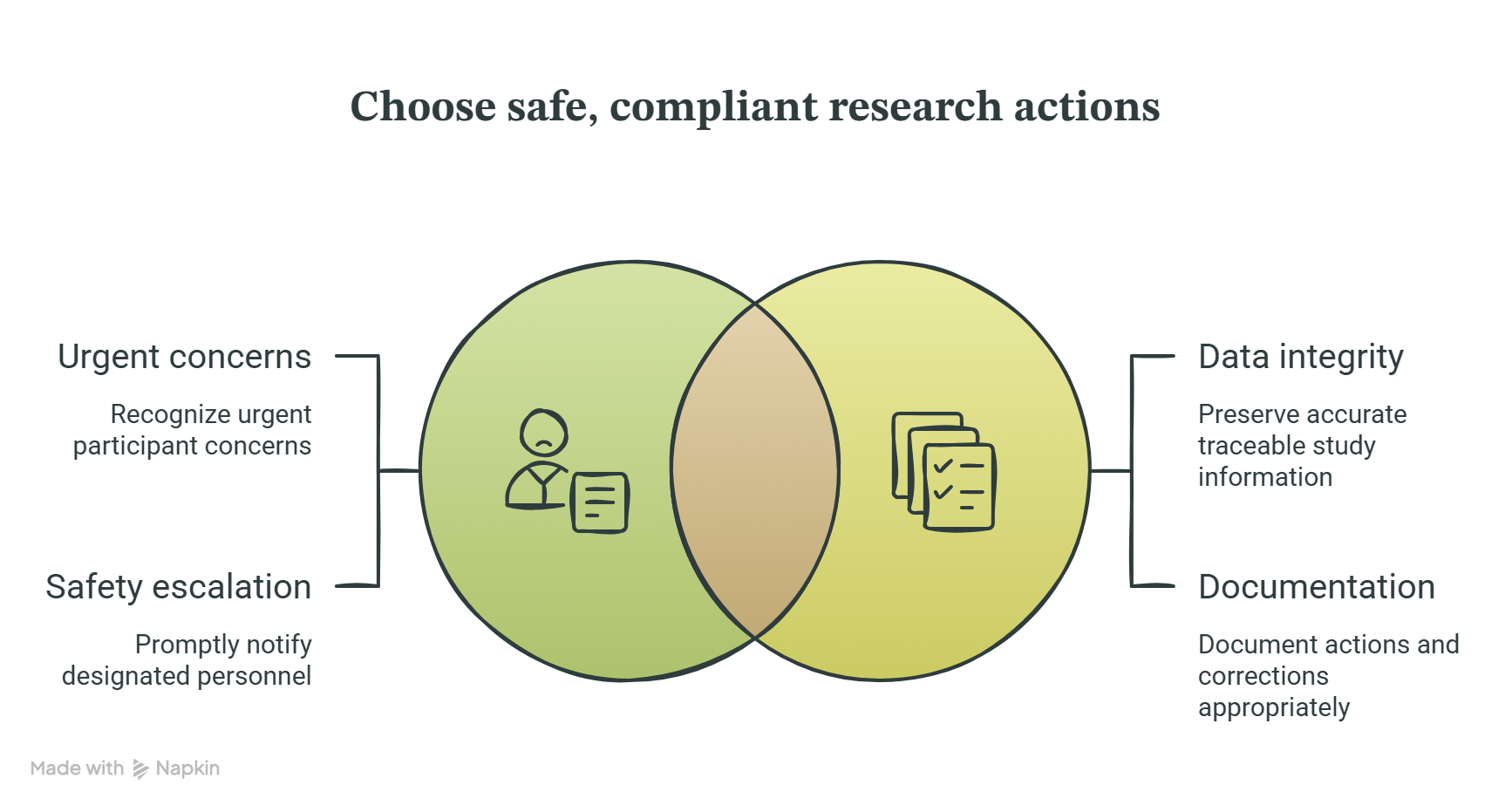
Participant safety: Does the proposed action protect the participant and recognize urgent concerns?
Authorization: Can a research assistant perform this action within their assigned responsibilities?
Data integrity: Will the action preserve accurate, traceable study information?
Protocol compliance: Does the response follow approved procedures and applicable requirements?
Consider a scenario in which a participant reports dizziness after receiving an investigational product.
An answer directing the assistant to change the treatment dose exceeds the usual authority of that role. An answer involving appropriate documentation and prompt notification of designated personnel is more consistent with the assistant's responsibilities.
The decision filters reflect research ethics, investigator accountability, adverse event reporting, and research assistant communication practices.
Learn to distinguish closely related concepts
Several important research terms are frequently confused during preparation.
Adverse event versus serious adverse event: An AE is an untoward medical occurrence associated with the use of a medicinal product in a participant, without necessarily having a causal relationship. An SAE meets one or more defined seriousness criteria, such as qualifying hospitalization, death, or a life-threatening event.
Severity versus seriousness: Severity describes intensity. Seriousness concerns the event's outcome or regulatory seriousness criteria. A severe headache may remain nonserious, while a less intense event may qualify as serious because it results in hospitalization.
Protocol deviation versus adverse event: A deviation concerns departure from protocol requirements. An adverse event concerns a medical occurrence. A single incident can involve both.
Source document versus eCRF: Source records contain the original or appropriately certified information supporting trial data. The eCRF captures data required for the clinical trial database. The applicable source-data plan determines which records serve as source.
Understanding these distinctions improves performance in medical safety assessments, clinical monitoring, trial data management, and GCP compliance.
Build a question-review log
A simple review log can reveal recurring weaknesses that total practice scores conceal.
For every incorrect or guessed answer, record the topic, the reason you selected your answer, the missing principle, and the rule that would have led to the correct choice.
Classify errors into four categories: knowledge gaps, incorrect interpretation, authorization mistakes, and avoidable calculation errors.
For example, repeated mistakes involving eligibility criteria suggest a need to review investigator responsibilities. Mistakes involving appointment dates suggest further trial scheduling practice.
Questions involving document corrections should be reviewed against data integrity requirements, while repeated escalation errors call for stronger research team communication skills.
An improvement in performance becomes meaningful when candidates can explain why their previous reasoning failed.
Manage uncertain questions efficiently
Candidates should establish a pacing strategy based on the actual examination timer. Since the current public program information does not clearly establish a time allowance, practice assessments can help determine an appropriate working pace.
During practice, answer straightforward questions efficiently, identify scenarios requiring additional analysis, and reserve review time when the assessment interface permits returning to earlier questions.
For difficult items, eliminate options that violate protocol requirements, exceed the assistant's authority, compromise records, or postpone necessary safety escalation.
This approach is particularly useful for protocol compliance questions, GCP scenarios, clinical data problems, and site coordination decisions.
5. Clinical Research Assistant Certification Exam Preparation: A Practical 14-Day Study Plan
A focused two-week preparation schedule can help candidates who have already completed the relevant course lessons consolidate their knowledge before the final assessment. Candidates beginning clinical research from scratch may require additional time to complete the full program and develop foundational understanding.
The schedule below emphasizes active recall, applied scenarios, and error correction.
Days 1–2: Diagnose weaknesses and establish GCP fundamentals
Start with a 30-question diagnostic assessment covering research ethics, informed consent, participant safety, source documentation, scheduling, and basic study responsibilities.
Record performance by subject. A score of 24 out of 30 provides less useful information than recognizing that four of the six incorrect answers concern investigator authority.
Review GCP principles, investigator obligations, ICH E6(R3) developments, and essential research assistant training.
Create a responsibility chart listing tasks the assistant can perform when appropriately authorized, tasks requiring supervisory review, and decisions reserved for qualified clinical personnel.
Deliverable: A responsibility matrix and prioritized knowledge-gap list.
Days 3–4: Master informed consent, eligibility, and participant safety
Use fictional cases involving outdated consent forms, missed consent steps, participant withdrawal, uncertain eligibility, and vulnerable populations.
For each case, explain what happened, which requirement applies, who must evaluate the issue, and what must be documented.
Study research ethics resources, clinical protocol adherence, participant education, and investigator GCP responsibilities.
Practice identifying whether proposed actions need an approval, a documented explanation, an immediate escalation, or a qualified medical determination.
Deliverable: Ten written case explanations with appropriate first actions.
Days 5–6: Strengthen documentation and electronic data management
Create fictional source records containing missing values, inconsistent dates, transcription errors, and late entries.
Practice identifying which information needs verification and what correction process is appropriate.
Use clinical data integrity guidance, GCP monitoring techniques, research documentation training, and clinical research quality management.
Give particular attention to electronic audit trails, authorized corrections, source-to-eCRF reconciliation, and essential-document version control.
Deliverable: A ten-case discrepancy log containing proposed resolutions and explanations.
Days 7–8: Practice safety reporting and operational escalation
Develop scenarios involving participant hospitalization, worsening symptoms, missed study assessments, repeated protocol deviations, and potentially compromised specimens.
For each case, identify the urgency of escalation, the responsible personnel, required supporting information, and relevant procedural controls.
Reinforce your understanding using adverse event reporting guidance, clinical trial safety oversight, medical monitoring plans, and research assistant communication practices.
Practice identifying what the assistant should document while awaiting qualified assessment.
Deliverable: A safety escalation decision chart containing at least eight different situations.
Days 9–10: Build operational accuracy
Focus on visit-window calculations, recruitment documentation, screening logs, sample labeling, courier coordination, inventory checks, and monitoring visit preparation.
Calculate ten visit windows using different reference dates and protocol-defined allowances.
Then work through ten operational discrepancies, such as incorrect kit identifiers, missing tracking numbers, expired supplies, and incomplete participant visit documentation.
Review trial logistics coordination, site operations oversight, protocol adherence procedures, and clinical monitoring techniques.
Deliverable: A visit-window calculation sheet and completed operational case set.
Days 11–12: Complete mixed mock assessments
Attempt one 50-question practice examination covering all major competency areas, using original questions separate from the certification examination.
Score every subject independently and analyze both incorrect answers and correct answers reached through guessing.
Prioritize any weakness involving participant safety, unauthorized decisions, or documentation integrity.
Review the affected topics through GCP learning resources, clinical data review, clinical protocol requirements, and clinical research assistant training guidance.
Complete a second mixed practice set using different questions to check whether your improvements transfer to unfamiliar scenarios.
Deliverable: Two performance summaries showing subject-level scores, recurring errors, and remaining weaknesses.
Days 13–14: Final review and exam readiness
Review your error log, responsibility matrix, documentation principles, and escalation procedures.
Revisit difficult examples involving investigator authority, medical safety reporting, data integrity, and trial logistics.
Before accessing the final assessment, confirm the active portal's question count, time allowance, permitted materials, attempt policy, and technical requirements.
A candidate consistently achieving 80–86% on unfamiliar mixed practice sets, while demonstrating sound reasoning in safety-critical scenarios, has a useful basis for judging readiness.
Deliverable: A concise final revision sheet and a completed technical exam-readiness check.
6. FAQs About the Clinical Research Assistant Certification Exam
-
CCRPS's current general certification information and Research Assistant course overview advertise a 50-question multiple-choice final examination. One course outline also lists a 25-question Research Assistant competency exam, so candidates should confirm which assessment appears in their active course version.
For preparation, practicing with 50-question mixed sets is a useful approach. Candidates should include research protocol questions, GCP principles, data integrity scenarios, and trial logistics problems to develop broad competency.
-
CCRPS publishes a 70% minimum passing score, with up to two attempts included.
For an equally weighted 50-question examination, 35 correct answers equal 70%. The actual assessment instructions govern final scoring.
Candidates should aim for a stronger practice margin by reviewing weak areas rather than repeatedly answering familiar questions.
For example, poor performance in adverse event reporting, informed consent responsibilities, or clinical trial data integrity deserves focused preparation, even when the overall practice score exceeds the published passing requirement.
-
The public CCRPS program information does not consistently establish a specific time allowance for the Research Assistant final examination.
Candidates should check the active exam instructions in their learning portal before beginning.
During practice, record how long different question categories take. Questions involving clinical trial scheduling, GCP compliance, clinical data discrepancies, and protocol deviations may require different amounts of analysis.
-
The CCRPS Research Assistant program is designed to accommodate eligible entrants from backgrounds including high school education, life sciences, and healthcare support.
Candidates without research experience may require additional preparation in clinical terminology, source documentation, GCP, and study workflows.
Useful starting points include essential research assistant training, entering clinical research without experience, entry-level clinical research roles, and clinical research resume preparation.
-
CCRPS describes its Research Assistant final assessment as scenario-based and designed to evaluate relevant clinical trial competencies.
Candidates should prepare for situations involving study documentation, patient coordination, safety escalation, and regulatory responsibilities.
The most useful practice questions require candidates to identify the appropriate first action, responsible authority, and documentation requirements.
Subjects such as GCP monitoring, patient safety, data accuracy, and clinical research communication provide valuable scenario material.
-
Yes. A Clinical Research Assistant generally supports research site or trial operations through documentation, scheduling, data entry, and appropriately delegated administrative or study activities.
A Clinical Research Associate, commonly abbreviated CRA, typically performs clinical trial monitoring and related sponsor or CRO oversight activities.
Candidates should distinguish the two roles when choosing training and understanding career requirements.
The Research Assistant versus CTA versus CRC guide, CRA career transition guide, site versus CRO employment comparison, and monitoring techniques overview explain these career differences.
