
Medical monitor certification exams demand sharp clinical judgment, accurate safety classifications, and confident decisions under regulatory pressure. Candidates must interpret adverse events, detect emerging safety signals, evaluate laboratory abnormalities, and distinguish investigator responsibilities from sponsor medical oversight. The difficult questions combine several clinical and regulatory issues, making seemingly reasonable answers dangerously misleading. This practice test includes 24 detailed scenario-based questions, explanations of incorrect choices, and a 30-scenario decision matrix covering the medical monitoring competencies most important for certification preparation and real-world clinical trial safety oversight.

1. Understand the Medical Monitor Exam Before Attempting the 24 Practice Questions
Medical monitoring requires the ability to evaluate clinical information and determine whether a finding requires immediate action, additional investigation, regulatory reporting, or continued surveillance.
A candidate must be able to connect clinical trial safety oversight with medical monitoring plans, clinical safety data assessment, and adverse event reporting obligations.
The 24 questions below are original educational practice questions. Certification providers determine their own exam blueprints, eligibility requirements, question counts, and passing scores.
The six competencies that matter most
Adverse event classification: Distinguish an adverse event (AE), serious adverse event (SAE), adverse reaction, suspected adverse reaction, and adverse event of special interest (AESI). Understand seriousness, intensity, relatedness, and expectedness as separate assessments.
Clinical safety interpretation: Evaluate laboratory trajectories, ECG changes, clinical symptoms, medical history, concomitant medication use, and protocol-defined safety thresholds. Proper medical safety data review considers the complete clinical context.
Regulatory safety reporting: Understand investigator-to-sponsor notification, sponsor medical review, expedited reporting criteria, and jurisdiction-specific deadlines. The pharmacovigilance reporting framework provides essential context for these decisions.
Protocol-driven medical decisions: Interpret eligibility criteria, treatment interruptions, dose-limiting toxicities, stopping rules, and medically significant deviations. Apply research protocol adherence alongside investigator responsibilities.
Aggregate safety surveillance: Identify emerging signals using event frequencies, exposure denominators, temporal patterns, comparator groups, and clinical plausibility. This is particularly important for ongoing medical safety assessments.
Medical governance and documentation: Understand investigator medical care, sponsor safety evaluation, pharmacovigilance case processing, independent committee recommendations, and clinical data integrity requirements.
How to attempt this practice test
Answer all 24 questions before checking their explanations when using this article as a self-assessment. Allow approximately 60–90 seconds per question for an initial diagnostic, adjusting that timing to your actual exam format.
For every response, identify the clinical risk, applicable reporting or protocol requirement, responsible decision-maker, and appropriate first action.
Record incorrect answers under five categories: classification error, clinical interpretation error, regulatory error, accountability error, or decision-sequencing error.
This method helps identify whether you need additional medical monitor training, pharmacovigilance practice questions, medical data review exercises, or GCP compliance revision.
| Medical Monitor Exam: 30 High-Value Clinical Safety Decisions | |||
|---|---|---|---|
| Clinical Scenario | Key Interpretation | Best Action | Exam Trap |
| 1. Severe outpatient headache | Severity and seriousness are different. | Assess all seriousness criteria separately. | Calling every severe AE serious. |
| 2. Inpatient hospitalization | Hospitalization can establish seriousness. | Assess event circumstances and report appropriately. | Waiting for proof of drug causation. |
| 3. Unexpected suspected reaction | Seriousness, expectedness, and causality matter. | Evaluate expedited reporting criteria. | Reporting every unrelated SAE as a SUSAR. |
| 4. Fatal suspected reaction | Potential seven-day U.S. IND safety report. | Evaluate criteria and urgent reporting deadlines. | Waiting for a completed final narrative. |
| 5. Elevated ALT and bilirubin | Potential important liver injury signal. | Arrange urgent clinical evaluation and assess causality. | Attributing liver injury without excluding alternatives. |
| 6. QTc threshold exceeded | Possible clinically significant cardiac risk. | Verify ECG, assess risk, and apply protocol rules. | Ignoring measurement quality or stopping criteria. |
| 7. Rising serum creatinine | Change from baseline may indicate kidney injury. | Review trend, symptoms, and concurrent medications. | Using only the absolute laboratory value. |
| 8. Febrile neutropenia | Potential urgent infection risk. | Ensure prompt clinical care and safety escalation. | Waiting for scheduled medical review. |
| 9. Eligibility violation | Participant safety and protocol integrity affected. | Assess impact and follow deviation procedures. | Changing enrollment criteria retrospectively. |
| 10. Dose-limiting toxicity | May trigger dose-escalation restrictions. | Apply DLT definition and authorized review process. | Escalating before the required safety review. |
| 11. Pregnancy exposure | Exposure follow-up differs from SAE classification. | Apply pregnancy reporting and monitoring procedures. | Automatically treating uncomplicated pregnancy as an SAE. |
| 12. Emergency unblinding | Treatment information may be needed for care. | Use authorized unblinding with controlled disclosure. | Breaking the blind unnecessarily. |
| 13. AE frequency increase | Signal interpretation requires comparative context. | Examine exposure-adjusted rates and case patterns. | Relying solely on raw event counts. |
| 14. Causality disagreement | Investigator and sponsor opinions may differ. | Preserve assessments and document rationale. | Overwriting the original assessment. |
| 15. Inconsistent MedDRA coding | Incorrect coding may conceal safety patterns. | Review verbatim terms and coding conventions. | Changing source descriptions to fit a code. |
| 16. Missing PV case | Safety database completeness is uncertain. | Reconcile the case and review reporting impact. | Closing the discrepancy based only on EDC entry. |
| 17. Emerging Investigator's Brochure risk | New safety information may change benefit-risk. | Assess participant protections and required updates. | Waiting automatically for the annual update. |
| 18. Nonserious AESI | Special interest does not automatically mean serious. | Apply defined AESI follow-up requirements. | Equating AESI with SAE. |
| 19. Conflicting event dates | Incorrect chronology may distort causality. | Request source-based clarification. | Replacing dates without an audit trail. |
| 20. Prohibited concomitant drug | Interaction and protocol risks may coexist. | Assess exposure, clinical risk, and deviation impact. | Treating it solely as a paperwork issue. |
| 21. Safety committee recommendation | Independent advice may require urgent action. | Follow governance and assess protective measures. | Ignoring recommendations to protect recruitment. |
| 22. Safety database reconciliation | Matching counts may conceal missing cases. | Match case IDs, events, dates, and case status. | Using case totals as the only reconciliation method. |
| 23. Cluster of infection cases | Background risk and exposure must be considered. | Assess chronology, denominators, and comparators. | Declaring causality from clustering alone. |
| 24. Missing critical laboratory tests | Potential risk exists before the missing data return. | Escalate for clinical evaluation and corrective follow-up. | Waiting until database cleaning. |
| 25. Treatment-related withdrawals | Discontinuations may reveal tolerability signals. | Review associated AEs and exposure patterns. | Treating withdrawal only as an enrollment problem. |
| 26. Important medical event | An event may qualify as serious without admission. | Assess whether urgent intervention prevented harm. | Requiring hospitalization in every serious case. |
| 27. Stopping threshold exceeded | Protocol-defined action may be triggered. | Follow stopping rules and authorized decisions. | Substituting informal judgment for required controls. |
| 28. Incomplete SAE follow-up | Missing details may affect ongoing safety evaluation. | Submit required initial reports and pursue follow-up. | Delaying reporting until the case is complete. |
| 29. Vendor safety alert failure | Escalation controls and sponsor oversight failed. | Address immediate risks and investigate the breakdown. | Assuming outsourcing removes sponsor accountability. |
| 30. Unresolved cases at close-out | Safety obligations may outlast final participant visits. | Assign follow-up owners and reconcile outstanding records. | Closing cases solely because dosing has ended. |
2. Medical Monitor Practice Questions 1–8: Adverse Events and Safety Reporting
Question 1. Can an adverse event be severe without being serious?
A participant develops an intense headache rated 9/10 after investigational treatment. The participant receives outpatient medication and recovers. The facts do not indicate hospitalization, persistent disability, a life-threatening condition, or another medically important outcome.
Which classification is most appropriate?
A. Automatically serious because the pain was severe
B. Nonserious based on the available facts, with severe intensity documented
C. Serious because the participant received medication
D. A suspected unexpected serious adverse reaction
Correct answer: B
Detailed explanation: Severity measures the intensity of an event. Regulatory seriousness refers to defined outcomes or circumstances, including death, life-threatening events, inpatient hospitalization, significant disability, congenital anomalies, and other important medical events.
A severe headache can therefore be nonserious. The reviewer should still evaluate its clinical significance and whether any additional seriousness criteria apply.
This distinction influences adverse event reporting, pharmacovigilance classification, and medical safety review.
Why the other answers fail: A confuses intensity with seriousness. C assumes receiving treatment establishes seriousness. D introduces unsupported relatedness and unexpectedness.
Question 2. Does hospitalization automatically establish an SAE?
A participant develops acute pancreatitis and is admitted for three days. The investigator believes gallstones may explain the event.
What is the appropriate classification?
A. Nonserious until the investigational drug is proven responsible
B. SAE based on qualifying inpatient hospitalization, with causality assessed separately
C. Automatically a SUSAR
D. An administrative deviation requiring no safety report
Correct answer: B
Detailed explanation: Inpatient hospitalization due to an untoward medical occurrence generally satisfies an SAE criterion. Relevant exclusions or distinctions, such as certain planned admissions, must be considered.
The presence of another plausible cause affects relatedness assessment, while seriousness is established independently.
Under GCP investigator responsibilities, the event requires appropriate medical management and applicable notification. The medical monitoring team and pharmacovigilance personnel subsequently evaluate reporting implications.
Why the other answers fail: A confuses seriousness with causality. C assumes the criteria for SUSAR classification are met. D disregards the medical event.
Question 3. What makes an adverse reaction a SUSAR?
A participant experiences an uncommon reaction requiring hospitalization. The reaction is unexpected against the applicable reference safety information, and available evidence suggests a reasonable possibility of investigational drug causation.
Which classification deserves consideration?
A. Expected nonserious adverse reaction
B. Serious unexpected suspected adverse reaction
C. Routine protocol deviation
D. Nonserious treatment-emergent event
Correct answer: B
Detailed explanation: SUSAR classification requires the relevant seriousness, suspected causal relationship, and unexpectedness criteria.
Medical reviewers must assess whether the event meets applicable reporting definitions and whether additional information is needed.
For U.S. IND studies, FDA IND safety reporting requirements provide the applicable framework. The review also requires sound clinical safety assessment, pharmacovigilance reporting knowledge, and medical monitor regulatory understanding.
Why the other answers fail: A conflicts with the stated seriousness and unexpectedness. C ignores the suspected reaction. D incorrectly describes the event as nonserious.
Question 4. What is the FDA deadline for an unexpected fatal suspected adverse reaction?
A U.S. IND sponsor receives information about an unexpected fatal suspected adverse reaction that meets the applicable reporting criteria.
What deadline applies?
A. Within 24 hours of entering the case into the database
B. As soon as possible, but no later than seven calendar days after the sponsor's initial receipt
C. Within 30 calendar days of final narrative completion
D. Only in the annual IND report
Correct answer: B
Detailed explanation: Under 21 CFR 312.32(c)(2), FDA notification for an unexpected fatal or life-threatening suspected adverse reaction must occur as soon as possible and no later than seven calendar days after the sponsor initially receives the information.
Other qualifying IND safety reports generally have a 15-calendar-day deadline after the sponsor determines that the information meets the reporting criteria.
Understanding the distinct triggers is essential for regulatory safety reporting, pharmacovigilance examinations, and medical monitoring compliance.
Why the other answers fail: A invents a universal FDA deadline. C delays required reporting. D overlooks an expedited obligation.
Question 5. How should a medical monitor assess uncertain drug causality?
A participant develops acute liver injury after investigational treatment. The participant also recently started another potentially hepatotoxic medicine and has risk factors for viral hepatitis.
Which approach is most appropriate?
A. Conclude causality because the event occurred after dosing
B. Exclude the investigational product because other causes are possible
C. Assess chronology, competing causes, clinical findings, exposure, and relevant dechallenge information
D. Require positive rechallenge before reaching any assessment
Correct answer: C
Detailed explanation: Medical causality assessment requires evaluating the available clinical evidence and its limitations.
The reviewer should examine symptom onset, medication exposure, biochemical trends, alternative diagnoses, the product's known safety profile, and the participant's clinical course.
Rechallenge may be medically inappropriate. Its absence does not prevent a reasoned safety assessment.
Apply medical safety review methods, clinical monitoring plan criteria, and pharmacovigilance causality principles.
Why the other answers fail: A treats temporal association as proof. B prematurely excludes a possible cause. D demands potentially unsafe evidence.
Question 6. What happens when the investigator and sponsor disagree on causality?
An investigator considers an SAE possibly related to the investigational treatment. The sponsor's medical reviewer believes an alternative medical condition provides a more convincing explanation.
What is the correct response?
A. Delete the investigator's assessment
B. Preserve and document the assessments, including their reasoning, while applying relevant reporting obligations
C. Record only the sponsor's opinion
D. Stop safety processing until both parties agree
Correct answer: B
Detailed explanation: Differences between medical assessments should be documented and managed through applicable safety procedures.
The sponsor may request additional information, review case chronology, and evaluate the evidence supporting relatedness. Reporting decisions must still comply with relevant obligations.
A clear record protects clinical trial data integrity and supports medical monitor oversight, investigator accountability, and pharmacovigilance inspection readiness.
Why the other answers fail: A and C compromise assessment traceability. D may delay required safety reporting.
Question 7. Is an adverse event of special interest automatically serious?
A protocol requires focused surveillance of suspected immune-mediated reactions. A participant develops a protocol-defined immune-related event that does not satisfy SAE seriousness criteria.
What should the medical monitor recommend?
A. Automatically classify the event as an SAE
B. Ignore the event because it is nonserious
C. Follow the protocol-defined AESI reporting and investigation requirements while assessing seriousness separately
D. Record it as life-threatening
Correct answer: C
Detailed explanation: An adverse event of special interest receives focused attention because of its potential relevance to the product's risk profile.
AESI status and regulatory seriousness are separate classifications. An event may require targeted testing, enhanced medical follow-up, or additional sponsor review while remaining nonserious.
The appropriate response follows the medical monitoring plan, protocol-specific safety procedures, and adverse event assessment requirements.
Why the other answers fail: A equates AESI status with seriousness. B misses the defined surveillance obligation. D assigns unsupported severity of outcome.
Question 8. Is pregnancy during investigational exposure automatically an SAE?
A participant reports pregnancy after receiving investigational treatment. There are no current complications. The protocol includes pregnancy exposure reporting and outcome follow-up.
What is the most appropriate approach?
A. Automatically report the pregnancy as an SAE
B. Wait until a complication occurs before documenting the exposure
C. Follow pregnancy exposure procedures and assess any associated adverse events individually
D. Remove all pregnancy information from the clinical database
Correct answer: C
Detailed explanation: Uncomplicated pregnancy is not automatically classified as an SAE.
Pregnancy exposure may still require prompt notification, follow-up, and appropriate medical assessment under the protocol and applicable regulations.
The reviewer should document relevant exposure timing, clinical risk, and required outcome follow-up.
This involves medical safety oversight, research protocol compliance, investigator clinical responsibilities, and pharmacovigilance procedures.
Why the other answers fail: A assumes seriousness. B disregards exposure-monitoring requirements. D compromises essential records.
3. Medical Monitor Practice Questions 9–16: Laboratory Safety, Dose Decisions, and Clinical Signals
Question 9. How should a medical monitor respond to possible drug-induced liver injury?
A participant's ALT rises above five times the upper limit of normal, while total bilirubin exceeds twice the upper limit of normal. The available record contains no established alternative explanation.
What should happen first?
A. Wait until the next routine safety listing
B. Arrange prompt clinical assessment and evaluate the possible liver injury signal
C. Declare definitive drug causality immediately
D. Remove the abnormal laboratory values from analysis
Correct answer: B
Detailed explanation: This laboratory pattern raises concern for potentially serious liver injury. Reviewers should evaluate alkaline phosphatase, clinical symptoms, the timing and trajectory of abnormalities, medication exposures, and alternative causes.
A potential Hy's law signal deserves careful assessment against the relevant criteria, including the pattern of liver injury and competing explanations.
The investigator should provide appropriate clinical evaluation, while the sponsor's medical oversight team assesses product-related risks and applicable protocol actions.
Strong preparation combines medical data interpretation, medical monitoring procedures, and participant safety obligations.
Why the other answers fail: A delays evaluation. C overstates causality. D compromises clinical trial integrity.
Question 10. What should happen when an ECG exceeds the protocol's QTc threshold?
A participant's ECG shows a QTc value above the protocol-defined interruption threshold. The automated measurement has not yet been independently verified.
What is the best response?
A. Ignore the result until the next scheduled visit
B. Promptly assess the participant, verify the measurement, and follow applicable safety instructions
C. Permanently discontinue every participant in the trial
D. Change the interruption threshold informally
Correct answer: B
Detailed explanation: A potential cardiac safety threshold breach requires timely clinical assessment and appropriate action.
Medical review should examine the ECG tracing, heart-rate correction method, baseline QTc, symptoms, electrolytes, concomitant medications, and protocol-defined treatment requirements.
Clinical management and sponsor-level oversight should follow their assigned responsibilities.
The scenario tests medical monitoring plan execution, medical safety review, and protocol adherence.
Why the other answers fail: A delays necessary assessment. C makes an unsupported study-wide decision. D bypasses authorized protocol change control.
Question 11. Why is a rising creatinine important even when its absolute value looks moderate?
A participant's serum creatinine increases substantially over 48 hours. The latest result is only moderately above the laboratory's usual reference range.
Which interpretation is strongest?
A. Kidney injury is excluded unless creatinine reaches a very high absolute value
B. The rate and magnitude of change may indicate acute kidney injury and require medical assessment
C. The change proves investigational drug causality
D. Only the final creatinine value should be reviewed
Correct answer: B
Detailed explanation: Kidney injury assessment requires longitudinal interpretation. Acute changes from baseline may be clinically significant before absolute values become markedly elevated.
The reviewer should evaluate urine output, fluid status, concurrent illness, medication exposure, symptoms, and protocol-defined safety actions.
A candidate focusing exclusively on reference ranges may miss an important clinical deterioration.
This reflects the value of longitudinal clinical safety review, medical monitoring plans, and investigator medical responsibilities.
Why the other answers fail: A and D ignore temporal changes. C makes an unsupported causal conclusion.
Question 12. What is the correct response to febrile neutropenia?
A participant receiving an investigational oncology treatment develops fever and severe neutropenia. The next scheduled medical review is two days away.
What is the most appropriate action?
A. Wait for the scheduled review
B. Ensure urgent investigator-led clinical evaluation and immediate appropriate safety escalation
C. Record the finding only as a protocol deviation
D. Request routine data clarification without additional medical action
Correct answer: B
Detailed explanation: Febrile neutropenia represents a potentially life-threatening clinical situation requiring urgent evaluation.
The investigator or responsible treating clinician should manage immediate medical care. The medical monitor supports urgent communication, clinical safety review, and applicable sponsor reporting.
Waiting for ordinary data-cleaning workflows may expose the participant to unacceptable risk.
Review medical monitor safety responsibilities, ethical clinical research requirements, and SAE reporting procedures.
Why the other answers fail: A introduces avoidable delay. C misses the medical urgency. D provides an insufficient response.
Question 13. What should happen after an eligibility criterion is violated?
A participant was enrolled despite baseline laboratory findings that violated an explicit exclusion criterion. The participant has already received investigational treatment.
What is the correct next step?
A. Change the eligibility criterion retrospectively
B. Evaluate participant safety, document the deviation, and follow appropriate medical and regulatory procedures
C. Delete the screening laboratory result
D. Continue treatment automatically
Correct answer: B
Detailed explanation: An eligibility violation may affect participant safety, trial compliance, and the reliability of study findings.
The investigator should determine whether continued treatment is clinically appropriate and consistent with protocol requirements. The sponsor should assess the deviation's impact, necessary escalation, and potential systemic causes.
The outcome may involve additional participant monitoring, treatment modification, documentation, and corrective action.
Relevant preparation includes protocol compliance, investigator responsibilities, site operations oversight, and quality management.
Why the other answers fail: A and C undermine research integrity. D ignores the unresolved clinical implications.
Question 14. Who decides whether dose escalation can proceed after DLTs?
During a Phase I dose-escalation trial, two participants experience toxicities potentially satisfying the protocol's dose-limiting toxicity definitions.
The clinical operations team wants to begin the next cohort immediately.
What is the appropriate response?
A. Escalate because only two participants experienced toxicity
B. Apply the DLT definitions and authorized dose-escalation review process before proceeding
C. Ignore the toxicities if symptoms have resolved
D. Allow operations staff to redefine the toxicity criteria
Correct answer: B
Detailed explanation: Dose-escalation decisions depend on the approved trial design, DLT definition, observation window, relevant clinical evidence, and predefined governance.
A medical monitor may provide clinical interpretation and recommendations, but decisions must follow the study's authorized process.
The team should assess whether required data are complete and whether the events meet stopping, holding, or cohort expansion criteria.
This draws on medical monitoring plans, trial safety oversight, protocol-defined responsibilities, and clinical trial milestone management.
Why the other answers fail: A overlooks the protocol decision process. C assumes resolution eliminates DLT significance. D bypasses approved criteria.
Question 15. When is emergency unblinding appropriate?
A participant experiences a critical medical condition. The treating physician determines that the treatment assignment is necessary to guide immediate clinical care.
Which response is appropriate?
A. Preserve blinding even when it compromises necessary medical treatment
B. Use the approved emergency unblinding procedure and limit disclosure appropriately
C. Reveal all treatment assignments to every site
D. Delay disclosure until database lock
Correct answer: B
Detailed explanation: Participant safety takes priority when treatment allocation is necessary for urgent medical care.
The investigator should follow authorized emergency unblinding procedures, ensure appropriate documentation, and limit unnecessary disclosure.
The medical monitor supports appropriate medical communication and sponsor oversight while preserving the integrity of remaining blinded data where possible.
The distinction is grounded in participant protection, investigator medical care, and medical monitoring governance.
Why the other answers fail: A and D may compromise care. C unnecessarily threatens study masking.
Question 16. How should a medical monitor evaluate a cluster of adverse events?
Five participants develop similar neurological events after receiving investigational treatment. Individual causality assessments remain uncertain.
What is the strongest approach?
A. Evaluate only the total number of events
B. Analyze event characteristics, timing, exposure, background risk, denominators, and appropriate comparator data
C. Declare causality because all events occurred after treatment
D. Exclude uncertain cases from aggregate analysis
Correct answer: B
Detailed explanation: Aggregate safety analysis can reveal patterns that are difficult to interpret from individual cases.
Medical reviewers should assess clinical similarities, event definitions, dose relationships, exposure-adjusted frequencies, relevant subgroups, and the expected background rate.
For events common in the underlying disease population, comparing treatment groups may be especially informative.
Appropriate signal evaluation requires clinical data review skills, pharmacovigilance knowledge, medical safety surveillance, and risk-based quality assessment.
Why the other answers fail: A ignores denominators and context. C overstates causality. D removes potentially important evidence.
Choose your biggest obstacle and reveal a targeted solution.
Submit
Instant self-assessment. Responses are not submitted or stored.
4. Medical Monitor Practice Questions 17–24: Safety Governance, Documentation, and Inspection Readiness
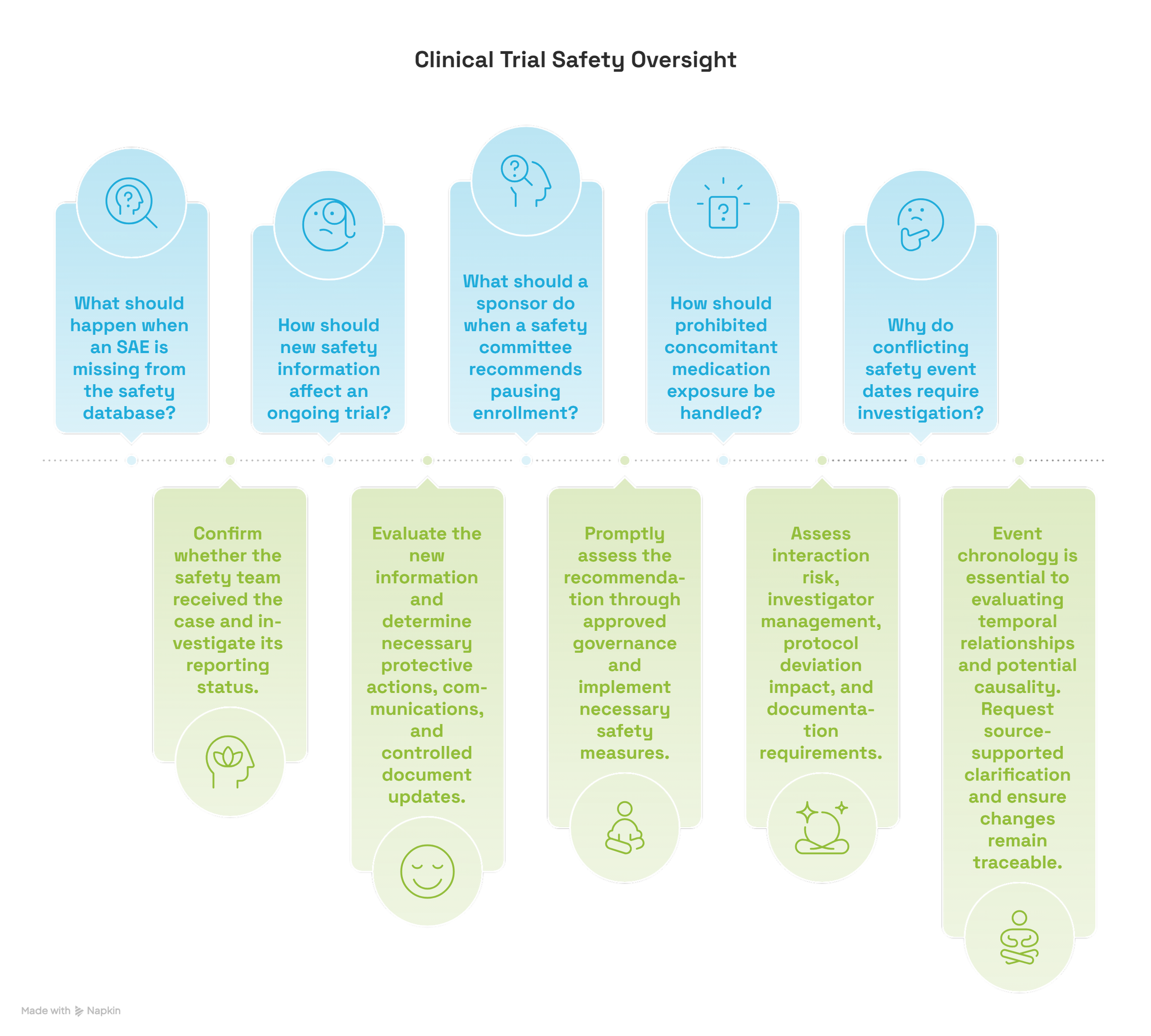
Question 17. What should happen when an SAE is missing from the safety database?
A trial's EDC contains a serious adverse event absent from the pharmacovigilance safety database.
What should the medical monitor prioritize?
A. Close the EDC query because the event exists in one system
B. Confirm whether the safety team received the case and investigate its reporting status
C. Delete the EDC event to make the databases consistent
D. Wait until final database lock
Correct answer: B
Detailed explanation: Missing cases can compromise sponsor safety review and regulatory reporting.
Reconciliation should compare event identifiers, seriousness, onset, notification dates, case status, follow-up information, and relevant reporting decisions.
If the case was never transmitted to pharmacovigilance, the team must determine whether required reporting deadlines or urgent safety actions have been affected.
This situation tests clinical data integrity, pharmacovigilance audit readiness, adverse event reporting, and medical safety oversight.
Why the other answers fail: A assumes documentation in EDC completes safety reporting. C destroys evidence. D risks delaying mandatory action.
Question 18. How should new safety information affect an ongoing trial?
A sponsor identifies convincing evidence of a new clinically important investigational product risk. Current participant-facing documents do not describe this concern.
What should happen next?
A. Wait until the routine annual Investigator's Brochure update regardless of urgency
B. Evaluate the new information and determine necessary protective actions, communications, and controlled document updates
C. Inform only the commercial team
D. Remove the information to avoid disrupting recruitment
Correct answer: B
Detailed explanation: Emerging safety information may change the benefit-risk assessment or affect a participant's willingness to remain in the trial.
The sponsor should determine whether changes to the protocol, Investigator's Brochure, informed consent materials, monitoring, or treatment restrictions are needed.
Appropriate communications and approvals must follow regulatory and ethics requirements. Urgent protective measures require timely consideration.
The relevant competencies include participant safety, medical monitoring plan revision, regulatory compliance, and investigator responsibilities.
Why the other answers fail: A ignores potential urgency. C neglects required research communications. D conceals safety information.
Question 19. What should a sponsor do when an independent safety committee recommends pausing enrollment?
An independent data monitoring committee identifies a concerning safety pattern and recommends temporarily pausing recruitment.
The trial team is behind schedule.
What is the correct response?
A. Ignore the recommendation because timelines take priority
B. Promptly assess the recommendation through approved governance and implement necessary safety measures
C. Continue enrollment automatically until the next quarterly meeting
D. Immediately unblind every investigator regardless of need
Correct answer: B
Detailed explanation: Independent safety committee recommendations should receive prompt consideration under the charter, protocol, and sponsor governance procedures.
The sponsor must evaluate the safety evidence and determine appropriate action, including possible enrollment or dosing restrictions, reporting, and communications.
The medical monitor contributes clinical interpretation but must operate within defined authority.
This decision requires understanding medical safety governance, trial leadership responsibilities, participant protection, and medical monitoring procedures.
Why the other answers fail: A and C disregard the safety recommendation. D introduces unnecessary unblinding.
Question 20. How should prohibited concomitant medication exposure be handled?
A participant receives a medication prohibited by the protocol because of a possible interaction with the investigational product.
What is the best approach?
A. Ignore the event because the medication was prescribed
B. Assess interaction risk, investigator management, protocol deviation impact, and documentation requirements
C. Automatically delete the participant's data
D. Retrospectively change the protocol
Correct answer: B
Detailed explanation: Prohibited concomitant medication use can affect participant safety, pharmacokinetics, treatment tolerability, and interpretation of trial results.
The reviewer should examine exposure timing, dosing, potential interactions, clinical consequences, and applicable protocol requirements.
The investigator remains responsible for medical care, while the medical monitor supports appropriate safety review and sponsor communication.
The question combines protocol compliance, medical data interpretation, investigator medical responsibilities, and quality oversight.
Why the other answers fail: A overlooks clinical risk. C assumes an unjustified data decision. D bypasses change control.
Question 21. Why do conflicting safety event dates require investigation?
An SAE narrative reports symptom onset before dosing, while the EDC record identifies an onset date two days after treatment.
What should the medical monitor do?
A. Select whichever date supports the preferred causality conclusion
B. Request source-supported clarification and ensure changes remain traceable
C. Delete the earlier narrative
D. Assume the discrepancy cannot affect medical assessment
Correct answer: B
Detailed explanation: Event chronology is essential to evaluating temporal relationships and potential causality.
A two-day discrepancy could materially alter the interpretation of a suspected drug reaction. The medical reviewer should assess source documentation, request clarification through the appropriate process, and preserve the correction history.
Accuracy and traceability are fundamental to clinical data integrity, pharmacovigilance case review, medical safety assessments, and regulatory reporting.
Why the other answers fail: A substitutes preference for evidence. C compromises the record history. D dismisses a potentially decisive clinical detail.
Question 22. How can inaccurate MedDRA coding conceal a safety signal?
Several participants report clinically similar neurological events using different descriptions. The assigned MedDRA terms place the cases in unrelated categories, potentially fragmenting the signal.
What should happen?
A. Accept all coding because the software processed it
B. Review verbatim terms, clinical descriptions, and applicable coding conventions
C. Rewrite the original event descriptions to match the chosen code
D. Exclude cases with ambiguous terms
Correct answer: B
Detailed explanation: Consistent, medically appropriate coding supports aggregate event retrieval, safety analysis, and signal detection.
The reviewer should work with qualified coding and pharmacovigilance personnel, preserve original descriptions, and request clarification where necessary.
Medically related events may require appropriate grouped searches or standardized queries to determine whether they represent a meaningful pattern.
The necessary skills are covered by pharmacovigilance safety analysis, medical monitoring data review, and data governance principles.
Why the other answers fail: A assumes automatic accuracy. C alters original evidence. D may conceal important safety information.
Question 23. Who remains accountable when an outsourced vendor misses a reporting deadline?
A pharmacovigilance service provider misses an applicable regulatory safety reporting deadline. The provider argues that responsibility was transferred through the service agreement.
Which statement is correct?
A. Outsourcing eliminates all sponsor responsibility
B. The sponsor retains overall responsibility for appropriate oversight of transferred sponsor activities
C. Contracting a vendor makes regulatory deadlines optional
D. The investigator must submit every sponsor regulatory report
Correct answer: B
Detailed explanation: Under ICH E6(R3), sponsors retain overall responsibility for appropriate oversight of transferred sponsor activities.
The service provider remains responsible for fulfilling its assigned contractual and operational obligations.
The immediate response should evaluate outstanding reporting, participant implications, affected cases, and necessary remediation. Subsequent investigation should identify the cause of the communication or process failure and verify corrective action.
This tests sponsor oversight, pharmacovigilance compliance, GCP reporting requirements, and clinical trial quality management.
Why the other answers fail: A misunderstands sponsor accountability. C disregards the regulation. D misassigns responsibilities.
Question 24. Can a study close while serious adverse event follow-up remains unresolved?
A clinical trial has completed its final participant visit. Several serious adverse events remain unresolved, and final safety database reconciliation is incomplete.
What is the most appropriate action?
A. Close all cases because study dosing has ended
B. Document remaining safety obligations, assign ownership, and complete required medical and data reconciliation activities
C. Remove open cases from the safety database
D. Transfer outstanding information to an uncontrolled spreadsheet
Correct answer: B
Detailed explanation: Trial completion milestones and ongoing safety obligations must be managed according to the protocol, applicable regulations, and required follow-up procedures.
A controlled close-out review identifies unresolved cases, outstanding medical information, reporting requirements, reconciliation discrepancies, and the personnel responsible for completion.
The medical monitor should support final safety review and ensure that unresolved obligations remain appropriately managed.
This links project close-out procedures, medical monitoring documentation, data integrity obligations, and pharmacovigilance audit readiness.
Why the other answers fail: A ignores continuing obligations. C destroys relevant information. D creates unacceptable documentation and traceability risks.
5. Evaluate Your Medical Monitor Practice Test Score and Fix Weak Competencies
Your total score is useful, but the clinical reasoning behind each answer provides a better indication of readiness.
Give yourself one point for each correct answer, producing a maximum score of 24.
For this original practice test, a score of 22–24 suggests strong recognition of the concepts covered and readiness for more complex unfamiliar scenarios. A score of 19–21 suggests a good foundation with identifiable gaps. A score of 15–18 indicates that several competencies need focused remediation. Scores of 14 or below suggest that foundational review should precede advanced timed practice.
These are educational study bands, not official certification passing thresholds.
Identify the error pattern before choosing what to study
Separate incorrect responses into five groups.
Classification errors involve confusion between AE, SAE, AESI, suspected reactions, seriousness, severity, and expectedness. Review adverse event reporting, pharmacovigilance examination concepts, and drug safety practice questions.
Clinical interpretation errors involve laboratory trajectories, ECG results, medical deterioration, alternative diagnoses, and aggregate signals. Practice explaining abnormalities using medical safety data review and relevant medical monitoring thresholds.
Regulatory errors involve reporting criteria, deadlines, protocol requirements, and required safety communications. Compare GCP adverse event obligations, investigator responsibilities, and medical monitor regulatory compliance.
Accountability errors arise when candidates confuse investigator medical care, sponsor oversight, pharmacovigilance case processing, or independent committee recommendations. Review medical safety governance and clinical project leadership.
Documentation errors involve missing audit trails, unresolved reconciliation discrepancies, poor case chronology, and inadequate corrective action. Focus on clinical data integrity, quality management, and pharmacovigilance inspection techniques.
Follow a 14-day medical monitor revision schedule
Days 1–2: Master safety classification. Build separate definitions and examples for seriousness, severity, causality, and expectedness. Complete unfamiliar pharmacovigilance case questions. Explain the correct reporting category without relying on memorized answer choices.
Days 3–4: Strengthen clinical interpretation. Review liver injury patterns, kidney function changes, QTc abnormalities, hematological safety issues, and suspected treatment-related complications. Apply medical data review methods to scenarios involving baseline changes, alternative causes, and treatment exposure.
Days 5–6: Learn responsibility boundaries. Compare investigator medical care, medical monitor assessment, sponsor safety oversight, and pharmacovigilance reporting. Use investigator GCP obligations, medical monitor responsibilities, and regulatory compliance guidance.
Day 7: Complete a timed mixed assessment. Use fresh questions and classify errors. Record total accuracy, uncertain correct answers, and the longest response times.
Days 8–9: Practice aggregate safety decisions. Study event clustering, exposure-adjusted comparisons, adverse event coding, emerging signals, and benefit-risk interpretation. Review ongoing medical safety assessments and pharmacovigilance surveillance competencies.
Days 10–11: Review inspection and documentation scenarios. Focus on EDC-to-PV reconciliation, traceability, incomplete narratives, safety reporting failures, and CAPA effectiveness. Connect clinical data governance with pharmacovigilance audit preparation.
Day 12: Attempt another full practice examination. Follow the official examination duration and question format where available. Identify whether your performance improvements transfer to unfamiliar scenarios.
Day 13: Repair your three weakest areas. Retest incorrect concepts using new medical cases. Give priority to mistakes involving participant risk, reporting obligations, and decision authority.
Day 14: Consolidate essential decisions. Review classification rules, regulatory timeframes, protocol stopping requirements, clinical escalation pathways, and the responsibilities of different trial stakeholders.
Use a five-question clinical decision filter
For every unfamiliar scenario, ask yourself:
What is the immediate medical risk? Identify the potential consequences for participant safety and trial integrity.
What evidence supports the concern? Evaluate chronology, clinical findings, exposure, medical history, and competing causes.
Who owns the decision? Determine the investigator's, medical monitor's, sponsor's, and pharmacovigilance team's respective responsibilities.
What action must happen first? Differentiate urgent care or reporting from later medical investigation and corrective action.
What documentation is required? Identify the evidence, rationale, communication, action, and follow-up needed to reconstruct the decision.
This framework brings together ethical trial conduct, medical monitoring procedures, regulatory safety compliance, and data integrity.
6. Frequently Asked Questions About the Medical Monitor Certification Exam
-
Prioritize adverse event classification, clinical safety assessment, causality, laboratory interpretation, protocol-defined treatment decisions, aggregate safety signals, and regulatory reporting.
A good preparation plan integrates medical monitor oversight, medical monitoring plan requirements, clinical data review, and pharmacovigilance assessment principles.
The exact examination content depends on the certification provider's official blueprint.
-
An adverse event is an untoward medical occurrence associated with a participant's use of a medicinal product without requiring an established causal relationship.
An SAE satisfies specified seriousness criteria, such as death, a life-threatening outcome, qualifying hospitalization, or another medically important event.
A SUSAR is a suspected adverse reaction that is serious and unexpected under the applicable regulatory framework.
Use SAE reporting guidance, pharmacovigilance terminology, and medical safety review techniques to practice the distinctions.
-
The medical monitor evaluates available clinical evidence, supports appropriate sponsor-level safety assessment, and coordinates necessary medical escalation within the assigned role.
Immediate participant care remains the responsibility of the investigator and appropriately qualified treating professionals.
Study clinical trial medical safety oversight, investigator medical responsibilities, safety reporting requirements, and medical monitoring plans.
-
Evaluate the baseline, magnitude and rate of change, clinical symptoms, concurrent medications, relevant medical history, and protocol-specific safety criteria.
A rapid increase in creatinine may signal clinically important deterioration despite a moderately elevated absolute value. Combined liver enzyme and bilirubin abnormalities may warrant urgent medical assessment.
Practice using clinical laboratory data review, medical monitoring thresholds, and protocol safety obligations.
-
Medical causality assessment considers treatment timing, pharmacological plausibility, known product risks, competing explanations, medical history, and available dechallenge information.
The degree of certainty depends on the clinical evidence and relevant reporting framework.
Candidates should practice evaluating causality through pharmacovigilance case examples, medical review techniques, and regulatory safety requirements.
-
Frequent mistakes include confusing severity with seriousness, assuming temporal association proves causality, overlooking protocol stopping rules, misinterpreting laboratory trends, and assigning decisions to the wrong responsible party.
Candidates also lose points by choosing corrective action when the question asks for immediate participant protection.
Strengthen these areas through medical safety oversight training, protocol compliance guidance, adverse event reporting practice, and clinical trial quality management.
