
The final hours before a Medical Science Liaison (MSL) certification exam can expose gaps that weeks of studying overlooked. Candidates may understand clinical trial endpoints yet struggle with off-label inquiries, adverse event escalation, key opinion leader interactions, or conflicting scientific evidence. Technical failures and unclear examination rules create additional risks. This exam-day checklist provides a practical preparation timeline, a 30-point readiness matrix, high-priority scientific review, realistic decision-making frameworks, and solutions for difficult questions. Use it to protect your preparation and demonstrate the clinical judgment expected in medical affairs.

1. Medical Science Liaison Certification Exam Requirements: What to Verify Before Test Day
The CCRPS Advanced Medical Science Liaison and Medical Monitor Certification (AMSLC) includes a competency assessment covering scientific communication, medical affairs compliance, clinical trial interpretation, stakeholder engagement, and safety oversight.
The current CCRPS MSL and Medical Monitor course listing describes a 50-question proctored competency exam, a 70% passing threshold, and two included attempts. However, a separate FAQ on the same course page mentions 60 questions, while some older CCRPS exam guides describe different formats.
Candidates should therefore verify their specific assessment details inside the active learning portal. A 70% threshold would equal 35 correct answers on an equally weighted 50-question assessment, but actual scoring must follow the rules displayed for the enrolled examination.
Confirm these examination details
Assessment format: Question count, question types, and any case-based components.
Passing requirements: Applicable percentage, scoring method, and whether partial credit is possible.
Time allowance: Total duration, countdown behavior, and any section-specific limits.
Attempt policy: Number of available attempts, retake conditions, and feedback availability.
Identity verification: Required documents and whether the exam uses remote proctoring.
Technical requirements: Supported browser, operating system, camera, microphone, and internet connection.
Navigation restrictions: Whether previous answers can be revisited and whether flagged questions remain accessible.
Permitted resources: Rules covering notes, reference materials, calculators, additional screens, and breaks.
The greatest avoidable exam-day risk is discovering an unfamiliar testing restriction after check-in. Candidates should use their official portal instructions for these details rather than assumptions based on other certification examinations.
Preparation should reflect the distinction between medical science liaison and medical monitor responsibilities. MSLs specialize in scientific exchange, evidence interpretation, and external expert engagement, while medical monitors carry clinical safety oversight responsibilities within trial governance.
The dual AMSLC curriculum develops overlapping competencies in medical affairs regulatory compliance, clinical trial safety oversight, medical monitoring plans, and clinical data interpretation.
Candidates transitioning from clinical practice or research should pay special attention to the boundary between giving scientifically balanced information and making decisions requiring another function's authority. This distinction becomes particularly important in medical affairs communication, GCP ethical obligations, pharmacovigilance reporting, and sponsor-side clinical trial oversight.
Establish an evidence-based readiness threshold
A candidate achieving 85% on familiar practice questions may still be vulnerable to unfamiliar compliance scenarios. A stronger measure combines performance on new questions with the ability to explain why alternative choices are inappropriate.
Use a suggested preparation target of 80–85% on unfamiliar mixed practice assessments and separately examine mistakes involving regulatory boundaries, participant safety, or incorrect interpretation of study results.
These are preparation benchmarks rather than additional CCRPS certification requirements.
Your final review should prioritize weaknesses demonstrated through practice, particularly in safety assessment techniques, regulatory compliance scenarios, clinical research data integrity, and clinical trial ethics.
| When | Check | Required Action | Problem Prevented | Targeted Review |
|---|---|---|---|---|
| 48 hours before | 1. Confirm exam format | Verify question count, duration, navigation and pass criteria in your active portal. | Planning around outdated assessment details. | MSL exam guide |
| 48 hours before | 2. Check eligibility | Confirm enrollment, required course completion and access permissions. | Unexpected access or enrollment issues. | MSL qualifications |
| 48 hours before | 3. Verify identification | Match registration details against documents required by the testing provider. | Check-in rejection. | Exam-day procedures |
| 48 hours before | 4. Test software | Run the official compatibility test on the computer you intend to use. | Unsupported browser or locked-down operating system. | Technical readiness |
| 48 hours before | 5. Test proctoring devices | Verify webcam, microphone and screen permissions if required. | Remote verification failure. | Remote exam checks |
| 24 hours before | 6. Verify connectivity | Test network stability and identify the approved outage-support procedure. | Disconnection without a recovery plan. | Assessment logistics |
| 24 hours before | 7. Review therapeutic basics | Recall disease mechanisms, treatment rationale and relevant clinical endpoints. | Weak interpretation of disease-area evidence. | Therapeutic-area review |
| 24 hours before | 8. Refresh trial designs | Contrast randomized, observational, blinded and open-label designs. | Overstating causal findings. | Clinical data interpretation |
| 24 hours before | 9. Review effect estimates | Interpret confidence intervals, hazard ratios, risk ratios and absolute effects. | Misrepresenting treatment benefit. | Evidence appraisal |
| 24 hours before | 10. Recheck endpoint hierarchy | Distinguish primary, secondary, exploratory and surrogate endpoints. | Treating exploratory findings as confirmatory. | Clinical evidence reliability |
| 24 hours before | 11. Revisit off-label inquiries | Apply approved medical information and scientific-exchange procedures. | Unapproved or misleading promotional communication. | MSL regulatory boundaries |
| 24 hours before | 12. Refresh AE reporting | Identify reportable information and the appropriate pharmacovigilance escalation route. | Safety information remaining unreported. | Adverse event reporting |
| 24 hours before | 13. Differentiate safety terms | Separate seriousness, severity, expectedness and causality. | Incorrect safety classifications. | Medical safety oversight |
| 24 hours before | 14. Review KOL engagement | Practice scientifically balanced discussion and appropriate expert interactions. | Confusing scientific exchange with sales activity. | KOL engagement strategy |
| 24 hours before | 15. Check CRM documentation | Know what scientific insights, interactions and follow-ups should contain. | Untraceable or inappropriate field records. | Field documentation rules |
| Evening before | 16. Review error log | Revisit incorrect and guessed practice answers, especially compliance questions. | Repeating known reasoning errors. | MSL practice questions |
| Evening before | 17. Review medical monitor boundaries | Differentiate MSL duties from medical safety assessment and monitoring authority. | Assigning clinical decisions to the wrong role. | MSL versus medical monitor |
| Evening before | 18. Prepare workspace | Remove restricted materials and check lighting, noise and seating. | Environment-related proctoring interruptions. | Workspace preparation |
| Evening before | 19. Protect rest time | Finish heavy studying and keep a consistent sleep schedule. | Fatigue-related reading and judgment mistakes. | Exam performance tips |
| Morning of exam | 20. Check appointment details | Confirm appointment time, timezone and permitted check-in period. | Missed appointment or late entry. | Exam-day planning |
| Morning of exam | 21. Secure power | Connect reliable power and confirm device charging. | Shutdown during assessment. | Device readiness |
| Morning of exam | 22. Review scientific red flags | Recall subgroup overinterpretation, unsupported claims and incomplete safety context. | Choosing an attractive but scientifically weak answer. | Evidence assessment |
| Before check-in | 23. Close unauthorized tools | Exit prohibited applications and disconnect restricted devices. | Security-rule violations. | Remote testing compliance |
| During check-in | 24. Verify identity | Complete requested identification and room checks exactly as instructed. | Delayed or invalid exam entry. | Check-in protocol |
| At exam launch | 25. Inspect question controls | Find the timer, progress indicator, flagging controls and submission rules. | Accidental omission or premature submission. | Exam format review |
| During assessment | 26. Use evidence hierarchy | Assess study design, endpoint validity, uncertainty and clinical relevance. | Misinterpreting published findings. | Scientific data appraisal |
| During assessment | 27. Apply compliance filters | Check whether communication is scientifically balanced, authorized and appropriately documented. | Selecting noncompliant field behavior. | Medical affairs compliance |
| During assessment | 28. Flag uncertain questions | Use permitted review functions instead of spending excessive time on one item. | Running out of time with unanswered questions. | MSL question strategy |
| Before submission | 29. Complete final review | Check unanswered items, qualifiers, units, and flagged responses if navigation permits. | Avoidable errors in completed work. | Assessment question practice |
| After submission | 30. Confirm completion | Save the permitted confirmation and review official result or retake instructions. | Uncertainty about submission or next steps. | Certification next steps |
2. The Last 24 Hours: Five MSL Competencies Worth Reviewing
A strong final-day revision strategy focuses on concepts that can change the correct answer to a realistic medical affairs problem. Repeatedly reading broad pharmacology chapters provides limited benefit when practice errors consistently involve evidence interpretation or compliance boundaries.
Scientific evidence interpretation
Medical Science Liaisons must accurately explain both the findings and limitations of clinical research.
Suppose a randomized clinical trial reports a hazard ratio of 0.72 for its prespecified primary time-to-event endpoint, with a 95% confidence interval of 0.56–0.93.
A hazard ratio of 0.72 indicates that the estimated instantaneous event hazard in the treatment group is 72% of that in the comparator group under the model used. It does not establish a 28% absolute reduction in event probability.
Candidates should verify the direction of the outcome, study design, proportional hazards assumptions where relevant, confidence interval, and endpoint definition before interpreting the result.
An answer that converts a hazard ratio directly into an absolute risk reduction contains a scientific interpretation error.
Review this distinction alongside clinical data assessment techniques, clinical data integrity, clinical trial monitoring methods, and MSL scientific communication preparation.
Also revisit the distinction between overall survival and progression-free survival, prespecified endpoints and exploratory outcomes, statistical significance and clinical importance, and randomized versus observational evidence.
Off-label scientific communication
An MSL may receive a question from a healthcare professional about an unapproved use of a medicine. The correct response depends on the jurisdiction, company procedures, the circumstances of the request, and the applicable regulatory framework.
In the United States, FDA guidance addresses certain communications of scientific information on unapproved uses, including particular firm-initiated communications. Candidates should recognize that regulatory expectations have important nuances.
An appropriate exam response generally requires an accurate, balanced scientific discussion conducted through authorized medical affairs processes, with appropriate context regarding product approval status, uncertainty, and the supporting evidence.
An MSL should also distinguish independent scientific exchange from inappropriate promotional activity and follow approved medical information processes.
Prepare through medical affairs compliance guidance, scientific communication practice, GCP ethical principles, and medical science liaison professional expectations.
Adverse event and safety signal escalation
Consider an MSL discussing a newly published study with a healthcare professional. During the conversation, the physician describes a suspected serious reaction in a patient taking the company's product.
The MSL should recognize potentially reportable safety information, collect the information permitted by established procedures, and promptly transmit it through the designated pharmacovigilance channel.
The healthcare professional's uncertainty about causality does not automatically eliminate the requirement to escalate the report.
Candidates should distinguish seriousness from severity, recognize potential safety information, and understand how field observations reach qualified drug safety personnel.
Study adverse event reporting requirements, medical monitor safety responsibilities, pharmacovigilance audit expectations, and medical monitoring plan development.
Key Opinion Leader engagement and scientific independence
MSLs build relationships with healthcare experts through scientifically credible, appropriate interactions.
Questions may involve a key opinion leader (KOL) who challenges published results, requests unpublished analyses, proposes an investigator-initiated study, or asks for information outside the approved product labeling.
A strong response requires understanding the scientific question, discussing available evidence accurately, identifying any compliance considerations, and following the appropriate organizational process.
Candidates should also recognize inappropriate incentives or attempts to link scientific engagement directly to prescribing behavior.
Review MSL engagement strategies, investigator-initiated trial procedures, medical affairs regulatory requirements, and scientific stakeholder communication.
Clinical trial governance and role boundaries
Dual MSL and Medical Monitor certification candidates should understand how scientific communication responsibilities differ from formal clinical trial safety decisions.
An MSL may report an observed safety concern or communicate scientific information to investigators. A designated medical monitor may perform qualified medical review of safety data and contribute to clinical safety decisions within assigned responsibilities.
The investigator retains applicable obligations regarding participant care and study conduct. The sponsor maintains its own trial oversight and regulatory obligations.
A question becomes easier when candidates first identify the role responsible for the decision.
Focus on MSL versus medical monitor responsibilities, investigator accountability, clinical trial safety governance, and medical monitoring decision frameworks.
3. MSL Exam Morning Checklist: Technical Setup, Final Review, and Check-In
Exam morning should be organized around activities that protect concentration and prevent avoidable interruptions. Candidates preparing for an online assessment should confirm the testing environment before launching the examination.
Three hours before: complete your final scientific review
Limit your final review to a concise sheet covering the areas where you previously made mistakes.
For clinical trial interpretation, include hazard ratios, confidence intervals, primary endpoints, subgroup findings, and major sources of bias.
For compliance, include the distinction between scientific exchange and promotional conduct, handling requests for off-label information, safety reporting, and documentation responsibilities.
For field medical practice, review KOL interaction scenarios, medical information requests, adverse event escalation, and scientific insight recording.
A useful approach is to take five unfamiliar questions and explain why each incorrect choice fails.
Concentrate on clinical data interpretation, medical affairs compliance, adverse event reporting, and MSL scenario questions.
Candidates who continue missing the same topic should revisit the governing decision principle rather than memorize the correct letter from a previous practice question.
Two hours before: stabilize the examination environment
For a remotely proctored examination, use the computer and internet connection that passed the provider's compatibility requirements.
Close unauthorized applications, verify required camera and microphone permissions, and confirm that operating-system notifications or background processes will not interfere.
Check whether additional monitors, headphones, phones, smartwatches, written notes, and calculators are permitted. Follow the exact rules for your assessment.
Arrange uninterrupted access to the examination workspace and identify the approved technical-support process.
These preparations resemble the principles behind clinical research quality management, inspection readiness, clinical trial documentation controls, and protocol-compliant operational planning.
A simple contingency check should answer three questions: How will I contact authorized support? What happens if the examination disconnects? Which actions require permission from the proctor?
During check-in: follow the authorized process
Keep the required identification and appointment information available according to the examination provider's instructions.
If remote check-in requires a room inspection or webcam verification, follow the prescribed sequence. Avoid changing equipment or restarting assessment software independently when the provider requires authorization.
Before beginning the assessment, identify the timer, question-navigation tools, review flags, break rules, and submission process.
If the exam contains multiple sections or different question formats, determine whether each section has a separate time restriction.
A candidate familiar with clinical research protocol adherence, investigator compliance requirements, quality management procedures, and documentation accountability should apply the same process discipline to examination rules.
Five minutes before starting: confirm your decision framework
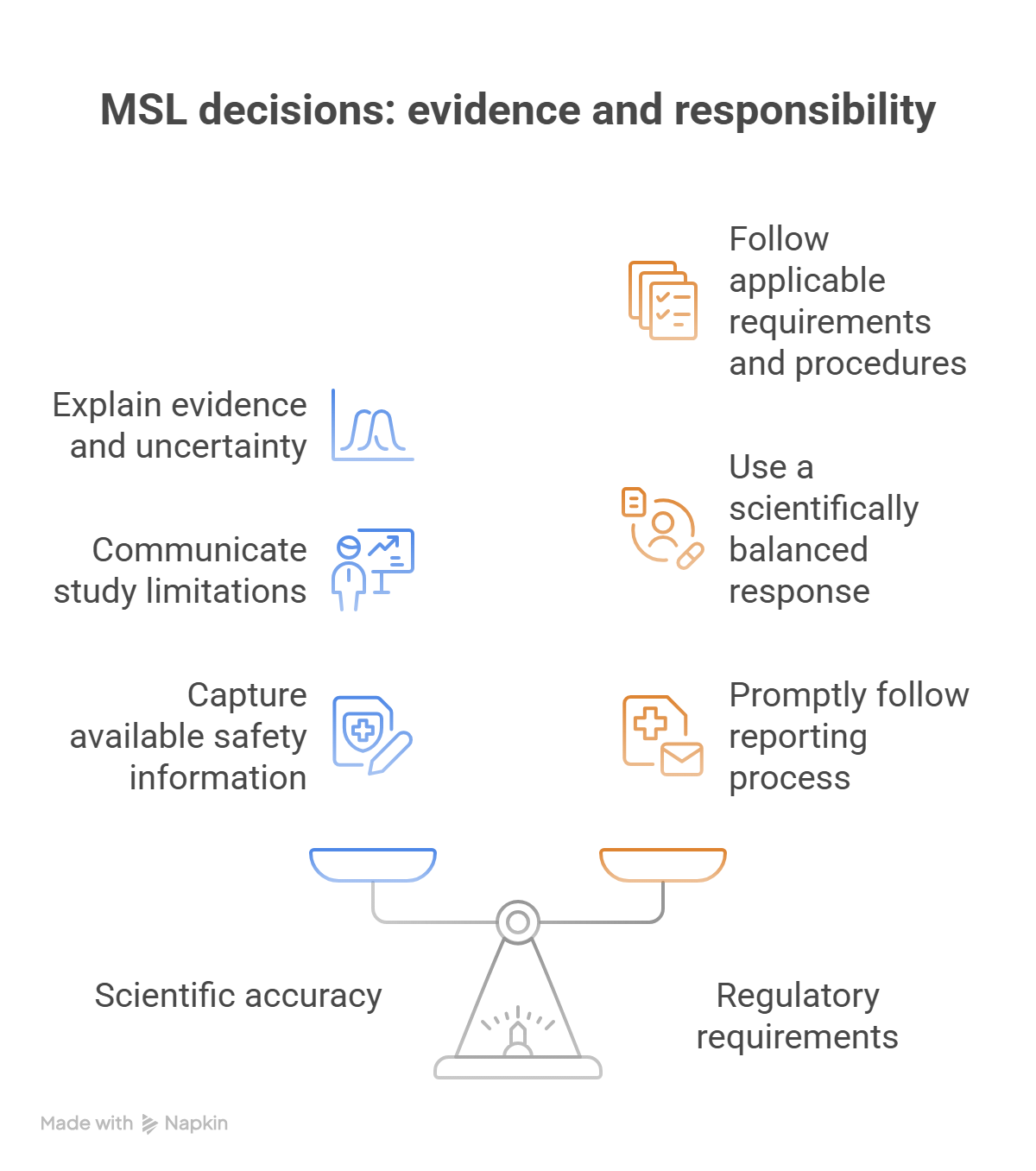
Recall the principles that should guide unfamiliar questions:
Scientific validity: What does the evidence establish, and what are its limitations?
Regulatory boundaries: Is the proposed action appropriate under the applicable requirements and procedures?
Participant safety: Does the situation require prompt safety reporting or clinical assessment?
Professional authority: Which person or function has responsibility for the decision?
Documentation: What information must be recorded, communicated, and followed up?
These priorities connect scientific evidence interpretation, medical affairs compliance, safety escalation responsibilities, and ethical clinical research conduct.
4. How to Answer Difficult MSL Certification Exam Questions
The most challenging Medical Science Liaison questions often contain several plausible answers. Candidates must identify the option that best satisfies scientific accuracy, regulatory requirements, ethical responsibilities, and the specific circumstances described.
Use a structured approach rather than selecting the answer that sounds most confident or persuasive.
Scenario 1: A clinical trial reports a favorable hazard ratio
Question: A randomized clinical trial reports a hazard ratio of 0.78 for an adverse clinical outcome, with a 95% confidence interval of 0.62–0.98. Which interpretation is most appropriate?
A. Treatment eliminates 22% of adverse events.
B. Treatment produces a 22-percentage-point absolute reduction in risk.
C. The treatment group has an estimated 22% lower instantaneous event hazard, with uncertainty reflected by the confidence interval.
D. Every patient receiving treatment experiences a 22% improvement.
Correct answer: C.
The hazard ratio expresses a relative comparison of event hazards. Its interpretation depends on the outcome, statistical model, and relevant assumptions.
The confidence interval excludes 1.0, supporting a statistically significant result at the conventional two-sided 5% level under the assumptions of the analysis.
However, the result alone does not establish an absolute risk reduction or describe benefits for individual patients.
Candidates should understand this distinction through clinical trial evidence interpretation, clinical data integrity, medical science liaison exam preparation, and scientific communication techniques.
Exam principle: Explain exactly what the evidence supports, including its uncertainty.
Scenario 2: A KOL asks about an unapproved use
A physician asks an MSL about published evidence for using the company's medicine in a patient population outside its approved labeling.
Which response is most appropriate?
A. Recommend the unapproved use based on personal clinical experience.
B. Provide an authorized, scientifically balanced response consistent with applicable requirements and company procedures.
C. Promise superior outcomes based on an exploratory subgroup analysis.
D. Ask the sales representative to encourage prescribing for the unapproved use.
Correct answer: B.
The appropriate response depends on the jurisdiction and circumstances of the communication. MSLs should follow applicable scientific exchange and medical information procedures, communicate study limitations, and accurately identify the medicine's approval status.
Candidates should distinguish permissible scientific communication from inappropriate promotional practices.
This distinction is especially important in medical affairs regulatory compliance, MSL scientific communication, research ethics, and professional medical affairs responsibilities.
Exam principle: Scientific claims require an appropriate evidence base and compliant communication process.
Scenario 3: A healthcare professional reports a serious reaction
During a scientific discussion, a healthcare professional tells an MSL that a patient required hospitalization after receiving the company's medicine. The physician believes the reaction may be unrelated to treatment.
What should the MSL do?
A. Ignore the event because causality has not been established.
B. Wait for a published safety report.
C. Capture the available safety information and promptly follow the required pharmacovigilance reporting process.
D. Independently determine that the event is unrelated to treatment.
Correct answer: C.
Potentially reportable safety information should be recognized and escalated through the designated safety reporting process.
Seriousness and causality are separate concepts. A causality assessment requires appropriate qualified review, while initial reporting follows applicable pharmacovigilance requirements and procedures.
Candidates preparing through adverse event reporting guidance, clinical trial safety oversight, medical monitoring responsibilities, and pharmacovigilance compliance training should recognize the importance of timely escalation.
Exam principle: Recognize reportable safety information and preserve the appropriate reporting pathway.
Scenario 4: An exploratory subgroup appears to benefit
A clinical trial fails to meet its primary endpoint. An exploratory analysis suggests a meaningful treatment effect in a small subgroup.
Which scientific conclusion is most defensible?
A. The medicine is proven effective in the subgroup.
B. The subgroup result should be presented with appropriate caveats about exploratory analyses, multiplicity, uncertainty, and the overall trial findings.
C. The negative primary endpoint should be excluded from scientific presentations.
D. The subgroup result automatically overrides the original trial objective.
Correct answer: B.
Exploratory analyses can generate hypotheses, but interpreting them requires attention to sample size, prespecification, multiplicity, and statistical uncertainty.
An MSL must provide scientifically balanced information, including relevant unfavorable findings and methodological limitations.
Review clinical trial data review, research data integrity, medical affairs scientific exchange, and MSL exam scenario practice.
Exam principle: Exploratory evidence must be interpreted according to its methodological limitations.
Scenario 5: Commercial teams request an inappropriate scientific commitment
A sales representative asks an MSL to arrange a scientific presentation specifically to increase a physician's prescribing of the company's product.
What is the best response?
A. Agree because prescribing growth supports company objectives.
B. Offer incentives to encourage attendance.
C. Maintain appropriate scientific independence and follow medical affairs compliance procedures.
D. Promise a favorable product comparison regardless of the available evidence.
Correct answer: C.
Medical affairs activities require appropriate independence, scientific accuracy, and compliance with applicable rules.
An MSL should maintain professional boundaries when commercial objectives create inappropriate pressure on scientific engagement.
Review MSL regulatory requirements, ethical scientific communication, KOL relationship management, and medical affairs career expectations.
Exam principle: Identify conflicts between legitimate scientific activities and inappropriate commercial influence.
Scenario 6: A KOL proposes an investigator-initiated study
A physician proposes an investigator-initiated clinical study and asks the MSL to guarantee funding approval before submitting the full research proposal.
What should the MSL do?
A. Promise funding based on the physician's professional influence.
B. Follow the organization's approved investigator-initiated research process and explain the independent review requirements.
C. Require prescribing commitments before considering the proposal.
D. Approve the proposed study without the designated scientific review.
Correct answer: B.
Investigator-initiated research proposals require appropriate scientific, ethical, operational, and financial evaluation.
An MSL may help explain submission procedures and communicate the proposal to authorized personnel, according to organizational policy.
Funding decisions should follow established processes and applicable requirements.
Candidates should examine investigator-initiated trial procedures, principal investigator responsibilities, medical affairs compliance, and clinical research ethical requirements.
Exam principle: Understand governance requirements before making commitments outside delegated authority.
5. MSL Exam-Day Mistakes That Cost Marks and How to Prevent Them
Candidates can lose marks through incorrect scientific assumptions, misinterpretation of question wording, poor time management, and misunderstanding the responsibilities of different medical affairs functions.
A useful final strategy involves identifying these mistakes before they occur.
Mistake 1: Treating statistical significance as proof of clinical importance
A statistically significant result can still represent a clinically modest effect. Similarly, a clinically important estimated effect may remain statistically uncertain because of limited sample size or imprecise measurement.
Candidates should consider absolute effects, the endpoint, patient population, uncertainty, and clinical consequences.
The distinction matters in clinical data assessment, medical science liaison scientific exchange, clinical research data integrity, and clinical trial quality management.
Correction: Ask whether the answer accurately reflects the study design and the evidence available.
Mistake 2: Confusing Medical Science Liaison and Medical Monitor authority
An MSL's responsibility for communicating scientific information should be distinguished from a medical monitor's designated responsibilities for clinical safety assessment.
Questions may deliberately introduce an action that appears clinically reasonable but falls outside the stated professional role.
Review MSL versus medical monitor career responsibilities, medical monitor safety oversight, clinical safety assessments, and sponsor-side compliance responsibilities.
Correction: Identify the person or function authorized to make the decision before selecting an answer.
Mistake 3: Selecting the most persuasive scientific response rather than the most appropriate one
A healthcare professional may ask for treatment comparisons or data from an unapproved indication.
The strongest answer must consider scientific accuracy, balance, regulatory requirements, and authorized communication pathways.
Candidates should recognize claims that exaggerate efficacy, omit unfavorable outcomes, or treat exploratory findings as definitive.
These issues connect medical affairs compliance, research ethics, clinical evidence appraisal, and professional MSL preparation.
Correction: Evaluate both the content of the proposed response and how it would be delivered.
Mistake 4: Spending too long on unfamiliar questions
A candidate who devotes excessive time to one complicated scenario may have insufficient time for straightforward questions later in the assessment.
If the examination permits reviewing previous answers, use a three-pass approach.
First pass: Answer questions where the relevant principle and correct choice are clear.
Second pass: Revisit complicated scientific interpretation and compliance scenarios.
Third pass: Examine flagged answers, unanswered items, qualifiers, and calculation errors before submitting.
Use MSL practice examinations, MSL certification preparation tips, data interpretation exercises, and regulatory scenario practice to improve speed without sacrificing accuracy.
The official question-navigation and timer rules determine whether this approach is available.
Mistake 5: Responding incorrectly to technical problems
Unexpected disconnections, examination freezes, or proctoring difficulties can interrupt an online test.
Candidates should follow the testing provider's authorized support process and retain permitted documentation of the incident.
Avoid independently changing devices, restarting assessment software, or attempting to bypass security measures when such actions require authorization.
The same disciplined approach supports clinical research documentation, inspection readiness procedures, operational quality management, and clinical trial protocol compliance.
Correction: Know the approved technical escalation process before the exam begins.
What to do immediately after the examination
After submitting the assessment, verify that the examination system confirms successful completion.
Follow the provider's instructions for viewing results, downloading permitted records, or accessing certification documents.
If the result is unsuccessful, use any available performance feedback to identify weak competencies before attempting a retake.
For example, mistakes involving KOL discussions may require further medical affairs communication preparation. Safety-related errors may warrant additional work on pharmacovigilance reporting, medical monitoring plans, and clinical safety assessment methods.
Once certified, candidates can connect their learning to practical career evidence, including scientific literature assessments, fictional KOL discussion plans, and medical affairs compliance scenarios.
These competencies can strengthen professional positioning when exploring MSL hiring expectations, MSL career pathways without a PhD, and medical monitor versus medical science liaison careers.
6. FAQs About the Medical Science Liaison Certification Exam Day
-
The current CCRPS AMSLC course overview advertises a 50-question proctored competency examination, while another section of the same page describes 60 questions. Older published guides give additional, differing figures.
Candidates should confirm the applicable question count in their active learning portal.
A useful preparation strategy is to practice using unfamiliar mixed assessments covering MSL exam topics, scientific interpretation, medical affairs compliance, and clinical safety oversight.
-
The current AMSLC course listing specifies a 70% passing score and two included attempts. However, candidates should follow the scoring and retake terms associated with their enrolled assessment.
For an equally weighted 50-question examination, 35 correct answers equal 70%.
A practice target of 80–85% can provide a useful preparation buffer.
Candidates should prioritize regulatory compliance, clinical safety reporting, data interpretation, and scientific communication rather than focusing exclusively on their overall practice score.
-
The CCRPS AMSLC program is offered through an online learning environment, and its current course listing describes a proctored competency assessment.
Candidates should confirm the exact proctoring arrangements, identity requirements, technical specifications, and permitted materials through their examination dashboard.
Anyone preparing for remote testing should complete the provider's official compatibility checks beforehand.
The same attention to procedural accuracy emphasized in GCP requirements, clinical trial quality management, and regulatory compliance training is useful when navigating exam-day instructions.
-
Permitted materials depend on the rules of the active assessment. Candidates should check whether notes, scientific references, calculators, additional devices, or online resources are allowed.
Do not assume that an online examination is open-book.
For efficient preparation, candidates should develop quick recall of clinical trial interpretation, MSL compliance boundaries, safety reporting, and medical monitoring responsibilities.
-
Focus on topics where a misunderstanding can materially change the answer.
High-priority subjects include clinical trial endpoints, confidence intervals, hazard ratios, study limitations, off-label scientific communication, adverse event escalation, and KOL engagement scenarios.
Candidates pursuing dual MSL and medical monitoring preparation should also revisit the distinction between scientific communication and clinical safety assessment responsibilities.
Use MSL certification study guidance, clinical data review techniques, medical affairs regulatory requirements, and MSL practice questions.
-
First identify the jurisdiction, who initiated the discussion, the scientific information being requested, and the available evidence.
Then evaluate the applicable communication requirements, the distinction between scientific exchange and promotion, and the correct organizational process.
Candidates should also consider the need to present product approval status, study limitations, and safety information accurately.
Review medical affairs compliance, MSL scientific communication, clinical research ethics, and clinical evidence assessment.
The strongest response should demonstrate scientific accuracy and compliance with the applicable procedures.
