
Research assistant certification exams demand practical judgment across informed consent, participant safety, protocol compliance, documentation, and clinical trial operations. Candidates frequently struggle when a question requires choosing the correct action rather than recalling a definition. A structured research assistant training plan can close this gap through realistic practice.
This workbook combines 30 original questions, answer explanations, practical worksheets, and performance tracking. It strengthens protocol adherence, research-team communication, and the clinical research competencies employers expect.

1. What's Inside the Research Assistant Certification Exam Workbook?
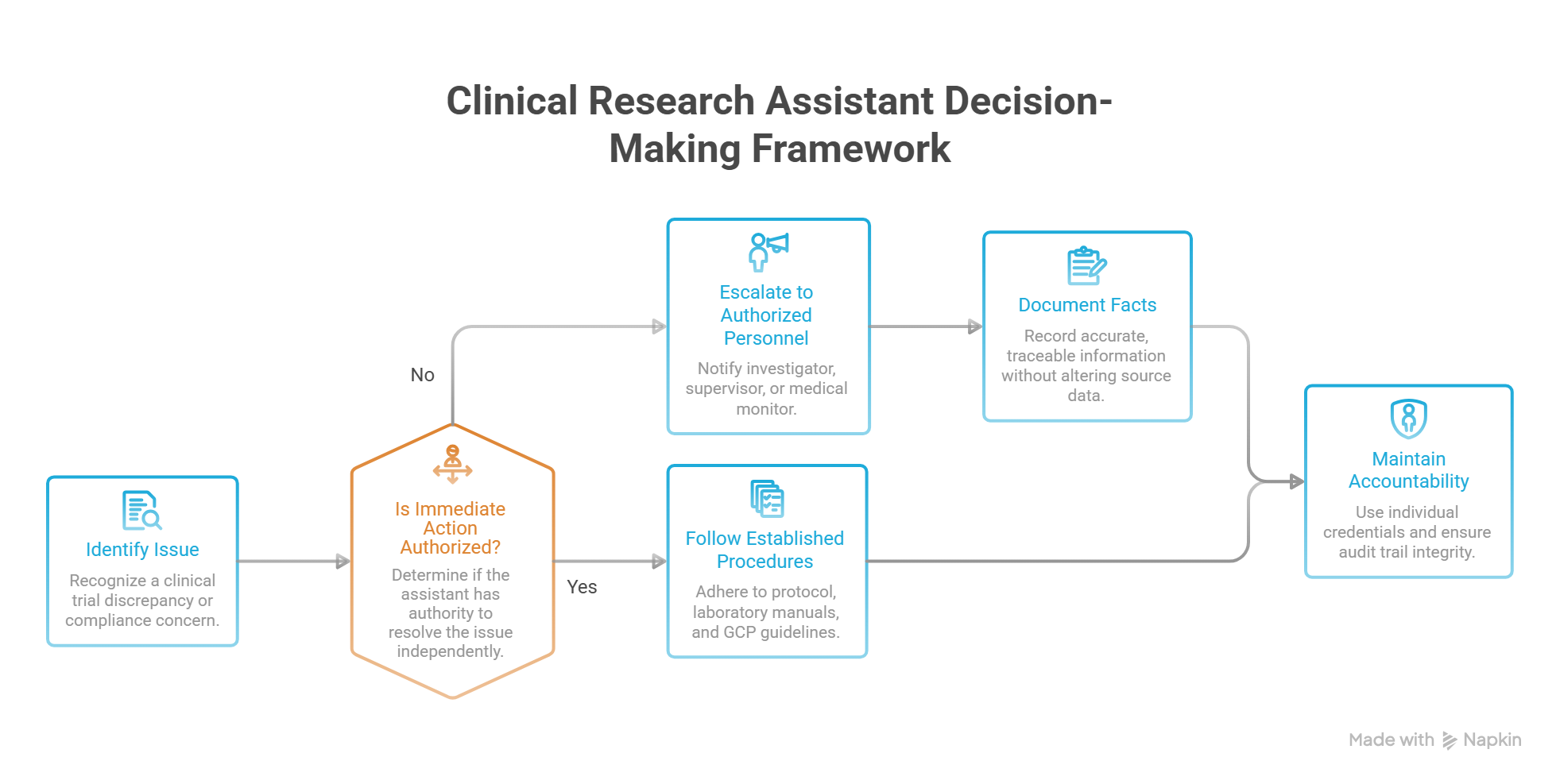
A useful certification workbook should test the decisions research assistants encounter while supporting clinical trials. These include verifying documentation, identifying protocol discrepancies, coordinating study supplies, protecting participant information, and escalating concerns through authorized channels.
The companion PDF contains 30 multiple-choice questions across six competency domains, detailed answer explanations, six practical worksheets, a scoring sheet, and a revision tracker.
Its questions are original educational exercises. Certification providers may assess different topics, question formats, and passing standards. Candidates should check their particular examination syllabus and the training requirements relevant to their role.
The six competency domains are:
Research ethics and informed consent: Recognizing consent problems, maintaining participant confidentiality, and understanding the limits of an assistant's responsibilities.
Protocol and site execution: Understanding eligibility documentation, visit windows, delegation, investigator supervision, and trial logistics coordination.
Participant safety: Recognizing potential adverse events, communicating important information, and following GCP safety reporting procedures.
Clinical data integrity: Verifying source records, responding to data queries, maintaining audit trails, and identifying inaccurate documentation.
Study specimens and supplies: Managing specimen identification, temperature excursions, inventory shortages, and documented shipments.
Quality and communication: Understanding monitoring findings, protocol deviations, corrective actions, and effective research-team collaboration.
These competencies overlap in real clinical trials. A missed visit can affect protocol adherence, specimen collection, source documentation, and clinical data reliability. The strongest candidates recognize those connections.
How to complete the workbook
Attempt the questions without opening the answer key. For every question, record your chosen answer and classify your confidence as high, medium, or low.
After completing the assessment, compare your choices with the explanations. Review every incorrect response and every correct response selected through guessing.
For each mistake, record the applicable principle, relevant evidence, responsible decision-maker, and appropriate next action. This method builds the reasoning required for GCP compliance, clinical research documentation, and quality-focused trial conduct.
| Research Assistant Certification: 28-Scenario Exam Decision Matrix | |||
|---|---|---|---|
| Exam Scenario | Best Decision Principle | Evidence to Verify | Common Exam Trap |
| 01. Consent signed after a study procedure | Preserve chronology and promptly escalate for assessment. | Consent timestamps, procedure records, approved requirements. | Treating retrospective consent as authorization. |
| 02. Outdated consent form used | Check approved version and reconsent requirements. | Version history, approvals, implementation instructions. | Assuming previous consent resolves new information. |
| 03. Participant cannot understand consent material | Arrange accessible explanation by authorized personnel. | Language needs, consent process, available assistance. | Treating a signature as proof of understanding. |
| 04. Participant data sent to wrong recipient | Contain disclosure and activate privacy reporting. | Recipients, information exposed, incident chronology. | Deleting local evidence without escalation. |
| 05. Conflicting eligibility laboratory values | Resolve discrepancy through qualified review. | Original results, protocol criteria, source records. | Selecting the value that permits enrollment. |
| 06. Participant misses a visit window | Verify protocol instructions and obtain direction. | Actual visit date, permitted window, procedures. | Changing dates to conceal deviation. |
| 07. Training evidence missing | Confirm training and authorization before independent work. | Training records, task delegation, supervision. | Assuming general experience replaces training. |
| 08. Investigator review required | Refer clinical decisions to qualified responsible personnel. | Investigator assessment, protocol, delegation records. | Allowing administrative staff to make medical decisions. |
| 09. Emergency department visit reported | Capture available facts and initiate safety escalation. | Event description, awareness time, reporting pathway. | Waiting for complete medical information. |
| 10. Severe symptom versus serious event | Distinguish intensity from seriousness criteria. | Clinical details and applicable safety definitions. | Treating severity and seriousness as equivalent. |
| 11. Clinically important lab alert | Ensure prompt handoff to qualified clinical personnel. | Result, alert status, reporting instructions. | Making independent treatment recommendations. |
| 12. Safety contact unavailable | Activate approved backup escalation procedures. | Contact tree, timestamps, communication attempts. | Waiting until normal working hours. |
| 13. Incorrect EDC entry | Correct through an authorized traceable process. | Source records, audit trail, correction rationale. | Overwriting the original entry without traceability. |
| 14. EDC query conflicts with source | Verify original evidence and seek authorized clarification. | Source notes, query details, original measurements. | Guessing which record is accurate. |
| 15. Shared EDC user account | Restore individually attributable system access. | Access logs, assigned roles, system controls. | Prioritizing convenience over accountability. |
| 16. Missing endpoint source record | Investigate whether the assessment actually occurred. | Source documentation, schedules, EDC entries. | Creating unsupported retrospective documentation. |
| 17. Specimen identification mismatch | Hold processing and resolve identity discrepancy. | Labels, requisitions, collection documentation. | Relabeling specimens without verification. |
| 18. Specimen temperature excursion | Document excursion and obtain authorized disposition. | Temperature logs, stability limits, laboratory manual. | Assuming refrigeration afterward resolves damage. |
| 19. Courier shipment delayed | Assess stability requirements and approved recovery options. | Collection time, tracking data, processing window. | Shipping compromised samples without review. |
| 20. Study kit shortage | Forecast requirements and coordinate approved replenishment. | Inventory, visit schedule, delivery lead times. | Borrowing materials from unrelated studies. |
| 21. Monitoring finding identified | Confirm facts, affected records, and assigned actions. | Monitoring report, source evidence, response deadline. | Treating the finding as a documentation formality. |
| 22. Protocol deviation repeated | Investigate root causes and assess participant impact. | Deviation trends, workflows, staffing, protocol. | Repeating ineffective training indefinitely. |
| 23. CAPA closed prematurely | Require evidence that corrective controls work. | Effectiveness metrics, follow-up results, recurrence. | Confusing completed action with resolved problem. |
| 24. Essential record unavailable | Locate evidence and investigate the record gap. | Filing history, version control, source systems. | Backdating missing trial documentation. |
| 25. Conflicting team instructions | Clarify authority, responsibilities, and instructions. | Delegation, protocol, documented communications. | Following whichever person is most senior. |
| 26. Participant receives repeated calls | Establish coordinated, participant-centered communication. | Contact logs, assigned coordinator, participant preferences. | Increasing calls without identifying the problem. |
| 27. Escalation ownership unclear | Identify accountable owner and confirm handoff. | Escalation procedures, contact records, action tracker. | Assuming someone else completed the notification. |
| 28. Study handoff incomplete | Reconcile outstanding tasks and establish accountable ownership. | Open queries, training records, supplies, pending visits. | Treating a verbal handoff as complete evidence. |
2. Research Assistant Certification Practice Questions: Ethics, Protocols, Safety, and Data
The following 12 questions provide a focused sample of the downloadable workbook. Answer them independently before reviewing the explanations in Section 4.
The questions emphasize the judgment required for research protocol compliance, participant protection, trial logistics, and clinical data integrity.
Q1. A Participant Completes a Procedure Before Signing Consent
A research assistant notices that a participant's consent form was signed at 10:20 AM, although a protocol-specific blood sample was collected at 9:55 AM.
What is the best action?
A. Obtain another signature and treat the issue as corrected.
B. Notify the investigator or designated supervisor promptly and preserve the original chronology.
C. Record the discrepancy for the next monitoring visit without further action.
D. Repeat the blood collection and close the issue.
Q2. A Potential Participant Worries About Losing Routine Care
During recruitment, a patient asks whether declining the trial will affect their usual healthcare.
Which response best supports ethical recruitment?
A. Explain the voluntary nature of participation and refer care-specific questions to the appropriate clinician.
B. Encourage participation because the investigator has recommended the study.
C. Ask the patient to decide before the clinic closes.
D. Explain that withdrawal rights apply only after randomization.
Q3. Eligibility Laboratory Values Conflict
A study assistant reviewing screening records finds two different laboratory values for a protocol-defined eligibility criterion.
The participant is scheduled for randomization that afternoon.
What should the assistant do?
A. Select the value most recently entered into EDC.
B. Flag the discrepancy and arrange qualified review before the eligibility decision.
C. Use the value that qualifies the participant.
D. Calculate the average and document it.
Q4. A Participant Misses a Protocol Visit Window
A participant arrives one day after the permitted visit window. The site is busy, and a colleague suggests proceeding with all procedures.
What is the best first step?
A. Verify the protocol and obtain direction from the investigator or appropriately delegated personnel.
B. Record the original scheduled date as the visit date.
C. Complete the procedures and resolve the issue during data cleaning.
D. Automatically discontinue the participant.
These questions test the differences between protocol adherence, investigator oversight, research ethics, and site coordination responsibilities.
Q5. A Participant Reports an Emergency Department Visit
A trial participant calls the research assistant and reports visiting an emergency department after developing a new symptom.
The assistant has limited medical information.
What is the most appropriate response?
A. Determine whether the investigational product caused the symptom.
B. Wait until the next scheduled visit to complete documentation.
C. Capture the available facts and promptly notify designated clinical or safety personnel.
D. Classify the event as non-serious because hospitalization has not been confirmed.
Q6. A Participant Reports a Very Painful Reaction
A participant describes a severe injection-site reaction that required local treatment.
Which statement is accurate?
A. Every severe adverse event is automatically serious.
B. Severity and regulatory seriousness describe different aspects of an event.
C. Only unexpected adverse reactions require documentation.
D. The assistant can independently exclude the event if symptoms resolve.
Q7. An EDC Entry Contains an Incorrect Date
An assistant discovers an incorrect assessment date entered into the electronic data capture system.
Which correction process is appropriate?
A. Use the authorized correction process while preserving traceability to the original entry.
B. Delete the complete record and enter a new one using a shared account.
C. Change the source document to match the EDC entry.
D. Ask the monitor to update both records without a documented explanation.
Q8. Staff Members Share an EDC Login
Several research assistants use one shared account because individual logins require additional administrative work.
What is the most significant data-integrity concern?
A. Study recruitment performance becomes difficult to predict.
B. Visit schedules automatically become inaccurate.
C. The EDC system may generate unnecessary queries.
D. Individual data-entry actions cannot be reliably attributed.
These scenarios address adverse event reporting, clinical safety oversight, source-data accountability, and GCP monitoring expectations.
Q9. A Research Specimen Has Conflicting Participant Identifiers
A blood sample reaches the processing area. The participant code on its label differs from the code on the requisition.
What should the assistant do?
A. Correct the specimen label to match the requisition.
B. Hold processing according to the applicable procedure and escalate the discrepancy.
C. Continue because the visit number is correct.
D. Ask the courier to select the appropriate participant code.
Q10. A Refrigerated Specimen Experiences a Temperature Excursion
A research specimen is discovered outside its specified storage temperature range.
What is the best response?
A. Dispose of the sample without documenting the excursion.
B. Return it to the refrigerator and continue normal processing.
C. Document the excursion, protect the specimen as instructed, and seek authorized disposition guidance.
D. Ship the specimen immediately to avoid further delay.
Q11. Repeated Visit Deviations Continue After Retraining
A site repeatedly misses protocol-defined visit windows. The team has completed refresher training, but the same deviations continue.
What should happen next?
A. Close the CAPA because training attendance is documented.
B. Remove missed visits from the site's performance report.
C. Investigate scheduling systems, workload, participant barriers, and process weaknesses.
D. Require additional working hours without investigating the underlying problem.
Q12. A Monitor Requests a Change to a Clinical Assessment
A trial monitor asks the research assistant to change the investigator's documented clinical assessment.
The assistant has no delegated authority to make clinical judgments.
What is the correct response?
A. Make the change because monitors represent sponsor oversight.
B. Update the EDC entry without altering the source assessment.
C. Ask an administrative colleague to decide which assessment is correct.
D. Refer the clinical assessment to the responsible investigator or qualified delegated clinician.
These questions connect trial logistics coordination, quality management, investigator accountability, and research assistant communication responsibilities.
3. Six Practical Research Assistant Workbook Exercises That Build Real Skills
Multiple-choice practice measures decision-making, while applied worksheets test whether candidates can organize evidence and communicate an appropriate action. These exercises can also produce useful examples for discussing transferable skills during entry-level clinical research interviews.
Exercise 1: Reconstruct an Informed Consent Timeline
Use a fictional consent incident involving a procedure conducted before consent documentation was completed.
Create four entries: verified event chronology, affected participant rights, required escalation, and preventive measures.
Record what is known separately from what requires confirmation. Explain which elements need investigator assessment and which documentation the assistant can prepare.
This exercise develops practical understanding of ethical research conduct, investigator responsibilities, protocol deviations, and accurate trial records.
Exercise 2: Build an Eligibility Verification Checklist
Imagine that a screening participant has conflicting source values for a required laboratory criterion.
Document the protocol requirement, each available result, the original source, the discrepancy, and the responsible reviewer.
Then state which information must be verified before an eligibility determination.
A strong worksheet preserves uncertainty until the responsible personnel resolve it. This supports protocol compliance, site oversight, source-data integrity, and investigator accountability.
Exercise 3: Write a Safety Event Handoff
Create a fictional case in which a participant reports an unscheduled emergency department visit.
Prepare a brief safety communication covering awareness time, information received, unknown details, responsible clinical contact, and confirmation of escalation.
Keep medical assessments separate from operational documentation.
A strong handoff communicates uncertainty accurately while allowing responsible personnel to initiate the appropriate adverse event reporting process.
Use medical safety oversight, safety assessment techniques, and research-team communication principles to evaluate the completed exercise.
Exercise 4: Resolve a Source-to-EDC Discrepancy
Develop a correction plan for a visit date entered incorrectly into EDC.
Identify the original source evidence, the person authorized to clarify uncertainty, the appropriate system correction, and the audit-trail information required.
Explain what should happen when the source itself is ambiguous.
The purpose is to develop consistent reasoning around clinical trial data integrity, GCP monitoring, research documentation requirements, and quality control.
Exercise 5: Create a Specimen Chain-of-Custody Record
A fictional research specimen experiences a courier delay.
Record its collection time, identification details, storage conditions, required processing window, courier status, and escalation history.
Determine which evidence must be available before authorized personnel assess specimen suitability.
This exercise strengthens research logistics coordination, protocol adherence, source documentation, and operational communication.
Exercise 6: Design a CAPA Effectiveness Check
Consider a site where repeated visit-window deviations continue despite staff retraining.
List possible contributing factors, including scheduling-system design, coordinator workload, unclear instructions, and participant availability.
Then propose targeted corrective actions, assign responsibility, and define a measurable effectiveness check.
For example, evaluate whether similar deviations recur over the next defined review period rather than counting completed training sessions alone.
This builds practical competence in clinical research quality management, monitoring findings, research site oversight, and team coordination.
4. Research Assistant Practice Questions: Correct Answers and Detailed Explanations
Q1. Correct Answer: B — Escalate the Consent Chronology Problem
A protocol-specific procedure occurring before documented consent raises a potentially significant participant-rights and compliance issue.
The assistant should preserve the original timestamps, promptly notify the investigator or designated supervisor, and assist with factual documentation.
Retrospective consent cannot authorize an earlier procedure. The responsible personnel must assess participant impact, applicable reporting obligations, and corrective measures.
The key principles are ethical trial conduct, investigator oversight, protocol compliance, and accurate source documentation.
Q2. Correct Answer: A — Protect Voluntary Participation
Clinical trial participation requires an informed and voluntary decision.
The participant should receive accurate information about the freedom to decline or withdraw, consistent with applicable consent requirements. Questions about individual treatment consequences should be directed to the qualified clinician.
Pressure, incomplete explanations, and unsupported assurances can undermine meaningful consent.
This tests participant rights, patient education practices, investigator obligations, and research assistant communication.
Q3. Correct Answer: B — Resolve the Eligibility Discrepancy
Conflicting laboratory values may affect whether a participant meets protocol-defined inclusion or exclusion criteria.
The assistant should identify the source of each value, document the discrepancy, and arrange review by appropriately qualified personnel before the relevant eligibility decision.
Using a favorable value, calculating an unsupported average, or relying solely on the latest EDC entry risks compromising participant selection and data reliability.
The relevant knowledge includes protocol eligibility requirements, clinical source-data integrity, investigator oversight, and site operations.
Q4. Correct Answer: A — Verify the Protocol and Seek Authorized Direction
Visit windows are defined by the study protocol and its applicable implementation instructions.
The assistant should establish the actual visit timing, review the relevant requirements, and obtain guidance from authorized personnel before proceeding with affected procedures.
The resulting action may include permitted rescheduling, documented deviation management, or another protocol-compliant response.
Accurate documentation remains essential. This requires protocol adherence, trial logistics planning, site oversight, and quality management.
Q5. Correct Answer: C — Capture Facts and Escalate Promptly
An emergency department visit may involve an event requiring timely medical and safety evaluation.
The assistant should document available information, including event description and awareness time, and notify the designated responsible personnel according to established procedures.
Causality and formal safety assessments belong to appropriately qualified personnel. Missing information can be followed up through the authorized process.
The question tests adverse event reporting compliance, medical monitor responsibilities, clinical safety review, and investigator accountability.
Q6. Correct Answer: B — Distinguish Severity From Seriousness
Severity describes the intensity of an event. Regulatory seriousness depends on defined outcomes or medically important criteria.
An intensely painful event may be severe without necessarily satisfying the criteria for a serious adverse event. A medically serious event can also occur without the highest symptom-intensity rating.
The responsible safety and medical personnel must apply the correct definitions.
Understanding this distinction is important for GCP safety reporting, medical safety oversight, pharmacovigilance knowledge, and clinical data review.
Q7. Correct Answer: A — Preserve Data Traceability During Corrections
An incorrect EDC entry should be corrected through the authorized system process.
A proper correction remains attributable, traceable, and consistent with verified source evidence. The original entry should remain recoverable through the applicable audit trail.
Shared credentials, undocumented replacement records, and unauthorized alterations create additional integrity problems.
The governing principles involve clinical trial data integrity, GCP monitoring, quality management, and investigator data responsibilities.
Q8. Correct Answer: D — Maintain Individual Accountability
Shared EDC accounts weaken the ability to identify who performed a particular data-entry action.
Individual authorization, appropriate access controls, and traceable records are fundamental to reliable trial data management.
An assistant should use an assigned account and follow the established process when access is missing or incorrect.
This tests source-data accountability, GCP-compliant monitoring, quality system controls, and trial documentation responsibilities.
Q9. Correct Answer: B — Escalate the Specimen Identity Mismatch
A participant-code mismatch threatens reliable specimen identification and attribution.
Processing should follow the laboratory manual and applicable procedures for identifying, separating, and escalating discrepancies.
A documented resolution should establish whether the specimen can be reliably attributed and whether authorized disposition permits further use.
The assistant should avoid unsupported relabeling or assumptions based on matching visit numbers.
The scenario covers trial logistics coordination, research protocol compliance, data integrity, and site quality oversight.
Q10. Correct Answer: C — Document and Assess the Temperature Excursion
Specimen stability depends on the protocol, laboratory manual, validated storage conditions, and the nature and duration of the excursion.
Returning a specimen to the intended temperature does not establish that it remains suitable for analysis.
The assistant should document the excursion, maintain the required handling controls, and escalate for authorized disposition.
This strengthens clinical trial logistics knowledge, protocol adherence, clinical trial data reliability, and quality management competence.
Q11. Correct Answer: C — Investigate the Root Cause of Repeated Deviations
Repeated missed visit windows suggest that the original corrective action failed to eliminate the underlying problem.
The team should investigate scheduling processes, staffing, reminders, participant burden, and protocol complexity.
A revised CAPA should identify appropriate controls and include an effectiveness check based on recurrence and operational evidence.
Documented training completion measures an activity. Sustainable improvement demonstrates that the intervention addresses the problem.
Relevant competencies include clinical research quality management, GCP monitoring findings, site operations oversight, and team communication.
Q12. Correct Answer: D — Respect Clinical Decision Authority
The investigator or appropriately qualified delegated clinician is responsible for reviewing and making the relevant clinical assessment.
A monitor may raise a concern, request clarification, or identify a discrepancy. The assistant should facilitate review while maintaining accurate documentation and role boundaries.
Changing a clinical assessment without appropriate authority can compromise both medical accountability and record integrity.
This question tests investigator GCP responsibilities, medical oversight, clinical data integrity, and cross-functional research communication.
5. How to Score Your Workbook and Build a Seven-Day Revision Plan
The 30-question PDF workbook awards one point for every correct response, producing a maximum score of 30.
Use the following ranges to guide additional study. These are educational benchmarks rather than official certification passing standards.
27–30 correct: Strong diagnostic performance. Move toward unfamiliar scenarios, focusing on confident reasoning and combinations of GCP ethics, data integrity, and quality oversight.
23–26 correct: Good foundation with targeted gaps. Identify the weakest competency domains and complete new research assistant practice activities related to those areas.
18–22 correct: Meaningful knowledge gaps. Rebuild critical concepts using worked examples covering protocol adherence, safety reporting, and source documentation.
Below 18 correct: Foundational preparation needed. Review the responsibilities of research assistants, investigators, and other trial personnel. Strengthen knowledge through essential research assistant training and free clinical research learning resources.
Classify every missed question
Use the following error codes in your workbook:
K — Knowledge gap: The governing term, principle, or requirement was unfamiliar.
A — Authority error: The answer assigned a clinical or regulatory decision to the wrong person.
S — Sequencing error: The eventual action was reasonable, but the first required step was missed.
D — Documentation error: The answer overlooked source verification, audit trails, or traceability.
R — Risk error: The response failed to prioritize participant safety, rights, or critical data.
A question answered incorrectly because of an investigator accountability misunderstanding requires different remediation from an error involving specimen logistics.
A focused seven-day workbook schedule
Day 1: Complete all 30 questions. Record accuracy, confidence, and reasons for incorrect answers. Review research assistant training fundamentals.
Day 2: Complete the informed consent and eligibility worksheets. Study participant rights and protocol adherence.
Day 3: Practice safety handoffs and adverse event classifications. Review AE reporting and medical safety oversight.
Day 4: Complete source-to-EDC reconciliation activities. Focus on clinical data integrity and monitoring expectations.
Day 5: Practice specimen tracking, inventory planning, and operational communication. Use trial logistics guidance and research-team collaboration strategies.
Day 6: Complete the CAPA exercise. Review quality management principles and protocol deviation management.
Day 7: Attempt a fresh timed assessment. Explain every selected answer without consulting notes. Revisit the weakest competencies using clinical research training resources.
Consistent accuracy on unfamiliar questions, supported by clear reasoning, is a stronger readiness signal than repeated success on memorized answers.
6. FAQs: Research Assistant Certification Workbooks and Practice Exams
-
A comprehensive workbook should address informed consent, ethics approvals, investigator responsibilities, protocol compliance, safety escalation, source documentation, EDC, specimen logistics, and trial quality management.
The precise examination coverage depends on the credentialing provider and the intended role.
Candidates should prioritize essential research assistant training requirements, GCP investigator responsibilities, clinical trial logistics, and ethical conduct.
Scenario-based preparation is especially valuable because administrative, clinical, and regulatory responsibilities frequently intersect during real studies.
-
The companion PDF contains 30 original multiple-choice questions distributed equally across six competency domains.
Each question has four answer choices and an explanation of the correct decision. Six additional worksheets provide practical exercises involving consent chronology, eligibility verification, safety handoffs, data corrections, specimen tracking, and CAPA.
Candidates can connect these exercises with protocol adherence, data integrity, safety reporting, and quality management.
-
Yes. The workbook is designed to help beginners develop familiarity with research operations and the limits of a research assistant's responsibilities.
Candidates entering clinical research from healthcare, laboratory science, administration, or other backgrounds should supplement practice questions with foundational training.
Review entry-level clinical research career paths, research assistant training, trial logistics responsibilities, and GCP fundamentals.
-
Research assistant certification programs may assess a wider range of operational competencies, including scheduling, specimen handling, documentation, communication, and site coordination.
GCP training primarily addresses the ethical, scientific, and quality requirements governing clinical trials, although specific courses may include additional operational material.
Candidates should verify their credential's actual curriculum, assessment requirements, and employer relevance.
Useful resources include GCP certification recognition guidance, research assistant training requirements, ICH E6(R3) career expectations, and clinical research credential evaluation.
-
Start by separating knowledge gaps from authority, sequencing, documentation, and risk-prioritization errors.
Then complete targeted scenarios that require explaining the correct first action and identifying the responsible personnel.
For example, an error involving participant hospitalization calls for reviewing safety reporting procedures, while an EDC correction error requires stronger understanding of source-data integrity.
Candidates should also practice research-team communication and quality-management scenarios before completing another unfamiliar assessment.
-
Relevant training can strengthen an application by demonstrating familiarity with clinical research terminology, ethical obligations, documentation, and site operations.
Employers also assess educational qualifications, transferable experience, communication ability, and evidence of practical competence.
Candidates can use completed fictional workbook exercises to demonstrate structured reasoning during interviews, clearly identifying them as training exercises rather than professional trial experience.
For broader career preparation, explore clinical research resumes for beginners, entry-level clinical research roles, certification versus practical experience, and research assistant training requirements.
