Principal Investigator Certification Exam Definitive Study and Preparation Guide
A Principal Investigator (PI) is the cornerstone of every clinical trial—responsible for ethical conduct, scientific rigor, and participant safety. As clinical research becomes more global and regulated, certification for PIs is no longer optional—it’s a professional necessity. Regulatory bodies like the FDA, EMA, and ICH-GCP all define the PI’s accountability in subject protection, protocol execution, and oversight of delegated duties.
This guide offers a strategic, exam-aligned roadmap to help you pass the PI certification confidently. Whether you’re leading academic trials or sponsor-driven studies, you’ll find targeted study strategies, practical tools, and high-yield concepts to ensure first-time success. As you progress, you’ll also find relevant insights linked from Principal Investigator Responsibilities in Clinical Trials —a core knowledge base every PI candidate should master.

Who Should Take the Principal Investigator Certification Exam?
Ideal Candidates and Career Impact
The Principal Investigator Certification is designed for professionals who already play a critical role in clinical research but want formal recognition and mastery over global compliance standards. Ideal candidates include:
MDs or DOs leading investigator-initiated trials in academic medical centers
PhDs and PharmDs managing sponsor-funded research
Medical Monitors, Clinical Scientists, or Sub-Investigators ready to step into full PI authority
Certification isn’t just a credential—it’s a career accelerator. Many trial sponsors now require certified PIs, especially for high-risk, multi-country studies. Certification provides tangible validation of your ability to oversee subject safety, data accuracy, and trial execution in line with ICH-GCP, FDA regulations, and IRB standards.
This exam is also a gateway for clinical professionals transitioning from coordinator or associate-level roles into research leadership. It differentiates you as someone who doesn’t just follow protocol—but owns it.
Why PI Certification Is Becoming Globally Valued
In a post-pandemic trial landscape, certification ensures that a PI fully understands and applies critical frameworks like subject protection, protocol compliance, and documentation accuracy. Countries participating in global trials—from the US and EU to Asia-Pacific and LATAM—are increasingly requiring PIs to demonstrate proficiency across ICH-GCP, FDA 21 CFR, and sponsor SOPs.
Certified PIs are now favored by:
Contract Research Organizations (CROs) for multinational studies
Pharmaceutical and biotech companies seeking regulatory-ready site leads
Academic health systems integrating trial leadership into tenure-track positions
The growing emphasis on certification stems from a need to reduce protocol deviations, protect subject rights, and improve data integrity. In short: a certified PI is a lower-risk, higher-performing investigator.
Want to explore exactly what those responsibilities include? Read our in-depth breakdown of Principal Investigator Responsibilities in Clinical Trials.
Who Should Take the Principal Investigator Certification Exam?
This certification is ideal for professionals already leading or transitioning into leadership in clinical trials. Whether you’re an MD, PhD, or Clinical Scientist, the exam validates your ability to oversee trials under global regulatory standards.
- MDs or DOs managing investigator-initiated studies
- PhDs/PharmDs coordinating sponsor-driven protocols
- Medical Monitors or Sub-Is stepping into PI roles
Certification isn't just a formality—it’s a globally recognized signal of your ability to lead trials safely, ethically, and efficiently.
Why PI Certification Is Globally Valued
With international trials expanding rapidly, sponsors and regulators increasingly require certified Principal Investigators to lead multicenter research. This ensures compliance with:
- ICH-GCP and FDA 21 CFR Part 312 standards
- Institutional and cross-border IRB requirements
- Sponsor SOPs for subject protection and data quality
Organizations that now favor certified PIs:
- CROs conducting global trials
- Pharma/biotech firms scaling study operations
- Academic health systems integrating research leadership
Explore Principal Investigator Responsibilities to understand what certification prepares you for.
Exam Format and Domains You Must Master
Understanding the exam structure is key to passing confidently. The Principal Investigator Certification Exam typically includes 100 to 125 multiple-choice questions, all based on real-world clinical trial scenarios. You’ll have 2 to 3 hours to complete the exam. Questions assess your judgment in areas like regulatory compliance, oversight delegation, ethics, subject safety, and documentation management.
Expect to face situation-based prompts such as:
“What should a PI do if a delegated task was not documented?”
“How would a PI handle AE reporting if the sponsor disagrees?”
Most answers require not just factual recall but application of ICH-GCP, FDA 21 CFR Part 312/812, and sponsor SOPs in realistic scenarios. A helpful primer on this is the Principal Investigator Responsibilities in Clinical Trials guide from CCRPS.
Key Domains: From Protocol to Final Report
To succeed, you must be fluent in every phase of a clinical trial. The exam’s core domains include:
Protocol design and feasibility review
Site selection, staff delegation, and GCP training
Informed consent management and ongoing subject engagement
Adverse event (AE/SAE/SUSAR) reporting and follow-up
Source documentation review and data integrity
Final reporting and audit preparedness
These are all discussed in the linked article on Principal Investigator Responsibilities, which serves as a critical reference.
What Makes PI Exams Unique
Unlike CRA or CRC exams, PI exams focus heavily on your ability to lead and document decisions. You’ll be tested on delegation logs, training documentation, informed consent versions, and subject protection under pressure. Your understanding of responsibilities, as described in the CCRPS PI Role Guide, will be essential to navigating these questions successfully.
Essential Topics to Focus On Before Test Day
Before exam day, it’s essential to master topics that directly reflect real-world responsibilities and regulatory demands. These aren’t just academic—they form the foundation of the PI role in any trial setting.
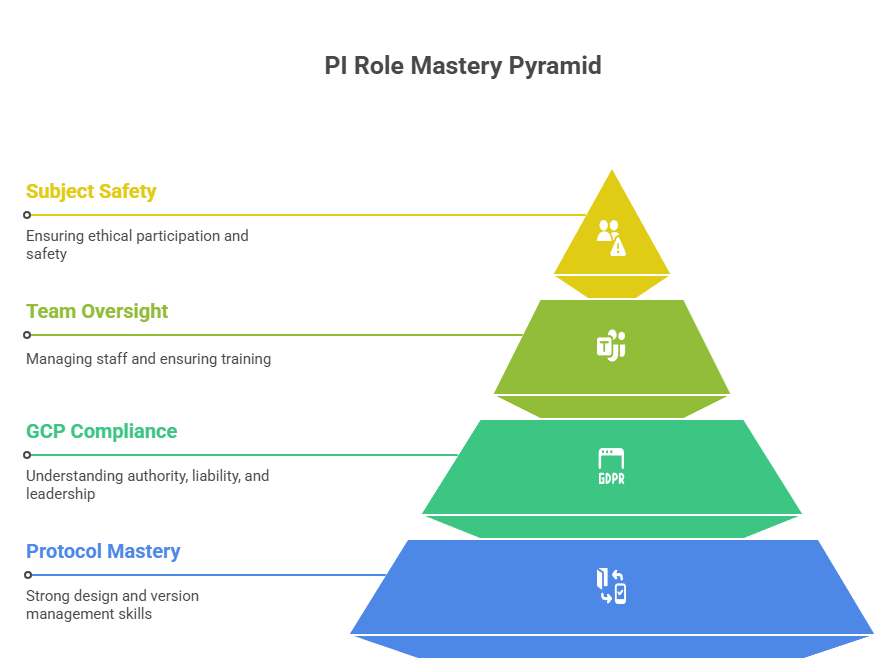
Protocol Development and Version Management
Strong protocol design is the bedrock of trial success. You must understand how to assess feasibility, manage protocol amendments, and ensure every version reflects updated safety data and regulatory shifts. The exam often presents cases where outdated protocol versions were mistakenly used, or where feasibility reviews were skipped. Knowing how to handle such errors is vital.
For structured guidance, review CCRPS’s Clinical Trial Protocol Development Guide, which details the lifecycle of protocol planning from draft to final approval.
Investigator Responsibilities Under GCP
GCP compliance isn’t just a checkbox—it defines your authority, liability, and leadership in the trial. You’ll be assessed on how you delegate duties, maintain subject safety, and document ongoing consent. For example, if a delegated staff member underperforms, how would you retrain and document corrective action?
Get fluent in these principles by reading the GCP Guidelines Mastery Guide, which outlines must-follow practices every PI should internalize.
Clinical Team Oversight and Documentation
One of the highest-yield topics is how you manage your trial team. The exam emphasizes your role in supervising delegated staff, maintaining logs, and ensuring training is current and documented. Expect scenarios where oversight lapses resulted in protocol deviations.
For oversight strategies, refer to CCRPS’s article on Managing Clinical Research Teams, which breaks down effective documentation and leadership techniques.
Subject Safety and Informed Consent
Ensuring ethical participation and reporting safety issues is central to the PI role. You’ll need to understand AE/SAE/SUSAR distinctions, when to re-consent participants, and how to approach vulnerable populations. You might face exam questions on what to do if a participant develops an unexpected reaction after dosing.
To prepare, study the Informed Consent Guide, which addresses both initial and ongoing consent obligations.
30-Day Study Strategy for Busy Clinical Professionals
If you’re balancing patient care, research, or academic duties, this 30-day strategy is built to work with your schedule—focusing on exam-critical topics using real tools and templates.
Phase 1: Understand the Exam Framework (Days 1–7)
Start by reviewing regulatory expectations from ICH-GCP, FDA, and EMA, with particular focus on how PI responsibilities intersect with sponsor SOPs. This sets the groundwork for all scenario-based questions. Pay special attention to source documentation, audit preparedness, and data privacy alignment.
A great starting point is this simplified ICH Guidelines Overview, which translates dense regulatory texts into actionable insights for investigators.
Phase 2: Master Core Domains (Days 8–20)
Dedicate this phase to drilling core PI topics—protocol adherence, delegation of authority, informed consent, AE/SAE handling, and data query resolution. Use real document templates such as DOA logs, protocol deviation trackers, and site staff training records. Reinforce your terminology knowledge with specialized glossaries designed for PI roles.
Use CCRPS’s Top 20 Clinical Research Terms for PIs to ensure you're fluent in the vocabulary that drives exam scenarios and real-world compliance.
Phase 3: Simulate Exam Conditions (Days 21–30)
Now’s the time to test retention. Complete two full-length mock exams under timed conditions. Afterward, focus reviews on missed questions and weak areas. Revisit AE logs, delegation examples, and case studies where protocol deviations triggered site audits.
Practice compliance interpretation using CCRPS’s Protocol Deviation Compliance Guide, which explains how regulators view—and penalize—avoidable PI errors.
| Phase | Days | Focus | Resources & Tips |
|---|---|---|---|
| Understand the Exam Framework | Days 1–7 | Regulatory standards, PI roles, source documentation, audit prep |
Review ICH-GCP, FDA, EMA guidelines. Use: ICH Guidelines Overview |
| Master Core Domains | Days 8–20 | Protocol adherence, DOA, informed consent, AE/SAE, data queries |
Practice with DOA logs, deviation trackers, training records. Use: Top 20 Clinical Research Terms for PIs |
| Simulate Exam Conditions | Days 21–30 | Mock exams, AE review, deviation handling, audit triggers |
Take 2 full mock exams. Focus review on weak areas. Use: Protocol Deviation Compliance Guide |
Tools and Templates You Should Practice With
To pass the PI certification exam and excel post-certification, you must master essential clinical trial documentation. These tools aren’t just paperwork—they are central to trial integrity, regulatory compliance, and sponsor trust.
Delegation of Authority Log, Site Staff Logs
Every Principal Investigator must know how to properly complete a Delegation of Authority (DOA) log. This includes assigning roles based on qualifications, documenting training, and ensuring that all site staff entries reflect protocol-specific responsibilities. Logs must be signed and dated accurately, with updates whenever team composition changes.
Use the Clinical Research Team Management Guide to learn how to effectively track, oversee, and audit your DOA and staff records throughout the study.
AE/SAE Logs, Visit Reports, eCRFs
Proper AE and SAE documentation is a cornerstone of PI responsibilities. Learn how to complete, verify, and escalate safety reports using sponsor forms or eCRFs. Document each site visit with details on patient status, protocol compliance, and any deviations.
CCRPS’s Adverse Events Management Guide offers a sharp breakdown of what makes or breaks compliant reporting—from initial identification to final resolution.
TMF/eTMF and Compliance Checks
Whether you’re working with paper-based Trial Master Files (TMFs) or electronic systems (eTMFs), your documentation must meet audit standards. That includes investigator brochures, signed protocols, consent forms, and communication logs. Understand retention timelines, version control, and sponsor submission requirements.
For a complete walkthrough, explore CCRPS’s Clinical Trial Documentation Under GCP Guide, which maps out exactly what auditors expect.

How CCRPS Certification Equips You for Real-World Success
Passing the Principal Investigator Certification Exam isn’t just a box to check—it’s a transition into authoritative, globally respected leadership in clinical research. CCRPS builds this transition into every component of its certification experience.
What the CCRPS PI Certification Covers
The CCRPS Principal Investigator Certification spans every domain critical for leading investigator-initiated and sponsor-driven trials. You’ll gain mastery in protocol development, delegation of duties, safety reporting, regulatory submission, and data accountability. The curriculum is aligned with FDA, EMA, and ICH-GCP frameworks and includes case-based training to help you handle real-world trial complexities confidently.
Global Applicability and Industry Acceptance
This certification is recognized by CROs, pharmaceutical sponsors, academic institutions, and independent trial sites worldwide. Whether you're managing U.S.-based oncology trials or multinational Phase III studies, the credential aligns with expectations from global regulatory bodies. Learn how certification aligns with global roles through our Clinical Research Regulatory Authorities Directory.
Alumni Success Stories and Completion Data
CCRPS-certified PIs report a strong reduction in protocol deviation rates and improved site readiness metrics. Completion data shows a first-time pass rate exceeding industry benchmarks, with alumni transitioning into lead PI roles, site directors, and medical monitors across top clinical research centers.
How CCRPS Certification Equips You for Real-World Success
Passing the Principal Investigator Certification Exam isn’t just a milestone—it marks your transition into globally respected leadership in clinical research. CCRPS embeds this transformation into every aspect of its curriculum.
What the Certification Covers
The CCRPS PI Certification trains you across all domains vital to trial leadership: protocol development, delegation of duties, safety reporting, regulatory submissions, and data accountability. Built around FDA, EMA, and ICH-GCP guidelines, the course integrates real case scenarios to prepare you for real-world complexities.
Global Relevance and Recognition
This certification is trusted by CROs, pharmaceutical sponsors, academic institutions, and independent sites. It equips you to lead trials ranging from U.S.-based oncology research to global Phase III studies. Explore its international relevance in our Clinical Research Regulatory Authorities Directory.
Measured Outcomes and Alumni Success
CCRPS-certified PIs consistently report fewer protocol deviations and better site readiness scores. Completion data shows a first-time pass rate above industry norms, with graduates moving into lead investigator, site director, and medical monitor roles worldwide.
Final Thoughts: How Certified PIs Lead Smarter and Safer Trials
Becoming a certified Principal Investigator means stepping into a leadership role where every decision influences subject safety, data integrity, and regulatory compliance. The PI Certification isn’t just about passing an exam—it’s about transforming your clinical instincts into globally trusted practice.
CCRPS supports this transformation by offering a curriculum built on real-world protocol execution, ICH-GCP alignment, and high-level documentation skills. With tools like delegation logs, TMF templates, and sponsor-ready oversight checklists, CCRPS prepares you not just for the test—but for the trial.
For clinical professionals ready to lead smarter, safer, and more compliant trials, the CCRPS Principal Investigator Certification is the next logical step.
-
A Principal Investigator (PI) is the lead authority responsible for the conduct, oversight, and regulatory compliance of a clinical trial. The PI ensures the study protocol is followed, data is collected accurately, and participant safety is prioritized. This includes supervising staff, managing delegation of duties, reviewing adverse events, and ensuring proper informed consent. The PI is also the main point of contact with sponsors and regulatory bodies, making their leadership essential to a trial’s success and ethical conduct.
-
The exam is challenging but manageable with focused preparation. It features 100–125 multiple-choice, scenario-based questions requiring real-world application of GCP, delegation practices, and ethical decision-making. Most questions are built around common trial issues, such as protocol deviations, adverse event reporting, and site oversight. It’s not about memorization—it’s about understanding how to lead a study compliantly. Candidates who study regularly, use practice questions, and review real documentation templates tend to perform well on the first attempt.
-
While not mandatory, prior experience in clinical trials—especially in oversight or decision-making roles—is highly recommended. Familiarity with ICH-GCP, FDA/EMA regulations, delegation logs, and IRB interactions helps tremendously. Those coming from CRC, CRA, or sub-investigator roles often transition well because they’ve been exposed to documentation standards and site-level responsibilities. However, even new investigators can succeed with a strong study plan, case-based learning, and practice simulations to build confidence in managing trial operations.
-
Yes. The CCRPS Principal Investigator Certification is open to clinical professionals worldwide. It’s designed based on ICH-GCP, FDA, and EMA guidelines, making it applicable in global trials. International candidates—from India, Europe, the Middle East, Africa, and Asia-Pacific—regularly enroll to boost their qualifications and align with sponsor requirements. All course materials and the exam are in English, and no physical presence is required since the entire process is online. It’s especially valuable for investigators involved in global multicenter studies.
-
You should prioritize four key domains: protocol development, delegation and training logs, informed consent processes, and adverse event reporting. These areas form the backbone of trial oversight. Practice how to manage amendments, document staff training, re-consent vulnerable populations, and respond to serious safety events. Use checklists, mock logs, and scenario questions to test your application of guidelines. A strong grasp of documentation accuracy, ethics, and regulatory alignment will give you the confidence to navigate the real test—and your role as PI.
