
Top 50 Principal Investigator Certification Exam Questions with Answers
Preparing for the Principal Investigator (PI) Certification Exam means more than memorizing definitions—it’s about applying real-world regulatory judgment. Each exam question tests how well you understand your obligations as a PI, including documentation, delegation, and ethical oversight. With increasing global trial complexity, regulators demand not only qualified investigators but certified ones who can lead confidently under scrutiny.
This guide features 50 realistic exam-style questions and answers to help you internalize the core responsibilities of a certified PI. You'll cover everything from GCP compliance to adverse event reporting, protocol execution, and subject safety—exactly what the exam focuses on.
Each answer is grounded in ICH-GCP, FDA 21 CFR, and sponsor SOP expectations. If you’re just starting, we recommend reviewing this primer on PI responsibilities in clinical trials to ensure foundational clarity before diving in.

Questions on GCP and Regulatory Compliance
Q1. What is a PI’s primary responsibility under ICH-GCP?
A1. To ensure the rights, safety, and well-being of trial subjects are protected and that the trial is conducted per the approved protocol, ICH-GCP, and regulatory requirements.
Q2. What must be included in a Trial Master File (TMF)?
A2. The TMF should include protocols, amendments, delegation logs, training records, ethics approvals, and source documentation. Learn more about GCP-required documentation.
Q3. When must protocol deviations be reported?
A3. Immediately if subject safety is at risk, otherwise in periodic reports and at close-out. The sponsor and IRB must be notified per SOPs.
Q4. What is the 21 CFR Part 312 requirement for PI documentation?
A4. PIs must maintain accurate case histories, signed informed consent, and reports of adverse events per FDA regulations.
Q5. What documentation proves GCP compliance?
A5. Signed protocol, delegation log, informed consent forms, and monitoring visit reports.
Q6. How should a PI respond to a sponsor audit?
A6. Provide access to requested documents, ensure staff availability, and demonstrate data integrity and protocol adherence.
Q7. Who ensures that staff are GCP-trained?
A7. The PI must verify and document that all staff involved in the trial have up-to-date GCP training.
Q8. What’s the best way to document PI oversight?
A8. Through meeting minutes, signed logs, audit trails, and ongoing review of data entries and visit reports.
Q9. How often should essential documents be reviewed?
A9. At each monitoring visit and routinely by the PI to ensure they remain current and complete.
Q10. What happens if the PI fails to report a deviation?
A10. It may trigger regulatory findings or trial suspension. Use a CAPA plan to document mitigation and retraining if needed.
Key PI Responsibilities under GCP
- Ensure subject safety and adherence to protocol under ICH-GCP guidelines.
- Maintain accurate documentation, including case histories, informed consent, and adverse events.
- Report protocol deviations promptly to the sponsor and IRB to avoid regulatory penalties.
Learn more about GCP compliance and PI responsibilities.
Informed Consent and Ethics Questions
Q11. What should a PI do if a subject didn’t re-consent after a protocol amendment?
A11. The subject must pause participation until re-consent is obtained. The PI should document the lapse, notify the IRB, and retrain staff. Understand consent protocols thoroughly here.
Q12. Who is legally allowed to obtain informed consent?
A12. Only individuals listed on the delegation log and trained on the protocol and consent process—usually the PI or sub-investigators.
Q13. What’s required for informed consent to be valid?
A13. It must be voluntary, documented with a signed and dated form, and based on clear explanation of risks, benefits, and procedures.
Q14. Can verbal consent ever be acceptable?
A14. Only under IRB-approved emergency protocols where written consent is not feasible, followed by formal written consent ASAP.
Q15. How should vulnerable populations be consented?
A15. With added protections, often involving legally authorized representatives and additional IRB safeguards.
Q16. When is re-consent mandatory?
A16. Whenever protocol changes impact subject rights, safety, or the study procedures.
Q17. What if a subject refuses to re-consent?
A17. The subject must be withdrawn from the study; document the refusal and notify the sponsor.
Q18. How long should signed consent forms be retained?
A18. As required by local regulations—typically for 2 years post-marketing or longer, depending on sponsor or country rules.
Q19. What makes a consent process inadequate?
A19. Rushed explanations, language barriers, missing signatures/dates, or failure to answer the subject’s questions.
Q20. What’s the PI’s responsibility after delegation of consent duties?
A20. The PI must review consent documentation regularly and ensure continuous training and oversight of delegated staff.
Which informed consent question do you feel least confident about?
Protocol Execution and Site Oversight
Q21. What should a PI do if site staff uses an outdated protocol version?
A21. Immediately halt subject activities under the old version, retrain the team, notify the sponsor and IRB, and document a protocol deviation. For more on PI responsibilities in protocol management, review this guide on clinical trial protocol development.
Q22. How should missed subject visits be handled?
A22. Document them clearly, assess for safety impact, and report as protocol deviations if timelines were critical.
Q23. Can a PI delegate protocol implementation to a coordinator?
A23. Yes, but the PI remains ultimately accountable and must verify adequate training and oversight.
Q24. What if the site has repeated minor deviations?
A24. Investigate root causes, retrain the team, implement CAPA, and escalate to the sponsor if needed.
Q25. How often should protocol version updates be reviewed with staff?
A25. At each amendment and during routine team meetings or site initiation visits.
Q26. Who should receive protocol amendment notifications?
A26. All delegated site staff, IRB/IEC, sponsor, and any vendors impacted by procedural changes.
Q27. What if the sponsor suggests implementing a protocol change before IRB approval?
A27. Decline—no changes should be implemented until IRB approval is granted, except in urgent safety cases.
Q28. What are red flags of poor site oversight?
A28. Frequent protocol deviations, untimely SAE reporting, outdated logs, and inconsistent documentation.
Q29. How is protocol compliance monitored?
A29. Through internal audits, CRA monitoring visits, and regular review of subject documentation and logs.
Q30. What makes protocol execution successful?
A30. Consistent training, clear delegation, real-time communication, and rigorous adherence to current approved versions.
| Key Question | Summary |
|---|---|
| Outdated Protocol Version | Halt activities, retrain, notify sponsor & IRB, and document deviation. |
| Missed Subject Visits | Document, assess safety, report deviation if timelines critical. |
| Delegation of Protocol | PI accountable, must verify training and oversight. |
| Repeated Minor Deviations | Investigate, retrain, implement CAPA, escalate if needed. |
| Protocol Version Updates | Review at amendments or routine meetings. |
| Protocol Amendment Notifications | Notify all delegated staff, IRB, sponsor, and impacted vendors. |
| Implementing Protocol Change Before IRB Approval | Decline unless urgent safety issue. |
| Red Flags of Poor Site Oversight | Frequent deviations, untimely SAE reporting, outdated logs. |
| Monitoring Protocol Compliance | Internal audits, CRA visits, review documentation/logs. |
| Successful Protocol Execution | Training, clear delegation, real-time communication, adherence. |
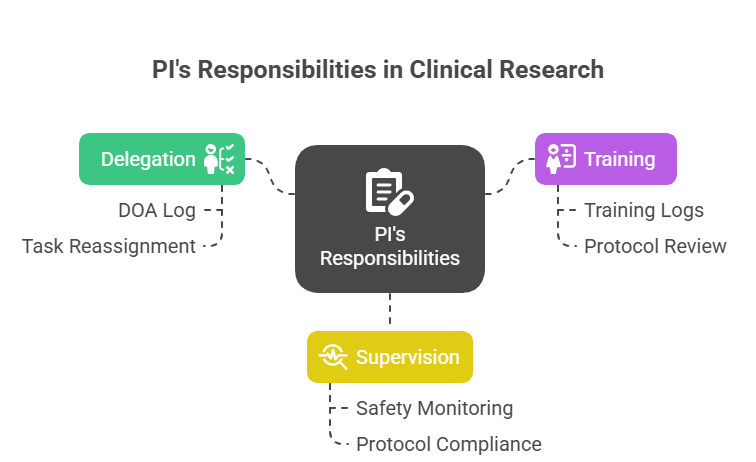
Delegation, Training, and Staff Supervision
Q31. What’s the PI’s responsibility for errors made by sub-investigators?
A31. The PI is ultimately responsible for all actions performed by sub-investigators. The PI must ensure they are properly trained, monitor their work closely, and address any deviations promptly. Learn more about overseeing clinical research teams in Managing Clinical Research Teams.
Q32. How often should training logs be updated and signed?
A32. Training logs should be updated after each training session or change in study protocol and signed by both the PI and the staff member.
Q33. Can the PI delegate the responsibility of monitoring subject safety to another investigator?
A33. Yes, but the PI must oversee the monitoring activities and ensure that subject safety is consistently prioritized. Any issues must be immediately reported to the PI.
Q34. How do you ensure site staff understand their roles and responsibilities?
A34. Through regular training sessions, review of the protocol, and by providing clear documentation of roles and responsibilities as outlined in delegation logs.
Q35. What documentation should a PI maintain regarding delegation?
A35. A Delegation of Authority (DOA) log, training records, and any correspondence that confirms staff understanding of their assigned tasks.
Q36. What if a sub-investigator is unable to perform their duties?
A36. The PI must either reassign the duties to another qualified staff member or take on the tasks themselves until an appropriate solution is found.
Q37. Should the PI be involved in every aspect of training?
A37. While the PI may delegate training, they must oversee the process to ensure staff competency and adherence to the protocol and regulatory requirements.
Q38. How should you manage a situation where the study coordinator is not following protocol?
A38. The PI should address the issue by reviewing training, providing corrective actions, and documenting the event. Continuous issues should lead to corrective and preventive actions (CAPA).
Q39. How do you track ongoing staff competence and training?
A39. By regularly reviewing training logs, conducting refresher training, and ensuring documentation is up to date and accessible.
Q40. What’s the best way to communicate expectations to site staff?
A40. Through clear, written protocols, regular meetings, and having a direct line of communication for any questions or concerns related to protocol compliance.
Safety, AE Reporting, and Subject Protection
Q41. What’s the required timeline for SAE reporting?
A41. Serious Adverse Events (SAEs) must be reported to the sponsor and IRB within 24 hours of being identified, unless a longer timeline is stipulated by protocol. For detailed steps, refer to Adverse Events Management.
Q42. If a subject reports a serious AE at home, what’s the PI’s next move?
A42. The PI must assess the severity, determine if immediate medical intervention is needed, and report the AE to the sponsor and IRB per protocol. The PI should also document the event thoroughly and take action to prevent recurrence.
Q43. What should the PI do if an AE is not promptly reported?
A43. The PI must immediately report the AE, document the delay, and implement corrective actions to ensure timely reporting in the future. Read more about AE reporting.
Q44. How does the PI ensure subject protection during a clinical trial?
A44. By maintaining informed consent, ensuring proper training of site staff, monitoring adverse events, and addressing any safety concerns immediately. Ongoing communication with the sponsor and regulatory bodies is also essential.
Q45. How should a PI handle an AE that is suspected to be related to the investigational product?
A45. The PI must assess the event, take necessary medical actions, and immediately notify the sponsor, IRB, and regulatory bodies. Documentation must include details about the incident, actions taken, and follow-up plans.
Q46. What should the PI do if a subject experiences a serious SAE but doesn't wish to report it?
A46. The PI must report the SAE per protocol, even if the subject refuses to allow it. Safety regulations require that the PI ensures the integrity of the reporting process for participant protection.
Q47. How does the PI ensure the safety of vulnerable populations in clinical trials?
A47. By ensuring additional safeguards, such as legally authorized representatives for minors or incapacitated adults, ensuring informed consent is fully understood, and ensuring the protocol includes protections specific to vulnerable groups.
Q48. What does the PI do if the subject withdraws consent mid-study?
A48. The PI must remove the subject from the trial, document the withdrawal, and ensure the subject’s data and samples are handled according to the protocol. The PI should also notify the sponsor and IRB as required.
Q49. What is the PI’s responsibility if a subject experiences a severe reaction post-study participation?
A49. The PI must follow up with the subject to assess health status, notify the sponsor, and report the incident as an SAE, following established reporting timelines.
Q50. How does the PI ensure ongoing safety monitoring during the trial?
A50. Through continuous monitoring of clinical data, regular review of AEs/SAEs, interim analysis reports, and ensuring ongoing informed consent processes. Regular audits and site visits further ensure that safety measures are consistently applied.
Safety, AE Reporting, and Subject Protection
- SAE Reporting: Report to sponsor & IRB within 24 hours. Refer to Adverse Events Management.
- Subject-Reported AE: Assess severity, intervene if needed, and notify sponsor & IRB.
- Delayed AE Reporting: Document delay, report immediately, and implement corrective actions.
- Ensuring Subject Protection: Ongoing informed consent, monitoring AEs, and staff training.
- AE Related to Investigational Product: Assess, notify sponsor/IRB, and document in detail.
- SAE Refused by Subject: Report per protocol even if subject refuses consent.
- Safety of Vulnerable Populations: Additional safeguards, informed consent, and protocol-specific protections.
- Withdrawal of Consent: Remove subject, document withdrawal, and notify sponsor & IRB.
- Severe Reaction Post-Study: Follow up with subject, report as SAE, and notify sponsor.
- Ongoing Safety Monitoring: Continuous data review, AE/SAE monitoring, and audits.
Final Thoughts: Practice the Way You’ll Be Tested
Succeeding in the Principal Investigator Certification Exam requires more than just theoretical knowledge—it requires the ability to apply real-world practices. The exam is designed to test your judgment and preparedness to manage clinical trials with compliance and subject safety at the forefront. By practicing with scenario-based questions, you’ll sharpen your ability to think critically under pressure and navigate complex regulatory requirements.
Using resources like CCRPS’s certification course and mock exams ensures you understand the expectations of the role. It’s not just about memorizing protocol details; it’s about demonstrating effective leadership, documentation skills, and the ethics required to manage clinical trials successfully.
By adopting a study plan that simulates the actual exam conditions, you can increase your chances of passing on the first attempt and stepping into a confident, leadership-driven PI role.
Explore CCRPS’s Principal Investigator Certification to transform your career and gain access to regulatory tools, templates, and exam simulations.
Frequently Asked Questions
-
To sit for the Principal Investigator Certification Exam, candidates must generally have a medical background, such as an MD, PharmD, or PhD, with direct involvement in clinical research. Ideal candidates are those who have led investigator-initiated or sponsor-driven trials, or those transitioning into a leadership role in clinical trials. Clinical professionals, including clinical researchers, sub-investigators, and those already working in clinical research positions, may also benefit from this certification as it formalizes their knowledge and skills, aligning with global regulatory standards.
-
Preparation time varies based on experience and familiarity with the material. On average, candidates spend about 4–6 weeks preparing for the exam, devoting 1–2 hours daily to study. This includes reviewing GCP guidelines, protocol management, adverse event reporting, and subject safety. A solid study plan, including mock exams and practice questions, is essential to mastering the content. For those with prior experience, focused study on weak areas may suffice. CCRPS offers a 30-day study roadmap, with resources that simplify this process.
-
The Principal Investigator Certification focuses more heavily on leadership, decision-making, and regulatory oversight in clinical trials, while other certifications (e.g., CRA, CRC) focus more on monitoring, coordination, and site management. The PI exam tests your ability to manage trial integrity, protect subject safety, and apply regulatory knowledge in complex, real-world scenarios. While CRA or CRC exams may test procedural adherence, the PI exam assesses how well you can lead, delegate, and ensure compliance at the trial’s highest level.
-
Earning the Principal Investigator Certification demonstrates your expertise in clinical trial leadership, making you a stronger candidate for senior roles like lead PI, site director, or medical monitor. It also aligns you with global regulatory standards, such as ICH-GCP, and helps you navigate complex sponsor and IRB expectations. This certification can give you a competitive edge in both academic settings and the pharmaceutical industry, opening doors to high-level clinical trials, multinational studies, and sponsor-driven projects.
-
If you don’t pass the PI certification exam, you’re allowed to retake it. There is no limit on the number of attempts, though a re-exam fee may apply. After failing, CCRPS recommends reviewing the exam feedback to identify areas where improvement is needed. Many candidates benefit from additional study, focused on weak areas such as protocol deviations, documentation compliance, and adverse event handling. Implementing a tailored study plan and taking more practice exams can greatly increase your chances of success on subsequent attempts.
