
Your research assistant certification exam tests decisions that can affect participant safety, study documentation, and clinical trial quality. A missed protocol restriction, incorrect specimen label, misunderstood consent responsibility, or unreported data discrepancy can expose weaknesses that memorized definitions rarely reveal. This practical checklist helps you prepare for the examination and the real responsibilities behind it, covering research assistant training requirements, clinical research protocol adherence, trial logistics coordination, documentation, GCP compliance, and exam-day decisions that demand accuracy under pressure.

1. Verify Your Research Assistant Exam Requirements and Identify the Highest-Risk Topics
Research assistant certification assessments can differ substantially in question count, duration, passing standard, permitted materials, and retake conditions. The first exam-day task is confirming the requirements of your specific assigned assessment.
For CCRPS learners, the Research Assistant course information and general examination information may describe different assessment configurations. Use the current examination instructions in your assigned learning portal to confirm your exact question count, passing score, attempts, and time limits. Avoid relying on a general FAQ or an unrelated certification examination for these details.
This matters particularly for candidates using research assistant certification to strengthen entry-level clinical research applications or compare clinical research assistant, CTA, and CRC career pathways.
Confirm the exam blueprint and authorized materials
Review the syllabus, relevant training modules, question format, permitted resources, submission procedure, and retake policy.
A research assistant exam may assess study methodologies, GCP principles, informed consent, trial documentation, data collection, and site operations. Some programs also assess basic statistics, research design, and interpretation of study results.
Pay close attention to ICH E6(R3) expectations, particularly proportionate training, documented responsibilities, participant protection, and reliable records. Review the role-specific skills outlined in essential research assistant training and clinical research ethics resources.
If the examination permits reference materials, confirm which documents and electronic resources are authorized. Complete a practice assessment using the same conditions.
Separate research assistant duties from investigator responsibilities
One of the most consequential examination traps involves assigning the right decision to the wrong person.
A research assistant may prepare visit documents, organize supplies, enter authorized study data, coordinate schedules, and flag discrepancies. However, the boundaries of specific duties depend on training, qualifications, delegation, protocol requirements, and applicable law.
The principal investigator retains responsibility for appropriate oversight of delegated trial activities. An assistant should escalate a clinical concern to authorized personnel rather than independently make medical decisions outside their assigned responsibilities.
Review investigator responsibilities under GCP, site operations oversight, and research assistant collaboration and communication.
Establish a practical knowledge baseline
Before entering the final revision period, work through five short scenarios: a missed visit window, an incorrectly labeled specimen, a consent-form discrepancy, a newly reported symptom, and a late source-data entry.
For each, identify the potential risk, relevant protocol requirement, authorized responsible person, immediate response, and necessary documentation.
These cases combine protocol adherence, trial logistics management, adverse-event reporting, and clinical-trial data integrity.
Record any errors in a compact review sheet. Label each mistake as a knowledge gap, role-boundary misunderstanding, incorrect escalation decision, or documentation failure. That classification tells you what to revise next.
| Research Assistant Certification Exam Day: 32-Point Readiness & Decision Matrix | |||
|---|---|---|---|
| Checkpoint | What to Verify | Common Failure | Best Action |
| 1. Assigned examination | Course and assessment identity | Preparing for another credential | Check your actual learner dashboard. |
| 2. Exam blueprint | Domains and topic weightings | Missing high-priority competencies | Map revision to assigned modules. |
| 3. Exam version | GCP edition and applicable course material | Using outdated principles | Verify relevant ICH E6(R3) coverage. |
| 4. Question format | Question count, scenarios, navigation | Incorrect pacing assumptions | Practice the stated assessment format. |
| 5. Score and retakes | Passing threshold and remaining attempts | Unexpected failure or extra fees | Confirm current provider rules. |
| 6. Permitted resources | Notes, books, calculators, web access | Accidental rule violation | Use only expressly authorized materials. |
| 7. Date and time | Local time zone and check-in window | Late arrival or missed access | Set reminders using the correct local time. |
| 8. Identification | Name, ID type and expiration | Check-in refusal | Resolve discrepancies in advance. |
| 9. Portal access | Account, passwords and assigned exam | Login or enrollment failure | Test access without launching the exam. |
| 10. Device compatibility | Browser, operating system and permissions | Exam software blocked | Run the official technical check. |
| 11. Connection and power | Internet stability and reliable electricity | Exam interruption | Prepare permitted contingencies. |
| 12. Testing environment | Workspace, devices, breaks and accommodations | Disqualification or distraction | Complete all applicable security checks. |
| 13. Research question | Hypothesis, outcome and study objective | Confusing study purpose with procedure | Identify exposures, outcomes and objectives. |
| 14. Study design | Randomized, observational and blinded designs | Incorrect causal interpretation | Classify examples by design and limitations. |
| 15. Basic statistics | Mean, median, variability and confidence intervals | Overstating findings | Interpret simple results and uncertainty. |
| 16. Delegation boundaries | Assigned duties, qualifications and oversight | Performing unauthorized tasks | Match actions to documented authorization. |
| 17. Informed consent | Approved version, timing and authorized staff | Invalid consent or privacy concerns | Confirm valid consent before relevant procedures. |
| 18. IRB/IEC approval | Current protocol and approved study documents | Using superseded materials | Verify effective version and approval status. |
| 19. Eligibility criteria | Inclusion/exclusion evidence and review authority | Ineligible participant enrollment | Flag missing or conflicting eligibility evidence. |
| 20. Visit windows | Schedule, timing limits and required procedures | Missed assessments or protocol deviations | Calculate visit windows and escalate conflicts. |
| 21. Specimen identification | Participant code, tube type, draw time and label | Misidentified or unusable sample | Follow identity, labeling and escalation SOPs. |
| 22. Sample handling | Processing intervals, storage and shipping conditions | Compromised sample integrity | Use the laboratory manual and approved workflow. |
| 23. Adverse-event recognition | New symptoms, hospitalization and escalation | Delayed safety communication | Notify authorized clinical staff promptly. |
| 24. Source documentation | Attribution, timing, accuracy and completeness | Unverifiable research data | Apply ALCOA+ documentation principles. |
| 25. EDC and eCRF entries | Source alignment, authorized entry and queries | Unsupported changes or inaccurate data | Resolve discrepancies with traceable evidence. |
| 26. Privacy and access | Least-privilege access and secure communication | Confidentiality breach | Use approved platforms and minimum necessary data. |
| 27. Randomization and blinding | Assignment process and access restrictions | Selection bias or accidental unblinding | Protect allocation and authorized access. |
| 28. Protocol deviations | Deviation recognition, impact and reporting | Hidden or repeated compliance failures | Document, escalate and follow corrective procedures. |
| 29. Communication | Urgency, recipient and essential facts | Unsafe or delayed escalation | State the issue, risk, evidence and next action. |
| 30. Quality and CAPA | Immediate correction versus recurrence prevention | Same operational error repeats | Separate containment, root cause and prevention. |
| 31. Question triage | Time budget, flagging and review features | Excessive time spent on one case | Use a time-controlled first pass if allowed. |
| 32. Completion evidence | Score report, certificate, date and issuer | Missing or unverifiable training proof | Save and verify approved completion records. |
2. Your Research Assistant Exam Preparation Timeline: 24 Hours to Check-In
The final 24 hours should prioritize active recall, accurate exam logistics, and practical decision-making. Repeatedly rereading training materials can create an inflated sense of familiarity without proving that you can handle realistic research situations.
24 hours before: verify access and resolve procedural risks
Open the assigned examination portal and verify that your assessment appears under the correct course. Confirm whether the exam is available on demand or has a scheduled start time.
Check any required identification, device compatibility, browser restrictions, internet requirements, and accommodation arrangements. Review the instructions for interruptions or technical problems.
If your program allows an open-book assessment, organize only the authorized study materials. If the examination is closed-book, practice without assistance. The same care used in clinical research compliance documentation should guide your preparation.
Create a final revision plan based on your error log. Candidates who repeatedly miss protocol adherence questions should revisit visit windows, eligibility requirements, and amendment control. Those struggling with trial logistics should practice specimen coordination, appointment scheduling, and document routing.
The evening before: rehearse five operational decisions
Use five short case studies instead of attempting to memorize every page of your course.
First, consider a participant arriving outside a protocol-defined visit window. Determine whether the procedure can proceed, who must assess the situation, and what documentation may be required. Then consider a missing laboratory-kit component that threatens the processing timeline.
Next, work through a participant who reports a new symptom, a specimen label that conflicts with the source record, and an EDC query that cannot be answered from the available documentation.
Each exercise should end with a defensible escalation and documentation plan. These cases reinforce clinical trial safety reporting, source-data integrity, research communication, and site quality management.
Close your preparation by reviewing the errors, particularly where your first response crossed an authorization boundary or overlooked a safety concern.
Two hours before: protect your working memory
Finish substantive revision. Prepare your testing environment, check approved materials, and confirm the examination instructions one final time.
Avoid beginning a completely unfamiliar module. A last-minute attempt to master advanced statistics or new regulations may displace stronger knowledge of informed consent, research assistant responsibilities, and basic clinical documentation.
If you are taking a timed examination, establish an initial pacing strategy. If your assessment has no stated time limit, concentrate on accuracy while avoiding unnecessary second-guessing.
During check-in: follow the exact testing rules
For supervised examinations, complete any required identity checks and follow proctor instructions. For self-paced online assessments, verify that the correct examination has loaded before beginning.
Understand whether questions can be revisited, whether the platform saves answers automatically, and whether final submission is irreversible.
If a technical issue occurs, use the authorized support process. Treat documentation of a disruption with the same discipline expected in trial operations communication and research quality procedures.
3. Master the Research Assistant Scenarios That Reveal Real Competency Gaps
Research assistant examinations often become challenging when a question combines basic scientific knowledge with an operational decision. A candidate may understand what randomization means but struggle when a participant's allocation is accidentally disclosed. Another may recognize an abnormal laboratory result but fail to identify the appropriate reporting pathway.
The strongest approach combines research methods knowledge with protocol-specific responsibilities and clinical research ethics.
Scenario 1: A participant's specimen has the wrong identifier
Suppose a blood sample is labeled with an identifier that differs from the participant's source record.
Your first priority is protecting specimen identity and preventing an unreliable result from entering the trial database. The appropriate response follows the laboratory manual, site SOPs, and authorized escalation process.
Do not assume the label can simply be replaced. Some specimen-identification discrepancies require quarantine, documented reconciliation, rejection, or recollection, depending on the applicable requirements.
This tests whether you understand how clinical trial logistics, source-data integrity, and research assistant training intersect.
Scenario 2: A participant asks the assistant to explain an unanticipated treatment risk
The assistant should recognize the participant's concern, preserve their opportunity to ask questions, and involve an appropriately qualified, authorized member of the study team.
The candidate should avoid independently interpreting medical risks beyond their competence or assigned authority.
This distinction is essential to ethical clinical research, investigator oversight, and research team communication.
A useful answer identifies the participant's immediate need, the appropriate person to address it, and the importance of allowing a genuinely informed decision.
Scenario 3: A sample requires processing within 30 minutes, but the laboratory is unavailable
The correct approach depends on the laboratory manual, study protocol, available contingency arrangements, and staff authorization.
An assistant should promptly escalate the risk, identify whether an approved alternative exists, document the timing accurately, and avoid misrepresenting a processing interval.
If a sample becomes unsuitable, the team must follow the applicable procedures concerning sample rejection, replacement, and documentation.
These decisions reflect trial logistics coordination, protocol compliance, and clinical research quality management.
Scenario 4: The EDC system displays a query about a missing assessment
An EDC query identifies information requiring review or clarification. The assistant should verify the available source documentation and respond only within their authorization and established procedures.
If the assessment was never performed, entering a fabricated value would compromise the study record. The correct response may involve documenting the missing assessment, determining whether a deviation occurred, and escalating for appropriate review.
Recognize the distinction between missing data, late data entry, and an inaccurate source record. These situations can require different corrective actions.
Review clinical-trial data integrity, protocol adherence, and quality management procedures.
Scenario 5: A participant reports dizziness during a scheduled research visit
A new symptom warrants timely communication to qualified clinical personnel, even if the assistant thinks it is minor or unrelated to the study treatment.
The assistant should follow the site's safety escalation procedure and accurately convey the available facts. Appropriate clinical personnel assess the participant and determine any required safety documentation and reporting.
Questions like this may test the difference between recognizing a potential adverse event and making a medical assessment.
Study adverse-event reporting requirements, clinical-trial safety oversight, and investigator responsibilities.
Scenario 6: A research report claims that a statistically significant result proves causation
Consider a study reporting a p-value below 0.05 for an association between treatment exposure and an outcome.
Statistical significance alone does not establish causality. Interpretation depends on study design, confounding, bias, effect size, precision, and the methods used.
For basic research methods questions, distinguish randomized from observational designs, recognize when correlation cannot support causal claims, and understand that a confidence interval conveys a range of estimates under a particular statistical method.
Candidates should also distinguish the mean from the median when data are skewed and recognize how outliers affect summary statistics.
These principles support research assistant competency development, clinical-trial data integrity, and informed evaluation of clinical research outcomes.
The highest-value final revision combines these six situations with an understanding of the precise boundaries of your role. For every question, identify the relevant evidence, potential harm, responsible person, and defensible next action.
What's Your Biggest Research Assistant Exam Day Blocker?
Choose your biggest concern to reveal a focused preparation strategy.
Work through five cases involving specimen mismatch, processing delays, out-of-window visits, missing assessments, and newly reported symptoms. For each, record the risk, responsible person, immediate response, and documentation.
Separate routine coordination, authorized data entry, and document preparation from medical judgments, clinical assessments, and other tasks requiring qualified personnel. Practice choosing the correct escalation recipient.
Review ALCOA+ principles, source-to-EDC reconciliation, documented corrections, audit trails, and privacy. Then practice identifying study designs, confounding, sampling bias, and basic statistical interpretation.
Use the assigned assessment dashboard to verify question count, passing score, attempts, timing, and permitted materials. Complete required identity and technical checks and save the authorized support instructions.
Read the final sentence of each scenario carefully. Identify the primary risk, authorized decision-maker, first compliant action, and documentation need. Use a time budget and review flagged questions if your platform supports it.
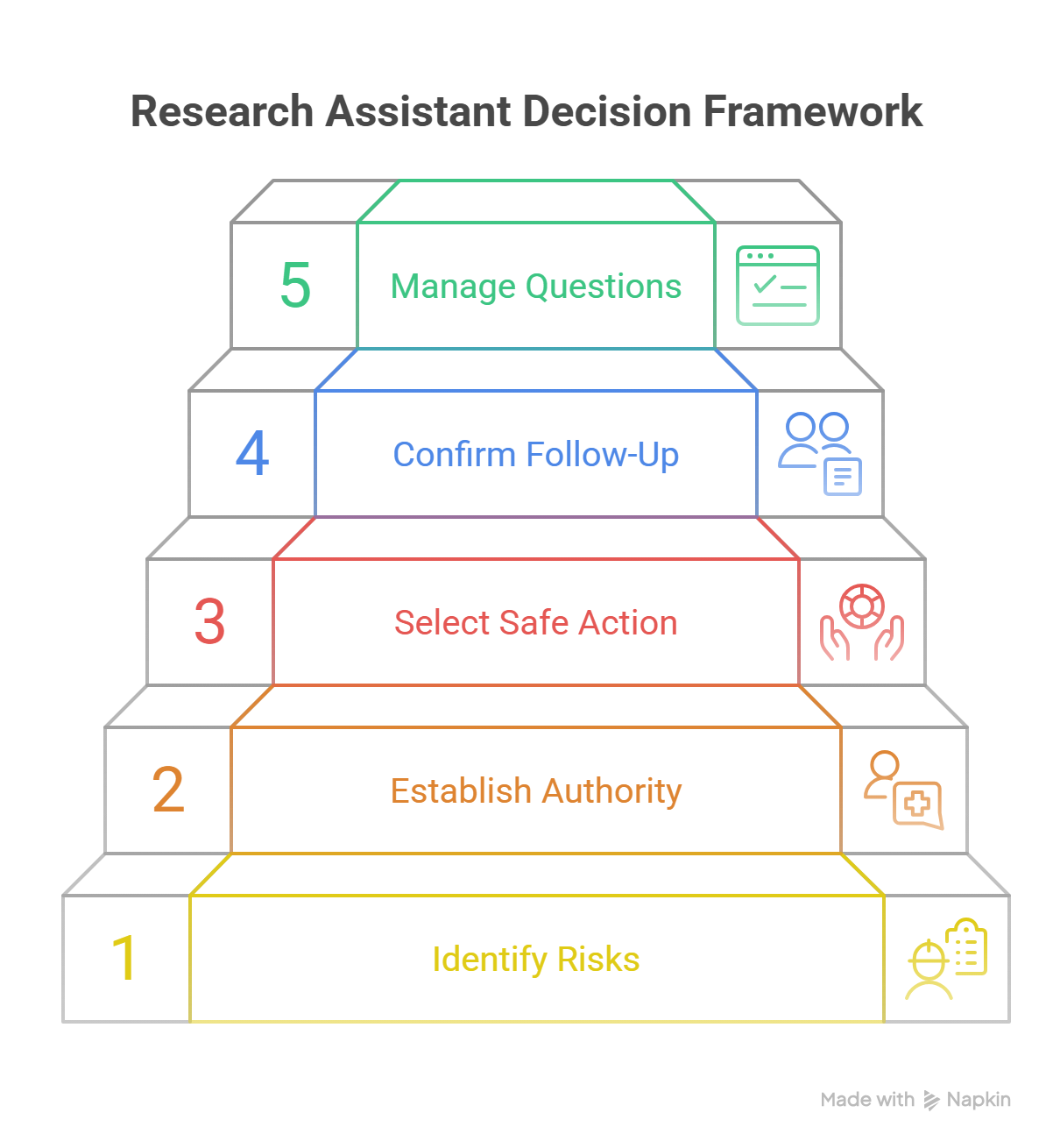
4. Use a Practical Decision Framework to Answer Research Assistant Exam Questions
Research assistant questions often present several actions that appear reasonable. The challenge is identifying which action is appropriate for the role, the urgency of the situation, and the evidence available.
A four-part decision framework reduces uncertainty while reinforcing the standards used in research assistant training and clinical research quality management.
First: identify what could go wrong
Determine whether the primary concern is participant protection, specimen quality, inaccurate records, protocol noncompliance, confidentiality, or research validity.
A mislabeled sample threatens identification integrity. A participant reporting chest pain creates a potentially urgent clinical concern. A missed assessment may affect protocol compliance and data completeness.
Each situation requires a different response. Practice distinguishing patient safety events from source-documentation problems and trial logistics failures.
Second: establish who can make the decision
Review the scenario for clues about delegation, training, and clinical authority.
An assistant may identify that a participant's laboratory result is outside a protocol threshold. The eligibility or medical significance of that result may require assessment by authorized clinical personnel.
Understanding investigator accountability and research assistant role boundaries helps you eliminate answers that exceed the assistant's authority.
Third: select the safest compliant action
The best response should address the immediate concern and follow the approved process. In urgent situations, protect the participant and involve appropriate clinical personnel.
For documentation problems, preserve the original evidence and use a traceable correction process. For missed procedures, establish whether a protocol deviation occurred and follow the appropriate reporting process.
In ambiguous cases, look for answers consistent with participant safety principles and clinical data integrity.
Fourth: confirm documentation and follow-up
A complete response may require documenting the issue, notifying the correct team member, confirming corrective action, and evaluating the risk of recurrence.
Differentiate an immediate correction from a broader corrective and preventive action. Replacing a missing kit resolves an immediate shortage, but repeated shortages may indicate a supply-management process failure requiring investigation.
This distinction connects trial logistics coordination, quality management, and clinical research communication.
Manage difficult questions without losing the examination
If the exam is timed, divide the available minutes between an initial pass and a review period.
For illustration, if an assessment includes 25 questions, permits 50 minutes, and you reserve five minutes for checking answers, your initial budget is approximately 1.8 minutes per question. Use your actual assessment conditions for this calculation.
Answer clear questions efficiently. Flag uncertain items when the platform permits navigation, and revisit them after completing the first pass.
Read qualifying words carefully: first, most appropriate, except, and within the assistant's responsibilities can completely change the answer.
When two choices appear equally plausible, identify which one best respects GCP delegation principles, protocol requirements, and participant protection.
5. Final Submission, Certificate Verification, and Post-Exam Career Preparation
The final minutes of an examination deserve the same attention as the initial questions. Before submitting, confirm that every required response has been completed and review flagged questions if the platform allows it.
A common source of avoidable errors is changing an answer because it feels too simple. Reconsider a response when you identify a specific mistake involving protocol interpretation, clinical safety responsibilities, or data integrity requirements.
Confirm that your examination was successfully submitted
Follow the provider's final submission instructions. Verify that a completion confirmation appears and establish how your official result will be delivered.
If the examination platform closes unexpectedly, use the authorized support procedure rather than repeatedly submitting or launching new sessions.
After passing, review the certificate for the correct name, course title, issuing organization, completion date, and any credential verification information.
These details matter when presenting training for research assistant positions, entry-level clinical research roles, or clinical trial assistant opportunities.
Use unsuccessful results to identify precise competency gaps
If you do not pass, review whatever diagnostic feedback the provider makes available. Confirm the remaining attempts, waiting requirements, and any additional costs before retesting.
Separate mistakes into categories. Incorrect statistical interpretation requires a different revision strategy from weak understanding of consent boundaries or specimen-handling procedures.
For operational weaknesses, revisit trial logistics responsibilities, protocol adherence, and clinical documentation standards.
For compliance-related weaknesses, prioritize clinical research ethics, investigator oversight, and safety reporting.
Convert your research assistant training into employable evidence
When updating your resume, state the exact credential awarded by your training provider. Include relevant skills such as protocol literacy, research documentation, clinical trial logistics, data quality, and ethical participant interaction.
Use practical examples to demonstrate understanding of research team communication, study coordination, and source-data reliability.
Employers often evaluate whether candidates can apply their training safely and accurately. Demonstrated skills help address the clinical research experience barrier, particularly when supported by a role-specific clinical research resume.
6. Frequently Asked Questions About Research Assistant Certification Exam Day
-
Prioritize the topics where your practice answers have shown weaknesses. High-value subjects include informed consent, protocol compliance, delegation, documentation, specimen handling, safety escalation, and basic research methodology.
Review a few case-based questions instead of rereading the entire course. Use research assistant training requirements, trial logistics responsibilities, and research protocol adherence to focus on practical decisions.
-
CCRPS's publicly available course information and general FAQ materials describe different examination configurations. The assigned course dashboard and current official assessment instructions should determine the question count you prepare for.
Check the passing score, question format, permitted resources, duration, and retake rules at the same time.
For a useful preparation baseline, review essential research assistant competencies and clinical research training resources.
-
This depends on the provider and the specific assessment assigned to you. Some research assistant training assessments allow reference materials, while others may impose restrictions.
Confirm the permitted materials in the official instructions before testing.
Even where reference materials are allowed, candidates benefit from understanding GCP responsibilities, informed consent requirements, and protocol compliance without searching for every answer.
-
Many research assistant training programs incorporate scenario-based assessment to evaluate practical judgment. These may cover missing documentation, participant concerns, sample identification, visit scheduling, eligibility restrictions, and data discrepancies.
A strong preparation method is to identify the primary risk, relevant protocol requirement, authorized decision-maker, and required response for each scenario.
Review trial logistics coordination, clinical safety reporting, and data integrity for realistic examples.
-
The assistant should promptly follow the site's escalation and emergency response procedures and involve appropriately qualified clinical personnel.
The assistant's responsibility is to recognize the potential concern, communicate accurately, protect the participant within their authorized role, and support appropriate documentation.
Medical evaluation and formal safety classification belong to qualified and authorized personnel under the applicable requirements.
Review investigator responsibilities, adverse-event reporting, and clinical trial safety oversight.
-
They can be important, depending on the curriculum. Relevant subjects may include study design, randomization, blinding, bias, sampling, descriptive statistics, confidence intervals, and interpretation of research findings.
Candidates should understand why a study's design affects the conclusions that can reasonably be drawn from its results.
For practical preparation, combine research assistant competency training with data integrity principles and quality-focused trial practices.
