
Preparing for the Research Assistant Certification Exam requires more than remembering clinical research terminology. Candidates must understand how to protect participants, interpret protocols, recognize safety concerns, maintain accurate records, and support trial operations without exceeding their responsibilities. These skills are especially challenging when examination questions present several reasonable-looking answers.
This guide provides a practical preparation framework built around active recall, spaced repetition, scenario-based learning, and targeted mock examinations. You will learn how to prioritize high-value topics, diagnose weak areas, and turn research assistant training into measurable examination readiness.
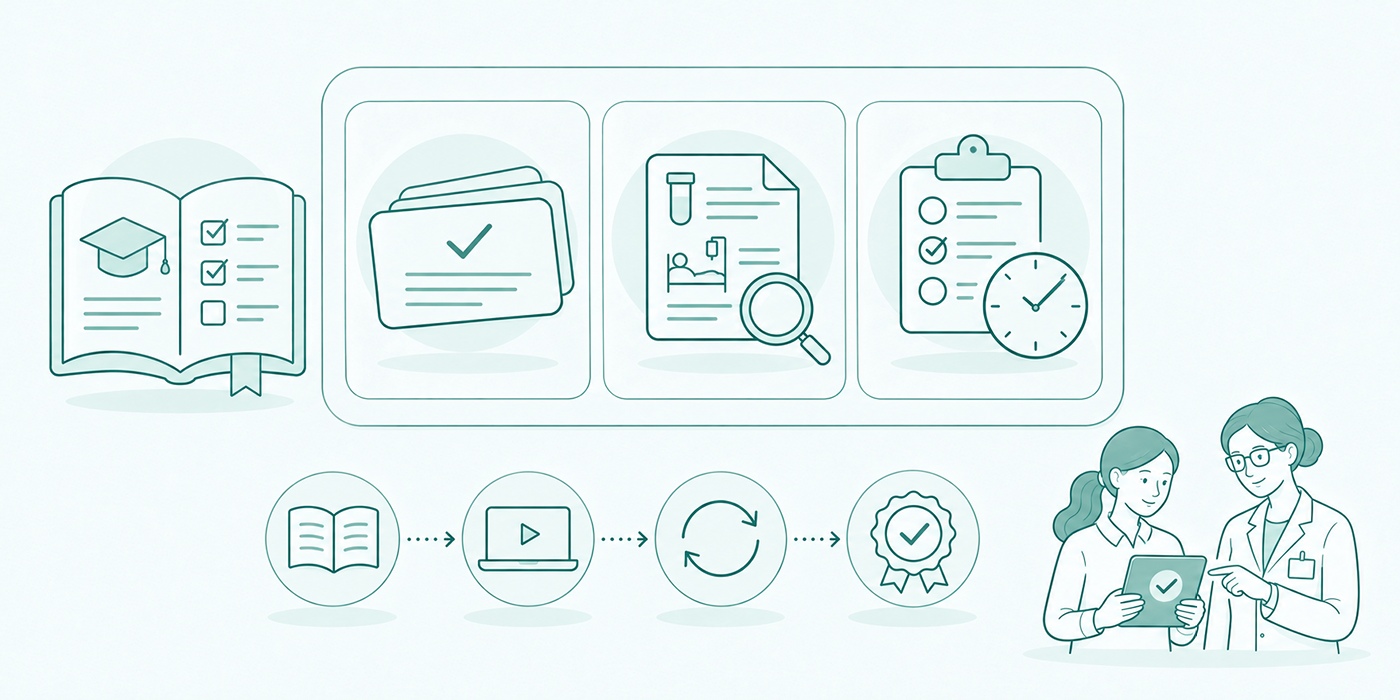
1. Build a Research Assistant Exam Study Blueprint Around the Skills Being Tested
The first study decision should be determining exactly what your certification assessment evaluates. Research assistant programs may cover clinical trial methodology, human-subject protection, regulatory responsibilities, recruitment, documentation, safety reporting, and operational coordination. The depth of each subject depends on the provider.
For candidates following CCRPS training, the Research Assistant Certification Exam study guide and research assistant training requirements provide useful starting points. Check your current course syllabus and assessment dashboard for the applicable exam format, passing requirements, and permitted attempts.
Turn every syllabus topic into a demonstrable skill
A weak study objective is “learn informed consent.” A stronger objective is “identify the correct response when a participant signs an outdated consent form after undergoing a study-specific procedure.”
This approach turns broad subjects into testable decisions. Apply it to ethical conduct, protocol adherence, safety reporting, and clinical trial data integrity.
For each topic, identify the governing principle, the research assistant's permitted role, the event that requires escalation, and the documentation needed afterward. This four-part method prevents candidates from memorizing a correct action while misunderstanding who is authorized to perform it.
Run a diagnostic assessment before planning revision
Select 30 unfamiliar questions spanning the major competencies. Answer them without notes, record your confidence, and assign each mistake to a subject.
A question answered correctly through guessing should remain in your review queue. Otherwise, a satisfactory score can conceal serious gaps in participant protection, trial logistics, or investigator responsibilities.
Calculate two results for every subject:
Accuracy: Correct answers divided by questions attempted, multiplied by 100.
Confidence calibration: Compare answers you marked as certain with the percentage actually correct.
For example, if you scored 8/10 on source documentation but only 4/10 on adverse event reporting, your next revision block should prioritize safety classification and escalation.
Allocate study time using risk and performance
Use a three-factor priority model: examination relevance, current weakness, and practical consequence.
A topic involving serious adverse event reporting deserves close attention because incorrect decisions can affect participant protection. A difficult topic involving trial data corrections is also important because poor record handling can compromise trial reliability.
An initial allocation of 60% of revision time to weak high-priority subjects, 25% to mixed scenario practice, and 15% to maintaining strong subjects is a reasonable starting point. Recalculate the allocation after each mock assessment.
Use the clinical research training directory and research assistant collaboration guidance to fill specific knowledge gaps rather than continuously collecting new study resources.
| Research Assistant Certification Exam: 30-Competency Study Matrix | |||
|---|---|---|---|
| Exam Competency | High-Value Practice Exercise | Common Failure Point | Evidence of Readiness |
| 1. GCP principles | Identify the GCP principle violated in five clinical scenarios. | Memorizing terminology without understanding practical consequences. | Explain each decision and the participant or data risk. |
| 2. Research ethics | Apply respect for persons, beneficence, and justice to recruitment. | Confusing ethical principles with administrative approval. | Justify protections in two vulnerable-participant cases. |
| 3. Informed consent | Resolve outdated-form and late-signature scenarios. | Treating signatures as sufficient proof of a valid process. | Identify timing, understanding, and escalation requirements. |
| 4. Investigator oversight | Map responsibilities across investigator and delegated staff. | Assuming delegation transfers accountability. | Identify the accountable role in five cases. |
| 5. Protocol structure | Locate eligibility, assessments, visit windows, and endpoints. | Confusing guidance documents with the approved protocol. | Locate a requested requirement within two minutes. |
| 6. Eligibility screening | Identify missing evidence in a borderline eligibility packet. | Making unauthorized eligibility decisions. | Escalate the uncertainty to the investigator appropriately. |
| 7. Participant communication | Draft a neutral scheduling call for a missed visit. | Providing unauthorized medical reassurance. | Keep communication within delegated responsibilities. |
| 8. Adverse events | Classify five symptoms by severity and seriousness. | Treating severe and serious as synonymous. | Explain each classification with relevant criteria. |
| 9. SAE escalation | Respond to a simulated unexpected hospitalization. | Waiting for all medical records before escalation. | Identify urgency, recipient, and minimum facts. |
| 10. Source documentation | Correct a fictional source-note error transparently. | Overwriting an original entry without traceability. | Preserve attribution and correction history. |
| 11. EDC data entry | Resolve a source-versus-eCRF date discrepancy. | Changing source values merely to match EDC. | Describe the investigation and correction pathway. |
| 12. Audit trails | Identify why shared electronic credentials compromise attribution. | Equating plausible values with reliable records. | Explain user access and change-history safeguards. |
| 13. Visit logistics | Calculate three visit windows using a mock schedule. | Counting from an incorrect anchor date. | Document compliant visit dates and escalation triggers. |
| 14. Specimen handling | Sequence labeling, processing, storage, and shipping steps. | Ignoring protocol-specific processing windows. | Identify the action required after a missed deadline. |
| 15. Drug accountability | Reconcile dispensed, returned, and remaining stock. | Adjusting discrepancies without investigation. | Explain reconciliation and authorized escalation. |
| 16. Protocol deviations | Classify missed, delayed, and unauthorized procedures. | Silently correcting deviations. | Describe accurate documentation and escalation. |
| 17. IRB/IEC review | Determine whether a study change needs prior review. | Assuming sponsor approval replaces ethics approval. | Identify the approval pathway and exceptions. |
| 18. Delegation logs | Check whether training predates task assignment. | Assuming a signature establishes competence. | Match training, qualification, and delegation dates. |
| 19. Essential records | Sort a mock file into regulatory record categories. | Misplacing approval or training documentation. | Find any requested document quickly. |
| 20. Monitoring visits | Prepare requested records for a fictional monitor. | Guessing answers beyond assigned responsibilities. | Provide evidence or escalate uncertainties. |
| 21. CAPA principles | Analyze a recurring documentation failure. | Repeating retraining without fixing the cause. | Separate correction, root cause, and prevention. |
| 22. Participant privacy | Respond to a misdirected participant email. | Ignoring accidental internal disclosures. | Describe containment and required notification. |
| 23. Vulnerable participants | Compare capacity, assent, and representative consent cases. | Assuming every vulnerable person lacks capacity. | Identify additional protections without stereotyping. |
| 24. Recruitment | Review a fictional recruitment message for undue influence. | Promising treatment benefits or guaranteed eligibility. | Identify compliant communication language. |
| 25. Trial phases | Compare primary objectives across trial phases. | Assuming every phase has the same purpose. | Explain typical objectives with necessary exceptions. |
| 26. Randomization and blinding | Analyze allocation concealment and emergency unblinding. | Confusing randomization with blinding. | Explain how each addresses different bias risks. |
| 27. ICH E6(R3) | Identify critical-to-quality factors in a mock protocol. | Assuming equal oversight for every data field. | Explain proportionate risk-based controls. |
| 28. Team coordination | Route safety, scheduling, pharmacy, and data queries. | Escalating urgent issues to the wrong contact. | Identify correct escalation pathways promptly. |
| 29. Trial close-out | Find unresolved queries and missing archival evidence. | Discarding records when participant visits end. | Describe reconciliation and retention responsibilities. |
| 30. Inspection readiness | Answer five fictional inspector requests using source evidence. | Reconstructing missing records as if they were originals. | Provide accurate records and acknowledge uncertainties. |
2. Master Active Recall, Spaced Repetition, and Interleaved Learning
The strongest revision technique depends on what you need to remember. Flashcards help with precise definitions and regulatory distinctions, while case-based retrieval helps you apply rules to decisions. Interleaving tests whether you can recognize the correct principle without being told which topic a question belongs to.
Use the methods together when preparing for GCP assessments, protocol compliance questions, research assistant competency assessments, and clinical trial documentation tasks.
Use active recall with operational questions
After studying a topic, close the source material and answer three questions from memory: What is the governing rule? When does it apply? What should a research assistant do when the situation occurs?
For informed consent, ask what happens when a participant receives an outdated form. For adverse event reporting, identify the information that should trigger urgent escalation. For EDC data entry, determine how to handle a discrepancy between source and electronic records.
Write the answer before reviewing the material. Then compare your response against the correct principle and add the missing detail. This exposes incomplete understanding much faster than reading a highlighted paragraph repeatedly.
Build three types of flashcards
Definition cards test exact distinctions. Examples include adverse event versus serious adverse event, protocol deviation versus protocol amendment, and source data versus case report form data.
Decision cards describe a situation and ask for the correct next action. An effective card might ask what an assistant should do when a participant reports an unexpected hospitalization.
Boundary cards test the limits of the assistant's role. Ask which tasks may be performed under appropriate delegation and which require investigator or other qualified professional involvement.
This combination supports research assistant training, investigator oversight, safety reporting responsibilities, and research team coordination.
Keep each card focused on one retrieval task. Long cards containing multiple independent facts are difficult to diagnose when you remember only part of the answer.
Use a spaced-repetition schedule that reacts to mistakes
For a newly learned concept, try retrieval on the same day, the following day, three days later, seven days later, and fourteen days later. Treat these intervals as a starting schedule rather than fixed rules.
If you forget a concept, retrieve the correct explanation and shorten the next review interval. If you recall it accurately across different scenarios, gradually extend the interval.
For example, a candidate studying investigator delegation might first recall the general rule, then answer a coordinator-task scenario, and finally evaluate a monitoring finding involving delegated work.
Apply the same progression to clinical trial safety monitoring, data integrity expectations, and research ethics requirements.
Interleave subjects after building their foundations
Early revision can focus on one subject at a time. Once you understand the main concepts, mix questions from several domains.
A 20-question practice set might include consent, adverse events, eligibility, record correction, monitoring, trial design, and specimen logistics. Avoid labeling questions by subject because real assessments may require you to recognize the relevant concept independently.
Interleaving is particularly effective for separating similar-looking responsibilities in site operations, clinical trial monitoring, protocol adherence, and quality management.
Structure a 60-minute study session
Use the opening 10 minutes for spaced retrieval of previous topics. Spend 15 minutes studying one weak competency, followed by 20 minutes answering unfamiliar scenarios. Dedicate the final 15 minutes to analyzing errors and writing corrective flashcards.
A missed source documentation question should produce a clear rule or decision card. A missed participant safety question should generate a scenario that tests the correct escalation sequence.
The essential measure is what you can retrieve and apply at the end of the session.
3. Study Through Realistic Research Assistant Scenarios and Responsibility Boundaries
Scenario-based preparation should closely resemble the decisions an assistant might face during trial conduct. These questions often require selecting an appropriate escalation pathway, identifying a documentation failure, or recognizing an activity that exceeds delegated authority.
The strongest scenarios combine research assistant duties, trial logistics, GCP investigator oversight, and clinical research communication.
Scenario 1: A participant reports an unexpected hospital visit
A participant calls to reschedule a study appointment and mentions being admitted to hospital the previous night. The assistant has no access to the discharge summary.
The correct study response should begin with recognizing a possible serious safety event, documenting the available facts, and promptly notifying the designated clinical or study professional through the established escalation pathway.
The assistant should avoid deciding that the hospitalization was unrelated to treatment or waiting for the complete hospital record before notifying the appropriate person.
This scenario tests knowledge from adverse event reporting, medical monitor responsibilities, medical data review, and research assistant collaboration.
Scenario 2: A screening record contains incomplete eligibility evidence
An assistant preparing a screening packet discovers that a required laboratory result is absent. The participant is already scheduled for the next study procedure.
The appropriate decision is to flag the missing information and refer the eligibility question to the investigator or other appropriately authorized personnel. The assistant should clearly document the missing evidence and avoid independently approving eligibility.
Practicing this decision builds the ability to distinguish logistical preparation from medical or protocol-specific judgment.
Connect the scenario to protocol adherence, clinical trial site oversight, research assistant task training, and investigator accountability.
Scenario 3: A source record and EDC entry disagree
The original source note shows that a visit occurred on Tuesday, while the electronic case report form lists Monday. A colleague suggests changing the electronic value without reviewing the source.
A well-prepared candidate should identify the need to investigate the discrepancy and follow authorized correction procedures, preserving appropriate traceability.
The key competency is distinguishing accurate correction from undocumented alteration. A reasonable-looking final record cannot replace an accountable record history.
This case reinforces clinical trial data integrity, monitoring responsibilities, quality management procedures, and GCP documentation requirements.
Scenario 4: A specimen exceeds its processing window
A scheduled collection is completed, but a courier delay means the sample cannot be processed or shipped within the specified window.
The candidate should locate the requirements in the current protocol or laboratory manual, protect the specimen as appropriate, inform the responsible staff, and document the deviation or excursion according to site procedures.
The assistant should avoid guessing that a delayed sample remains acceptable or changing recorded collection times.
Practice this through clinical trial logistics, research protocol compliance, site operations oversight, and quality management strategies.
Use the four-line explanation technique
After answering any scenario, write four short lines: the immediate issue, the accountable professional, the correct action, and the evidence required to demonstrate compliance.
Then explain why each alternative answer fails. This prevents familiarity with one correct option from being mistaken for mastery.
Apply the method to informed consent, participant safety, clinical trial monitoring, and investigator responsibilities.
What Is Your Biggest Research Assistant Exam Preparation Problem?
Choose one. Your answer reveals a targeted study strategy.
Submit
Select an answer above to see your recommended study approach.
4. Use Timed Mock Exams and an Error Register to Improve Scores Consistently
Mock examinations should produce actionable evidence about readiness. A useful assessment measures accuracy, speed, confidence, and the type of reasoning error behind each missed question.
Before attempting a timed mock, verify the question count, assessment format, and permitted time with your training provider. Use the same conditions whenever possible.
For additional preparation, review research assistant exam guidance, GCP assessment expectations, protocol compliance resources, and clinical trial quality principles.
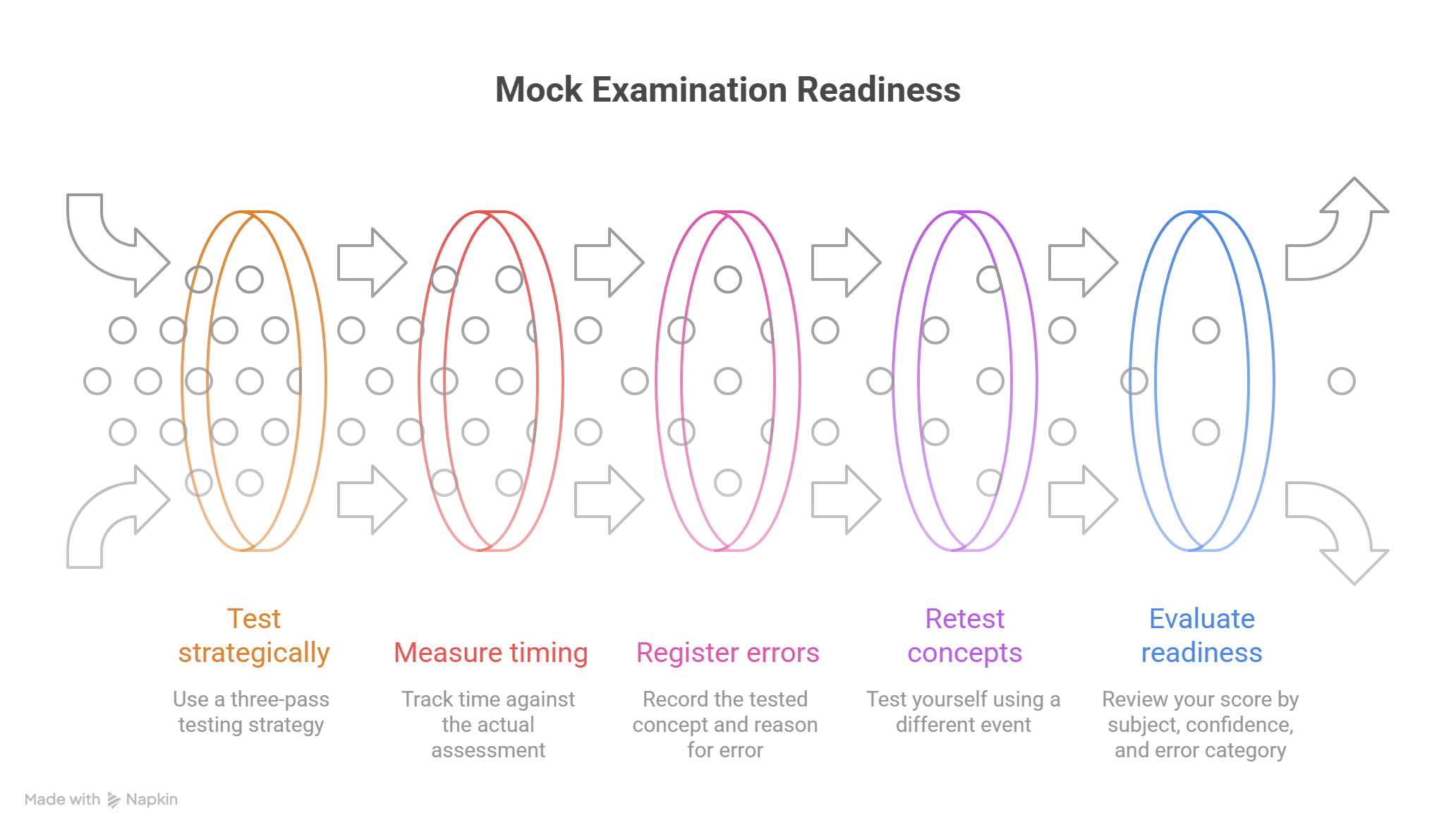
Use a three-pass testing strategy
During the first pass, answer questions you can resolve confidently and efficiently. Mark uncertain questions for review instead of repeatedly reconsidering the same options.
During the second pass, work through questions requiring careful interpretation, such as those involving consent documentation, safety classification, investigator accountability, or data corrections.
During the third pass, check unanswered items and revisit marked responses where you can identify a specific reason to change your decision.
Measure timing against the actual assessment
Divide the available examination time by the number of questions to establish the average time allowance.
For illustration, a 30-question practice assessment completed in 45 minutes permits an average of 90 seconds per item. This is a practice example, not a claim about the CCRPS exam format.
Track whether you spend excessive time interpreting terminology, distinguishing responsibilities, or rereading long clinical scenarios.
If SAE reporting questions consistently consume twice as much time as other subjects, the underlying classification system may require revision. If monitoring questions trigger repeated rereading, practice extracting the key issue and responsible role before reviewing answer choices.
Build an error register with five fields
For each incorrect or low-confidence response, record the tested concept, selected answer, correct principle, reason for error, and next review date.
Classify mistakes into four groups.
Knowledge errors: You could not recall the governing principle or terminology. Review the concept using GCP study materials.
Responsibility errors: You confused the research assistant's supporting role with the investigator's or sponsor's authority. Revisit investigator responsibilities and RA task boundaries.
Interpretation errors: You missed a condition such as before enrolment, immediately, serious, or most appropriate. Practice isolating decision-critical wording in protocol scenarios.
Sequencing errors: You recognized multiple appropriate actions but selected one that should happen later. Rehearse the correct order using patient safety guidance and quality management procedures.
Retest concepts through new scenarios
Suppose you incorrectly answered a question about a hospitalization. After reviewing the applicable SAE requirements, test yourself using a different event involving emergency treatment, a medically important event, or an expected serious event.
A correct response to a new scenario provides stronger evidence of understanding than selecting a familiar answer from the original question bank.
Use this principle for clinical trial safety reporting, investigational product accountability, EDC documentation, and monitoring activities.
Evaluate readiness by domain
A high overall score can conceal a serious weakness in one critical area.
For instance, a candidate may answer almost every terminology and trial-phase question correctly while repeatedly missing consent or safety escalation scenarios.
Review your score by subject, confidence, and error category. Consider setting a personal practice target above the provider's published passing standard to allow for performance variation. Your personal target should never be presented as an official pass mark.
Before attempting the real assessment, confirm that you can reason through unfamiliar ethical decisions, protocol deviations, data integrity issues, and safety reporting situations.
5. Follow a 14-Day Research Assistant Exam Study Schedule With Measurable Milestones
A concentrated two-week schedule can help candidates consolidate previous training and prepare for assessment. Learners beginning with limited clinical research knowledge may need longer to complete the curriculum and develop reliable understanding.
Use the schedule as a revision framework after reviewing the research assistant certification syllabus and role-specific training requirements.
Days 1–3: Establish fundamentals and responsibility boundaries
Day 1: Complete a 30-question diagnostic assessment and classify every error. Review clinical research objectives, trial phases, protocol structure, and key terminology. Reinforce the basics through research assistant exam strategies and clinical research training resources.
Day 2: Focus on GCP principles, informed consent, IRB/IEC review, and participant rights. Write five scenarios that distinguish an assistant's support tasks from authorized clinical decisions. Use ethical conduct guidance and investigator responsibilities.
Day 3: Build a responsibility map covering research assistants, coordinators, investigators, sponsors, and CROs. Test your understanding of task delegation, escalation, and oversight using site operations guidance and clinical team communication.
Days 4–7: Strengthen documentation and safety skills
Day 4: Practice source documentation, EDC discrepancies, record corrections, and audit trails. Write accurate correction explanations for three fictional errors using data integrity principles and quality management guidance.
Day 5: Review adverse events, seriousness criteria, reporting responsibilities, and participant safety escalation. Complete ten new scenarios using adverse event reporting guidance and medical monitoring responsibilities.
Day 6: Study protocol deviations, visit windows, eligibility support, specimen handling, and investigational product logistics. Practice with research protocol adherence, trial logistics, and site oversight techniques.
Day 7: Complete a timed mixed-topic assessment. Compare scores against the initial diagnostic test, examine confidence calibration, and update your study priorities. Review errors using research assistant examination guidance and GCP compliance resources.
Days 8–11: Apply advanced concepts and reduce repeated mistakes
Day 8: Study recruitment, retention, vulnerable participant safeguards, and confidentiality. Practice identifying coercive language, privacy breaches, and communication that exceeds the assistant's responsibilities. Consult patient education resources and research ethics guidance.
Day 9: Review randomization, blinding, trial endpoints, and basic trial design. Practice explaining what each design feature accomplishes and what research assistants need to recognize operationally. Use medical monitoring guidance and trial management resources.
Day 10: Focus on ICH E6(R3), proportionate quality management, monitoring approaches, and computerized systems. Identify critical-to-quality factors in two fictional study designs. Reinforce the concepts through E6(R3) competency guidance and risk-based quality management.
Day 11: Practice monitoring visit preparation, issue escalation, root cause analysis, and trial close-out. Explain why an undocumented correction or fabricated replacement record creates a compliance problem. Review GCP monitoring techniques and trial close-out requirements.
Days 12–14: Confirm examination readiness
Day 12: Complete a fresh mock examination using the current provider's format where available. Record total accuracy, performance by competency, average time per question, and answers selected with low confidence.
Day 13: Revisit only the concepts still producing incorrect or uncertain responses. Use the error register to construct new questions involving safety reporting, protocol compliance, data handling, and investigator oversight.
Day 14: Complete a final mixed practice set and give short explanations for each decision. Confirm your actual exam requirements, review necessary access arrangements, and avoid introducing large amounts of new material immediately before testing.
Use a final readiness checklist
Before taking the exam, verify that you can interpret a protocol, distinguish trial roles, recognize a potential SAE, identify consent-related problems, handle data discrepancies appropriately, and explain the escalation sequence for a protocol deviation.
Your strongest evidence of readiness will be consistent performance on unfamiliar scenarios, particularly those involving participant protection, clinical trial safety, research data integrity, and research assistant operational duties.
6. Frequently Asked Questions About Research Assistant Certification Exam Study Strategies
-
Study duration depends on the depth of the certification curriculum and your existing knowledge. Candidates with healthcare, laboratory, or clinical research experience may require less foundational review than those entering the field for the first time.
A practical approach is to complete a diagnostic assessment, identify weak competencies, and allocate revision time accordingly. Two weeks may be suitable for focused review after training, while beginners may need several additional weeks.
Use the research assistant certification study guide, essential RA training requirements, free clinical research training resources, and exam preparation strategies to plan your workload.
-
Prioritize the subjects emphasized by your training provider, then focus additional time on weak areas with important clinical or regulatory consequences.
For clinical research assistant assessments, this commonly means GCP, ethics, informed consent, trial roles, protocol literacy, safety reporting, documentation, data handling, and trial operations.
A candidate struggling with safety escalation should review adverse event reporting before spending more time on familiar terminology. Another struggling with trial records should emphasize data integrity, monitoring requirements, and documentation-related quality controls.
-
The useful number depends on question quality, subject coverage, and whether you can explain the reasoning behind your answers.
Begin with a diagnostic set, practice smaller topic-specific groups, and then complete unfamiliar mixed-topic assessments. Track performance by competency rather than relying on a lifetime question total.
Twenty carefully reviewed questions can reveal more about your weaknesses than a large set completed without feedback.
Include scenarios involving research protocol compliance, clinical trial safety reporting, investigator responsibilities, and site operations.
-
Terminology recall is useful for foundational questions, while application requires understanding how the terms influence practical trial decisions.
A candidate may correctly define an adverse event yet struggle to recognize a hospitalization requiring escalation. Another may recall data-integrity terminology but select an inappropriate correction procedure.
Practice connecting concepts with GCP ethics, SAE reporting procedures, clinical trial data handling, and research assistant task boundaries.
-
Create a role matrix that separates task preparation, operational execution, clinical judgment, delegated authority, and oversight.
For each task, identify which professional may perform it under appropriate training and delegation, who supervises the activity, and who retains accountability.
Practice with scenarios involving consent discussions, eligibility determination, safety reporting, protocol deviations, and medical questions.
Review investigator GCP responsibilities, research assistant training, research team collaboration, and PI site oversight.
-
Start by identifying the specific causes of your mistakes. Separate forgotten information, misunderstood responsibilities, incorrect scenario interpretation, and poor decision sequencing.
For every missed question, write the governing principle and test yourself again using a new scenario.
If you repeatedly miss data correction questions, practice reconstructing the source of a discrepancy. If safety questions remain difficult, build a decision tree for AE recognition and SAE escalation.
Target weaknesses through research data integrity resources, medical monitor safety guidance, clinical research quality strategies, and exam study guidance.
