
Clinical Research Certification Illinois: Everything You Need to Know for 2025–2026
Illinois has evolved into one of the Midwest’s most dynamic centers for clinical research innovation, driven by its powerful mix of hospitals, universities, and biotech startups. From Chicago’s medical corridors to Peoria’s clinical hubs, opportunities for Clinical Research Associates (CRAs) and Coordinators (CRCs) continue to expand. Yet most professionals struggle with certification clarity, internship scarcity, and uncertainty about salary ROI.
This comprehensive CCRPS guide explains how to launch, grow, and sustain a research career in Illinois in 2025–2026—covering employers, salaries, certifications, and strategic advancement.

1) Understanding Illinois’s Clinical Research Landscape
Illinois currently supports more than 600 active clinical trial sites, making it one of the top five U.S. states for life-science employment. According to CCRPS Clinical Research Certification, the state’s dense healthcare network—spanning Northwestern Medicine, the University of Chicago, and AbbVie—creates consistent hiring momentum for trained CRCs and CRAs.
Why Illinois leads:
Academic-Industry Integration: Chicago’s research ecosystem thrives on partnerships between Northwestern University, UIC, and pharmaceutical giants such as AbbVie and Astellas.
Therapeutic Breadth: Oncology, cardiology, endocrinology, and rare disease studies dominate—ideal for certified professionals seeking therapeutic depth.
Remote Monitoring Growth: Roughly 45 % of Illinois-based trials now integrate decentralized or hybrid protocols, aligning perfectly with CCRPS’s remote-CRA skill modules.
Compare this with Clinical Research Certification in Indiana or Clinical Research Certification in Michigan to understand regional advantage differences.
2) Why Illinois Is Becoming a National Research Hotspot
Illinois offers the infrastructure of a major biopharma hub without the cost pressures of coastal markets. Compared to Clinical Research Certification in New York, Illinois provides larger entry-level hiring pipelines and stronger academic mentorship networks.
Competitive advantages:
Funding Density: NIH and private-sector funding in Illinois surpassed $1.1 B in 2024, strengthening site budgets and staffing.
Urban + Rural Trial Reach: Chicago drives innovation, while Peoria and Springfield host diverse patient demographics, improving study reliability.
Corporate Recruitment: AbbVie and Astellas routinely prioritize CCRPS-trained professionals for monitoring and documentation roles.
Through the CCRPS CRA Certification pathway, Illinois professionals gain instant alignment with national SOP standards and hybrid-trial methodologies.
3)Certification Pathways for Illinois Professionals
Aspiring researchers can choose from multiple CCRPS specializations, each built to fast-track career mobility.
1. CCRPS CRA Certification – best for candidates handling site communication and source verification.
2. CCRPS CRC Certification – designed for on-site data, EDC management, and regulatory prep.
3. Advanced Clinical Project Manager Program – ideal for professionals pursuing leadership.
Employers such as Northwestern Medicine and Rush Health report hiring preferences for CCRPS graduates due to their ICH-GCP compliance and audit-readiness training.
To benchmark pathways, review The Ultimate Guide to Becoming a CRA in Ohio.
4) Job Market Outlook and Growth Potential
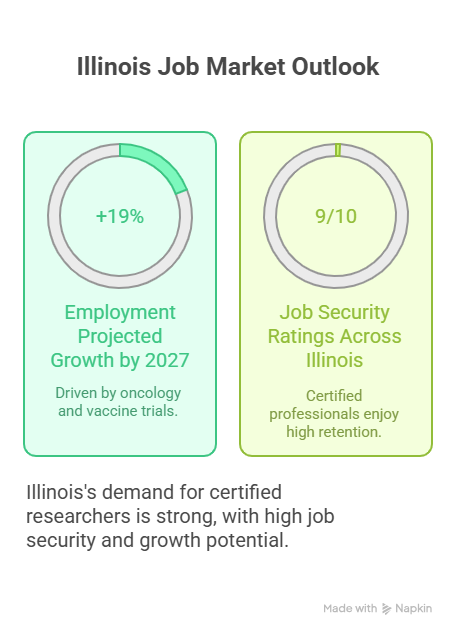
Illinois’s demand for certified researchers continues to outpace national averages. Based on CCRPS analytics, employment is projected to grow 19 % by 2027—driven by new oncology and vaccine trials.
Typical career progression for certified professionals:
CRC I → CRC II (6–12 months) → CRA (1–2 years) → Project Manager (2–4 years).
Top employers such as AbbVie, ICON, and Rush Health prioritize candidates who already possess CCRPS credentials, minimizing training overhead. Certified professionals also enjoy higher retention and 9 / 10 job security ratings across Illinois sites.
5) Why CCRPS Certification Delivers the Best ROI
CCRPS programs provide globally benchmarked education that meets Transcelerate BioPharma alignment, recognized by CROs nationwide.
Distinct benefits:
Fully online, self-paced completion within 8–12 weeks.
Built-in ICH-GCP modules, case simulations, and audit documentation practice.
Career support and resume resources through CCRPS partner network.
Graduates frequently report 2–3× salary growth within a year. Compare benefits with Clinical Research Certification in Kentucky or Clinical Research Certification in Nebraska.
6) Frequently Asked Questions
-
Typically 8–12 weeks of flexible, self-paced study. Full-time learners often finish sooner.
-
All major institutions—AbbVie, Astellas, Northwestern Medicine, and University of Chicago—recognize CCRPS CRA/CRC certifications.
-
Yes—CCRPS training bridges clinical backgrounds into research operations and trial coordination skills.
-
CRCs earn around $58 K–$72 K, while CRAs reach $90 K +, depending on experience and specialization.
-
Yes—nearly half of Illinois trials now include remote monitoring positions for trained CRAs.
-
CCRPS offers shorter, application-driven curricula with global recognition and no membership restrictions.
-
Most graduates secure entry positions within 3 months and advance to CRA within two years.
