
The 100 Most Important Clinical Research Terms You Must Know 2025 Edition
Clinical research operates within an intricate framework of specialized terminology, each term a key to navigating trials, compliance, and patient safety. Mastery of this vocabulary isn’t optional; it’s essential for professionals seeking to deliver precise results and uphold regulatory standards. Whether you’re a newcomer or a seasoned expert, understanding the most critical clinical research terms elevates your ability to interpret protocols, analyze data, and ensure ethical, compliant studies. This 2025 edition distills the 100 most important terms, equipping you with not just definitions, but context-rich, real-world applications tailored for high-stakes environments.
In an era where precision, compliance, and data integrity dictate success, being fluent in the language of clinical research transforms how you approach your work. This guide is not a superficial glossary; it’s a curated repository of actionable knowledge. You’ll discover how these terms underpin study design, influence participant safety, and drive robust data collection, setting you apart as a competent, informed clinical research professional ready for 2025 and beyond.

Key Terms You Must Know: Categories and Definitions
Trial Phases and Design Terminology
Clinical research phases progress from Phase 0, where micro-dosing trials assess pharmacokinetics, to Phase I, where safety and dosage are tested. Phase II expands on safety and efficacy assessments in larger groups, leading to Phase III, which confirms effectiveness and monitors rarer side effects across broader populations. Phase IV tracks long-term safety and effectiveness post-marketing. Supporting designs include Pilot Study (small-scale feasibility trials), Open-Label Trial (treatment assignments are known), Placebo-Controlled Trial (participants receive placebo or active treatment), Adaptive Trial (protocol adjustments based on interim data), and Sequential Trial (allows early decisions as data accumulates). Each term represents a building block of clinical trial design, essential for professionals to plan, execute, and analyze studies correctly.
Design rigor hinges on terms like Crossover Design, where participants receive multiple treatments in sequence to improve comparative data, and Double-Blind, ensuring neither participant nor investigator knows the treatment assignment, minimizing bias. Randomization balances groups by chance, while Parallel Design assigns each participant to one group only. Cluster Randomization applies randomization to groups rather than individuals, and Block Randomization ensures balanced allocations in smaller subgroups. Stratified Randomization accounts for specific confounding factors, and Blinded Endpoint Assessment hides treatment allocation from outcome assessors. A Washout Period clears the effects of previous treatments, and a Superiority Trial tests if one treatment is more effective than another. These terms are critical to data integrity and credibility.
Participant-Related Terms
Ethical participation begins with Informed Consent, ensuring participants understand the study and agree voluntarily. Assent involves minors or individuals with limited capacity providing agreement alongside guardians. Inclusion Criteria define characteristics required for participation, while Exclusion Criteria specify conditions disqualifying individuals. Vulnerable Populations include groups needing heightened protections, such as pregnant women or those with cognitive impairment. Screening assesses potential participants for eligibility, leading to Enrollment—formal inclusion in the trial. Withdrawal occurs when a participant exits, and Loss to Follow-Up happens when they can’t be reached. Compliance measures adherence to study protocols. These terms ensure data reliability and participant safety.
Regulatory and Compliance Terms
Clinical research depends on terms that guarantee integrity and regulatory approval. Good Clinical Practice (GCP) outlines ethical and scientific standards. ICH Guidelines harmonize technical requirements globally, while 21 CFR Part 11 governs electronic records and signatures in FDA-regulated studies. Regulatory Submission involves presenting trial data for approval. Site Monitoring Visit allows regular oversight, and Audit inspects trial conduct. Inspection is a regulatory authority's site review, while Compliance refers to adherence to protocols. Deviation means unplanned departures from protocol, and Protocol Violation indicates serious breaches. Mastery of these terms ensures smooth regulatory processes and protects participant welfare.
Oversight mechanisms include the Institutional Review Board (IRB) and its international counterpart, the Ethics Committee (EC), which review protocols to protect participants. The Data Safety Monitoring Board (DSMB) independently oversees data integrity and safety, empowered to modify or halt trials. Serious Breach refers to significant noncompliance, while Safety Reporting mandates submitting adverse event data to authorities. Clinical Trial Registration requires public disclosure of study details, and Informed Consent Form (ICF) documents participant understanding. Protocol Amendment updates trial procedures, while the Trial Master File (TMF) and Site File organize study documentation. These terms keep trials compliant, ethical, and audit-ready.
Data and Statistical Terms
Data integrity demands familiarity with terms like P-Value, indicating the chance that results occurred randomly, and Confidence Interval (CI), specifying a probable range for true effects. Statistical Power reflects a study’s ability to detect real differences, while Type I Error and Type II Error refer to false positives and negatives. Sample Size Calculation determines participant numbers for sufficient power. Standard Deviation (SD) and Variance measure data variability, with Interquartile Range (IQR) capturing middle-range variability and Effect Size quantifying the magnitude of difference. Understanding these terms fortifies trial design, enhances data analysis, and meets regulatory standards for evidence quality.
Safety and Pharmacovigilance Terms
Safety terminology ensures participant protection and trial credibility. An Adverse Event (AE) is any unfavorable occurrence during a trial, while a Serious Adverse Event (SAE) involves hospitalization or severe risk. Suspected Unexpected Serious Adverse Reaction (SUSAR) identifies severe, unanticipated drug reactions. Pharmacovigilance refers to continuous monitoring of drug safety, and the Risk Management Plan (RMP) outlines strategies to minimize risks. Data Lock Point (DLP) marks final data collection for analysis. Causality Assessment evaluates the link between treatment and adverse events, while a Safety Signal triggers further investigation. Periodic Safety Update Report (PSUR) summarizes ongoing safety data, and MedDRA standardizes adverse event terminology. Mastery of these terms is essential for maintaining regulatory compliance and protecting patient well-being.
Essential Tools and Documents in Clinical Research
Precise data capture starts with Case Report Forms (CRFs), which document trial data. Source Data supports CRF entries, while Electronic Data Capture (EDC) digitizes data management. Query Management resolves discrepancies, and Data Cleaning ensures data accuracy. The Investigator’s Brochure (IB) compiles clinical and preclinical data for investigators, while an Investigator Meeting trains study teams. A Product Dossier contains comprehensive product information for regulators, and Safety Updates ensure current safety knowledge. The Study Reference Manual outlines procedural instructions. The Clinical Study Protocol (CSP) guides study execution, detailing Study Objectives, Eligibility Criteria, Schedule of Assessments, and Endpoint Definitions—each ensuring the trial’s structure and integrity.
Additional Must-Know Terms
Critical concepts rounding out essential terminology include Random Error, reflecting variability by chance, and Systematic Error, indicating bias. Interim Analysis evaluates data before trial completion, while Stopping Rules define when to end a trial early. Intention-to-Treat (ITT) includes all randomized participants in analysis, while Per-Protocol Analysis focuses on compliant participants. Biostatistics applies statistical methods to biomedical data. Data Integrity ensures accuracy and consistency. Quality Assurance (QA) oversees adherence to standards, while Quality Control (QC) checks data accuracy. Site Initiation Visit (SIV) launches study operations, and Close-Out Visit finalizes site activities. Source Document Verification (SDV) compares CRFs with original data, Trial Status Reporting updates progress, and the Clinical Development Plan (CDP) lays out long-term strategies.
| # | Term | Definition |
|---|---|---|
| 1 | Phase 0 | Micro-dosing trials to assess pharmacokinetics. |
| 2 | Phase I | Tests safety and dosage. |
| 3 | Phase II | Evaluates efficacy and side effects. |
| 4 | Phase III | Confirms effectiveness and detects side effects. |
| 5 | Phase IV | Monitors long-term safety and effectiveness post-marketing. |
| 6 | Pilot Study | Small-scale feasibility trial. |
| 7 | Open-Label Trial | Treatment assignments are known to all. |
| 8 | Placebo-Controlled Trial | Participants receive placebo or active treatment. |
| 9 | Adaptive Trial | Protocol adjustments based on interim data. |
| 10 | Sequential Trial | Allows early decisions as data accumulates. |
| 11 | Crossover Design | Participants receive multiple treatments sequentially. |
| 12 | Double-Blind | Neither participant nor investigator knows treatment assignment. |
| 13 | Randomization | Assigns treatments by chance to balance groups. |
| 14 | Parallel Design | Participants assigned to a single treatment group. |
| 15 | Cluster Randomization | Randomizes groups instead of individuals. |
| 16 | Block Randomization | Ensures balanced allocations in subgroups. |
| 17 | Stratified Randomization | Balances confounders across groups. |
| 18 | Blinded Endpoint Assessment | Assessors unaware of treatment assignments. |
| 19 | Washout Period | Clears effects of prior treatment. |
| 20 | Superiority Trial | Tests if one treatment outperforms another. |
| 21 | Informed Consent | Participants understand and agree to study participation. |
| 22 | Assent | Agreement from minors or those with limited capacity. |
| 23 | Inclusion Criteria | Participant characteristics required for trial. |
| 24 | Exclusion Criteria | Conditions disqualifying participants. |
| 25 | Vulnerable Populations | Groups needing heightened protections. |
| 26 | Screening | Assessing eligibility pre-enrollment. |
| 27 | Enrollment | Formal inclusion of participants. |
| 28 | Withdrawal | Participant-initiated exit. |
| 29 | Loss to Follow-Up | Participants unreachable for evaluation. |
| 30 | Compliance | Participant adherence to protocol. |
| 31 | Good Clinical Practice (GCP) | Global ethical and scientific standards. |
| 32 | ICH Guidelines | Harmonized technical requirements. |
| 33 | 21 CFR Part 11 | US regulations for electronic records/signatures. |
| 34 | Regulatory Submission | Presentation of trial data for approval. |
| 35 | Site Monitoring Visit | Regular oversight of trial operations. |
| 36 | Audit | Systematic inspection of study conduct. |
| 37 | Inspection | Regulatory authority’s site review. |
| 38 | Deviation | Unplanned departure from protocol. |
| 39 | Protocol Violation | Serious breach of study procedures. |
| 40 | Institutional Review Board (IRB) | Ethical review of study protocols. |
| 41 | Ethics Committee (EC) | International equivalent of IRB. |
| 42 | Data Safety Monitoring Board (DSMB) | Independent safety and integrity oversight. |
| 43 | Serious Breach | Significant noncompliance with protocol. |
| 44 | Safety Reporting | Submission of adverse event data. |
| 45 | Clinical Trial Registration | Public disclosure of study details. |
| 46 | Informed Consent Form (ICF) | Document outlining trial information for participants. |
| 47 | Protocol Amendment | Formal updates to trial procedures. |
| 48 | Trial Master File (TMF) | Comprehensive trial documentation. |
| 49 | Site File | Local repository of study documents. |
| 50 | Case Report Form (CRF) | Form capturing participant data. |
| 51 | Source Data | Original data supporting CRF entries. |
| 52 | Electronic Data Capture (EDC) | Digital system for managing CRFs. |
| 53 | Query Management | Resolving data discrepancies. |
| 54 | Data Cleaning | Ensuring data accuracy and completeness. |
| 55 | Investigator’s Brochure (IB) | Compilation of preclinical and clinical data. |
| 56 | Investigator Meeting | Training and protocol review for teams. |
| 57 | Product Dossier | Comprehensive product data for regulators. |
| 58 | Safety Updates | Periodic safety summaries. |
| 59 | Study Reference Manual | Guidelines for study conduct. |
| 60 | Clinical Study Protocol (CSP) | Master document for study procedures. |
| 61 | Study Objectives | Defined goals of the trial. |
| 62 | Eligibility Criteria | Standards for participant selection. |
| 63 | Schedule of Assessments | Timelines for procedures. |
| 64 | Endpoint Definitions | Criteria for trial outcomes. |
| 65 | Random Error | Variability by chance in data. |
| 66 | Systematic Error | Bias affecting data accuracy. |
| 67 | Interim Analysis | Data evaluation before trial completion. |
| 68 | Stopping Rules | Criteria for early trial termination. |
| 69 | Intention-to-Treat (ITT) | Includes all randomized participants. |
| 70 | Per-Protocol Analysis | Includes only compliant participants. |
| 71 | Biostatistics | Statistics applied to biomedical data. |
| 72 | Data Integrity | Accuracy and consistency of data. |
| 73 | Quality Assurance (QA) | Oversight of protocol adherence. |
| 74 | Quality Control (QC) | Operational checks for data accuracy. |
| 75 | Site Initiation Visit (SIV) | Study startup meeting at site. |
| 76 | Close-Out Visit | Final review after study completion. |
| 77 | Source Document Verification (SDV) | Comparing CRF entries with source data. |
| 78 | Trial Status Reporting | Progress updates for stakeholders. |
| 79 | Clinical Development Plan (CDP) | Strategic plan for product development. |
| 80 | P-Value | Probability that results occurred by chance. |
| 81 | Confidence Interval (CI) | Range where true value likely falls. |
| 82 | Statistical Power | Ability to detect real effects. |
| 83 | Type I Error | False positive result. |
| 84 | Type II Error | False negative result. |
| 85 | Sample Size Calculation | Determining participant numbers needed. |
| 86 | Standard Deviation | Measure of data variability. |
| 87 | Variance | Square of standard deviation. |
| 88 | Interquartile Range (IQR) | Middle 50% of data range. |
| 89 | Effect Size | Magnitude of difference or effect. |
| 90 | Adverse Event (AE) | Unfavorable medical occurrence in trial. |
| 91 | Serious Adverse Event (SAE) | Life-threatening or serious event. |
| 92 | SUSAR | Unexpected severe adverse reaction. |
| 93 | Pharmacovigilance | Monitoring of drug safety. |
| 94 | Risk Management Plan (RMP) | Mitigation strategies for identified risks. |
| 95 | Data Lock Point (DLP) | Final data collection before analysis. |
| 96 | Causality Assessment | Link between event and treatment. |
| 97 | Safety Signal | New safety information requiring action. |
| 98 | Periodic Safety Update Report (PSUR) | Ongoing safety reporting to regulators. |
| 99 | MedDRA | Standardized terminology for adverse events. |
| 100 | Quality Control (QC) | Operational checks for data accuracy. |
Essential Tools and Documents in Clinical Research
Case Report Forms (CRFs)
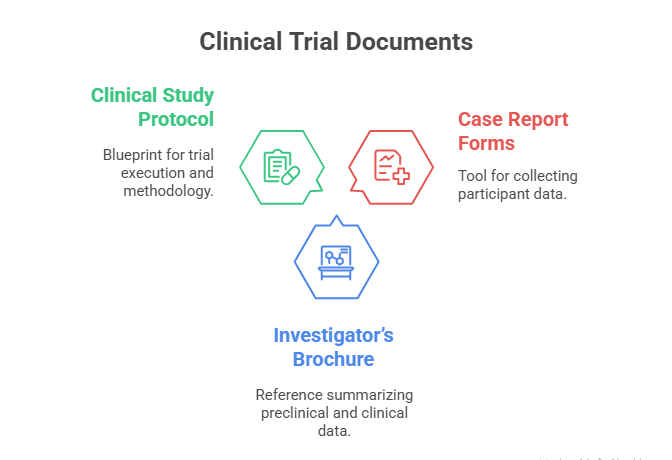
In clinical research, the Case Report Form (CRF) is the fundamental tool for collecting participant data. Each CRF is meticulously designed to align with the study protocol, ensuring consistent, comprehensive data capture. Electronic Data Capture (EDC) systems are now standard, replacing paper CRFs to streamline data entry, reduce errors, and enable real-time monitoring. CRFs must be pre-tested for clarity, accuracy, and compliance with regulatory standards, as any data inconsistencies can compromise the integrity of the trial. Properly completed CRFs also facilitate data cleaning and verification, essential for timely database lock and statistical analysis.
Investigator’s Brochure (IB)
The Investigator’s Brochure (IB) serves as the comprehensive reference document summarizing the preclinical and clinical data of the investigational product. It guides investigators by providing safety profiles, dosing regimens, and pharmacokinetic/pharmacodynamic data. A well-prepared IB reduces protocol deviations, enhances participant safety, and ensures regulatory compliance. It also facilitates informed consent by offering investigators a robust understanding of potential risks and benefits, empowering them to communicate effectively with participants. Regular updates to the IB during the trial reflect evolving safety and efficacy data, ensuring continuous investigator awareness.
Clinical Study Protocol (CSP)
The Clinical Study Protocol (CSP) is the blueprint for trial execution, detailing objectives, methodology, participant eligibility, assessments, endpoints, and statistical analysis plans. Its clarity and completeness are critical for site teams, monitors, and regulatory reviewers. The CSP must align with Good Clinical Practice (GCP) and regulatory requirements, minimizing ambiguities that could lead to deviations or noncompliance. Protocol amendments must be managed transparently, with timely communication to investigators and ethics committees. The CSP also provides the framework for the Trial Master File (TMF), ensuring that all essential documents are traceable and audit-ready.
Real-World Application and Compliance
These documents and tools aren’t just theoretical; they directly impact trial efficiency, regulatory approvals, and participant safety. A poorly designed CRF or outdated IB can lead to missing data, protocol violations, or even participant harm. Conversely, well-prepared documentation streamlines audits, accelerates data lock, and reinforces the trial’s credibility. Regulatory bodies and sponsors scrutinize these tools to assess trial quality. Mastery of document preparation and compliance management is a key differentiator for clinical research professionals, enabling them to anticipate challenges, align stakeholders, and deliver high-quality, compliant trials.
How CCRPS Certification Equips You to Master the Language of Clinical Research
The Certified Clinical Research Professionals Society (CCRPS) certifications are not just a credential—they are a comprehensive immersion into the clinical research ecosystem. From trial phases to data integrity and pharmacovigilance, CCRPS courses embed each critical term in hands-on, case-driven learning. Rather than rote memorization, the curriculum ensures you master applying concepts like Crossover Design, Data Safety Monitoring Board (DSMB) oversight, and Risk Management Plan (RMP) development to real-world scenarios. This depth of understanding transforms you from a passive observer to an active contributor in trial design, execution, and reporting.
CCRPS certification goes beyond definitions to equip you with the nuanced competencies required in modern clinical research. You’ll gain the expertise to draft Clinical Study Protocols (CSP), lead informed consent processes, manage Trial Master Files (TMF), and navigate regulatory submissions. The program’s integrated approach helps you develop the agility to handle unexpected challenges, from SUSAR reporting to protocol amendments.
Linking Knowledge to Real-World Clinical Roles
Certified professionals from CCRPS are highly valued across clinical research organizations (CROs), sponsors, and regulatory agencies. The program’s real-world focus means you’re not just learning isolated terms; you’re training for pivotal roles where these terms become your daily tools. Whether you’re managing investigator meetings, conducting site monitoring visits, or analyzing trial data with p-values and confidence intervals, CCRPS certification prepares you for the dynamic challenges of clinical trials.
By mastering this specialized terminology within a structured, CPD-accredited framework, you enhance your credibility and demonstrate commitment to excellence. The CCRPS curriculum bridges the gap between academic knowledge and operational expertise, positioning you as a standout candidate for roles in trial coordination, data management, monitoring, and beyond.
Conclusion: Clinical Research Mastery
Mastery of clinical research terminology isn’t optional—it’s essential. From trial phases and compliance standards to statistical metrics and safety protocols, these terms form the backbone of credible, efficient, and ethical clinical trials. Understanding them transforms professionals from passive participants into proactive leaders, capable of driving complex studies from inception to completion.
The Certified Clinical Research Professionals Society (CCRPS) certification embeds this knowledge into hands-on, real-world scenarios, preparing you to navigate evolving regulatory landscapes and ensure participant safety. By internalizing these 100 terms within a structured, CPD-accredited framework, you’re not just memorizing jargon—you’re mastering the language of clinical research excellence. Position yourself at the forefront of clinical research by equipping yourself with the tools, insights, and credibility to lead.
Frequently Asked Questions
-
Phase 0 trials are exploratory studies using micro-doses of a drug to gather preliminary pharmacokinetic data without therapeutic intent. These trials help determine if a compound behaves as expected in humans before proceeding to further development. Phase I trials, on the other hand, test safety, tolerability, and appropriate dosage in a small group of participants. They involve administering escalating doses to evaluate adverse effects and pharmacokinetics. Unlike Phase 0, Phase I trials provide therapeutic doses and are often the first trials where participants may receive a drug intended for treatment.
-
A Data Safety Monitoring Board (DSMB) is an independent group that monitors clinical trial data to ensure participant safety and data integrity. It reviews accumulated data at regular intervals, assessing adverse events, serious adverse events (SAEs), and potential safety signals. If emerging data suggests increased risk or unexpected safety issues, the DSMB can recommend protocol modifications, trial suspension, or termination. The board operates independently from the trial sponsor, ensuring unbiased oversight. Their role is crucial in maintaining participant welfare and trial credibility, especially in large-scale or high-risk studies.
-
Randomization is the process of assigning participants to different treatment groups by chance, reducing bias and ensuring balanced group characteristics. It helps distribute known and unknown confounding factors evenly across groups, enhancing the trial’s internal validity. Randomization ensures that differences in outcomes are due to the intervention rather than external factors. Techniques like block and stratified randomization further enhance balance in subgroup analyses. Without randomization, a trial risks producing skewed results that can misinform regulatory decisions, patient care, and future research.
-
Case Report Forms (CRFs) are structured tools for systematically capturing participant data during a trial. CRFs ensure that all protocol-required information is consistently and accurately recorded, which is crucial for data integrity. Errors in CRFs can compromise data quality and lead to delays in analysis and regulatory submission. Modern trials often use Electronic Data Capture (EDC) systems, streamlining data entry, validation, and query resolution. Properly designed and tested CRFs minimize discrepancies, support regulatory compliance, and facilitate efficient data cleaning, ultimately ensuring credible trial results.
-
The Investigator’s Brochure (IB) compiles essential preclinical and clinical data about the investigational product. It informs investigators about the drug’s mechanism of action, dosing, known risks, and potential benefits. The IB is regularly updated to reflect emerging safety and efficacy data, ensuring that investigators remain informed throughout the trial. A comprehensive IB helps prevent protocol deviations, enhances safety management, and supports clear communication during the informed consent process. Regulatory bodies often scrutinize the IB during inspections to assess study preparedness and participant safety.
-
Statistical power measures a trial’s ability to detect a true effect if one exists, while sample size refers to the number of participants required to achieve that power. Adequate statistical power reduces the risk of Type II error (false negatives). Sample size is calculated based on expected effect size, variability, and desired power level. Underpowered trials may fail to detect meaningful differences, while overpowered trials waste resources and expose more participants than necessary. Proper calculation ensures efficient, ethical, and scientifically valid study outcomes, aligning with regulatory expectations.
-
Protocol amendments are formal changes to the study design or procedures after a trial begins. These may include updates to inclusion criteria, dosing regimens, assessment schedules, or safety monitoring protocols. Amendments are often prompted by emerging safety data, regulatory feedback, or logistical considerations. They must be reviewed and approved by ethics committees or institutional review boards (IRBs) before implementation. Timely and well-communicated amendments ensure participant safety, maintain data integrity, and align the trial with evolving scientific and regulatory landscapes.
