
Your GCP certification exam can be derailed by a single overlooked requirement: mismatched identification, an outdated ICH guideline, misunderstood adverse-event reporting, or a technical failure during remote proctoring. Strong preparation covers both clinical knowledge and examination logistics. Whether you are completing Good Clinical Practice training or strengthening your clinical research career qualifications, this checklist provides practical steps for verifying requirements, mastering ICH E6(R3) expectations, navigating difficult scenarios, and documenting your results.
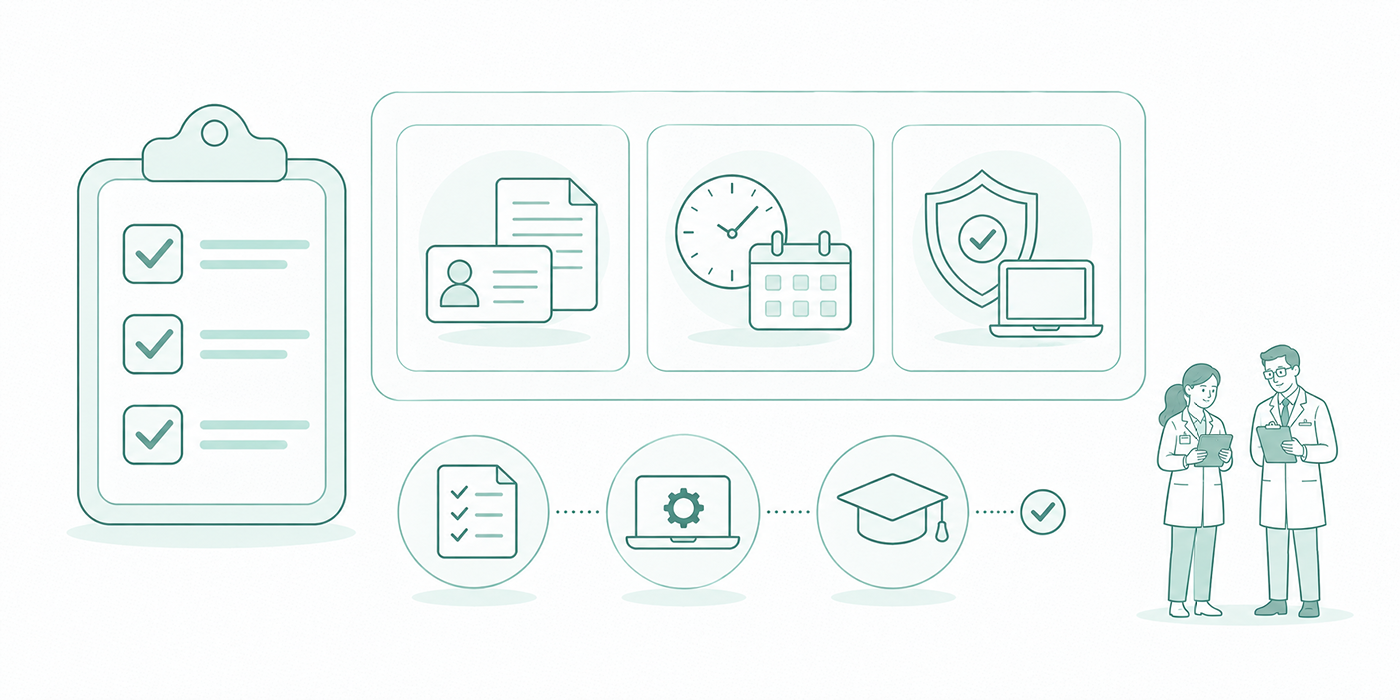
1. Verify Your GCP Exam Requirements Before Exam Day
The first checkpoint is identifying exactly which assessment you are taking. GCP training completion examinations, institutional refresher assessments, and professional certification examinations can follow different rules. Confusing these categories leads candidates to prepare for irrelevant topics, assume the wrong passing standard, or arrive without required identification.
Start by confirming your examination provider, course title, registration status, and candidate instructions. Someone completing general GCP certification training faces different requirements from someone pursuing a professional credential to support clinical research career progression. Use the official candidate handbook or learning portal to establish the exact assessment conditions.
Confirm the guideline version and exam blueprint
ICH E6(R3) introduces updated expectations involving quality by design, proportionate risk management, participant protection, and clinical-trial data governance. The FDA issued its final E6(R3) guidance in September 2025. ACRP examinations transitioned from E6(R2) to E6(R3) on July 15, 2026.
For candidates preparing in 2026, understanding ICH E6(R3) clinical research requirements is particularly valuable. Review how the updated framework influences investigator responsibilities, risk-based quality management, and clinical-trial data integrity.
Your provider's current examination blueprint determines what you will actually be tested on. Check the covered guidelines, domain weightings, question types, and any required supplementary materials.
Confirm your examination conditions
Verify the time limit, passing requirements, allowed attempts, retake restrictions, scheduling policy, and authorized resources. Passing scores vary between providers. Professional certification examinations may use scaled scoring, while course assessments may use percentage-based thresholds.
The distinction matters when evaluating employer-recognized GCP credentials and identifying certification program red flags. Confirm whether your employer or institution requires a specific training provider, curriculum, or completion record.
Identify your highest-risk preparation gaps
A candidate may know informed consent principles but struggle to distinguish serious adverse events from severe events. Another may understand GCP monitoring procedures while misinterpreting investigator oversight or protocol deviations.
Review incorrect practice answers by topic. Prioritize concepts involving participant rights, reporting responsibilities, essential records, and inspection-ready documentation. Candidates from research assistant backgrounds should pay particular attention to delegated responsibilities, while those pursuing CRA roles should strengthen their understanding of monitoring, escalation, and sponsor oversight.
The objective is a clear picture of the exam requirements and the specific knowledge weaknesses that could affect your result.
| GCP Certification Exam Day: 30-Point Readiness & Risk Prevention Matrix | |||
|---|---|---|---|
| Checkpoint | What to Verify | Risk if Overlooked | Recommended Action |
| 1. Exam identity | Exact provider, credential, and course | Preparing for the wrong assessment | Match your registration to the official exam handbook. |
| 2. Exam blueprint | Domains, topic weightings, and question format | Spending revision time on low-priority material | Allocate review time according to the published blueprint. |
| 3. ICH GCP version | E6(R2), E6(R3), and supplementary requirements | Applying outdated guidance | Confirm the version and study its relevant changes. |
| 4. Passing standard | Percentage or scaled-score requirements | Incorrect assumptions about passing | Check the exact assessment scoring policy. |
| 5. Retake rules | Number of attempts, waiting period, and fees | Unexpected additional expense or delays | Save the provider's current retake policy. |
| 6. Time zone | Local appointment time and daylight-saving changes | Missing the examination appointment | Cross-check local time and set two reminders. |
| 7. Account access | Active login and correct examination portal | Locked account or inaccessible exam | Test login beforehand without starting the exam. |
| 8. Legal name | Registration name matches accepted ID | Check-in rejection | Resolve discrepancies with the provider in advance. |
| 9. Identification | Required number, type, and validity of IDs | Admission refusal despite registration | Prepare every required original document. |
| 10. Check-in window | Arrival time and check-in deadline | Late arrival and forfeited appointment | Build a buffer around the official check-in time. |
| 11. Accommodations | Approved accessibility arrangements | Unavailable adjustments during testing | Obtain and confirm required approvals beforehand. |
| 12. Testing location | Remote or physical examination arrangements | Incorrect check-in procedure | Follow instructions for the registered delivery method. |
| 13. System compatibility | Operating system, browser, and secure software | Application launch failure | Run the provider's system test on your exam device. |
| 14. Device permissions | Administrative privileges and security settings | Proctoring software blocked by device controls | Verify software permissions and device ownership rules. |
| 15. Camera and microphone | Video clarity, microphone, and access permissions | Failed proctor identity verification | Test equipment through the approved platform. |
| 16. Internet connection | Stable connection meeting provider requirements | Disconnected or interrupted session | Test connectivity and learn the recovery procedure. |
| 17. Power availability | Battery, charger, and power reliability | Sudden device shutdown | Use a reliable supply and an approved power setup. |
| 18. Testing room | Privacy, interruptions, and room-scan rules | Security violation or interrupted check-in | Prepare a compliant, quiet testing environment. |
| 19. Desk contents | Phones, screens, watches, papers, and accessories | Prohibited-item violation | Remove everything outside the approved materials list. |
| 20. Reference policy | Open-book status and permitted learning resources | Unauthorized consultation of notes | Use only explicitly approved resources. |
| 21. Break restrictions | Break eligibility, time limits, and section locks | Lost access or exam termination | Plan breaks according to the specific testing policy. |
| 22. Technical support | Approved contact channel and incident process | Unsupported restart or undocumented interruption | Know the official incident-reporting procedure. |
| 23. Informed consent | Voluntary participation, timing, comprehension | Incorrect answers on participant protections | Practice scenarios involving consent before procedures. |
| 24. AE and SAE reporting | Seriousness, severity, causality, and timelines | Confusing safety classifications and reporting duties | Review event classification and escalation examples. |
| 25. Protocol deviations | Identification, impact, documentation, notification | Inadequate escalation or concealment | Practice compliant deviation-response decisions. |
| 26. Investigator oversight | Delegation, qualifications, and accountability | Misidentifying the responsible party | Map each trial activity to its authorized owner. |
| 27. Data integrity | Source records, attribution, corrections, audit trails | Accepting unverifiable or altered evidence | Prioritize traceable and documented corrections. |
| 28. Risk-based oversight | Critical-to-quality factors and proportionate controls | Misunderstanding ICH E6(R3) applications | Evaluate risk to participants and trial reliability. |
| 29. Time management | Question count, navigation, and review features | Running out of time on difficult questions | Use a first-pass budget and flagging strategy if allowed. |
| 30. Completion evidence | Certificate, score report, and verification information | Unusable or missing proof of training | Verify, download, and securely retain official records. |
2. Your 24-Hour and Exam-Morning GCP Preparation Schedule
The final day should protect the work you have already completed. Last-minute revision is most useful when it addresses identified weaknesses. Repeatedly reading familiar material can consume valuable time while leaving serious gaps in safety reporting, protocol compliance, or data governance.
24 hours before: finish your technical and administrative checks
Run the official compatibility test if you are taking a remotely proctored examination. Use the computer, operating system, network, and testing environment you will actually use. Confirm that the required software can access your camera and microphone.
If your employer controls your computer, check whether security restrictions prevent software installation or screen sharing. Address these problems before the appointment. Treat this like a clinical research quality-control check: identify an anticipated failure, verify its controls, and establish an approved contingency.
Locate the official help desk or proctoring support instructions. Confirm what happens if your connection drops, your identification cannot be verified, or the assessment unexpectedly closes.
Check your ID documents and registration details. For example, current ACRP examination instructions require two qualifying forms of identification and a legal-name match. Other assessments may use different requirements. Candidates evaluating GCP credential recognition should always follow the rules associated with their specific examination.
The evening before: conduct a focused clinical review
Allocate your remaining study time using an error log rather than beginning a new textbook chapter.
If you missed questions involving consent timing, review clinical research ethics. If you confused delegated duties with ultimate responsibility, revisit investigator oversight and site operations management. If monitoring decisions were difficult, focus on remote and on-site monitoring and risk-based trial management.
Create a single-page review sheet with four fields: scenario, primary risk, responsible party, and correct next action. Use it during permitted preparation, and remove it from your testing environment if the examination prohibits notes.
The goal is to recognize clinical decision patterns quickly. Candidates with experience in research assistant coordination may already understand operational scenarios, while candidates transitioning from other healthcare roles can strengthen their understanding through protocol-focused training.
Two hours before: stabilize your examination environment
Finish substantive revision and prepare your workspace.
Check your power supply, internet stability, device permissions, room lighting, and permitted materials. Arrange your environment to prevent interruptions. For remote examinations, do not assume that headphones, paper, smartwatches, additional monitors, or phones are allowed.
Eat appropriately and avoid unfamiliar stimulants. Plan around the official break policy, which may restrict when you can leave the workstation or return to previously completed questions.
For a final mental review, recall the priorities behind participant safety, clinical safety escalation, and documentation integrity.
During check-in: protect your examination eligibility
Follow the testing provider's procedures for identity verification, room inspection, candidate agreements, and software launch.
A remote examination may require visual verification of your surroundings. A test center may require personal belongings to be stored in designated locations. Follow the instructions provided for your appointment.
If the system fails, contact the authorized support channel. Record an incident through that process when directed. Independent restarts or device changes can create additional security problems.
The discipline resembles clinical protocol adherence and investigator compliance responsibilities, where authorized procedures, traceability, and appropriate escalation determine whether an action is acceptable.
Before starting the assessment, confirm that you understand the timer, question-navigation controls, break instructions, and submission process.
3. Review the GCP Topics Most Likely to Expose Knowledge Gaps
Strong GCP exam preparation requires understanding how principles apply when patient safety, data reliability, and operational decisions conflict. Candidates who memorize definitions may still struggle when a question introduces an emergency, incomplete documentation, competing responsibilities, or a protocol deviation.
Use the following six scenarios to strengthen your ICH E6(R3) knowledge and practical understanding of clinical research ethics.
Scenario 1: A participant signs the consent form after a study-specific procedure
The critical issue is whether valid informed consent was obtained before the procedure. A signature recorded afterward does not retroactively establish that the earlier activity was authorized.
The responsible team should protect the participant, involve the investigator, document what occurred, evaluate the impact, and follow applicable deviation-reporting procedures. The exact response depends on the circumstances and governing requirements.
This scenario tests the distinction between a signed document and a valid consent process. Review informed-consent ethics, investigator obligations, and protocol deviation management.
Scenario 2: A participant is hospitalized, but the investigator believes the event is unrelated to treatment
Hospitalization may meet the seriousness criteria for a serious adverse event, subject to applicable definitions and exceptions. The investigator's assessment of treatment-relatedness is a separate determination.
In applicable drug trials, investigators generally report SAEs promptly to the sponsor under the protocol and regulatory requirements, including when causality remains uncertain. The sponsor subsequently evaluates its own reporting obligations.
Understanding the distinction between seriousness, severity, expectedness, and causality is essential for adverse-event compliance, medical-monitor safety assessments, and pharmacovigilance responsibilities.
Scenario 3: A study coordinator discovers an incorrect source-data entry
The appropriate response preserves the original information and establishes a traceable correction consistent with the applicable procedures. The correction should identify the responsible person and preserve information necessary to reconstruct the change.
Overwriting a source record without an audit trail can compromise data integrity. Changing dates to conceal a delayed entry creates additional compliance concerns.
For examination questions, connect the situation to clinical-trial data integrity, research documentation standards, and GCP monitoring activities.
Scenario 4: A principal investigator delegates an important study activity
Delegation requires that the assigned individual be appropriately qualified, informed, trained, and authorized for the activity. The investigator must maintain appropriate oversight of delegated work.
If an unqualified person conducts a restricted clinical assessment, the primary concern extends beyond incomplete delegation paperwork. Evaluate potential participant risk, the validity of the assessment, and any necessary corrective actions.
This is a high-value distinction for candidates studying principal investigator oversight, research assistant training, and site coordination responsibilities.
Scenario 5: A sponsor delegates monitoring activities to a CRO
The agreement should clearly allocate trial activities and responsibilities. The sponsor remains accountable for ensuring appropriate oversight and trial quality.
An examination answer claiming that delegated work automatically transfers every sponsor obligation is generally inconsistent with GCP principles.
Study how CRO and sponsor responsibilities, clinical monitoring, and trial project leadership interact. This becomes particularly relevant when preparing for CRA career advancement.
Scenario 6: A monitoring plan reduces routine source-data verification
ICH E6(R3) supports proportionate, risk-based approaches. The relevant question is whether the proposed monitoring strategy adequately protects participants and supports reliable trial results.
A well-designed plan identifies critical-to-quality factors, evaluates important risks, establishes controls, and responds appropriately to emerging concerns. The appropriate monitoring frequency and methods depend on the trial's characteristics.
Review quality management strategies, clinical monitoring techniques, and data-review responsibilities.
Across all six scenarios, ask four questions: What could harm the participant or compromise evidence? Who has responsibility? What action is required? How must the action be documented?
What Is Your Biggest GCP Certification Exam Day Concern?
Choose one. Your answer reveals the preparation step that deserves your attention.
Work through five scenarios involving consent, eligibility, safety, protocol deviations, and data corrections. For each case, identify the primary risk, responsible person, compliant response, and documentation requirement.
Confirm the guideline version assessed by your provider. Review ICH E6(R3) quality by design, critical-to-quality factors, proportionate oversight, and data governance. Give priority to the topics listed in your actual examination syllabus.
Separate event seriousness from causality, distinguish investigator and sponsor duties, and review consent timing. For deviations, identify the immediate safety response, escalation pathway, documentation, and required follow-up.
Match your registration name to the required IDs. Test your actual examination device, internet connection, webcam, microphone, and approved software. Confirm check-in time, break rules, prohibited items, and the technical-support procedure.
Calculate your first-pass time budget and reserve review time. Answer clear questions efficiently, flag difficult ones if your platform permits, and change an answer only when you identify a specific error in your original reasoning.
4. Apply a Four-Filter Method to Difficult GCP Exam Questions
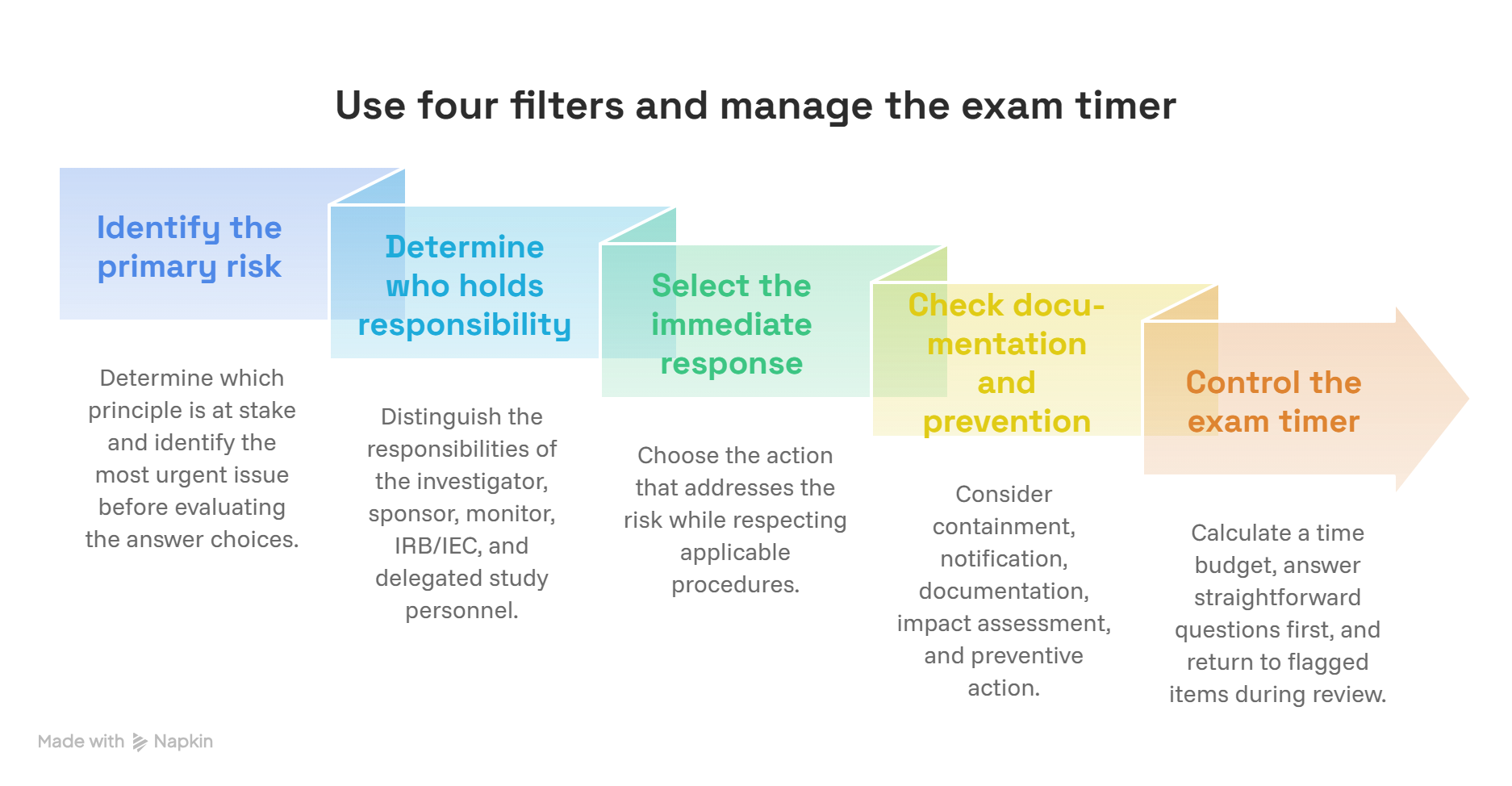
Clinical scenario questions become more manageable when you use the same reasoning process consistently. Four filters can help you distinguish between plausible answers and identify the response that best matches the facts presented.
Filter 1: Identify the primary clinical or compliance risk
Read the scenario and determine which principle is at stake. A missing consent signature may raise participant-rights concerns. An unexplained change in an electronic record may involve clinical-trial data integrity. A hospitalization may trigger safety reporting responsibilities.
Some scenarios involve overlapping risks. A protocol deviation affecting eligibility may require both participant-safety assessment and review of protocol compliance.
Identify the most urgent issue before evaluating the available answer choices.
Filter 2: Determine who holds responsibility
GCP distinguishes the responsibilities of the investigator, sponsor, monitor, IRB/IEC, and delegated study personnel.
A question about participant medical care may involve investigator responsibilities. Questions involving monitoring strategy, vendor selection, or trial-level quality management may involve sponsor oversight.
Review site operations management, medical-monitor responsibilities, and clinical project leadership to clarify where different responsibilities begin and end.
Filter 3: Select the most appropriate immediate response
Look for the action that addresses the relevant risk while respecting the applicable procedures.
If a participant faces an urgent safety threat, medical assessment and necessary protective action take priority. Follow-up may involve adverse-event reporting, safety data review, or medical monitoring procedures.
If a source record contains an error, the answer should preserve data traceability. If a trial process repeatedly fails, evaluate the need for quality-system corrective actions.
Filter 4: Check documentation, escalation, and prevention
A compliant response often involves several stages: immediate containment, appropriate notification, documentation, assessment of impact, and preventive action.
Distinguish between these stages when a question asks what to do first or what constitutes the most appropriate response.
Use your knowledge of GCP monitoring, protocol deviation handling, and clinical research quality management to evaluate the full response.
Control the exam timer without sacrificing judgment
Calculate your time budget using the examination duration, total questions, and intended review period.
For example, a hypothetical 60-question examination lasting 90 minutes leaves 75 seconds per question if you reserve 15 minutes for review.
When navigation permits, complete straightforward questions first, flag uncertain items, and return to them using a defined review period. Be careful with questions containing first, except, most appropriate, and must.
If you are unsure whether a scenario relates to participant safety, investigator accountability, or risk-based oversight, return to the four filters instead of repeatedly rereading the question.
5. Complete the Exam, Verify Your Certificate, and Prepare for Employer Acceptance
Exam completion involves three separate checks: successful submission, accurate result reporting, and usable evidence of training.
Before submitting, review unanswered questions if the platform allows. Confirm that flagged items have been addressed and that you understand whether pressing the final submission control permanently closes the examination.
After submission, follow the provider's instructions for viewing scores, downloading completion documents, or awaiting official results. Different providers issue results and credentials through different processes.
Verify your certificate details
Check that your name, training provider, course title, completion date, and any issued verification information are accurate.
Maintain the certificate and relevant authorized training records securely. NIH expects covered clinical trial personnel to retain documentation of their GCP training, and its guidance calls for refresher training at least every three years. Employer, sponsor, and institutional requirements may add further obligations.
Accurate documentation matters when applying for entry-level clinical research jobs, preparing a clinical research resume, or establishing qualifications for research assistant roles.
Respond to an unsuccessful examination result
Use diagnostic feedback, where provided, to identify weak areas. Separate content gaps from problems with question interpretation, timing, or technical access.
If weaknesses involve informed consent, SAE reporting, or investigator responsibilities, rebuild those concepts through realistic scenarios.
If difficulties primarily involve risk-based monitoring, data integrity, or ICH E6(R3) expectations, focus your next preparation cycle on those domains.
Confirm the provider's retake policy before scheduling another attempt.
Turn GCP training into credible professional evidence
Describe your credential precisely on your resume. Include the provider's name and the correct course or certification title.
Employers distinguish training completion from professional certification and demonstrated clinical experience. Candidates can strengthen their applications by combining GCP knowledge with examples involving protocol adherence, trial logistics coordination, and research communication.
For someone pursuing a CRC position, emphasize participant coordination and study documentation. For a prospective CRA, highlight monitoring, escalation, protocol compliance, and site communication.
The strongest applications connect GCP certification knowledge with verifiable examples of professional competence.
6. Frequently Asked Questions About GCP Certification Exam Day
-
Identification requirements depend on your provider. Some professionally proctored assessments require two IDs, including a current government-issued primary document. Other GCP training assessments may use account-based verification or different identification procedures.
Check the required legal-name match, acceptable document types, expiration rules, and check-in conditions. Resolve any mismatch in advance.
Candidates evaluating recognized GCP certification programs should review the provider's examination handbook and credential verification standards.
-
The required passing score depends on the assessment provider and scoring method.
Some training assessments use a percentage threshold. Professional certification examinations may use scaled scores. For example, ACRP uses a scaled passing score of 600 on a scale extending to 800 for its certification examinations.
Verify the standard for your exact examination and avoid relying on thresholds described for other providers.
When comparing clinical research certifications, consider employer recognition, syllabus coverage, and practical relevance alongside the passing requirements.
-
The coverage depends on the provider. ACRP transitioned its examinations to ICH E6(R3) in July 2026. Other providers may adopt updated content through their own curriculum and assessment processes.
Candidates should study the principles of risk proportionality, quality by design, data governance, and sponsor-investigator oversight where these fall within the examination blueprint.
Review ICH E6(R3) requirements, clinical quality management, and investigator oversight to strengthen practical understanding.
-
Permitted resources vary. Some learning assessments allow reference materials, while secure certification examinations may prohibit outside resources.
Check whether your examination is open-book, whether printed materials are permitted, and whether the provider authorizes access to electronic references.
For closed-book assessments, practice applying research ethics, protocol requirements, and data integrity principles without external assistance.
-
The outcome depends on the platform and incident circumstances. Some providers offer approved reconnection procedures, while others require support intervention or an incident review.
Learn the authorized reporting method before the assessment begins. Follow the proctor's instructions regarding reconnection, device use, and examination recovery.
Preparing for technical disruption is a useful application of risk management principles and operational contingency planning.
-
Prioritize informed consent, participant safety, investigator and sponsor responsibilities, adverse-event reporting, protocol deviations, data integrity, monitoring, essential records, and risk-based quality management.
Choose your revision priorities using the official blueprint and the questions you previously answered incorrectly.
Candidates struggling with safety scenarios should review adverse-event reporting, medical monitoring plans, and clinical safety assessments.
Candidates struggling with operational scenarios should emphasize site oversight and protocol adherence.
