
ICH-GCP certification exam questions often test decisions that clinical research professionals must make under pressure. A serious adverse event requires immediate escalation, a consent error demands transparent documentation, and an unexplained data correction can threaten the credibility of an entire study. Understanding these distinctions is essential for passing scenario-based assessments.
This guide provides 15 realistic practice questions, detailed answer explanations, and a comprehensive decision matrix aligned with ICH E6(R3). You will learn how to identify regulatory responsibilities, eliminate misleading answer choices, and apply Good Clinical Practice principles to situations involving clinical trial monitoring and participant safety.
1. How to Solve ICH-GCP Certification Exam Questions Using the E6(R3) Framework
The most difficult ICH-GCP questions present several technically plausible answers. One option may describe appropriate documentation, another may address sponsor notification, and a third may prioritize participant protection. Your task is to determine which action best answers the exact question at the specific stage of the incident.
ICH E6(R3) establishes 11 overarching GCP principles and detailed guidance addressing investigator responsibilities, ethical trial conduct, data integrity, and sponsor oversight. The revised framework emphasizes quality by design, proportionate controls, and reliable clinical evidence. Regulatory implementation dates and training-provider requirements vary across jurisdictions.
The five-step method for difficult GCP scenarios
Use the following decision sequence when two answers appear defensible.
Step 1: Identify the immediate risk.
Ask whether the scenario affects participant safety, consent, confidentiality, protocol compliance, or critical trial data. A participant requiring urgent medical attention creates a different immediate priority from a delayed administrative filing.
Reviewing clinical trial safety oversight alongside medical monitoring plans helps distinguish urgent clinical risks from routine operational deficiencies.
Step 2: Identify the accountable professional.
The principal investigator, sponsor, CRO, monitor, and IRB/IEC have different responsibilities. Delegating trial activities does not automatically transfer accountability for those activities.
Candidates should understand principal investigator oversight, clinical research team management, and the operational differences between sponsor and CRO responsibilities.
Step 3: Determine the first required action.
Look for keywords such as immediately, first, most appropriate, and primary responsibility. They determine whether the answer concerns treatment, escalation, verification, or documentation.
A protocol deviation requiring urgent intervention should be assessed against protocol adherence requirements and ethical participant protection.
Step 4: Identify the evidence required to demonstrate compliance.
A compliant decision should produce appropriate documentation. Examples include a dated consent form, attributable electronic correction, safety report, temperature excursion record, or documented corrective action.
The evidence must support reconstruction of events. Understanding clinical trial data integrity and quality management strategies is essential for answering these questions accurately.
Step 5: Eliminate the answer choices that create new compliance risks.
Look for options involving backdated signatures, concealed protocol deviations, unnecessary delays, unqualified task delegation, or undocumented record changes.
These are recurring failure modes in clinical research quality assurance and GCP monitoring activities.
Understand the difference between examination knowledge and operational competence
A candidate may memorize that serious adverse events require reporting while still struggling to decide what happens when causality remains uncertain. Another may recognize the term risk-based monitoring but fail to identify which trial data deserve the greatest oversight.
Strong preparation connects the regulatory principle to an operational decision. This becomes particularly valuable for professionals pursuing clinical research coordinator positions, CRA career opportunities, and clinical project management roles.
| ICH-GCP Certification Exam: 30-Scenario Decision Matrix | ||||
|---|---|---|---|---|
| Exam Scenario | Competency Tested | Correct Decision | Critical Mistake to Avoid | Study Resource |
| 1. Consent signed after a study procedure | Consent timing | Protect participant, document and escalate deviation | Backdating the signature | Consent ethics |
| 2. New important safety information | Ongoing informed consent | Assess participant communication and re-consent | Withholding information until trial completion | Safety plans |
| 3. Participant cannot read consent | Impartial witness | Use a witness throughout the consent discussion | Obtaining only a retrospective witness signature | Patient rights |
| 4. Emergency enrolment | Emergency consent safeguards | Follow approved emergency procedures and applicable law | Assuming emergencies eliminate ethics oversight | Ethics |
| 5. Participant stops treatment | Withdrawal rights | Respect choice and clarify follow-up options | Automatically removing all previously collected data | Withdrawal |
| 6. Unexpected hospitalization | Serious adverse event reporting | Report immediately after reasonable awareness, subject to specified exceptions | Waiting for complete causality evidence | SAE reporting |
| 7. Mild expected adverse event | AE classification | Document and report according to protocol | Classifying every adverse event as serious | Safety oversight |
| 8. Life-threatening clinical event | Immediate participant protection | Provide necessary medical care and complete required escalation | Delaying treatment for administrative approval | Participant safety |
| 9. Urgent protocol deviation | Immediate-hazard exception | Eliminate immediate hazard and complete notifications | Delaying necessary intervention | Protocol rules |
| 10. Delegated coordinator tasks | Investigator oversight | Verify competence and appropriate supervision | Treating delegation as transfer of accountability | PI duties |
| 11. Untrained staff conducts procedure | Personnel qualifications | Stop unauthorized work and assess impact | Creating misleading retrospective training records | Training |
| 12. Incorrect eligibility decision | Protocol compliance | Assess safety, scientific impact and reporting | Ignoring ineligibility because participant is stable | Site oversight |
| 13. Drug storage excursion | Investigational product handling | Segregate affected product and request disposition | Dispensing before suitability assessment | Trial logistics |
| 14. Drug accountability mismatch | Inventory reconciliation | Investigate dispensing, return and inventory records | Changing counts without justification | Accountability |
| 15. EDC contradicts source data | Traceable corrections | Investigate and correct with an audit trail | Overwriting records without preserving history | Data integrity |
| 16. Shared EDC credentials | User attribution | Secure access and assess affected entries | Continuing shared login arrangements | Audit trails |
| 17. Missing electronic audit trail | Electronic record reliability | Assess system controls and reconstructability | Assuming accurate totals establish full integrity | System quality |
| 18. Repeated endpoint discrepancies | Critical-to-quality factors | Target controls toward endpoint reliability | Treating all data fields as equally critical | Risk management |
| 19. Centralized monitoring detects outlier | Risk-based monitoring | Investigate signal before escalating conclusions | Automatically declaring misconduct | Monitoring |
| 20. Remote monitoring planned | Monitoring feasibility | Assess secure access and suitability | Assuming remote review is always equivalent | Remote visits |
| 21. CRO identifies major deficiencies | Sponsor accountability | Ensure documented sponsor oversight and remediation | Assuming outsourcing ends sponsor responsibility | Sponsor oversight |
| 22. Repeated protocol noncompliance | CAPA | Investigate root cause and verify effectiveness | Repeated retraining without cause analysis | CAPA |
| 23. Ethics approval lapses | IRB/IEC compliance | Verify permitted activities and obtain necessary approval | Assuming sponsor approval replaces ethics review | Ethics review |
| 24. Emergency unblinding needed | Blinding safeguards | Use approved procedure and limit disclosure | Distributing treatment assignments widely | Medical oversight |
| 25. Participant identifier exposed | Confidentiality | Contain disclosure and follow privacy procedures | Ignoring an internal confidentiality breach | Data protection |
| 26. Wearable device data missing | Digital data reliability | Investigate technical failure and endpoint impact | Inventing replacement observations | E6(R3) |
| 27. Essential study records missing | Inspection readiness | Investigate gaps and preserve reliable evidence | Fabricating retrospective originals | Documentation |
| 28. Audit identifies undisclosed deviation | Quality assurance | Assess impact, reporting and corrective action | Removing the finding from the audit trail | Quality review |
| 29. Database lock approaching | Data finalization | Resolve critical queries and confirm readiness | Closing unresolved queries administratively | Trial milestones |
| 30. Trial close-out with missing records | Records retention | Reconcile obligations and establish secure retention | Destroying records after the last patient visit | Close-out |
2. Informed Consent and Participant Rights: Practice Questions 1–5
Informed consent questions examine the entire decision-making process. Candidates must understand documentation, participant comprehension, voluntary participation, independent safeguards, and the timing of study procedures.
The following scenarios connect informed consent ethics with investigator accountability and practical patient education procedures.
Question 1. Consent Obtained After a Study Procedure
A study coordinator collects protocol-specific blood samples before discovering that the participant has not signed the approved informed consent form. The participant explains that the trial was discussed during a screening appointment.
What is the most appropriate response?
A. Obtain a signature using the date of the screening appointment.
B. Accept the verbal discussion as sufficient evidence of consent.
C. Inform the investigator, assess the impact, document the actual chronology, and follow required deviation procedures.
D. Remove the blood collection from the study records.
Correct answer: C
Detailed explanation:
The informed consent process should be completed and appropriately documented before trial participation, subject to specific legally permitted exceptions. The team must investigate the event and assess any implications for the participant.
The appropriate response involves the investigator, transparent documentation, and any necessary notifications. A later signature cannot establish that consent was properly documented before the procedure.
Option A creates misleading evidence. Option B overlooks the documentation requirements in the scenario. Option D conceals a study procedure and compromises the trial record.
This distinction connects informed consent requirements, protocol deviation handling, clinical trial data integrity, and site oversight responsibilities.
Exam trap: Believing a late signature can retroactively establish compliant prior consent.
Question 2. New Safety Information During an Ongoing Trial
A sponsor identifies a newly recognized risk that could influence whether participants wish to continue receiving investigational treatment.
What should the investigator and sponsor assess?
A. Whether revised consent materials, required ethics approval, and timely participant communication are needed.
B. Whether the information can remain undisclosed until the trial finishes.
C. Whether every participant must immediately discontinue treatment.
D. Whether coordinators can communicate the information without recording the process.
Correct answer: A
Detailed explanation:
Important new information affecting willingness to continue participation should be communicated in a timely manner. The responsible parties should determine whether approved consent materials need revision and whether formal re-consent is required.
The appropriate approach depends on the nature of the risk, the clinical circumstances, the protocol, and applicable regulatory requirements.
The investigator may also need to assess individual participant safety and ongoing treatment suitability.
Candidates can strengthen this reasoning through medical monitoring plans, safety assessment procedures, investigator GCP responsibilities, and ethical research principles.
Exam trap: Assuming every safety update automatically requires discontinuation of all participants.
Question 3. A Participant Cannot Read the Consent Form
An adult participant understands spoken explanations and has the capacity to make medical decisions but cannot read the informed consent document.
Which safeguard is required under the applicable GCP consent process?
A. The study coordinator signs on the participant's behalf.
B. A relative automatically becomes the legally acceptable representative.
C. The sponsor provides verbal approval for enrolment.
D. An impartial witness remains present throughout the consent discussion and completes the required attestation.
Correct answer: D
Detailed explanation:
ICH E6(R3) provides for an impartial witness during the entire informed consent discussion when the participant or legally acceptable representative cannot read.
The witness confirms that the information was accurately explained and apparently understood, and that consent was freely given.
The participant's inability to read does not automatically affect their capacity to make an informed decision.
This distinction matters for participant rights, clinical trial patient education, research assistant training, and ethical compliance procedures.
Exam trap: Confusing literacy with decision-making capacity.
Question 4. Emergency Enrolment Without Prior Consent
An unconscious patient may be eligible for an emergency clinical trial intervention. The legally acceptable representative cannot be contacted before the intervention must begin.
Which approach may be permissible?
A. Enrol the patient without assessing consent-related requirements.
B. Follow a legally permitted and appropriately approved emergency consent process, including subsequent consent requirements.
C. Ask the study monitor to authorize enrolment.
D. Assume emergency trials are exempt from ethics committee review.
Correct answer: B
Detailed explanation:
Emergency enrolment can be permissible when the relevant safeguards, applicable laws, and approved procedures are satisfied.
The investigator must follow the trial's emergency provisions and ensure that the participant or representative is informed and consent sought as required when practicable.
The examination focuses on the distinction between approved emergency research procedures and unauthorized enrolment.
Candidates should review research ethics requirements, investigator responsibilities, protocol adherence, and patient protection principles.
Exam trap: Treating medical urgency as unrestricted permission to bypass consent safeguards.
Question 5. Withdrawal From Investigational Treatment
A participant decides to stop taking the investigational product but agrees to continue safety follow-up visits.
What should the investigator do?
A. Delete all previously collected participant data.
B. Continue treatment until the sponsor authorizes withdrawal.
C. Respect the treatment decision, discuss appropriate follow-up, and document the agreed plan.
D. Inform the participant that refusing treatment ends access to routine healthcare.
Correct answer: C
Detailed explanation:
Stopping investigational treatment, discontinuing study follow-up, and withdrawing permission for particular future activities are distinct matters.
The investigator should respect the participant's choice while explaining suitable follow-up options and addressing any clinical safety considerations.
The protocol, informed consent arrangements, applicable law, and data protection requirements govern how previously collected information is handled.
This understanding supports competent clinical trial site management, participant communication, GCP investigator oversight, and trial documentation.
Exam trap: Assuming discontinuation of treatment automatically requires removal of existing trial records.
3. Safety Reporting, Delegation, and Protocol Compliance: Practice Questions 6–10
Safety reporting requires distinguishing seriousness, severity, expectedness, and causality. Operational questions also test whether investigators understand their continuing responsibilities when tasks are assigned to other qualified professionals.
Study these scenarios alongside adverse event reporting guidelines, clinical safety oversight, and research protocol compliance.
Question 6. Reporting a Serious Adverse Event With Uncertain Causality
A participant is unexpectedly hospitalized. The investigator becomes aware of the hospitalization but has insufficient information to establish whether the investigational product caused the event.
What is the best response?
A. Wait until causality is conclusively established.
B. Report the SAE immediately to the sponsor, include a causality assessment, and provide follow-up information as needed.
C. Wait for the next scheduled monitoring visit.
D. Report only if the event is confirmed to be unexpected.
Correct answer: B
Detailed explanation:
Under ICH E6(R3), serious adverse events should generally be reported immediately after the investigator reasonably becomes aware of them. The report should include a causality assessment.
The protocol may identify specified events that do not require immediate reporting, subject to applicable regulatory requirements.
The investigator should provide further information through follow-up reporting as it becomes available.
The crucial distinction concerns the timing of the initial report and the completeness of the medical investigation.
This reasoning is central to GCP adverse event reporting, medical monitoring responsibilities, drug safety assessments, and pharmacovigilance audit preparation.
Exam trap: Waiting for final causality evidence before making the initial SAE report.
Question 7. Distinguishing Severity From Seriousness
A participant develops intense nausea that resolves with treatment and does not meet any serious adverse event criterion.
How should the event be evaluated?
A. Every severe adverse event must automatically be classified as serious.
B. An event is serious only when its relationship to treatment is confirmed.
C. Severity and seriousness should be assessed separately using the relevant criteria.
D. Severe events can be excluded from study documentation when expected.
Correct answer: C
Detailed explanation:
Severity describes the intensity of an event. Seriousness concerns defined outcomes or circumstances, such as death, life-threatening events, hospitalization, significant disability, congenital anomaly, or other medically important events as applicable.
An event can be severe without meeting seriousness criteria. A relatively mild symptom may also be associated with a serious clinical outcome.
Candidates should understand these distinctions before studying suspected adverse reactions and expedited safety reporting.
Review pharmacovigilance examination topics, safety assessment techniques, adverse event reporting, and medical monitor responsibilities.
Exam trap: Treating severity and seriousness as interchangeable classifications.
Question 8. Protocol Deviation to Eliminate an Immediate Hazard
During a trial visit, an investigator identifies an immediate danger to a participant that requires a medical intervention outside the approved protocol.
What is the most appropriate action?
A. Protect the participant through the necessary intervention and promptly complete required notification and reporting.
B. Delay medical treatment until the next ethics committee meeting.
C. Continue following the protocol despite the immediate danger.
D. Ask the monitor to assume responsibility for the medical decision.
Correct answer: A
Detailed explanation:
ICH E6(R3) permits a protocol departure when necessary to eliminate an immediate hazard to a participant.
The investigator should act to protect the participant and then complete the required sponsor notification and subsequent reporting under applicable procedures.
The exception is tied to immediate participant protection. Routine operational convenience does not create the same justification.
This distinction applies to investigator GCP obligations, protocol adherence requirements, ethical trial conduct, and medical safety oversight.
Exam trap: Requiring advance administrative approval for an intervention needed to address an immediate hazard.
Question 9. Delegation of Clinical Trial Responsibilities
A principal investigator delegates eligible study procedures to an appropriately qualified coordinator.
Which statement best describes the investigator's obligations?
A. All responsibility transfers to the coordinator when the delegation log is signed.
B. Sponsor approval removes the requirement for investigator supervision.
C. Delegated personnel become solely responsible for regulatory compliance.
D. The investigator remains responsible for appropriate oversight of the delegated activities.
Correct answer: D
Detailed explanation:
Delegated trial activities require appropriately qualified personnel, clear responsibilities, suitable training, and adequate supervision.
The investigator remains responsible for appropriate oversight of activities performed under their authority.
A delegation log provides documentary evidence of responsibility allocation, while the actual qualifications, training, and oversight arrangements determine whether delegation is appropriate.
This is important for principal investigator site oversight, research coordinator responsibilities, research assistant training requirements, and clinical research leadership.
Exam trap: Treating documented delegation as a substitute for appropriate investigator supervision.
Question 10. Investigational Product Temperature Excursion
A research pharmacist discovers that investigational product storage exceeded the specified temperature range overnight. The affected units are still physically intact.
What should happen next?
A. Continue dispensing because the packages look undamaged.
B. Segregate the affected stock, preserve excursion records, and obtain an authorized decision on product disposition.
C. Discard the product without recording the deviation.
D. Modify the temperature log to reflect the required storage conditions.
Correct answer: B
Detailed explanation:
Temperature excursions require assessment against product-specific stability information, sponsor procedures, and applicable requirements.
Affected stock should be controlled while suitability is evaluated by the responsible parties.
Visual appearance alone cannot establish continued product stability, potency, or acceptable quality.
The site should preserve the actual excursion data, document the investigation, and follow authorized disposition instructions.
Candidates preparing for clinical trial logistics responsibilities, site operations oversight, quality management, and research protocol compliance should understand investigational product accountability from receipt through final reconciliation.
Exam trap: Assuming a brief temperature excursion or unchanged packaging establishes product suitability.
What Is Your Biggest ICH-GCP Exam Preparation Blocker?
Choose one. Your answer points to the most useful next step.
Submit
4. Data Integrity, Risk-Based Monitoring, and Sponsor Oversight: Practice Questions 11–15
ICH E6(R3) emphasizes reliable clinical trial information, proactive identification of critical-to-quality factors, and proportionate controls. These concepts are central to modern trials using remote monitoring, digital devices, centralized analytics, and outsourced services.
The following questions apply trial data integrity principles, risk-based quality management, and GCP monitoring techniques.
Question 11. Electronic Case Report Form Discrepancy
An EDC record indicates that a participant completed a study assessment on Monday. The original source documentation records the assessment on Tuesday.
What is the most appropriate action?
A. Change the source record to match the EDC.
B. Delete the EDC entry and re-enter the value without explanation.
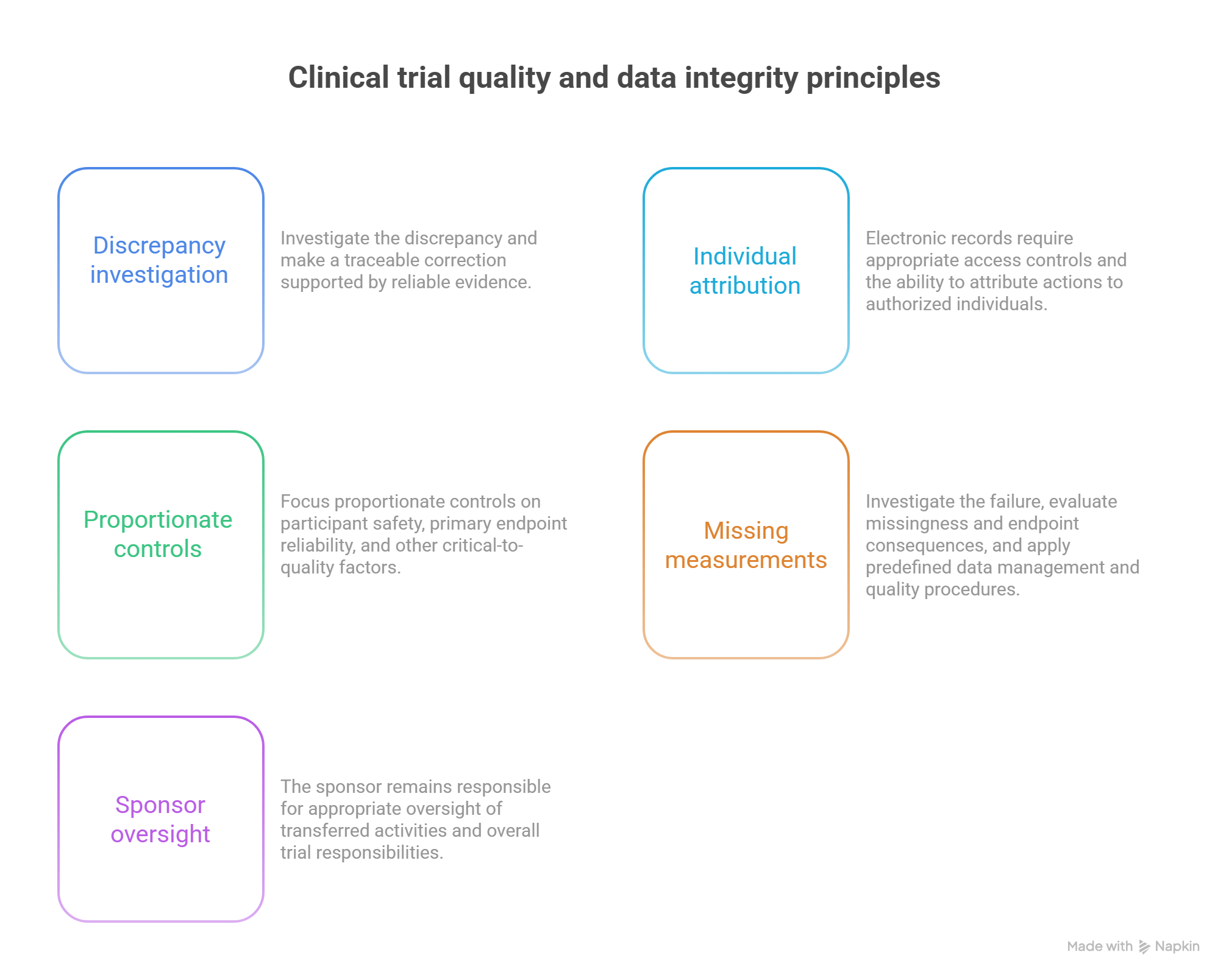
C. Investigate the discrepancy and make a traceable correction supported by reliable evidence.
D. Leave both records unchanged because the assessment was completed.
Correct answer: C
Detailed explanation:
A discrepancy between source documentation and electronic trial data requires investigation.
The team should determine which record accurately reflects the event and use authorized correction procedures to preserve the record's history.
Electronic corrections should support appropriate attribution, traceability, and reconstruction.
The source record itself may require correction if reliable evidence establishes an original documentation error. Any change must preserve the previous information and the correction history where required.
This scenario tests clinical trial data integrity, GCP monitoring procedures, clinical research quality controls, and investigator documentation oversight.
Exam trap: Prioritizing agreement between two records over the factual accuracy and traceability of the underlying information.
Question 12. Shared Electronic Data Capture Credentials
An audit identifies that two coordinators have used the same electronic data capture account for several weeks.
What is the most significant compliance concern?
A. The database may contain insufficient storage capacity.
B. Individual data-entry and modification activities may lack reliable attribution.
C. The number of electronic queries may increase.
D. Monitoring visits may become more expensive.
Correct answer: B
Detailed explanation:
Electronic records require appropriate access controls and the ability to attribute actions to authorized individuals.
Shared credentials can weaken audit trail interpretation and undermine confidence in the history of electronic data.
The site should secure access, investigate affected entries, assess the reliability of existing records, and apply appropriate corrective action.
This example demonstrates the connection between data integrity requirements, quality management systems, clinical monitoring expectations, and E6(R3) competency requirements.
Exam trap: Assuming technically accurate data values establish sufficient electronic record integrity.
Question 13. Prioritizing Critical-to-Quality Factors
A sponsor is designing a randomized clinical trial involving a primary efficacy endpoint, a safety-critical dosing procedure, and several optional exploratory questionnaires.
Which monitoring strategy best reflects ICH E6(R3)?
A. Verify every optional questionnaire response before reviewing dosing compliance.
B. Apply identical monitoring intensity to every trial procedure.
C. Prioritize records based exclusively on verification cost.
D. Focus proportionate controls on participant safety, primary endpoint reliability, and other critical-to-quality factors.
Correct answer: D
Detailed explanation:
Quality by design requires identifying factors fundamental to participant protection and reliable trial results.
The sponsor should assess the importance of trial activities, associated risks, available controls, and the consequences of potential failures.
Monitoring intensity should reflect those factors.
For example, repeated errors affecting the primary endpoint may justify immediate targeted oversight, while lower-risk administrative discrepancies may be addressed through proportionate controls.
This approach connects clinical research quality management, risk-based monitoring, clinical trial project management, and data reliability responsibilities.
Exam trap: Assuming every data field requires identical verification intensity.
Question 14. Missing Data From Wearable Devices
A clinical trial collects secondary endpoint information through wearable devices. A software defect causes intermittent missing measurements across multiple participants.
What should the sponsor do?
A. Replace the missing observations using invented average values.
B. Exclude affected participants without assessing the trial impact.
C. Investigate the failure, evaluate missingness and endpoint consequences, and apply predefined data management and quality procedures.
D. Ignore the problem because data collection was automated.
Correct answer: C
Detailed explanation:
Digital data collection requires suitable controls for accuracy, completeness, traceability, transfer, and reliability.
A device malfunction can affect the completeness of clinical evidence even when the device previously functioned correctly.
The sponsor should assess whether missingness is systematic, whether it affects particular participants or time periods, and whether the impact threatens meaningful interpretation.
The response may require system corrections, additional monitoring, and documented data handling decisions.
This topic is increasingly relevant to E6(R3) clinical research skills, clinical trial data integrity, quality management strategies, and medical data review.
Exam trap: Assuming automated data collection eliminates the need for data quality evaluation.
Question 15. CRO Oversight and Sponsor Accountability
A pharmaceutical sponsor contracts a CRO to conduct monitoring and data management. The CRO identifies repeated significant deficiencies across several study sites.
Which statement best describes sponsor responsibility?
A. All accountability transfers permanently to the CRO.
B. The CRO can resolve the deficiencies without informing the sponsor.
C. Sponsor involvement begins only after database lock.
D. The sponsor remains responsible for appropriate oversight of transferred activities and overall trial responsibilities.
Correct answer: D
Detailed explanation:
Sponsors may transfer trial-related activities to qualified service providers, while maintaining responsibility for appropriate oversight.
The agreement should clearly describe responsibilities, communication arrangements, and expectations for quality and performance.
Significant noncompliance may require investigation, escalation, corrective and preventive actions, and subsequent effectiveness checks.
A sponsor must be able to demonstrate that its oversight processes are appropriate for the responsibilities transferred.
This principle is relevant to CRO and sponsor operations, clinical project management, quality assurance strategies, and study monitoring responsibilities.
Exam trap: Treating contracted operational responsibilities as a complete transfer of sponsor accountability.
5. A 14-Day ICH-GCP Exam Preparation Plan to Eliminate Knowledge Gaps
Effective GCP preparation requires a structured progression from foundational principles to unfamiliar clinical scenarios.
Candidates who repeatedly complete the same question bank may develop answer recognition without improving their underlying reasoning. A stronger approach combines targeted reading, practical application, error analysis, and fresh testing.
This 14-day plan can be adapted to the syllabus and assessment format specified by your provider.
Days 1–3: Master GCP responsibilities and ethical foundations
Day 1: Learn the overarching GCP principles.
Study participant rights, trial design, scientific reliability, informed consent, and appropriate oversight.
Connect GCP ethical requirements with investigator responsibilities. Create examples explaining how each principle changes a clinical decision.
Day 2: Build a regulatory responsibility map.
Separate the investigator, sponsor, IRB/IEC, CRO, and monitoring functions.
For each party, record its typical responsibilities, approval authority, reporting obligations, and oversight requirements.
Use principal investigator oversight guidance, clinical research leadership principles, and sponsor versus CRO comparisons.
Day 3: Practice consent and participant protection scenarios.
Complete unfamiliar questions involving consent timing, re-consent, impartial witnesses, withdrawals, and emergency research.
Review clinical trial patient education, ethics compliance resources, and research protocol adherence.
Days 4–7: Develop operational GCP judgment
Day 4: Master safety reporting.
Create separate definitions and decision trees for AE, SAE, severity, seriousness, causality, expectedness, and suspected adverse reactions.
Use examples from adverse event reporting guidance, pharmacovigilance examination topics, and medical monitoring responsibilities.
Day 5: Study protocol compliance and investigator delegation.
Focus on eligibility, protocol deviations, delegation records, staff competency, and investigator oversight.
Connect these concepts to site operations, research assistant training, and protocol adherence requirements.
Day 6: Review data integrity and electronic systems.
Practice questions involving source discrepancies, audit trails, access controls, electronic records, and missing data.
Study data integrity responsibilities, monitoring methods, and quality management controls.
Day 7: Complete a mixed practice assessment.
Attempt 30 unfamiliar questions under timed conditions.
For every incorrect answer, record the relevant principle, the reason the selected option failed, and the evidence supporting the correct choice.
Days 8–11: Strengthen advanced E6(R3) competence
Day 8: Study critical-to-quality factors.
Identify trial activities that directly affect participant protection and the reliability of important results.
Apply quality management principles to situations involving endpoints, dosing procedures, and data reliability.
Day 9: Compare monitoring approaches.
Examine onsite monitoring, remote monitoring, centralized review, and targeted oversight.
Use GCP monitoring guidance, CRA career preparation, and clinical quality management.
Day 10: Learn corrective and preventive action.
Study root cause analysis, corrective action, preventive controls, and effectiveness verification.
Examine why repeated retraining may be insufficient when the underlying problem involves staffing, procedures, system design, or inadequate oversight.
Use clinical research quality strategies and trial leadership guidance.
Day 11: Study sponsor and vendor accountability.
Focus on outsourcing, computerized systems, data transfers, escalation pathways, and trial close-out.
Review clinical project management responsibilities, quality oversight, and trial close-out procedures.
Days 12–14: Validate readiness and correct remaining weaknesses
Day 12: Attempt a fresh examination simulation.
Use unfamiliar questions and follow your provider's actual assessment format when available.
Record your answers and confidence levels separately. A correct guess should remain in the review queue.
Day 13: Classify every remaining knowledge gap.
Group errors into four categories: regulatory knowledge, responsibility confusion, missed scenario details, and incorrect action sequencing.
Target those gaps through GCP training resources, ICH E6(R3) career expectations, and clinical certification evaluation.
Day 14: Test application instead of recall.
Complete another unfamiliar question set and explain each decision without relying on answer-position recognition.
A useful readiness signal is your ability to identify the accountable professional, immediate action, applicable principle, and required documentation in a scenario you have never encountered before.
How to interpret your practice performance
For the 15 questions in this article, use the following as informal study guidance rather than an official passing threshold.
A score of 13–15 suggests strong performance on these scenarios, with further practice needed on unfamiliar and more complex cases. A score of 10–12 suggests a useful foundation with identifiable gaps. A score of 7–9 indicates that application and decision sequencing need additional work. A score of 0–6 suggests revisiting the foundational GCP concepts before attempting another timed assessment.
The quality of your reasoning matters alongside the score. A candidate who can explain why an answer is correct and identify why the alternatives fail demonstrates deeper understanding.
This competence transfers directly to clinical research coordinator work, CRA monitoring responsibilities, pharmacovigilance careers, and clinical trial management.
6. Frequently Asked Questions About ICH-GCP Certification Exam Practice Questions
-
ICH develops internationally harmonized clinical research guidelines. GCP training and assessment are delivered by different training providers, employers, research organizations, and academic institutions.
Assessment formats, passing requirements, and completion documentation can therefore vary.
Candidates should verify the curriculum, training version, assessment requirements, and employer acceptance before enrolling.
Understanding the difference between recognized GCP training and broader clinical research certification helps establish realistic expectations.
Prospective learners should also assess certification program credibility and available clinical research training resources.
-
The number of questions depends on the training provider and examination design.
Some programs use short knowledge checks after individual modules, while others use comprehensive final assessments.
Candidates should confirm the actual question count, time allowance, passing threshold, permitted attempts, and assessment format before testing.
A practical preparation approach combines terminology questions with scenario-based application exercises.
Study resources covering GCP principles, investigator responsibilities, safety reporting, and clinical trial monitoring can help build broader readiness.
-
Many candidates find questions involving overlapping responsibilities particularly demanding.
For example, a serious adverse event may require investigator medical judgment, sponsor reporting, documented follow-up, and additional ethics or regulatory communication.
Other challenging areas include consent deviations, computerized systems, trial data corrections, and proportionate risk management.
The most useful preparation combines medical monitor responsibilities, quality management strategies, clinical research data integrity, and investigator GCP obligations.
Practice questions become more valuable when candidates explain the regulatory logic behind every answer.
-
ICH E6(R3) provides the updated framework for GCP, including quality by design, proportionate oversight, modern data governance, and contemporary trial technologies.
Candidates should check which guideline version applies to their examination, institution, sponsor procedures, and regulatory jurisdiction.
Implementation timelines vary, and organizations may have transition requirements.
Understanding ICH E6(R3) career expectations alongside employer-recognized GCP qualifications helps candidates select appropriate training.
Professionals should also review clinical research quality management and monitoring techniques to understand how revised principles influence daily work.
-
Many introductory GCP courses accept candidates without prior clinical trial employment, although eligibility and assessment rules depend on the provider.
Beginners should learn how participant protection, informed consent, safety reporting, documentation, and clinical responsibilities interact.
A useful learning exercise is to work through realistic site scenarios and identify the responsible person and correct action.
Candidates exploring clinical research careers without experience can combine GCP preparation with research assistant training, clinical coordinator career guidance, and entry-level role comparisons.
-
Independent clinical research associate responsibilities require suitable qualifications, training, experience, and employer authorization.
GCP training demonstrates familiarity with relevant principles, while effective monitoring also requires operational competence.
A CRA should understand monitoring plans, essential records, consent verification, site communication, deviations, issue escalation, and monitoring reports.
Professionals considering this career path can study CRA transition routes, remote and onsite monitoring techniques, site versus CRO career differences, and clinical research certification versus experience.
