Washington’s biotech–device–digital-health triangle (Seattle–Bellevue–Bothell) quietly hires operators—PV professionals who can control Day-7/15 clocks, code MedDRA cleanly, and author inspection-ready narratives. With an accredited pharmacovigilance certification plus a proof portfolio (two anonymized narratives, a coding rulebook, E2B(R3) exports, and a PBRER shell), you’ll compete for hybrid/remote roles serving the Pacific Northwest. Calibrate your phrasing to CCRPS state playbooks such as New York, Pennsylvania, North Carolina, and Oregon—then localize the cadence to Washington’s inspection culture.

1) Washington’s PV Reality in 2025–2026: Speed, Proof, and Device Nuance
Washington employers emphasize execution over pedigree. If you demonstrate timeline control, document your expectedness logic, and show coding QC evidence, you’ll win interviews for hybrid/remote PV roles that also cover OR/ID/MT. Anchor your resume bullets to measurable outcomes—on-time SUSAR %, coding rework reduction, follow-up closure time—mirroring high-bar phrasing across New York and Pennsylvania. For checklist discipline, borrow cadences from Oregon and Utah; for CRO-style polish, study North Carolina.
Interview playbook (pain-point neutralizers)
“Day-7/15 slips.” Present a SUSAR calendar, escalation bands, and clock-start evidence—language consistent with Rhode Island.
“Narratives unclear.” Show a before/after edit with causality rationale and targeted follow-ups (tone akin to Virginia).
“MedDRA rework high.” Produce your synonym list + coding rules and QC sign-off trail—documentation rhythm you’ll also see in Tennessee.
| Key Factor | 2025 Data (Washington) |
|---|---|
| Entry Roles | PV Associate, Drug Safety Associate, Case Processor |
| Mid-Level Roles | Safety Scientist, Signal Detection Scientist, PV Ops Lead |
| Senior Path | PV Manager, Aggregate Reports Lead, Benefit-Risk Lead |
| Hybrid/Remote Share | ≈60–70% across Seattle–Bellevue–Bothell; multi-state portfolios common |
| Entry Salary | $78k–$92k base (higher COLA; hybrid stipends appear) |
| Mid Salary | $96k–$118k; signal/aggregate exposure lifts offers |
| Senior Salary | $122k–$155k; device + combo product history trends higher |
| Hiring Hubs | Seattle, Bellevue, Bothell, Redmond, Tacoma, Spokane |
| Core Safety Systems | Oracle Argus, ArisGlobal LifeSphere, Veeva Safety, Vault QMS |
| Coding Standards | MedDRA v26+; WHO-Drug/WHO-DD for products |
| Case Sources | Clinical, post-market, literature, PSPs, spontaneous reports |
| Regulatory Outputs | SUSARs, expedited ICSRs, PBRER/PSUR, DSUR, RMP |
| US/EU Timelines | Serious/SUSAR 7–15 days; regional nuances by label |
| Signal Process | Detection → Triage → Validation → Analysis → Recommendation → Tracking |
| Audit Hotspots | Clock-starts, expectedness, narrative clarity, MedDRA QC, CAPA proof |
| Device Vigilance | Strong device ecosystem; combo-product vigilance valued |
| Interview Proof | 2 narratives + coding rules + E2B(R3) exports + PBRER shell |
| First 90-Day Wins | SUSAR calendar, follow-up SOP, synonym list, QC rubric, CAPA library |
| Cross-Over Talent | RN/PharmD/CRA/Med Writer/Epi → rapid PV ramp |
| Time to Offer | 6–12 weeks with portfolio + strong references |
| Networking Targets | Hospital research, device firms, CRO satellites, digital-health teams |
| WA Edge | Device + biotech + software mix; fast innovation cycles |
| Common Gaps | Vague narratives, weak expectedness rationale, missed follow-ups |
| Screened Skills | Narratives, MedDRA hierarchy, E2B(R3), CAPA writing, signal notes |
| Literature Screening | Cadence, de-duplication, abstract narrative sourcing |
| Aggregate Rhythm | Lock shells early; rolling tables; tracked QC initials |
| Regulators to Know | FDA/FAERS, EMA/EudraVigilance, MHRA/Yellow Card, Health Canada |
| Long-Term Path | PV Manager → Signal Lead → Benefit-Risk → Global Safety leadership |
| Remote Leverage | Position for PNW + Mountain West coverage to widen options |
2) A 14-Day Washington Execution Plan (From Learning to Offer)
Days 1–2 — Resume calibration.
Rewrite bullets around on-time SUSAR %, coding QC ≥98%, rework ↓, and follow-up closure time. Copy the crisp phrasing style you see in New York and Pennsylvania.
Days 3–5 — Build the portfolio pack.
Bundle 2 anonymized narratives, coding rulebook, timeline grid, signal memo, PBRER shell, E2B(R3) screenshots. Index the files. Process cadence like Oregon.
Days 6–8 — Target employers.
Shortlist device firms, biotech, CRO satellites, digital-health safety teams. Pitch hybrid coverage (WA + OR/ID/MT). Cite Washington, Oregon, and Utah to signal regional fluency.
Days 9–11 — Mock inspection.
Run a 10-point PV audit: clock-starts, expectedness, seriousness, narrative quality, coding QC, submission proof, CAPA, retraining records, literature triage, version control. The discipline mirrors Rhode Island.
Days 12–14 — Interview sprints.
Answer with mini SOPs: “Here’s my Day-15 calendar, coding rules, follow-up letter, E2B(R3) export, CAPA.” Close with hybrid bands (e.g., 1–3 days/month onsite, rest remote). Reinforce with links to Washington and neighbors Oregon, Utah.
3) The Skills Washington Screens For (and How to Prove Each One)
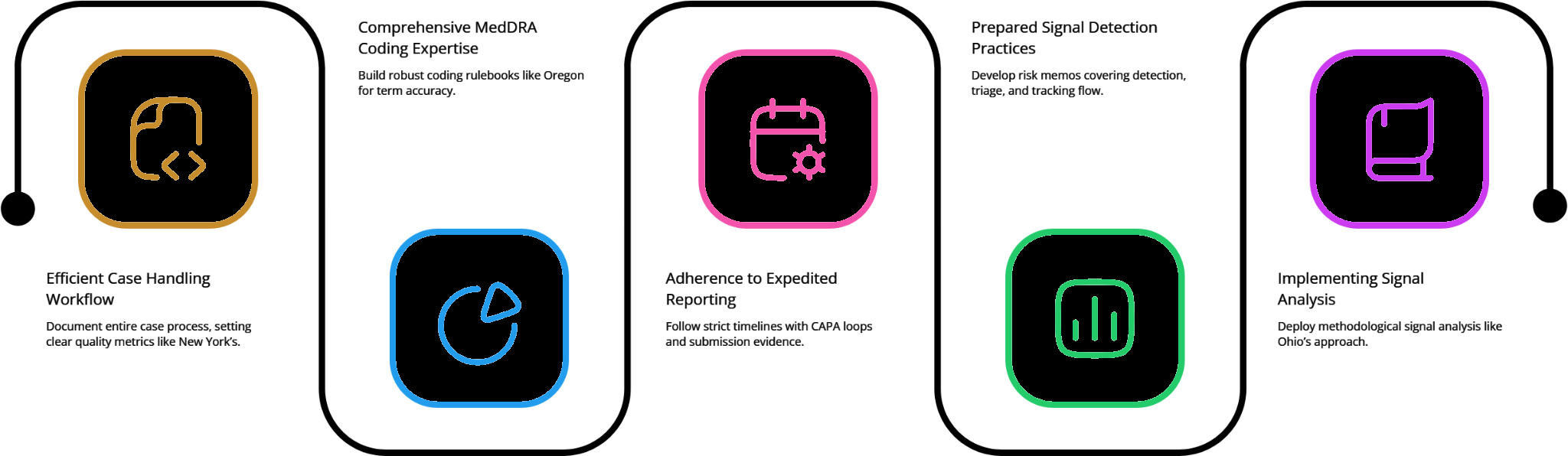
End-to-end case handling (with receipts).
Show the chain: intake note → seriousness/expectedness → clean narrative → MedDRA coding with synonym policy → QC checklist → E2B(R3) file → submission record. Phrase as metrics, as you see in New York and Pennsylvania.
MedDRA mastery (rework killer).
Draft a coding rulebook covering spelling variants, multi-SOC edge cases, device vigilance wording, and escalation rules. QC sign-off grid mirrors Oregon; CAPA phrasing aligns with Virginia.
Expedited reporting discipline.
Keep a clock-start matrix (US/EU/UK/Canada), calendar alerts, and miss→CAPA→retrain loop. Retain submission evidence (portal screenshots, email timestamps). Discipline is consistent with Rhode Island.
Signals & benefit-risk.
Prepare a 1-page signal memo: detection method → triage criteria → validation → analysis → recommendation → tracking. Analytical tone like North Carolina and Ohio.
Aggregate reports (PBRER/PSUR/DSUR).
Lock the shell early; keep rolling tables; use tracked changes with QC initials. Add device-combo nuance. Documentation rigor: Tennessee and Wisconsin.
Your #1 Blocker to PV in Washington?
4) The Skills Washington Screens For (and How to Prove Each One)
End-to-end case handling (with receipts).
Show the chain: intake note → seriousness/expectedness → clean narrative → MedDRA coding with synonym policy → QC checklist → E2B(R3) file → submission record. Phrase as metrics, as you see in New York and Pennsylvania.
MedDRA mastery (rework killer).
Draft a coding rulebook covering spelling variants, multi-SOC edge cases, device vigilance wording, and escalation rules. QC sign-off grid mirrors Oregon; CAPA phrasing aligns with Virginia.
Expedited reporting discipline.
Keep a clock-start matrix (US/EU/UK/Canada), calendar alerts, and miss→CAPA→retrain loop. Retain submission evidence (portal screenshots, email timestamps). Discipline is consistent with Rhode Island.
Signals & benefit-risk.
Prepare a 1-page signal memo: detection method → triage criteria → validation → analysis → recommendation → tracking. Analytical tone like North Carolina and Ohio.
Aggregate reports (PBRER/PSUR/DSUR).
Lock the shell early; keep rolling tables; use tracked changes with QC initials. Add device-combo nuance. Documentation rigor: Tennessee and Wisconsin.
5) Ladders, Compensation, and How to Accelerate Toward Signal/Aggregate Leadership
Year 0–1 — PV Associate/Case Processor.
KPIs: on-time expedited submissions, MedDRA QC ≥98%, narrative clarity, follow-up closure time. Phrase like high-bar states New York and Pennsylvania.
Year 1–3 — Safety Scientist.
Own signals, aggregate inputs, deviation CAPAs, literature cadence. Show rework reduction via your coding rulebook. CRO phrasing like North Carolina.
Year 3–5 — PV Manager/Aggregate Reports Lead.
Deliver PBRER/PSUR/DSUR predictably; coach juniors on narratives/coding; institutionalize QC checklists and version control. Documentation tone aligns with Tennessee and Wisconsin.
Compensation levers.
Negotiate with metrics: on-time SUSAR %, coding rework delta, aggregate cycle-time, audit findings closed, hybrid multi-state coverage (WA+OR/ID/MT). This framing resonates with Oregon and PNW teams.
6) FAQs: Pharmacovigilance Certification in Washington (2025–2026)
-
Hands-on case labs, MedDRA practice, E2B(R3) exports, and aggregate shells. Assemble a portfolio: 2 narratives, coding rules, SUSAR calendar, PBRER shell—tone like Pennsylvania.
-
Bring a clock-start matrix, alarms, and submission logs; include a CAPA template and retraining notes. This discipline echoes Rhode Island.
-
Quickly. Leverage clinical judgment and documentation strength. Build mock cases and aggregate inputs. Aim for inspection-ready tone like Virginia.
-
Argus / LifeSphere / Veeva Safety, MedDRA v26+, WHO-DD, E2B(R3), DSUR/PBRER. Mention QC checklist, synonym list, coding audit—process language common to Oregon.
-
Yes—device vigilance and combo-product cases are frequent; show device-specific coding examples and risk-file linkages. Documentation habits mirror Tennessee.
-
Typically $78k–$92k base; negotiate with on-time SUSAR rates, coding QC ≥98%, and aggregate cycle-time wins. Regional framing across Oregon helps.
-
Yes—hybrid/remote roles are common if you bring portfolio evidence, timeline control, and signal/aggregate readiness. Position for PNW coverage (WA+OR/ID/MT).
-
Quarterly mini-audits, versioned narratives, MedDRA updates, rolling aggregate tables, and a set literature cadence—the same maintenance mindset you’ll see emphasized in Virginia.
