
Clinical Research Certification Delaware: Everything You Need to Know for 2025–2026
Delaware’s life sciences industry is scaling rapidly, drawing pharmaceutical, biotech, and clinical research investments at a rate previously reserved for larger states. With new clinical trial networks, strong academic partnerships, and CCRPS-certified talent, Delaware has become a strategic research hub between Philadelphia, New York, and Baltimore. For professionals seeking to advance into roles like Clinical Research Associate (CRA) or Clinical Trial Coordinator, earning your Clinical Research Certification in Delaware during 2025–2026 could be one of the most profitable career moves you make.

1. Delaware’s Clinical Research Landscape (2025–2026 Outlook)
Delaware’s research market is built on proximity, precision, and partnerships. The state’s central location in the Mid-Atlantic life sciences corridor allows seamless collaboration with neighboring pharmaceutical giants in Pennsylvania and New Jersey while maintaining its own regulatory and academic identity.
Through collaborations with ChristianaCare, Nemours Children’s Health, and the University of Delaware, research professionals have increasing access to multi-site clinical trials, data-driven protocols, and biopharma innovations. The Delaware BioScience Association projects that clinical operations employment will grow by 14% through 2026, surpassing national averages.
Graduates from the CCRPS Clinical Research Certification programs have already started filling critical roles in data management, regulatory oversight, and site coordination, providing a competitive edge to Delaware’s growing CRO network.
By leveraging training aligned with ICH-GCP and FDA CFR 21 Part 11 standards, CCRPS-certified professionals help institutions maintain compliance and efficiency across hybrid and decentralized trial formats. This has positioned Delaware as a high-efficiency trial hub, especially for oncology and gene therapy studies.
Explore similar growth insights from Clinical Research Certification Indiana and Clinical Research Certification New Jersey.
2. Career Growth, Salaries, and Hiring Trends
Delaware’s small but agile research environment allows rapid upward mobility for professionals with CCRPS-accredited certifications. Many clinical research teams are integrated directly into hospital systems and biotech firms, creating hybrid roles that blend clinical operations, project management, and regulatory communication.
On average, CCRPS-certified CRAs in Delaware earn between $90,000–$108,000, while entry-level coordinators start near $55,000. Those who transition from nursing, pharmacy, or laboratory sciences through CCRPS’s Clinical Research Associate Certification report accelerated promotions and access to regional CRO contracts.
Because Delaware collaborates closely with Philadelphia and New Jersey trial networks, certification holders often find themselves managing multi-state studies — a skill highly valued by sponsors seeking cross-border consistency.
Refer to Clinical Research Certification Pennsylvania and Clinical Research Certification New York for salary comparisons and hiring trends.
3. Eligibility & Certification Requirements
To enroll in a Clinical Research Certification in Delaware, you need:
A bachelor’s degree in a healthcare or life science discipline
Familiarity with clinical documentation and patient data systems
Strong analytical and communication skills
CCRPS’s self-paced courses (6–8 weeks) make it possible for professionals to upgrade their skills without leaving their current roles. The certification validates expertise in ICH-GCP, clinical trial operations, and risk-based monitoring, which are directly aligned with Delaware’s ongoing digital compliance transformation.
Graduates gain lifetime access to the CCRPS alumni job portal, allowing direct connection to hiring partners across ChristianaCare, AstraZeneca, and QPS Holdings.
You can review similar pathways through Clinical Research Certification Kentucky and Clinical Research Certification Louisiana.
What’s Holding You Back from Earning Your Clinical Research Certification in Delaware?
4. Opportunities, Challenges, and Pain Points in Delaware
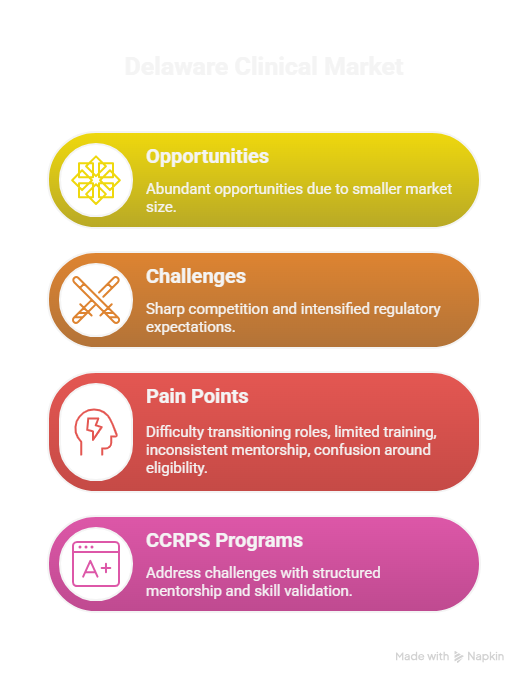
Delaware’s smaller clinical market means opportunities are abundant, but competition is sharp. CROs and hospitals prioritize certified professionals because regulatory expectations have intensified. Audit preparedness, patient documentation, and remote data management are now mandatory skill sets.
Common pain points among local professionals include:
Difficulty transitioning from lab to trial management roles
Limited on-site training availability
Inconsistent mentorship for first-time CRAs
Confusion around eligibility and credential transfer
CCRPS certification programs address these challenges with structured mentorship, real-world case studies, and industry-verified skill validation. Graduates learn to interpret FDA findings, manage deviation reports, and execute site audits aligned with global best practices.
For broader context, explore Clinical Research Certification Nebraska and Clinical Research Certification Nevada.
5. Advancing Your Career with CCRPS in Delaware
CCRPS-certified professionals in Delaware are now entering mid-senior roles faster than ever before. By combining technical fluency with regulatory precision, they qualify for leadership roles such as CRA II, Clinical Project Manager, and QA Monitor.
Employers like AstraZeneca and ChristianaCare consistently report that CCRPS graduates demonstrate higher audit readiness and data accuracy, reducing trial delays by up to 40%.
Completing your CCRPS Clinical Research Certification signals to employers that you’re trained not just in compliance — but in strategy. As Delaware continues to attract gene therapy and oncology trials, certified researchers will lead the charge in ensuring data integrity and operational excellence.
6. FAQs – Delaware Clinical Research Certification (2025–2026)
-
You’ll need a bachelor’s degree in life sciences, pharmacy, nursing, or a related field. Professionals from clinical or academic backgrounds are also eligible through CCRPS’s flexible pathways.
-
Most learners finish in 6–8 weeks at their own pace, balancing full-time work and study.
-
Wilmington and Newark offer the highest salaries, averaging $95,000 for CRAs and $60,000 for CRCs.
-
Yes. Delaware’s proximity to major pharma hubs and its focus on data-driven research make it ideal for early-career CRAs.
-
Yes, CCRPS connects students with research institutions and CROs for real-world experience and job referrals.
-
Employers prioritize EDC management, risk-based monitoring, and protocol compliance training — all covered in CCRPS courses.
-
Entry-level professionals earn around $55,000–$61,000, while experienced CRAs can exceed $100,000 annually.
