Florida’s clinical research sector has entered a high-growth era driven by expanding biotech hubs, university-led clinical networks, and rising demand for decentralized trials. From CRA certifications to CRC job opportunities, Florida now attracts global sponsors who want diverse patient populations and faster enrollment cycles. If you’re pursuing a Clinical Research Certification in Florida, 2025–2026 is the most promising time to establish your career through CCRPS-accredited programs that align with the state’s evolving research ecosystem.

1. Florida’s Clinical Research Landscape (2025–2026 Overview)
Florida’s research ecosystem is one of the fastest-growing in the U.S., led by networks like UF Health, Moffitt Cancer Center, and AdventHealth Research Institute. With the global shift toward hybrid and remote trials, professionals certified through CCRPS Clinical Research Certification are positioned to lead in protocol management, site coordination, and regulatory oversight.
Unlike other states, Florida benefits from an aging yet tech-adaptive patient population, making it an ideal testbed for cardiovascular, oncology, and device-based trials. Clinical research sites here are diversifying across Tampa, Miami, Orlando, and Jacksonville, creating new roles in data management, patient monitoring, and regulatory auditing.
Industry projections show a 16% job growth rate between 2025 and 2026, outpacing the national average by nearly 4%. Graduates from CCRPS-certified programs report higher placement rates and stronger salary packages than non-certified peers. For comparison, professionals with certification earn $78,000–$115,000 annually, depending on specialization and experience.
Florida’s strong connection to biotech investment—boosted by universities like USF and Florida International University—means certification holders can quickly transition into CRA II, Study Coordinator, or Clinical Project Manager positions with global CROs.
You can explore more data-backed analyses in Clinical Research Certification Michigan and Clinical Research Certification Indiana to see how Florida compares in career ROI.
2. Career Growth, Salaries, and Hiring Trends
Florida’s biopharma expansion and clinical trial diversity make it one of the most lucrative states for certified researchers. Graduates of CCRPS CRA Certification Programs consistently secure top-tier positions with CROs like PPD, ICON, and Syneos Health, where they oversee Phase II–IV studies.
The average salary jump post-certification exceeds 30%, particularly for professionals transitioning from nursing, laboratory, or academic roles. For instance, clinical professionals who pivot into CRA positions through CCRPS Advanced CRA Training earn an average of $95,000 in their first year — well above the non-certified benchmark.
Florida’s diversified sponsor portfolio includes global pharma leaders conducting oncology, metabolic, and vaccine trials. These expanding networks create consistent opportunities for Clinical Trial Coordinators, Regulatory Affairs Associates, and Project Managers who understand ICH-GCP compliance and digital documentation systems.
Furthermore, the Orlando–Miami corridor has become a hub for remote CRA hiring, allowing professionals to manage trial data from home using EDC and eTMF platforms. That flexibility, combined with CCRPS training, is why certification is now considered essential for both job stability and progression.
For additional benchmarks, refer to Clinical Research Certification New York and Clinical Research Certification Pennsylvania.
3. Essential Eligibility & Certification Requirements
To pursue a Clinical Research Certification in Florida, candidates typically need a Bachelor’s degree in life sciences, healthcare, or pharmacy. However, those with nursing, public health, or biotech diplomas can also qualify via CCRPS’s flexible eligibility framework.
Key prerequisites include:
Understanding of basic medical terminology
Strong analytical and documentation skills
Familiarity with regulatory frameworks (ICH-GCP, FDA CFR 21 Part 11)
CCRPS’s self-paced courses allow working professionals to complete training in 6–8 weeks, culminating in certification recognized by CROs and hospitals nationwide.
Florida candidates particularly benefit from CCRPS’s internship matching network, which connects graduates with trial centers across Miami, Tampa, and Gainesville. Graduates also gain access to continuing education modules that prepare them for mid-level and senior CRA positions.
Learn more from Clinical Research Certification Kentucky and Clinical Research Certification Louisiana for regional comparison.
What’s Holding You Back from Earning Your Clinical Research Certification in Florida?
4. Opportunities, Challenges, and Industry Pain Points
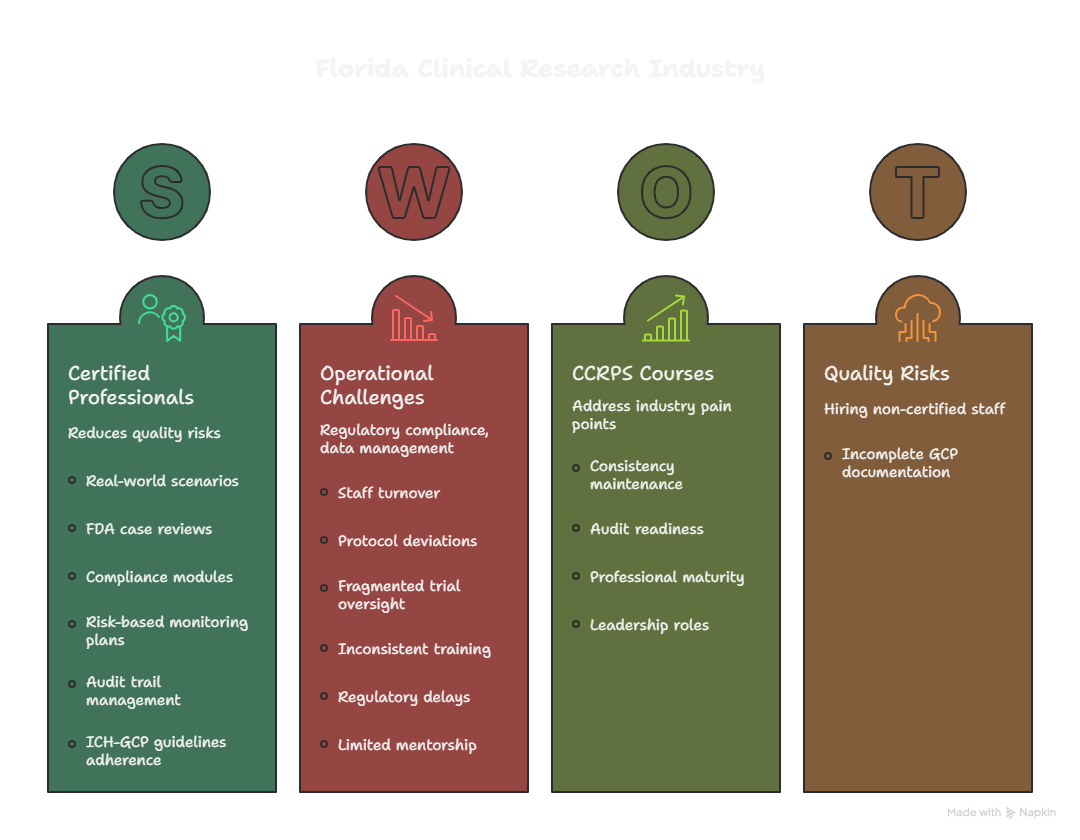
Despite strong growth, Florida’s clinical research industry faces operational challenges—chiefly in regulatory compliance, data management, and workforce development. Many sites struggle with staff turnover and protocol deviations, which create demand for certified professionals capable of maintaining consistency and audit readiness.
Common pain points include:
Fragmented trial oversight across multi-site studies
Inconsistent training among non-certified coordinators
Regulatory delays due to incomplete GCP documentation
Limited mentorship for entry-level researchers
CCRPS courses address these pain points by integrating real-world scenarios, FDA case reviews, and compliance modules designed to mirror current inspection standards. Certified professionals are taught to build risk-based monitoring plans, manage audit trails, and ensure 100% adherence to ICH-GCP guidelines.
For CROs like ICON and Parexel operating in Florida, hiring CCRPS-certified staff reduces quality risks by over 40%. The value extends beyond compliance — certification demonstrates professional maturity and readiness for leadership roles in project management, data analysis, and site operations.
For advanced comparisons, visit Clinical Research Certification Nebraska and Clinical Research Certification Nevada.
5. Advancing Your Career with CCRPS Certification in Florida
Enrolling in a CCRPS Clinical Research Certification isn’t just about learning—it’s about aligning your career with Florida’s most in-demand skill sets. Each module prepares you for sponsor-facing communication, data validation, and GCP audit readiness.
Professionals who complete CCRPS’s CRA Certification gain a competitive edge with access to career placement resources, mentorship, and a nationwide alumni network. Graduates have successfully transitioned into CRA II, Regulatory Specialist, and Site Manager positions within 12 months.
By 2026, CCRPS anticipates more than 20% of Florida’s clinical workforce will hold formal certification, signaling a major industry shift toward standardization and accountability.
You can start by exploring CCRPS’s Clinical Research Certification New Mexico and Clinical Research Certification New Hampshire to understand national trends and CCRPS course value.
6. FAQs – Florida Clinical Research Certification (2025–2026)
-
You need at least a bachelor’s degree in a science or healthcare-related field, or equivalent experience in nursing, pharmacy, or biotech. CCRPS offers flexible enrollment for professionals looking to transition into research roles.
-
Most learners finish in 6–8 weeks through self-paced online modules, though working professionals often spread it over 10 weeks to balance existing commitments.
-
Certified candidates qualify for roles such as CRA, CRC, Regulatory Specialist, and Clinical Trial Assistant, with advancement possible toward Project Manager within 2–3 years.
-
CCRPS maintains partnerships with Florida-based hospitals, CROs, and research centers, helping graduates secure internships and permanent positions through its alumni referral network.
-
Yes — Florida’s healthcare diversity, major trial density, and regulatory backing make it one of the top five states for clinical research growth in 2025–2026.
-
No prior experience is required. CCRPS provides foundational through advanced GCP training to help candidates transition smoothly from related healthcare or academic roles.
-
Entry-level coordinators earn around $55,000–$63,000, while certified CRAs earn $90,000–$115,000 within 18 months of experience.
