
Clinical Research Certification New Hampshire: Everything You Need to Know for 2025-2026
New Hampshire’s life sciences economy is small but mighty: academic medicine (Dartmouth-Hitchcock), device manufacturing, and Northeastern CRO footprints converge to create outsized demand for credentialed clinical operations talent. If you’re targeting CRC/CRA, regulatory, or QA roles in 2025–2026, earning a recognized, GCP-aligned credential is the single highest-leverage step you can take. Below, you’ll find a no-fluff roadmap that covers eligibility, training, internships, salaries, state hiring patterns, and hard tactics for breaking in—plus a ready-to-embed data table and interactive poll in CCRPS styling. Throughout, we include contextual internal resources so you can benchmark New Hampshire against neighboring markets and accelerate your plan.

1) Why Certification Now: The Employer Lens
Hiring managers in New Hampshire increasingly screen for two signals: (1) fluency in ICH-GCP and FDA 21 CFR requirements and (2) verifiable monitoring, documentation, and safety competencies. A recognized credential demonstrates both, compressing the time they need to ramp you on protocols, SOPs, and inspection readiness. Candidates who complete a rigorous program modeled on global standards (e.g., the CCRPS approach used across states like Utah, Virginia, and Washington) enter interviews with stronger credibility and clearer deliverables.
Practically, this means you can own source documentation accuracy, eCRF integrity, AE/SAE escalation, and site communications from day one. For candidates coming from adjacent roles (public health, nursing, lab ops), a compact certification accelerates the pivot by translating your prior experience into trial-ready outputs. Comparing nearby markets is useful: see Vermont for a rural-academic mix similar to upper Valley dynamics, or contrast larger ecosystems like Pennsylvania and New York to calibrate compensation.
New Hampshire Clinical Research Certification Outlook (2025–2026)
| Key Metric | 2025–2026 Data for New Hampshire |
|---|---|
| Projected Job Growth | 18% statewide increase |
| Average CRA Salary | $82,000 – $112,000 annually |
| Entry-Level CRC Pay | $60,000 – $68,000 |
| Top Hiring Hubs | Lebanon, Portsmouth, Nashua, Concord |
| Leading Employers | Dartmouth-Hitchcock, Lonza, Novocure, BioXCell |
| Recommended Program | CCRPS Clinical Research Certification |
| Course Duration | 6–8 weeks (self-paced online) |
| Exam Format | 100-question proctored online exam |
| Passing Score | 75% |
| Renewal Period | Every 3 years (24 CE credits) |
| Compliance Coverage | ICH-GCP, HIPAA, FDA 21 CFR |
| Remote Roles | ≈ 40% hybrid/remote options |
| Top CRO Partners | IQVIA, Parexel, ICON, PPD |
| Internship Duration | 8–12 weeks |
| Career Progression | CRC → CRA → Project Manager → Director |
2) Step-By-Step: Earning Your Credential in New Hampshire
Define your target seat. If you’re CRC-bound, emphasize patient scheduling, source docs, and visit flow. If CRA-bound, emphasize monitoring plans, RBM (risk-based monitoring), and CAPA literacy. Use CCRPS modules tailored to those outputs—this same modular path is what peers follow in South Carolina and South Dakota to move quickly.
Enroll in an ICH-GCP-aligned course. Programs patterned on FDA inspection findings, protocol deviations, and 21 CFR parts (312/50/56) reflect real sponsor expectations. That’s why CCRPS frameworks used in Rhode Island and West Virginia port so well to New Hampshire employers.
Master the artifacts. Build proficiency in the documents that drive audits: protocol, ICF, monitoring reports, site logs, delegation of authority, training records, and essential documents. For cross-comparison, scan how Oregon and Tennessee structure their training-to-employment arcs.
Sit the exam. A scenario-based 100-question assessment forces you to apply GCP, privacy, and safety principles to ambiguous trial situations—the same ambiguity you’ll face monitoring sites.
Renew strategically. Use CE to fill gaps you discover in your first year (e.g., vendor oversight, decentralized trial workflows). The same cadence works for colleagues in Wisconsin and Washington who maintain mobility across sponsors.
3) Positioning for New Hampshire Employers: Tactics That Work
Translate experience into site outcomes. Hospitals and sponsors want CRCs who reduce data queries and shorten close-out timelines; they want CRAs who detect systemic issues before they become inspection findings. Calibrate your resume bullets to outcomes (e.g., “reduced SDV discrepancy rate by 23% across three sites”).
Map your target employers. In Lebanon/Upper Valley, clinical ops often ties to academic divisions; along the Seacoast (Portsmouth), device and biotech activity intersects with Boston’s corridor. For trajectory planning, compare job ladders in North Dakota or South Carolina to see how smaller markets structure CRA II → Lead CRA moves.
Exploit hybrid monitoring. Many regional CRAs cover parts of Maine, Vermont, and Massachusetts. Training designed for remote monitoring, tele-visits, and eSource (mirroring best practices you’ll also see in Utah and Oregon) increases your usable bandwidth and attractiveness to CROs.
Close the CE loop. Use renewal credits to specialize (oncology safety management, device vigilance, pharmacovigilance) and to strengthen promotion cases—an approach widely used by professionals featured across CCRPS’s state resources like Rhode Island and West Virginia.
What’s Holding You Back from Getting Certified?
4) Internships & Early Experience: Converting Training Into Offers
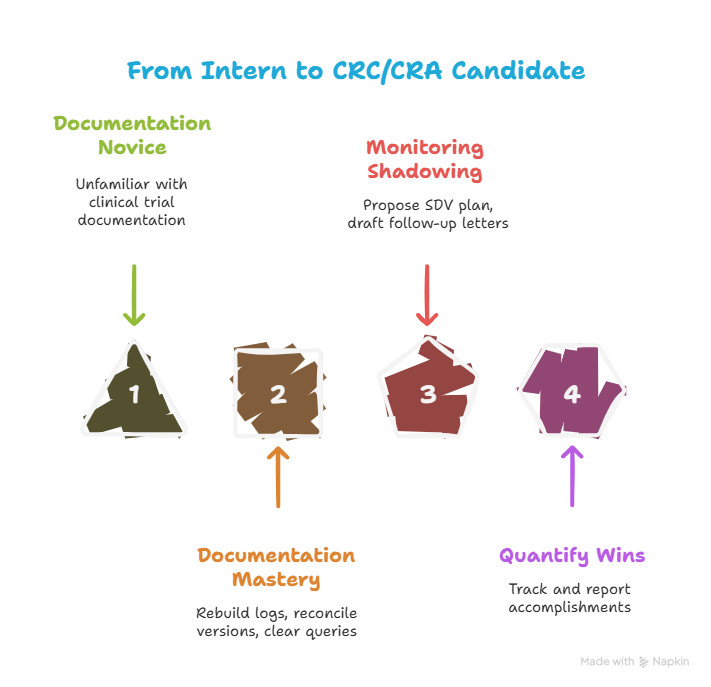
Internships are where you convert theory into muscle memory. Winning placements means signaling you can immediately reduce coordinator workload and increase data quality. Here’s how to stack the deck:
Lead with documentation mastery. Offer to rebuild a delegation log, reconcile ICF versions, or clear outstanding queries.
Shadow monitoring patterns. Propose a mini-SDV plan for a single visit; practice drafting a follow-up letter with actionable CAPA suggestions (a skillset reinforced in states like Pennsylvania and Tennessee).
Quantify wins. “Closed 17 open queries in Week 1; synced DOA log and training attestations across 3 active studies.” Those bullets travel well to CRC/CRA interviews in New York or Virginia if you later relocate.
Where to look: Academic research units, integrated health systems, and regional CRO satellites. If you need a benchmark for internship expectations and rotations, skim how South Dakota and South Carolina structure their 8–12 week experiential paths.
5) Salaries, Bands, and Fast-Track Promotions
CRC early career (NH): $60k–$68k, with increments for oncology/device exposure.
CRA I–II: $82k–$112k baseline; travel premiums and therapeutic specialization can push total comp higher—numbers similar to Vermont but below New York metro bands.
Levers you control in Year 1–2:
Therapeutic focus. Oncology/rare disease experience commands premium.
Monitoring complexity. Multi-site, multi-country experience accelerates readiness for Lead CRA.
Audit skill. If you can prep a site for inspection (and demonstrate 21 CFR literacy), you’re promotion-ready.
Use state guides for comp reality checks—e.g., Wisconsin or Washington—when negotiating or considering remote roles with NH coverage.
6. FAQs: Clinical Research Certification in New Hampshire (2025–2026)
-
-
Expect 6–8 weeks of self-paced study culminating in a 100-question proctored exam—an approach mirrored in Rhode Island and West Virginia.
-
Yes, it’s recognized by CROs, sponsors, and research hospitals nationwide.
-
No credential can guarantee placement, but programs embedded with CRO/hospital partners substantially raise hit rates. Use internship playbooks similar to those in Pennsylvania and New York to target rotations that convert.
-
Every 3 years with 24 CE credits. Many professionals stack CE toward niche expertise (oncology safety, DCT operations) to justify promotions, a tactic common in North Dakota and Oregon.
-
Entry CRCs begin around $60k–$68k; CRAs average $82k–$112k with scope for $120k+ in high-complexity trials. Compare bands with Vermont and Washington to calibrate offers.
-
Academic research (Lebanon), integrated health systems (statewide), and CRO satellites (Seacoast/Greater Boston corridor). If you’re mobile, use nearby markets—Rhode Island, Vermont—for additional interviews while your NH pipeline warms up.
