
Time Management Strategies for the Clinical Research Coordinator Exam
Time management on the CRC exam isn’t about “working faster.” It’s about making fewer time-wasting decisions under pressure. Most candidates don’t fail because they don’t know clinical research—they fail because they burn minutes rereading questions, second-guessing basics, and getting trapped in detail-heavy scenarios. This guide gives you an exam-grade time system: pacing rules, triage methods, and question-handling workflows built around real CRC responsibilities, GCP logic, and safety/regulatory priorities.
1. The CRC Exam Time Trap: Why Smart Candidates Still Run Out of Minutes
The CRC exam punishes “slow certainty.” If you try to fully solve every question in one pass, you’ll lose time to three hidden drains:
Context switching: bouncing between protocol, safety, IRB, documentation, and data questions without a stable decision framework. Anchor your thinking in CRC responsibilities and certification and the execution spine of protocol management responsibilities.
Over-reading: many items include extra narrative. The right move is to detect the question’s “domain” fast: consent/ethics, safety reporting, regulatory documents, protocol deviation, or data/CRF. This becomes automatic when you’ve mastered ICH guidelines simplified and GCP compliance strategies for CRCs.
Unnecessary perfectionism: you don’t need perfect recall—you need correct prioritization. Most tricky questions collapse if you apply safety-first logic from AE identification and management and timeline discipline from drug safety reporting timelines.
The fastest CRCs in the room aren’t guessing. They’re using a repeatable mental checklist: “What’s being tested? What’s the safest compliant action? What documentation or escalation is required?” That mindset mirrors real-world collaboration with monitors and auditors using CRA documentation techniques and inspection expectations from audit/inspection readiness guidance.
2. Build Your CRC Exam Pacing System (So You Don’t “Feel” Fast—You Are Fast)
A pacing system must be simple enough to use while stressed. Here’s a high-performance structure:
1) Use a two-pass plan with strict time boxes
Pass 1: Answer anything you can solve confidently in ~45–60 seconds. If it’s not resolving, flag it and move. This mirrors how CRCs triage tasks in real sites: act on what you can execute safely, escalate what needs more information—exactly the mindset in protocol management responsibilities and regulatory documents management for CRCs.
Pass 2: Return to flagged questions with your remaining time and treat them as “highest yield.”
This prevents the #1 killer: spending 4 minutes on one vignette while losing 4 easier points elsewhere.
2) Create a domain-first decision ladder
When you identify the domain, you instantly narrow the rules you need:
Safety → use AE identification logic, CRC escalation discipline from essential AE reporting techniques, and strict timing from drug safety reporting requirements.
Consent/ethics → default to IRB/authorization logic from IRB roles and high-level controls from ICH guidelines simplified.
Protocol → enforce the “protocol-first” stance backed by protocol guide with examples and endpoints clarity via primary vs secondary endpoints.
Data/CRF → lean on field-level discipline from CRF best practices and monitoring expectations from CRA documentation techniques.
Trial design concepts → use clarity tools like randomization techniques and blinding types and importance.
This saves time because you stop searching your brain for “everything.” You pull the right playbook instantly.
3) Use “first correct action” to beat multi-step traps
Exam writers love options that are “good actions” but in the wrong order. CRC logic is sequence-driven: verify → document → escalate → implement. This matches real compliance behavior reinforced in GCP compliance strategies for CRCs and also aligns with inspection readiness themes in audit/inspection guidance for CRAs. Choose the earliest step that protects participants and creates traceability.
3. Fast Question Handling: The CRC “Triaging Vignettes” Method
Long vignette questions are designed to steal your time. You beat them with a structured reading method.
Step 1: Read the last line first
The last sentence tells you what you’re solving: “What should the CRC do next?” “Which document is required?” “What is the correct reporting action?” This keeps you from absorbing irrelevant story detail.
Step 2: Highlight only the “trigger words”
You’re hunting for a small set of triggers:
Safety triggers: hospitalization, ER, life-threatening, death, pregnancy, medically significant → default to safety logic grounded in AEs identification/reporting and time discipline in drug safety reporting timelines.
Ethics triggers: consent changes, new risk info, vulnerable populations, recruitment language → default to IRB oversight requirements and ICH principles.
Protocol triggers: visit window missed, prohibited med, eligibility borderline → anchor to protocol management responsibilities and the protocol guide.
Data triggers: discrepancy, query, correction, missing source → use CRF best practices and documentation norms from CRA techniques.
Step 3: Eliminate two answers quickly
You’re not trying to “prove” the right answer first—you’re deleting wrong ones fast. Look for:
actions that bypass IRB approval (wrong per IRB roles)
actions that delay safety escalation (wrong per AE reporting fundamentals and drug safety timelines)
actions that “fix” source by editing history (wrong per data integrity logic embedded in CRF best practices)
Now most items become a 50/50 selection—and that’s where your second-pass time should be spent.
What is your biggest CRC exam time problem right now?
Choose one. Each option corresponds to a specific fix in this guide.
4. High-Yield Time Saves by Domain: Safety, Protocol, IRB, Docs, and Data
This is where you gain minutes without sacrificing accuracy.
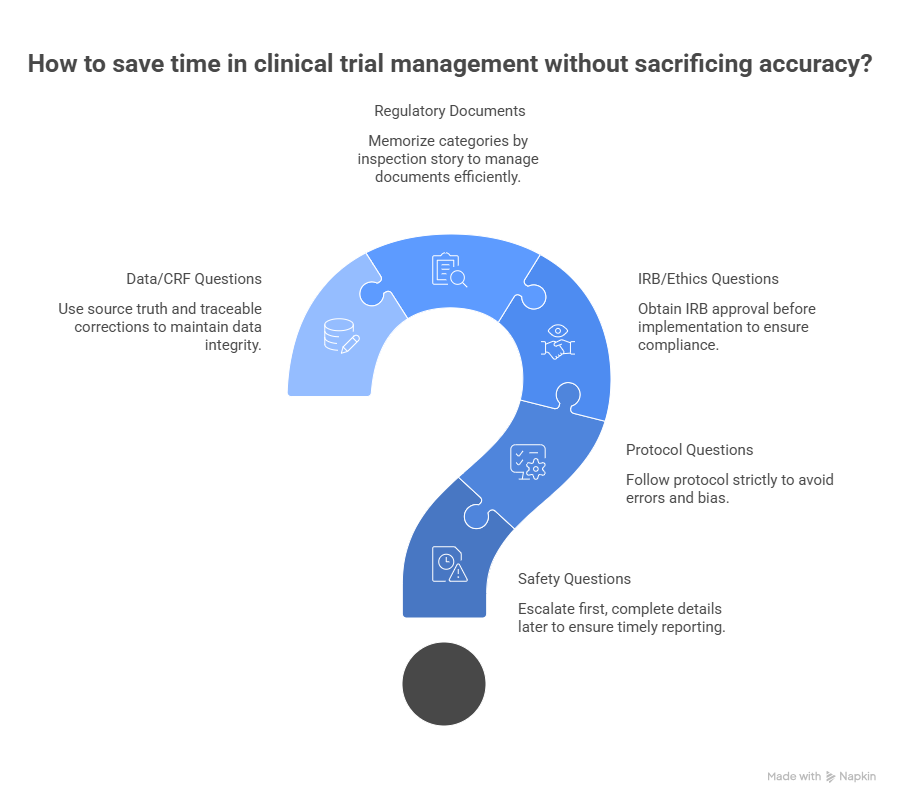
Safety questions: win by enforcing the timeline spine
Most safety questions are solved by identifying what starts the reporting clock and what requires escalation. When you see ER/hospitalization language, your brain should auto-load:
Time-saving rule: escalate first, complete details after. Many wrong options suggest waiting for confirmation, labs, or provider signoff before notifying. That’s a trap. The CRC role is to ensure the event is documented and escalated, consistent with real-world safety operations and PV logic described in pharmacovigilance fundamentals.
Protocol questions: “protocol-first” beats “common sense”
If an option sounds clinically reasonable but conflicts with protocol requirements, it’s wrong. Your shortcut is to frame every action as: “Does the protocol allow it, and is it documented correctly?” This is reinforced by the clinical trial protocol guide and CRC execution responsibilities in protocol management. It also intersects with design concepts like randomization and blinding where the “helpful” action can unintentionally bias the trial.
IRB/ethics questions: use the IRB gate rule
If the question involves changes to consent, recruitment language, study procedures, or risk information, your default is: no implementation until IRB approval is active. That’s the fastest way to solve ethics items, grounded in IRB roles and responsibilities and the principles summarized in ICH guidelines simplified.
Regulatory documents: memorize categories by “inspection story”
Instead of memorizing endless lists, think: “What documents prove the site was authorized, trained, approved, and controlled?” Use the mental map in managing regulatory documents for CRCs and cross-reference audit expectations from inspection readiness. This prevents time drain from list recall.
Data/CRF questions: source truth + traceable correction
You save time by using one rule: source is the truth; corrections must be traceable. That aligns with CRF best practices and how monitors judge quality in CRA documentation techniques. Options that suggest “updating source to match CRF,” “deleting errors,” or “changing values without rationale” are time-saving traps that are simply wrong.
5. Your 7-Day Practice Plan to Build Speed Without Losing Accuracy
Speed isn’t talent. It’s automation. You build it through repeated micro-drills that force your brain to classify and decide quickly.
Day 1–2: Domain tagging drills (10 minutes each)
Take mixed questions and practice labeling them instantly: safety, IRB, protocol, docs, data. Then force yourself to state the rule you’d apply. Use CCRPS references to anchor the rule sets: GCP strategies for CRCs, ICH principles, protocol guide, and AE reporting fundamentals.
Day 3–4: Vignette compression drills (15 minutes each)
Use last-line-first reading. Identify 3 trigger words, then choose the “first correct action.” The goal is to stop narrative absorption. Reinforce the “safest compliant next step” rule using IRB logic, drug safety timelines, and protocol management responsibilities.
Day 5: 50/50 mastery session (20 minutes)
Collect questions where you’re stuck between two good answers. For each, write the single rule that breaks the tie:
IRB approval gate
safety escalation clock
protocol-first requirement
source truth and traceability
delegation/authorization boundaries
These tie-breakers are baked into CRC role guidance and audit expectations from inspection readiness.
Day 6: Timed mini-exam (half-length)
Apply strict two-pass rules. No exceptions. This teaches you that skipping a hard item is not failure—it’s strategy.
Day 7: Review only flagged items + build a “rule sheet”
Your rule sheet should be short and lethal. Each line should be a principle you use to decide in seconds. Use CCRPS guides as your backbone: AE reporting, regulatory documents, protocol management, and CRF best practices.
6. FAQs: Time Management Strategies for the CRC Exam
-
Use a strict two-pass system with a 45–60 second time box for pass 1. Flag hard items and return later. This prevents the “one question eats five minutes” failure pattern.
-
Read the last line first, tag the domain (safety/IRB/protocol/docs/data), then hunt only for trigger words. Use safety rules from AE reporting fundamentals and protocol logic from the protocol guide to decide quickly.
-
Use “answer then justify”: pick your best answer, then confirm it using one rule (IRB gate, safety timeline, protocol-first, source traceability). If the rule supports it, don’t change it.
-
Choose the option that is the first correct action and most protects participant safety and documentation integrity. “More advanced” steps are often wrong if they skip approval, escalation, or documentation basics.
-
Apply the timeline spine: onset, awareness, escalation, outcome. Most wrong answers delay escalation. Use drug safety reporting timelines as your anchor and reinforce with essential AE reporting techniques.
-
Do short timed drills: domain tagging, vignette compression (last-line-first), and 50/50 tie-breaker practice. Build a one-page rule sheet using CCRPS guidance on GCP compliance and documentation discipline from CRA techniques.
