
Clinical Regulatory Specialist Career Pathway Steps and Skills
Clinical Regulatory Specialists are the navigators of the entire drug development ship. While investigators and operations teams focus on recruitment, timelines, and budgets, regulatory specialists make sure every decision is anchored to ICH, FDA, EMA, MHRA, and local requirements so the trial doesn’t collapse at the marketing authorization stage. This role is perfect if you enjoy connecting science, law, and real-world operations. In this guide, we’ll break down the step-by-step career pathway, required skills, future trends, and advancement strategies so you can move from entry-level contributor to trusted strategic partner in global clinical research.

1. Why Clinical Regulatory Specialists Are Core to Modern Clinical Development
Regulatory teams used to be seen as “the people who file submissions.” Today, Clinical Regulatory Specialists are embedded in trial design from day zero. They translate complex requirements into operational choices—eligibility criteria, safety reporting structures, protocol deviation handling, and GCP-aligned documentation. When sponsors explore decentralized trials, AI-enabled oversight, or wearable-powered endpoints, regulatory specialists are the ones who map these innovations against agency expectations.
They collaborate with Clinical Compliance Officers, project managers, medical monitors, and Pharmacovigilance teams to ensure submissions are defensible and timelines realistic. In emerging regions such as India, Africa, or post-Brexit UK, they guide local feasibility and regulatory strategy. When done well, regulatory input reduces avoidable protocol amendments, inspection findings, and approval delays—converting “compliance” into speed-to-market and competitive advantage.
2. Step-by-Step Career Pathway: From Junior Associate to Strategic Regulatory Leader
The smartest way to view the Clinical Regulatory Specialist career is as a sequence of levers you gain control over—documents, timelines, strategies, then entire portfolios. Early on, you focus on learning the mechanics: tracking submissions, compiling country packages, understanding GCP-aligned documentation rules, and observing how project managers negotiate internal deadlines. You learn where protocol wording clashes with local regulation, how ethics committees react to risk language, and how PV delivers safety narratives for DSURs and RMPs using outputs from case processing and signal detection.
Mid-career, you begin owning complete submissions—INDs/CTAs, substantial amendments, and responses to health authority questions. You participate in strategy discussions for complex decentralized designs, tricky geographies like China, and novel technologies such as smart pills and digital biomarkers. You learn to pre-empt likely objections, using regulatory intelligence, past agency precedents, and internal QA findings from risk-based audits.
At senior levels, you define end-to-end regulatory strategies for programs, not just individual trials. You partner with Clinical Compliance Officers, QA, and commercial teams to align submissions with launch pricing, access plans, and real-world evidence strategies. You may lead health authority meetings, convert complex benefit–risk data into persuasive narratives, and influence portfolio decisions—deciding which indications, markets, and label expansions are worth regulatory investment. Ultimately, you become the person leadership calls when they want speed with safety, not shortcuts.
3. Core Skills, Tools, and Competencies Every Regulatory Specialist Must Master
Clinical Regulatory Specialists succeed when they blend technical literacy, regulatory insight, and narrative skill. You must interpret protocols, CSRs, and statistical outputs well enough to explain them to authorities without overselling or under-stating risk. That means close collaboration with medical monitors, statisticians, PV leaders managing RMPs, and quality teams who own GCP compliance.
On the tools side, you must become fluent with RIM systems, eTMF structures, and submission publishing platforms, plus the specific portals for EU-CTR/CTIS and key national agencies. As sponsors adopt AI-powered oversight, blockchain-backed documentation, and regionally distributed trials in India, Africa, and China, regulators expect you to understand both the technology and its risk implications.
Soft skills are equally critical: you must write like a lawyer and think like a project manager. Clear, concise responses to authority questions can save months of back-and-forth. Firm but collaborative communication with clinical operations, site management teams, and finance (who own budget oversight) keeps submissions synchronized with reality. Over time, your credibility comes from being right early—flagging feasibility issues, ethics concerns, or labeling risks long before they become public problems.
What’s Blocking You Most from Growing as a Clinical Regulatory Specialist?
4. Positioning Yourself for Global, Remote, and High-Impact Regulatory Roles
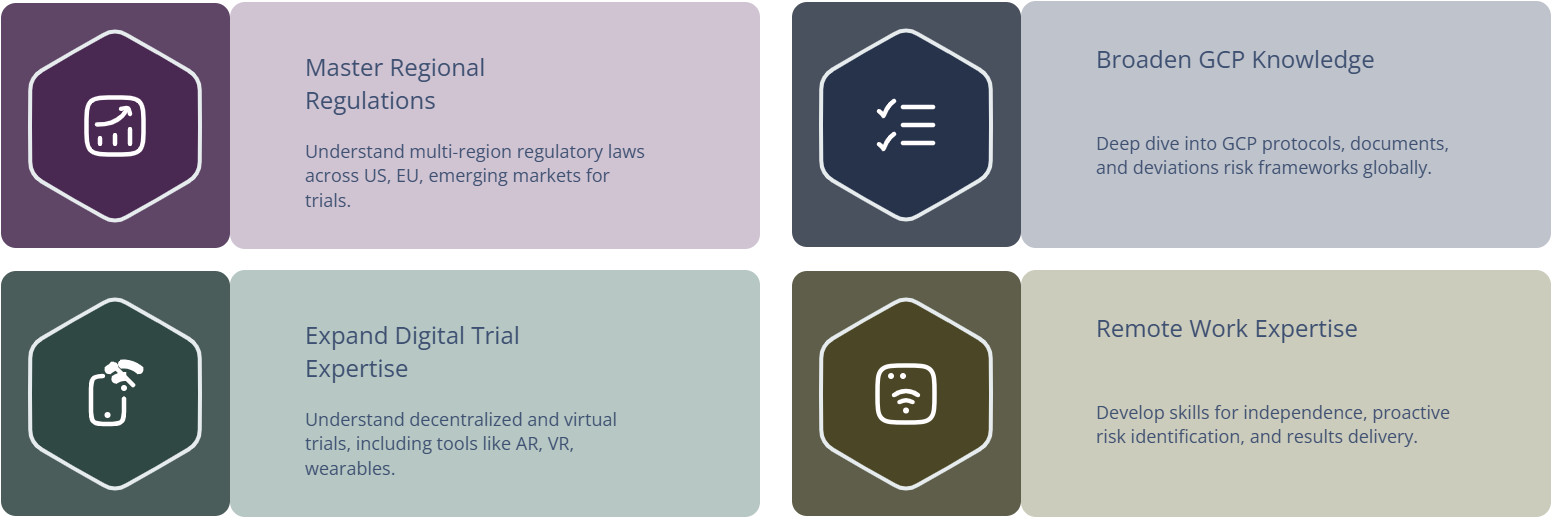
If you want high-leverage, global, or remote Regulatory Specialist positions, you must be more than a local country expert. Start by building a strong foundation in GCP expectations, documentation, and protocol deviation risk across different trial models: traditional site-based, hybrid decentralized, and fully virtual designs using wearables and VR/AR. Then, deliberately expose yourself to multi-region submissions, whether through global CRO assignments or sponsor-side roles covering US/EU plus emerging markets like India and Africa.
Remote-friendly employers look for people who can independently drive submissions and proactively surface risks, not just follow checklists. That means understanding interfaces with QA (who own risk-based quality planning), PV (who manage case processing and signal detection), and commercial strategy. Develop the habit of writing crisp, structured briefing notes that summarize regulatory options, trade-offs, and likely authority reactions. Over time, you want leadership to see you as the person who can turn complex regulatory noise into clear strategic decisions on indications, markets, and trial designs.
5. Salary Growth, Promotion Strategy, and Common Pitfalls to Avoid
From a compensation perspective, the biggest jumps happen when you move from “submission executor” to “regulatory strategist.” Entry-level roles pay well compared to many site-based positions, but plateau quickly if you only assemble documents and route signatures. To break through, you must show how your work reduces rejections, shortens authority review cycles, and minimizes additional information requests. Track how many queries you prevent through proactive wording changes, how much earlier you secure approvals compared to plan, and how closely your risk assessments match actual outcomes in complex AI-enabled trials or novel geographies like China and India.
Common pitfalls include staying too narrow (one country, one therapeutic area, one type of trial) and avoiding cross-functional exposure. Regulators assess totality of evidence; your career should mirror that. Seek rotations or projects with QA, PV, Clinical Compliance Officers, and project managers. Learn how site operations and monitoring really work, so your strategies don’t live only on paper. Pair this with continuous regulatory intelligence, tracking how different authorities respond to decentralized models, blockchain-secured data, and advanced therapies. This combination of breadth and depth is what justifies senior titles and the salary bands that come with them.
6. FAQs: Clinical Regulatory Specialist Career Pathway & Skills
-
Leverage your operational experience as a differentiator. You already understand protocol execution, deviation risk, and documentation gaps. Start by supporting submission-related tasks—collecting site documents, reviewing consent forms for country-specific compliance, and checking that TMF documentation matches protocol and regulatory expectations. Ask to join regulatory submission meetings or review cycles, and volunteer to draft small sections (cover letters, summaries). When you apply for Regulatory Associate roles, highlight your frontline knowledge of GCP, monitoring, and site management; hiring managers value candidates who understand how regulations play out in real clinics, not just on paper.
-
You need both. On-the-job learning exposes you to real-world timelines, authority behaviors, and internal politics, but it can be patchy and company-specific. Structured training in GCP essentials, regulatory frameworks, and submission strategy gives you a portable, systematic foundation you can apply across employers and regions. It also reassures hiring managers that your expertise isn’t limited to one SOP set. Ideally, pair formal education with hands-on work on at least a few full submission cycles—IND/CTA, amendments, DSURs, and end-of-study packages—plus exposure to PV deliverables like RMPs and signal reports.
-
At mid-level, companies are looking for ownership and foresight. You must show you can independently run country or multi-country submissions, maintain accurate trackers, and pre-empt questions using regulatory intelligence. Strong writing skills—especially for responses to authorities and briefing documents—are a major differentiator. Experience aligning regulatory plans with project management roadmaps, PV timelines, and QA inputs from risk-based quality planning helps, because it shows you think beyond your silo. If you can speak confidently about decentralized and AI-enabled trials, backed by insights from CCRPS-style analyses on AI in trials, you immediately stand out.
-
Credibility starts long before the meeting invite. Contribute to clarity and consistency in every document authorities see: protocols, IBs, CSRs, DSURs, and responses. Make sure your sections are logically structured, cross-referenced, and aligned with GCP documentation standards. Volunteer to draft internal briefing notes summarizing potential authority concerns and proposed answers; this trains your thinking and shows leadership you understand regulatory reasoning. When you do join authority calls, focus on active listening, taking precise notes, and observing how senior colleagues frame benefit–risk and mitigate concerns. Over time, you can own targeted topics—like DCT elements or PV processes—especially if you’ve deepened your knowledge via resources on signal management and RMPs.
-
Yes—if you turn your location into an advantage instead of a limitation. Sponsors expanding into India, Africa, or regional hubs like China and the Middle East need people who understand both local regulations and global sponsor expectations. Build a strong baseline in ICH, FDA, and EMA rules, then specialize in the nuances of your region—ethics committee behaviors, language requirements, import/export rules, and data privacy. Work with CROs listed in global directories, targeting accounts with US/EU sponsors. Over time, as you demonstrate reliability across multiple programs, you’ll be trusted with cross-region submissions and remote-friendly strategic roles.
