
Regulatory Affairs Specialist Career Roadmap: Essential Steps and Salaries
Regulatory Affairs Specialists (RAS) are the timekeepers of evidence: they turn messy, cross-functional inputs into submissions that get approval faster, with fewer inspection findings. It’s not about memorizing guidance; it’s about repeatable systems—terminology discipline, RBQM awareness, device–drug nuance, and geo-route strategy. This roadmap shows you exactly what to learn, what to build, and how to prove it, with high-leverage CCRPS resources like Top 100 Acronyms, AI-powered trials, and the Salary Report 2025.

1) What a Regulatory Affairs Specialist Actually Delivers (Beyond “Paperwork”)
A great RAS reduces time-to-approval and findings-per-inspection by designing the submission system itself: document taxonomy, traceability, labeling logic, and change-control hygiene. You will translate clinical signals into defensible claims while pre-answering inspector questions. To speak cleanly and avoid “word salad,” drill the Top 100 Acronyms. To align methods with modern designs, study AI-powered trials and inspection posture from remote AI audits. For geo agility, track Brexit’s impact and India’s acceleration.
Pain points you’ll neutralize: broken traceability, slow exhibit retrieval, ambiguous labeling rationales, reactive CAPAs, and duplicated geo work. Your antidotes: a submission architecture, amendment impact heatmaps, and a model inventory for any AI-assisted drafting (auditor-friendly logic from remote AI audits).
| Core Competency | What to Produce (Evidence) | Business Impact | Risk to Manage | CCRPS Resource |
|---|---|---|---|---|
| Terminology Precision | Glossary (150+ terms) with examples | Cleaner submissions, fewer queries | Inconsistent language | Top 100 Acronyms |
| Submission Architecture | Module taxonomy + naming standards | Rapid retrieval during inspections | Traceability gaps | Remote AI Audits |
| Global Route Strategy | US/EU/UK/China 1-page comparisons | Realistic timelines | Overgeneralization | China 2030, Brexit impact |
| Clinical Literacy | Phase cheatsheets + endpoints matrix | Claims aligned to evidence | Endpoint mismatch | AI-Powered Trials |
| RBQM Awareness | RBQM trigger → labeling memo | Risk-aware submissions | Over/under-flagging | RBQM Remote |
| DCT & Logistics | Televisit/home-nursing addendum | Lower dropout risk | Privacy drift | Drone Meds |
| Safety & PV | ICSR/PSUR/DSUR flow with SLAs | Fewer case backlogs | Narrative inconsistency | PV Careers |
| Device-Drug Nuance | Checklists for implants/software | Faster review cycles | Human-factors gaps | Adaptive Designs |
| Vendor Oversight | CRO scorecard + escalation tree | Predictable deliverables | Opaque metrics | CRO Directory |
| Country Mix Intelligence | Geo briefs (EU/UK/India/Africa) | Faster starts, fewer amendments | Geopolitical shocks | Countries Winning 2025 |
| Big-Tech Stack Literacy | Data lineage & exit-plan memo | Audit-proof pipelines | Vendor lock-in | Amazon & Google |
| Labeling Mastery | Mock PI/SmPC with citations | Cleaner label negotiations | Promotional risk | PI Terms |
| Evidence Writing | CSR/IB section rewrites | Editor-grade clarity | Attribution errors | Test Strategies |
| Deviation → CAPA | Root-cause rubric + examples | Fewer repeat issues | Weak causality | Acronyms |
| Inspection Readiness | Room map + Q&A binder | Faster close-outs | Unready SMEs | Audit Playbook |
| Change Control | Amendment impact heatmap | Less scope creep | Version confusion | Adaptive Protocols |
| Stats & Claims | Endpoint → label linkage table | Credible claims | Overreach | AI-Powered Trials |
| Comms for Execs | 1-pagers per milestone | Faster decisions | Over/under-briefing | Study Environment |
| Salary Intelligence | Band targets + proof of ROI | Better comp outcomes | Underselling impact | Salary Report 2025 |
| Remote Work Systems | Versioned templates/macros | Throughput at scale | Doc drift | Remote CRA Jobs |
| Career Signaling | Portfolio site (8–10 artifacts) | Interview magnet | Unverifiable claims | High-Paying Roles |
| Geo Diversification | EU/UK vs India brief | Placement agility | Duplicated work | India Boom |
| Frontier Cohorts | Africa capacity memo | Diversity + speed | Infra gaps | Africa Frontier |
| Big-Bet Planning | Cycle-time compression model | More shots on goal | Bad assumptions | Country Mix |
| AI Writing Guardrails | RAG + citation SOP | Audit-proof drafts | Hallucinations | Discipline |
| Team Enablement | Playbooks + checklists library | Fewer escalations | Stale SOPs | Enablement |
| Networking Engine | Target list of CROs/Sponsors | Focused outreach | Random applications | Top 100 CROs |
2) Skills to Master & the Portfolio to Prove Them (Get Hired on Evidence)
Hiring managers don’t need “interest”—they need proof. Build 8–10 artifacts from the table above and host them on a tidy portfolio.
Submission blueprint. Show module structure, naming, and a two-click retrieval demo. Tie to RBQM thinking from remote AI audits.
Labeling pack. Mock PI/SmPC plus endpoint→claim mapping. Align with adaptive designs in AI-powered trials.
Geo routes. US/EU/UK/China routes in one page each; discuss divergence after Brexit and localization per China 2030.
Deviation→CAPA narratives. Show strong root cause + effectiveness checks; keep terminology tight with the Acronyms guide.
DCT/Logistics addendum. Televisits, home nursing, and drone-delivered meds (see drone trends) to de-risk retention (pair with dropout prediction).
Vendor oversight. CRO scorecards + SLAs; source prospects from the Top 100 CROs directory.
AI guardrails. RAG + citations SOP so LLM-assisted CSRs/IBs stay inspection-ready (discipline from test-taking strategies).
3) 12-Month Roadmap (Associate → Specialist Performance in Writing)
Quarter 1 — Foundations & Language.
Build your submission architecture (modules, naming, links). Draft a model inventory for any AI-assisted drafting (purpose, owners, datasets, validation)—the stance inspectors expect per remote AI audits. Drill terminology with the Acronyms guide. Write one endpoint→claim mapping aligned with AI-powered trials.
Quarter 2 — Geo & Logistics.
Publish 1-pagers on US/EU/UK/China routes (fold in Brexit and China 2030). Attach a DCT addendum with televisits + drone meds (DCT logistics) and retention guardrails from dropout prediction).
Quarter 3 — RBQM, Safety, and Inspection.
Draft RBQM trigger memos that update label language; link to inspection POV from remote AI audits. Build ICSR/PSUR/DSUR flow with SLAs (career data: PV report). Run a mock inspection: room map, Q&A binder, exhibit pointers.
Quarter 4 — Scale & Salary.
Show cycle-time compression: before/after metrics for assembly, labeling, and close-outs. Quantify impact and align to ranges in the Salary Report 2025 and adjacent comps like top-paying roles. Expand your vendor pipeline via the CRO directory.
Your Biggest Blocker to RAS Readiness?
4) Market Demand & Salary Signals (Where to Aim, What to Negotiate)
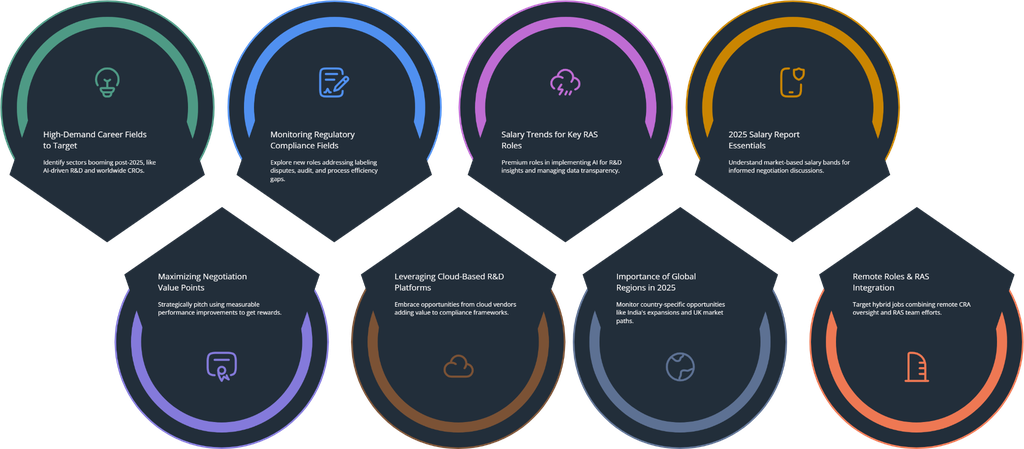
Demand concentrates where trials accelerate and manufacturing scales. Track country-mix realities from 2025 winners, expansion corridors in India, and post-Brexit pathways (UK analysis). As cloud vendors embed deeper in R&D stacks, RAS roles that can argue data lineage, explainability, and exit plans will command premiums (context: Amazon & Google).
Salary negotiation framework.
Anchor asks to outputs you control: (1) submission assembly lead time, (2) labeling dispute cycle time, (3) inspection close-out speed. Present “before → after” deltas and cite market bands from the Salary Report 2025. For remote-leaning roles, mine opportunities adjacent to the Remote CRA programs list, which often overlap with RA teams.
Where to look.
Build a focused short-list with the Top 100 CROs directory. Cross-reference each prospect’s geo exposure with countries winning 2025 and your device–drug appetite (tie to AI-powered trials).
5) Promotion Path: Specialist → Senior Specialist → Manager (Without Waiting Years)
90-day proof that changes how you’re seen.
Ship a submission architecture everyone uses (modules, naming, links, templates).
Publish a CAPA narrative rubric with anonymized real examples; align acronyms with the Acronyms guide.
Add an RBQM→labeling playbook so safety/quality signals actually update your claims (philosophy from remote AI audits).
180-day initiatives that signal “Senior.”
Run a mock inspection day: 25 likely questions, two-click exhibit access, and a debrief template.
Deliver a geo-variance brief (EU/UK vs India/China) with resourcing implications (tie back to Brexit, India, China 2030).
Implement AI writing guardrails (RAG + citations SOP); coach writers using test-taking strategies.
12-month “Manager signals.”
Own a cross-functional submission outcomes review (cycle time, rework, findings).
Stand up a vendor oversight scorecard with SLAs (pipeline from the CRO directory).
Tie business impact to comp bands using the Salary Report 2025 and high-paying roles signals (top 10 jobs).
6) FAQs: Regulatory Affairs Specialist (Sharp, practical answers)
-
Ship evidence, not opinions: a submission architecture, a labeling pack (endpoint→claim mapping), and an inspection binder. Use the Acronyms guide for clean language; mirror inspector expectations via remote AI audits.
-
Three levers: (1) assembly lead-time (from draft to submission), (2) labeling dispute cycle time, (3) inspection close-out speed. Quantify deltas and anchor to the Salary Report 2025.
-
When RBQM flags drift/outliers, your risk sections and sometimes claims must update. Build a memo template that turns RBQM signals into regulatory language; posture aligns with remote AI audits.
-
EU/UK divergence after Brexit, India’s speed (India boom), China localization (China 2030), and Africa capacity (frontier).
-
Adopt RAG + citation SOPs, maintain a model inventory, and enforce “no unsupported claims.” Keep discipline via test-taking strategies and standardize prompting in a shared environment (study environment).
-
Shortlist CROs/sponsors from the Top 100 CROs directory; favor teams building RBQM-aware pipelines and device-drug submissions (tie to AI-powered trials).
