
Clinical trials struggle with data provenance, consent versioning, and multi-party trust across sponsors, CROs, sites, and regulators. In 2025, blockchain stops being a buzzword and becomes the backbone for tamper-evident audit trails, programmable smart-contract workflows, and granular patient permissions that travel with data. Paired with digital biomarkers, wearables, and AI failure prediction, a ledgered approach turns scattered evidence into inspection-ready lineage. Below is a zero-fluff blueprint—built around risk, ROI, and validation—linking to CCRPS resources on acronyms, PI terminology, and regional realities.

1) Why blockchain now: the concrete problems it fixes in 2025
Monitors and auditors face three enduring bottlenecks that blockchain directly addresses:
Source integrity at scale. As trials ingest eSource, EHR extracts, ePRO, and device streams, reconciling what changed, who changed it, and when it changed becomes brittle. A permissioned ledger provides immutable hash anchors for each event, letting AI risk engines detect anomalies against a cryptographically verifiable history.
Consent and protocol version drift. Smart contracts can encode consent scope, withdrawal logic, and protocol amendments, preventing data use outside authorized versions—vital when deploying VR tasks, AR assessments, or smart pills with new data rights.
Multi-party reconciliation. Sponsors, CROs, depots, and regulators waste cycles reconciling drug accountability and temperature excursions. Recording serialized packs and cold-chain telemetry on-chain (with off-chain payloads) gives everyone the same shared, time-stamped truth, which is invaluable in complex geographies like India’s expanding footprint and Africa’s frontier sites.
Result: fewer disputes at close-out, faster database locks, and a cleaner inspector narrative that ties every material event to a verifiable hash, complemented by your acronym and PI-term baselines so cross-functional teams speak the same language.
| # | Control | What Inspectors Will Ask | Evidence You Should Produce | Owner |
|---|---|---|---|---|
| 1 | Ledger type | Why permissioned, not public? | Rationale doc; governance; node roster | IT/QA |
| 2 | Data model | What’s on-chain vs off-chain? | Schema, hash strategy, retention plan | Data Eng |
| 3 | Consent encoding | How is consent scope enforced? | Smart-contract code + test cases | Legal/Clinical |
| 4 | Protocol versioning | Amendment handling? | Versioned contracts; diff tests | QA/Clin Sci |
| 5 | Identity & roles | Who writes/reads? | RBAC map; node keys; audit logs | Security |
| 6 | Data lineage | eSource→EDC traceability? | Lineage diagrams + hash proofs | Data Eng |
| 7 | ZKP strategy | Privacy w/ verifiability? | Zero-knowledge proof specs | Privacy/AI |
| 8 | Smart-contract QA | How were contracts validated? | Static analysis; unit/integration runs | QA/Dev |
| 9 | Dispute workflow | How are challenges resolved? | On-chain challenge/resolve steps | QA |
| 10 | Cold-chain anchors | Drug accountability? | Serialized pack hashes; sensor anchors | Supply/IRT |
| 11 | ePRO/device QC | Stream reliability? | Missingness/outlier gates | Data Eng |
| 12 | AI triggers | How alerts are raised? | Risk thresholds; precision/recall | AI Lead |
| 13 | CAPA linkage | Closed-loop control? | CAPA IDs embedded in events | QA |
| 14 | Node ops | Availability & backups? | SLA; RTO/RPO; failover tests | IT |
| 15 | Key mgmt | Compromise response? | HSM/rotation/run-book | Security |
| 16 | Interoperability | FHIR/CDISC mappings? | Mapping specs + unit tests | Data Eng |
| 17 | Regulator access | Read-only inspection nodes? | Provisioning SOP; audit trail | QA/IT |
| 18 | Cost model | Fees & scaling? | TCO projections; cloud sizing | Finance/IT |
| 19 | Vendor oversight | 3rd-party governance? | Qualification files; SOC2/ISO | QA/Procure |
| 20 | Archival & export | Long-term re-compute? | Export format; container builds | IT/QA |
| 21 | Site burden | Work actually reduced? | Query/time-on-task metrics | Site Ops |
| 22 | Jurisdiction | Data residency? | Regional node placement plan | Legal/IT |
| 23 | Fraud patterns | Duplicate subjects? | Graph checks + alerts | AI/QA |
| 24 | Education | Staff competencies? | Role curricula & pass scores | L&D |
| 25 | Inspector pack | One-click dossier? | PDF bundle: lineage/CAPA | QA |
| 26 | Public proofs | External verifiability? | Periodic hash anchoring | IT |
| 27 | Amendment drift | Auto-revalidation? | Diff tests → redeploy gates | Clin Sci/QA |
| 28 | ROI tracking | Value beyond travel? | Prevented findings; lock speed | PMO/Finance |
2) Architecture & data flow: on-chain anchors, off-chain payloads, and smart-contract logic
Design pattern: keep payloads off-chain (EDC rows, PDFs, images, device files), store hashes on-chain, and attach minimal metadata (subject pseudonym, visit window, consent scope ID). This balances privacy with verifiability.
Event ingestion. Site EHR → FHIR/HL7 → lakehouse mapped to CDISC; each commit generates a deterministic hash written to the ledger. When wearables or smart pills stream data, hourly batch anchors cover windows to avoid gas/fee spikes.
Consent smart contract. Contracts encode allowed uses, expiry, withdrawal, and jurisdiction. If a subject withdraws, the contract writes a revocation event; downstream AI pipelines must read the contract before processing, preventing scope creep.
Supply chain. Each kit’s serialized ID and cold-chain telemetry hash are anchored at handoff. This complements logistics innovations like drone delivery that expand last-mile complexity.
Audit fabric for AI. Risk models compare current data to prior hash-anchored states to detect tampering or back-dated entries, aligning with remote AI audits and reducing human SDV.
Outcome: a single, shared truth across sponsor, CRO, and site—useful in distributed ecosystems highlighted by regional winners and Brexit-era UK constraints.
3) Validation, privacy & regulatory posture: how to pass inspection without hype
Treat blockchain as a computerized system under GxP with additional cryptographic controls:
System validation. Perform IQ/OQ/PQ on the ledger itself and unit/integration tests on smart contracts; record defect classes (replay protection, role misconfigurations, timestamp drift). Tie every deploy to a Change Control Board with rollback and diff-aware test sets—the same discipline used for AI audit models.
Data minimization & ZK proofs. Keep PHI off-chain; use zero-knowledge proofs to attest that “a value met a range” without revealing it. Map patient identifiers to on-chain pseudonyms via HSM-backed keys stored off-chain.
Inspector narrative. Lead with risk control: show a live flow of “EHR lab → hashed anchor → AI query → CAPA closure,” then hand over a one-click inspector pack. Reinforce with shared language from acronyms and PI terms.
Vendor oversight. Qualify ledger operators and contract developers like other CROs—use the CRO directory to benchmark third-party capacity, SLAs, and evidence practices.
Common failure modes: placing PHI on-chain irreversibly; no plan for key compromise; hash anchors that don’t deterministically reproduce; and unfunded node operations beyond the pilot.
What’s Your Biggest Challenge in Starting Certification?
4) High-ROI use cases: where blockchain returns value first
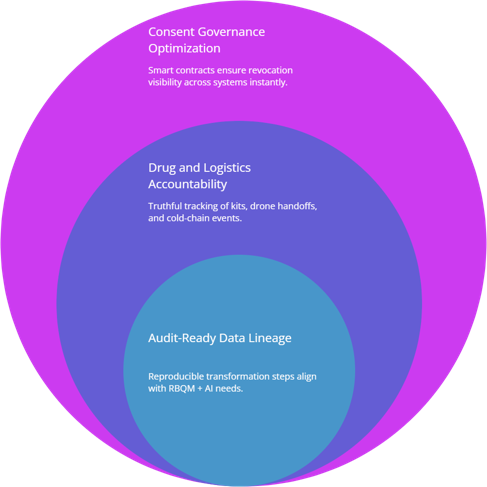
Consent governance that never drifts. Contracts encode allowed data uses by version and site. When a subject withdraws, the revocation is immediately visible to all systems processing wearable or digital biomarker streams.
Drug accountability & cold-chain truth. Serialized kit IDs, depot handoffs, and excursion events are hash-anchored, easing investigations and dispute resolution—especially when adding drone logistics.
Audit-ready data lineage. Every EHR-to-EDC transformation step is reproducible; remote AI audits can prove both why an anomaly was flagged and when the underlying data changed—tight alignment with RBQM+AI practices.
Automated payments and micro-incentives. Smart contracts release site payments upon event confirmation (visit completion, data lock) and can escrow participant stipends for decentralized trials, matching regional realities outlined in country winners.
Fraud detection. Graph-based checks on hashed identifiers reveal duplicate enrollments across sites—especially relevant in high-growth regions like India and Africa.
Executive metrics: prevented major findings, database lock speed, inspection-pack turnaround, and cost per prevented deviation. Cross-reference talent costs via global salary and top-paying roles to model ROI.
5) Change management & workforce: from monitors to ledger-literate investigators
Blockchain doesn’t eliminate monitors; it elevates them:
New competencies. Lineage reasoning, smart-contract literacy, and explainability for AI/crypto interactions. Upskill with CCRPS exam toolkits such as test-taking strategies, study environments, and anxiety control.
Operating cadence. Weekly virtual reviews over ledger evidence replace travel-heavy inspections. Remote options align with work-from-home CRA programs.
Career mobility. Ledger + AI skills open doors to PV signal roles (see pharmacovigilance salary trends) and technical leadership across CRO ecosystems.
Scorecard for year one:
≥35% reduction in reconciliation time; ≥40% fewer major findings at close-out; ≤24h inspector-pack generation; precision >0.75 for AI alerts using ledger anchors; measurable site-burden reduction.
6) FAQs — Blockchain for clinical trials (2025)
-
Use permissioned. Trials involve PHI and regulated actors; you need governance, RBAC, and data residency. For external transparency, periodically anchor aggregate Merkle roots to a public chain while keeping payloads off-chain. Tie this to a clear inspector pack that proves lineage without disclosing PHI.
-
On-chain: hashes, timestamps, pseudonymous pointers, and contract state (consent scope, protocol IDs, payment states). Off-chain: actual EDC rows, ePRO/device payloads, PDFs, and imaging. This lets AI audit models trust provenance while respecting privacy.
-
Yes—reconciliation and drug accountability shrink, and queries become more targeted because AI compares current values to anchored history. Track burden via queries/participant/week and time-to-close metrics, then showcase improvements alongside CCRPS CRC/CRA salary data when building the case.
-
Treat them like medical-grade software: static analysis, unit/integration tests, negative tests (replay, role abuse), and OQ/PQ on staging with realistic data. Every deploy passes through CCB with rollback. Keep edge-case libraries similar to those you maintain for AI risk models.
-
They accept control and explainability Lead with your validation dossier, consent contract logic, hash-based lineage, and CAPA linkage. Offer read-only inspection nodes plus a simple PDF dossier. Use CCRPS primers on acronyms and PI terms for consistent language across teams.
Q6. How does blockchain interact with decentralized trials?
It’s a force multiplier. Consent, scheduling, and micro-incentives are automated via contracts; device uploads get hourly hash anchors; disputes over geofenced compliance are resolved from the ledger. This pairs well with VR/AR endpoints and digital biomarkers.Q7. What’s the fastest “start small” pilot?
Begin with drug accountability anchoring (serialized IDs + temperature events) at two sites, add consent contracts for one protocol amendment, and publish inspection-ready dashboards. Use CCRPS’s country winners to pick regions with digitally mature partners. -
It’s a force multiplier. Consent, scheduling, and micro-incentives are automated via contracts; device uploads get hourly hash anchors; disputes over geofenced compliance are resolved from the ledger. This pairs well with VR/AR endpoints and digital biomarkers.
-
Begin with drug accountability anchoring (serialized IDs + temperature events) at two sites, add consent contracts for one protocol amendment, and publish inspection-ready dashboards. Use CCRPS’s country winners to pick regions with digitally mature partners.
