
Why Decentralized Clinical Trials Will Eliminate 80 Percent of Traditional Research Sites by 2028
Decentralized clinical trials aren’t a side quest anymore—they’re the main route to faster enrollment, lower cost per randomized patient, and broader access. By 2028, the mix of eConsent, ePRO/eCOA, wearables, home-health logistics, and AI-driven oversight will make large brick-and-mortar networks economically irrational. Sponsors that standardize DCT operations now compress timelines, improve audit readiness, and capture under-represented populations at scale. Below is the hard, operational playbook—how the math works, where quality risks hide, and exactly how sponsors, CROs, and sites must pivot to win the transition.

1) The Hard Economics: Why 80% of Brick-and-Mortar Sites Disappear
Traditional sites rely on fixed costs—leased space, visit-hour constraints, paper workflows, and travel-heavy monitoring. DCTs invert that math: patients are distributed; data is centralized. Sponsors shift spend from overhead to logistics and analytics—reducing cost per randomized patient while compressing FPI and database lock. Central RBQM removes the travel-time tax that props up a long tail of small clinics, echoing patterns described in The End of Clinical Trial Monitors, AI-Powered Clinical Trials, and Predicting Patient Dropout. Add direct-to-patient IP flows and last-mile models from Drone-Delivered Medications, and the site footprint contracts sharply. Meanwhile, Big Tech’s cloud/logistics from Amazon and Google’s Entry further consolidates the stack.
Net effect: start-up shrinks 6–12 weeks and per-patient costs fall as enrollment expands beyond zip-code radius—especially when sponsors exploit country arbitrage from The Countries Winning the Clinical Trial Race in 2025 and scale plays highlighted in India’s Clinical Trial Boom. Retention improves because burden drops and risk is flagged early by centralized analytics, driving faster database lock and cleaner inspections aligned to remote AI audit expectations. For budget owners, fewer pass-throughs and better role leverage (CRA/CRC centralization mapped in the 2025 Salary Report) turn DCT from a “tool” into an operating model with compounding returns across portfolios.
| Key Factor | 2025–2028 DCT Reality (What Replaces Sites) |
|---|---|
| Start-up cycle time | Central IRB + templated vendor rails compress start-up by 6–12 weeks; staffing benchmarks in the CCRPS salary analyses. |
| Reach | Nationwide tele-pre-screening; recruitment math shifts when you use AI retention tools from pieces like [Predicting Patient Dropout](https://ccrps.org/clinical-research-blog/predicting-patient-dropout-how-ai-will-solve-clinical-trial-retention-by-2026). |
| FPI volatility | Rolling activation via tele-PI oversight; automation patterns echo [AI-Powered Clinical Trials](https://ccrps.org/clinical-research-blog/ai-powered-clinical-trials-how-robots-will-run-your-next-study-by-2030). |
| Visit burden | 60–80% of encounters shift to home nurse + tele-visits, supported by last-mile models such as [Drone-Delivered Medications](https://ccrps.org/clinical-research-blog/why-your-next-clinical-trial-might-use-drone-delivered-medications-2025-trends). |
| Data latency | Streaming ePRO/eCOA; remote AI queries; monitoring models in [The End of Trial Monitors](https://ccrps.org/clinical-research-blog/the-end-of-clinical-trial-monitors-how-remote-ai-audits-will-take-over-2025). |
| Protocol deviations | Wearable window alerts; RBQM terms clarified in [Top 100 Acronyms](https://ccrps.org/clinical-research-blog/top-100-acronyms-in-clinical-research-explained-clearly-ultimate-reference-guide). |
| Diversity | Rural and shift-work populations recruited via tele-language; frontier geographies in [Africa’s Next Frontier](https://ccrps.org/clinical-research-blog/why-africa-is-the-next-big-frontier-for-clinical-trials-20252030-predictions). |
| PI availability | Tele-PI + sub-I network with digital delegation; responsibilities clarified in [PI Terms for PIs](https://ccrps.org/clinical-research-blog/top-20-clinical-research-terms-for-principal-investigators-pis-clear-definitions-and-examples). |
| Cost per randomized | Site overhead replaced by logistics + data services; country mix levers in [Countries Winning the Race](https://ccrps.org/clinical-research-blog/the-countries-winning-the-clinical-trial-race-in-2025-youll-be-surprised). |
| Monitoring load | Central review replaces travel; CRA upskilling backed by [CRA Salaries Worldwide](https://ccrps.org/clinical-research-blog/clinical-research-associate-cra-salaries-worldwide-2025-data-report). |
| Coordinator efficiency | CRC shifts to data orchestration; productivity signals in [CRC Salary Guide](https://ccrps.org/clinical-research-blog/clinical-research-coordinator-salary-guide-2025-global-trends-and-comparisons). |
| Vendor sprawl | Consolidation into 4–6 core platforms; evaluate coverage via [CROs Hiring Directory](https://ccrps.org/clinical-research-blog/top-100-clinical-research-organizations-cros-hiring-crcs-amp-cras-in-the-usa-complete-2025-directory). |
| Cold chain | Direct-to-patient IoT shippers; post-Brexit routing issues discussed in [Brexit & UK Research](https://ccrps.org/clinical-research-blog/how-brexit-could-make-or-break-uks-clinical-research-industry-by-2025). |
| Lab logistics | Doorstep phlebotomy with digital chain-of-custody; India’s scale advantages in [India’s Trial Boom](https://ccrps.org/clinical-research-blog/indias-clinical-trial-boom-why-its-set-to-overtake-europe-by-2028). |
| PV signal flow | Real-time ingestion to PV; career scaling in [PV Salaries & Growth](https://ccrps.org/clinical-research-blog/pharmacovigilance-specialist-salaries-and-career-growth-2025-industry-report). |
| Device adherence | Passive wearables + app nudges; attrition mitigation in [AI for Retention](https://ccrps.org/clinical-research-blog/predicting-patient-dropout-how-ai-will-solve-clinical-trial-retention-by-2026). |
| Data quality | Automated edit checks at capture; robotic ops themes in [Robots Run Your Study](https://ccrps.org/clinical-research-blog/ai-powered-clinical-trials-how-robots-will-run-your-next-study-by-2030). |
| Inspection readiness | Unified eTMF with immutable audit; remote inspection expectations in [Remote AI Audits](https://ccrps.org/clinical-research-blog/the-end-of-clinical-trial-monitors-how-remote-ai-audits-will-take-over-2025). |
| Recruitment equity | Community partners + retail clinics; country outlooks in [China 2030](https://ccrps.org/clinical-research-blog/will-china-dominate-clinical-research-by-2030-exclusive-market-predictions). |
| Protocol design | DCT-first feasibility; align endpoints to remote capture—best practices echoed across CCRPS exam prep resources. |
| Big Tech influence | Cloud + logistics lift in [Amazon & Google in Trials](https://ccrps.org/clinical-research-blog/amazon-and-googles-entry-into-clinical-trials-why-pharma-should-worry-2025-predictions). |
| Geographic arbitrage | Mix hubs where policy/logistics favor DCTs; see [Countries Winning 2025](https://ccrps.org/clinical-research-blog/the-countries-winning-the-clinical-trial-race-in-2025-youll-be-surprised). |
| Role evolution | AI shifts tasks; reskilling guidance in [Meet Your New Boss](https://ccrps.org/clinical-research-blog/meet-your-new-boss-how-ai-will-replace-clinical-research-jobs-by-2028). |
| Education & readiness | Teams upskill via [Proven Test-Taking Strategies](https://ccrps.org/clinical-research-blog/proven-test-taking-strategies-for-clinical-research-exams) and [Study Environment Guides](https://ccrps.org/clinical-research-blog/creating-the-perfect-clinical-research-certification-study-environment). |
| Salary planning | Comp bands shift with centralization; see [2025 Salary Report](https://ccrps.org/clinical-research-blog/clinical-research-salary-report-2025-average-pay-by-role-and-location). |
| MSL/Medical Monitor routes | High-impact remote roles; see [MSL Study Guide](https://ccrps.org/clinical-research-blog/medical-science-liaison-certification-exam-ultimate-study-guide) and [Top 50 MM/MSL Questions](https://ccrps.org/clinical-research-blog/top-50-questions-for-the-medical-monitor-and-msl-certification-exam). |
| Entry talent sourcing | Remote-first pathways in [Passing the Clinical Research Assistant Certification](https://ccrps.org/clinical-research-blog/passing-the-clinical-research-assistant-certification-expert-strategies). |
| Macro market shifts | Country competition dynamics in [The Countries Winning the Race](https://ccrps.org/clinical-research-blog/the-countries-winning-the-clinical-trial-race-in-2025-youll-be-surprised). |
| Future site role | Procedure hubs + tele-sub-I orchestration replacing long tails of small private practices. |
2) What Actually Replaces Sites: The DCT Operating Stack
A credible DCT isn’t “Zoom plus couriers.” It’s a governed stack with auditability:
Recruitment & Feasibility: EHR pre-screening, AI-ranked registries, and community partners aligned to country mixes in Countries Winning 2025 and cost models informed by 2025 Salary Report.
Consent & Enrollment: eConsent with comprehension checks and remote IDV; terminology fluency from Top 100 Acronyms and PI Terms.
Visits & Procedures: Mobile nurses, retail clinics, and smart kits; regional momentum from India’s Trial Boom and policy nuance in Brexit’s Research Impact.
Data Capture: ePRO/eCOA, wearables, tele-clinician notes, and robotic process automations summarized in AI-Powered Clinical Trials.
Oversight: Remote SDV/SDS, central statistics, and AI anomaly detection from Remote AI Audits.
Retention: Predictive churn intervention per AI for Retention, multilingual coaches, and missed-window recovery workflows.
Talent pathways shift accordingly: centralized remote CRAs/CRCs (see CRA Salaries Worldwide, CRC Salary Guide), and ascending PV/Drug Safety careers (PV Salaries & Growth). Entry-level pipelines evolve via Passing the Clinical Research Assistant Certification.
3) Quality, GCP, and Inspector Expectations in a Virtual Footprint
Regulators don’t resist decentralization; they resist loss of control. To keep confidence high, sponsors codify oversight visibly:
Clear medical accountability: The PI remains accountable; sub-Is and home-health vendors execute under SOPs. Terminology clarity from PI Terms prevents delegation drift.
Data integrity and attribution: Immutable eSource, device calibration logs, and role-mapped access. Audit techniques in Remote AI Audits ensure central statistics catch anomalies early.
PV readiness: Real-time AE capture, centralized triage, and better MedDRA coding capacity tied to PV Salaries & Growth workforce trends.
Supply/IP controls: Direct-to-patient shipments with IoT temperature and photo-verified accountability; last-mile lessons from Drone-Delivered Medications.
Country nuance: Policy flux matters—China 2030 and Brexit’s Impact influence where to anchor hubs.
Your biggest blocker to going 70–90% decentralized by 2028?
4) Transition Playbooks for Sponsors, CROs, and Sites That Want to Survive
Sponsors
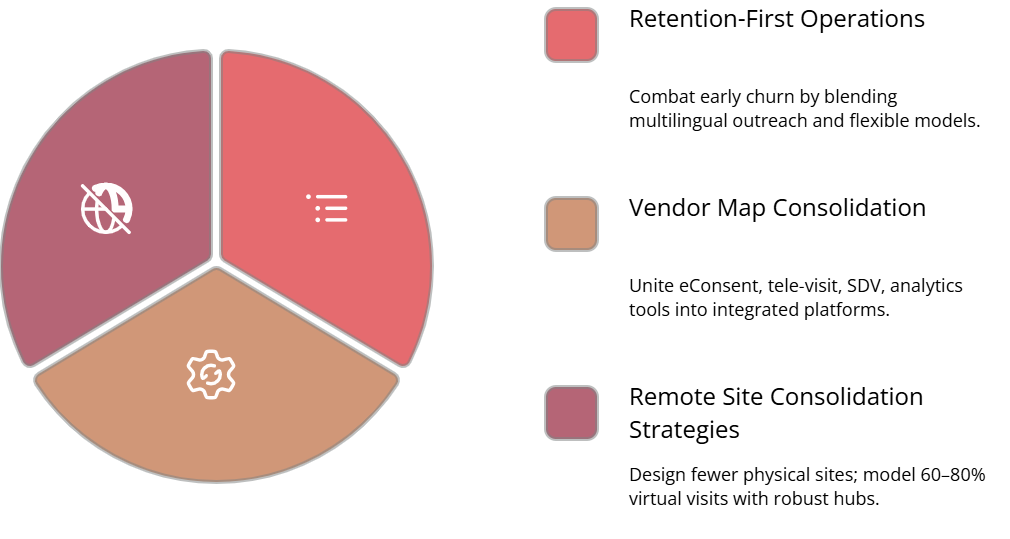
Design for fewer sites. Model 60–80% remote visits by default; aim for 5–12 “virtual hubs” rather than dozens of clinics. Use country selection logic from Countries Winning 2025 and logistics leverage from Amazon & Google in Trials.
Consolidate the vendor map. Prefer platforms uniting eConsent, eCOA, tele-visit, remote SDV, logistics, and analytics. Anchor RBQM on patterns in Remote AI Audits.
Retention-first ops. Operationalize early churn interventions guided by AI for Retention; combine multilingual outreach with flexible windows.
CROs
Evolve CRA/CRC roles. Train central analysts who oversee larger geographies and eSource portals; compensation realities in CRA Salaries Worldwide and CRC Salary Guide.
Own last-mile capability. Build/partner for mobile nurses, retail clinics, and rapid IP routing; cross-apply lessons from Drone-Delivered Medications.
Standardize speed. Productize “eConsent in days, first tele-visit in weeks” using automation playbooks in AI-Powered Clinical Trials.
Traditional Sites (that want to live)
Become a tele-sub-I hub. Offer remote supervision, source portals, concierge scheduling; specialize in complex procedures. Upskill with CCRPS resources such as Proven Test-Taking Strategies.
Specialize where anchors are essential. Interventional radiology, inpatient infusions, and complex imaging remain site-centric; decentralize everything else.
Monetize accuracy. Track deviation rates, query aging, and adherence SLAs; use dashboards to sell quality to sponsors.
5) 2025→2028 Roadmap & KPIs Sponsors Should Track
2025 – Stack consolidation. Site counts drop 30–40% in new protocols; remote monitoring becomes default per Remote AI Audits. KPIs: time to eConsent live, % virtual visits, AI-flag resolution time.
2026 – Retention algorithms scale. Double-digit churn reduction across indications as described in AI for Retention. KPIs: visit adherence, device uptime, PRO completion, unplanned visit rate.
2027 – Logistics dominance decides winners. Direct-to-patient cold chain and regional drone corridors from Drone-Delivered Medications. KPIs: IP delivery time, temperature excursion rate, first-attempt success for home visits.
2028 – 80% fewer traditional sites. Sites remain where specialized equipment or complex procedures are unavoidable. Elsewhere, virtual hubs with home networks dominate. KPIs: sites per protocol, monitor travel days, $/patient, database lock days.
Career implications. AI shifts task mix (see Meet Your New Boss). Reskill toward MSL and Medical Monitor paths via MSL Study Guide and Top 50 MM/MSL Questions, or pursue remote-first CRC/CRA programs using CROs Hiring Directory and Remote CRA Programs.
6) FAQs: Decentralized Trials & the 80% Site Reduction Forecast
-
Dermatology, metabolic, respiratory, neurology (non-procedural), and immunology—study types dominated by repeat ePROs, vitals, and tele-assessments. Follow-up phases in interventional cardiology or oncology decentralize heavily, while anchor procedures stay site-based. Recruitment design should borrow patterns from Countries Winning 2025 to expand reach without sacrificing quality.
-
A documented RBQM plan, central statistical surveillance, remote source access, device calibration logs, and role-mapped SOPs. Techniques in Remote AI Audits show how to pre-empt findings with anomaly detection and targeted source verification.
-
Consolidate into a DCT platform uniting eConsent/eCOA/tele-visit/remote SDV/logistics/analytics. Budget by patient-month and home-visit units, not site retainers. Use comp/availability signals from 2025 Salary Report and country-mix levers from India’s Trial Boom.
-
Properly executed, it lowers dropout. Predictive models from AI for Retention, concierge logistics, and flexible windows reduce burden and catch at-risk participants early.
-
They scale. A single remote CRA can cover larger geographies via eSource portals and central analytics; coordinators shift to patient-concierge/data-orchestration roles. Upskill with Remote CRA Programs and terminology mastery via Top 100 Acronyms.
-
Complex procedures requiring specialized equipment (interventional radiology, inpatient infusions, certain imaging) and intensive first-dose safety remain site-centric. Smart sites pivot into procedure hubs with tele-sub-I networks, while decentralizing follow-ups to home-health.
