
Clinical Compliance Officers (CCOs) now sit at the intersection of risk, data, and inspection readiness. The job isn’t “policing binders”—it’s designing repeatable controls that keep trials audit-proof while accelerating database lock. In 2025, that means fluent command of RBQM, CSV for AI-enabled tools, and eSource→EDC lineage—plus coaching teams to prevent deviations before they exist. This guide gives you the exact pathway, skills matrix, and validation playbook, with deep dives linked to CCRPS resources on acronyms, PI terminology, AI risk prediction, and salary benchmarks to help you move fast and correctly.

1) Role mandate: what a Clinical Compliance Officer actually owns
A CCO turns ambiguous risk into controlled behaviors. You author SOPs that match protocol realities, not generic templates; implement RBQM so risk is measured before deviations appear; and orchestrate validation so cloud tools and AI features pass IQ/OQ/PQ. You’ll routinely translate complex ideas—digital biomarker variability, wearable signal quality, and AI-alert precision—into site-friendly SOP language. Because language causes mistakes, keep acronyms and PI terms front-and-center during onboarding.
Add-on: You also own the inspector narrative—a one-click dossier that shows lineage graphs, alert → resolution → CAPA chains, and timestamp integrity. Formalize change control so every amendment retriggers validation with diff-aware tests, and encode precision targets to cap query noise and reduce site burden.
What success looks like: prevented major findings, faster lock, and shorter CAPA cycles. Use market data to size your team and justify tooling with the 2025 salary report and top-paying roles analysis.
Add-on: Track a tight scorecard—time-to-CAPA initiation, inspection-pack lead time, and query precision/recall—and benchmark staffing using CRC and CRA guides. Tie budget asks to cost per prevented finding to convert quality wins into executive-level ROI.
| # | Skill/Control | What “Good” Looks Like | Evidence to Show | Where to Learn |
|---|---|---|---|---|
| 1 | RBQM Design | Risk metrics tied to protocol | Thresholds + re-trigger logic | AI risk prediction |
| 2 | CSV for Cloud Tools | IQ/OQ/PQ per release | Versioned validation packs | Test strategies |
| 3 | Data Lineage | eSource→EDC traceable | Field-level mapping & unit tests | Acronyms guide |
| 4 | Audit Trail Integrity | Immutable, time-synced logs | NTP reports, append-only proof | Global winners |
| 5 | CAPA Management | Closed loop, measurable | CAPA IDs tied to queries | Salary report |
| 6 | Consent Governance | Version & scope control | Consent matrix, audit sample | PI terms |
| 7 | Vendor Oversight | KPIs tied to quality | Supplier qual, SLAs, audits | CRO directory |
| 8 | AE/SAE Case Flow | Timely, complete narratives | Timeliness charts, QC rate | PV salaries |
| 9 | Data Privacy | Minimization + lawful basis | DPIA/RoPA, role matrix | VR endpoints |
| 10 | Device/Wearable QC | Missingness controls | QC gates & alerts | Wearables |
| 11 | Digital Biomarkers | Clinically meaningful signals | Validation dossier & ranges | Digital biomarkers |
| 12 | Protocol Amendment Control | Diff-aware testing | Amendment re-validation packs | AR assessments |
| 13 | Training & Competency | Role-based curricula | Scores, refresh cadence | Study environment |
| 14 | Inspection Readiness | One-click dossier | Inspector packs with lineage | Exam anxiety |
| 15 | Site Burden Management | Query volume caps | Burden dashboards | CRC salary |
| 16 | Fraud Detection | Duplicate subject checks | Graph alerts & actions | Country winners |
| 17 | Cold-Chain Oversight | Excursion handling | Telemetry + CAPA trail | Drone delivery |
| 18 | Change Control Board | Governed releases | Minutes, rollbacks | Top paying jobs |
| 19 | Document Control | Single source of truth | Effective dates & version map | Test strategies |
| 20 | Statistical Literacy | Read risk charts | Signal vs noise analyses | AI insights |
| 21 | PI/Site Coaching | Preventive behaviors | RCA notes & outcomes | PI terms |
| 22 | eConsent Review | Language & logic checks | Approved templates, change log | VR trials |
| 23 | Economic Framing | Quality tied to ROI | Cost/major finding avoided | Salary report |
| 24 | Remote Audit Readiness | Virtual inspections smooth | Secure portals + packs | AI audits |
| 25 | Terminology Mastery | Zero ambiguity | Glossary & training scores | Acronyms |
| 26 | Career Navigation | Planned upward moves | Skills map to roles | Remote CRA |
| 27 | Regional Nuance | Policy sensitivity | Country playbooks | Brexit impact |
| 28 | MSL/Medical Monitor Liaison | Safety–compliance bridge | Issue log & alignment | MSL guide |
2) Pathway into the role: exact steps from zero to hired
Start adjacent, climb deliberately. Common feeder paths are CRC → CRA → CCO, PV associate → compliance specialist, or data manager → quality. Calibrate expectations with CRC salary trends and CRA pay data, then target a compliance internship or hybrid “quality analyst” role at CROs from the CRO directory.
Build the exam muscle. CCOs succeed because they can learn fast under pressure. Use CCRPS playbooks such as proven test-taking strategies, creating a study environment, and overcoming exam anxiety to accelerate certifications and vendor qualifications.
Collect evidence early. Volunteer to close a CAPA, run an RBQM threshold review, or assemble an inspection pack. Tie your outcomes to inspection language using acronyms and PI terminology so hiring managers trust your maturity.
3) Systems you must master: RBQM, CSV, lineage, and inspection packs
RBQM that matters. Replace “%SDV” with risk thresholds tied to patient safety and inspection probability. AI early-warning methods help prioritize alerts from wearables, smart pills, and AR/VR endpoints (VR, AR).
CSV for modern stacks. Treat every release like a mini-inspection: requirements → risk → IQ/OQ/PQ → residual risk sign-off. Keep diff-aware test sets for protocol amendments and prove timestamp integrity across systems.
Lineage to stop disputes. Document eSource→EDC mappings and unit harmonization; show before/after transformations with deterministic code. If your program uses drone cold-chain, incorporate controls from drone-delivered medications to link telemetry to CAPA triggers.
Inspection packs that “sell themselves.” Export a single dossier with lineage graphs, alert→resolution→CAPA chains, and sign-offs; attach a glossary using acronyms and PI terms so regulators never guess.
What’s Your Biggest Obstacle to AI-Ready Trials in 2025–2030?
4) Day-to-day playbook: the first 90 days done right
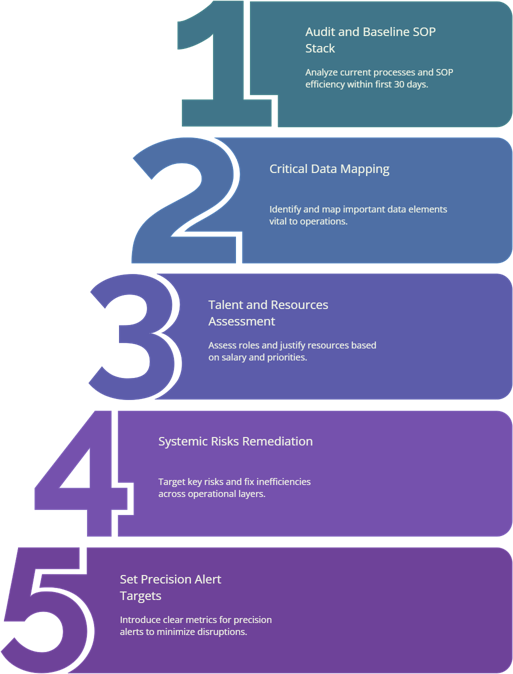
Days 1–30: Baseline and triage. Audit SOP stack, map critical data elements, and measure MTTD/MTR (time to detect/resolve). Set weekly reviews for query precision and site burden. Cross-check talent capacity with salary economics and the top jobs list to justify resources.
Days 31–60: Fix systemic risks. Introduce precision targets for alerts; publish CAPA SLAs; and require one-click inspection packs. Where device endpoints exist, apply QC patterns from wearables and digital biomarkers to reduce noise.
Days 61–90: Institutionalize behaviors. Launch role-based curricula using study environment and test strategies, then stress-test with a mock inspection. For partner selection and regional scale-up, triangulate capabilities via the CRO directory and country winners analysis.
Dashboards that matter. Monitor: prevented major findings; inspection-pack lead time; CAPA age; eSource→EDC mismatch rate; and site query volume. Align every metric with a remediation owner.
5) Career growth & compensation: where the CCO path leads
Ceiling and options. From CCO you can step into Head of Quality, Inspection Readiness Lead, RBQM Director, or cross into PV signal detection (compare outcomes with PV salary growth). If communication is a strength, an MSL/Medical Monitor liaison path is viable—spin up knowledge using the MSL study guide and MM/MSL questions.
Add-on: Package your promotion case with hard metrics—prevented major findings, faster lock, CAPA cycle-time cuts—and benchmark offers using the global salary report. CCOs who can narrate RBQM outcomes with AI audit evidence often leapfrog into director-level roles.
Remote leverage. Many compliance roles are hybrid or remote; explore programs and employers via the remote CRA/quality list. Use CRC and CRA salary guides to negotiate fair compensation tied to measurable risk reduction.
Add-on: When negotiating remote packages, price in home-office stipends and time-zone premiums for global oversight; tie incentives to alert precision and inspection-pack readiness targets from your AI audits program. Remote-first CCOs who reduce site burden and query noise reliably can command top-of-band pay.
6) FAQs — Clinical Compliance Officer (2025)
-
Evidence beats titles. Show hands-on RBQM thresholding, CSV packs for a cloud system, and a finished inspection dossier. Supplement with CCRPS learning assets—test strategies, study environment—and anchor interviews in standard acronyms and PI terms to signal fluency.
-
CCOs now validate AI-assisted alerts, set precision targets, and supervise device QC. Ground your SOPs in AI failure prediction and endpoint guidance from wearables and digital biomarkers so inspectors see signal, not hype.
-
Track major findings prevented, database-lock acceleration, CAPA initiation time, query precision, site burden, and inspection-pack lead time. Tie results to an ROI line item using the salary report to justify headcount and tooling.
-
Start with data lineage and CAPA mastery, then add CSV. Use CRC trends and CRA salary guides to position your experience; practice building a mock inspection pack with clear acronyms and PI terms sections.
-
Choose a CRO with a mature RBQM stack and transparent validation; shortlist from the CRO directory. If adopting novel logistics like drone-delivered medications, ensure telemetry feeds your CAPA system and inspection pack.
-
Send the one-click dossier upfront: lineage graphs, alert→resolution→CAPA, and SOP excerpts. Maintain a glossary using acronyms and PI terms; narrate how precision targets prevent alert fatigue. Reference AI risk controls to justify thresholds.
