
How To Get a Pharmacovigilance Certification in Wisconsin: Everything You Need to Know in 2025-2026
Wisconsin’s healthcare corridor—Madison–Milwaukee–Green Bay—is a quiet powerhouse for pharmacovigilance (PV). Academic medical centers, device innovators, and CRO satellites pull PV talent that can code MedDRA cleanly, hold SUSAR clocks, and author audit-ready narratives. If you present accredited certification + proof artifacts (mock cases, coding rulebook, PBRER shell), you’ll outpace bigger-market competitors for hybrid/remote roles serving the Upper Midwest. Calibrate your language to standards in CCRPS state playbooks like New York, North Carolina, Ohio, and Pennsylvania, then adapt it to Wisconsin’s inspection culture.

1) Wisconsin’s PV Reality in 2025–2026: Why This Market Rewards Proof Over Hype
Wisconsin employers value repeatable process over pedigree. That’s your advantage. If you can show (not just claim) ability to control timelines, code consistently, and author crisp narratives, you will win hybrid offers across Milwaukee–Madison—often supporting multi-state portfolios (IL–MN–IA–MI). Calibrate your resume to inspection-ready phrasing modeled in CCRPS guides for Pennsylvania, New York, and CRO-dense North Carolina. Borrow structural clarity from Oregon and QC-minded Tennessee so every artifact screams audit-aware.
Interview pain points you must neutralize
“Day-15 keeps slipping.” → Present your SUSAR calendar, escalation bands, and clock-start evidence (email/EDC timestamps). See timeline framing across Rhode Island and discipline-first Wisconsin.
“Narratives are weak.” → Show before/after narrative edits with causality rationale and follow-up requests. Style cues echo Virginia and Washington.
“MedDRA rework is high.” → Provide a synonym list + coding rules and your QC sign-off trail. Model the documentation cadence visible in Ohio and Utah.
| Key Factor | 2025 Data (Wisconsin) |
|---|---|
| Typical Entry Titles | Drug Safety Associate, PV Associate, Case Processor |
| Mid-Level Titles | Safety Scientist, Signal Detection Scientist, PV Ops Lead |
| Senior/Lead Path | PV Manager, Aggregate Reports Lead, Benefit-Risk Lead |
| Remote/Hybrid Share | ≈55–65% hybrid/remote across Milwaukee–Madison corridor |
| Salary (Entry) | $72k–$85k base; hybrid stipends common |
| Salary (Mid) | $88k–$108k; signal/aggregate exposure boosts offers |
| Salary (Senior) | $112k–$140k; device + combo products trend higher |
| Top Hiring Locations | Milwaukee, Madison, Green Bay, Waukesha, Kenosha |
| Core Safety Systems | Oracle Argus, ArisGlobal LifeSphere, Veeva Safety, Vault QMS |
| Coding Standards | MedDRA v26+; WHO-Drug/WHO-DD for products |
| Case Sources | Clinical, post-market, literature, PSPs, social mentions (triaged) |
| Regulatory Outputs | SUSARs, expedited ICSRs, PBRER/PSUR, DSUR, RMP |
| US/EU Timelines | 7–15 days (serious); others per region and product label |
| Signal Process | Detection → Triage → Validation → Analysis → Recommendation → Follow-up |
| Audit Hotspots | Clock-starts, expectedness, narrative clarity, MedDRA QC, CAPA proof |
| Interview Proof | Two anonymized narratives + coding rules + E2B(R3) exports + PBRER shell |
| Device DV Nuance | Combination product signals; device vigilance terms in MedDRA |
| First 90-Day Wins | SUSAR calendar, follow-up SOP, synonym list, QC rubric, CAPA library |
| Cross-Over Backgrounds | RN, PharmD, CRA, med writer, epidemiology → rapid PV ramp |
| Time to Offer | 6–12 weeks with portfolio and local references |
| Networking Targets | Academic safety teams, CRO satellites, device safety groups |
| Wisconsin Edge | Device + pharma mix; strong inspection culture → growth for disciplined PV |
| Common Gaps | Vague narratives, missing expectedness logic, weak CAPAs |
| Skills Most Screened | Narratives, MedDRA hierarchy, E2B(R3), CAPA writing, signal notes |
| Literature Screening | Journal triage cadence, de-duplication, abstract narrative sourcing |
| Aggregate Rhythm | Lock shells early; rolling tables; tracked changes with QC sign-off |
| Regulators to Know | FDA/FAERS, EMA/EudraVigilance, MHRA/Yellow Card, Health Canada |
| Long-Term Path | PV Manager → Signal Lead → Benefit-Risk → Global Safety leadership |
2) Step-by-Step: Earning a Wisconsin-Ready Pharmacovigilance Certification
1) Pick an accredited, skills-first certificate.
Prioritize case processing labs, MedDRA v26+ practice, E2B(R3) exports, SUSAR clock controls, and aggregate report shells. Keep terminology aligned with standards in New Jersey and Midwest Ohio.
2) Build a live portfolio while training.
Create two anonymized narratives, a coding rulebook (LLT→PT→HLT→SOC with examples), a SUSAR calendar, and a PBRER skeleton. Structure and tone: see Pennsylvania and Oregon.
3) Document practice hours with evidence.
If you’re new, simulate end-to-end cases: intake → narrative → MedDRA coding → QC → E2B(R3) → submission proof. Borrow the checklist mentality showcased in Wisconsin and process-heavy Tennessee.
4) Rehearse regulator scenarios.
Flashcards for US/EU/UK/Canada timelines, seriousness vs expectedness, follow-ups, listedness, and CAPA drafting. Tight phrasing inspired by Rhode Island and Washington.
5) Secure Wisconsin-savvy mentorship.
Aim for mentors with device + pharma exposure. Reference the regional logic across South Dakota, North Dakota, and neighbor markets echoing Wisconsin’s inspection pace like Virginia.
3) The Skills Wisconsin Screens For (and Exactly How to Prove Them)
Case intake → closure, with evidence.
Show the entire chain: intake note → seriousness/expectedness → MedDRA LLT→PT→HLT→SOC → narrative → QC proof → E2B(R3) export → submission record. Borrow documentation tone from Pennsylvania and checklist rigor from Tennessee.
MedDRA mastery (rework killer).
Create a coding rulebook: spelling variants, preferred terms, device vigilance wording, and escalation rules for clinical review. Mirror the process clarity in Oregon and Utah.
Expedited reporting discipline.
Keep a clock-start matrix (US/EU/UK/Canada), calendar alerts, and a CAPA template for misses. Demonstrate submission evidence (screens/logs) and retraining proof—standards echoed across Rhode Island and Washington.
Signal & benefit-risk.
Prepare a one-pager signal memo: detection method → validation criteria → analysis → recommendation → tracking. Add literature screenshots and disproportionality notes. Style cues: North Carolina and Ohio.
Aggregate reports.
Lock a PBRER shell early. Maintain rolling tables, highlight tracked-changes with QC initials. Bring the device nuance if applicable. Inspection-friendly tone aligns with Virginia and documentation-tight Wisconsin.
Your #1 Blocker to PV in Wisconsin?
4) Career Ladders, Compensation, and How to Accelerate to Signal/Aggregate Leadership
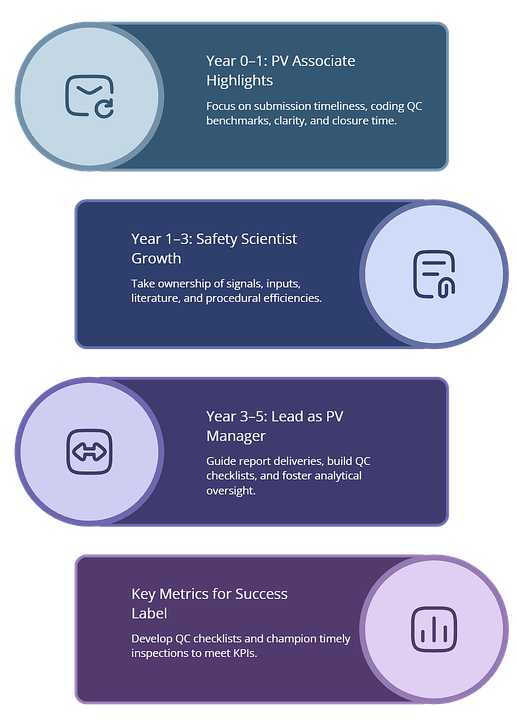
Year 0–1 — PV Associate/Case Processor.
Your KPI stack: on-time expedited submissions, coding QC ≥98%, narrative clarity (peer-reviewed), follow-up closure time. Phrase outcomes like high-bar markets: New York and Pennsylvania.
Year 1–3 — Safety Scientist.
Own signals, aggregate inputs, deviation CAPAs, and literature cadence. Show rework reduction from your coding rulebook. Reference CRO-dense North Carolina to align with sponsor expectations.
Year 3–5 — PV Manager/Aggregate Reports Lead.
Deliver PBRER/PSUR/DSUR on schedule; coach juniors on narratives/coding; institutionalize QC checklists and version control. Tone aligns with inspection-aware Rhode Island and documentation-tight Virginia.
Compensation levers.
Negotiate with metrics: on-time SUSAR %, coding rework delta, aggregate cycle time, audit findings closed, hybrid multi-state coverage (WI+IL/MN/IA/MI). Cross-reference regional leverage language in Washington and Upper-Midwest-adjacent Ohio.
5) 14-Day Wisconsin Execution Plan (From Learning to Interviews)
Days 1–2: Resume calibration.
Rewrite bullets with measurable PV outcomes (on-time SUSAR %, QC pass rate, coding rework reduction). Align phrasing to New York and audit-aware Pennsylvania.
Days 3–5: Portfolio pack.
Bundle two anonymized narratives, coding rulebook, timeline grid, signal memo, PBRER shell. Reference device vigilance nuances as seen across process-centric Oregon and QC-minded Tennessee.
Days 6–8: Target employers.
Shortlist CRO satellites, device firms, and academic safety groups. Pitch hybrid coverage across WI + MN/IL/IA/MI. Establish regional literacy by citing Wisconsin, Ohio, and Washington.
Days 9–11: Mock inspection.
Run a 10-point PV audit: clock-starts, expectedness, seriousness, narrative clarity, MedDRA QC, submission proof, CAPA, retraining records, literature triage, version control. Borrow rigor from Rhode Island and documentation-tight Virginia.
Days 12–14: Interview sprints.
Answer with mini SOPs: “Here’s my SUSAR Day-15 calendar, coding rules, follow-up letter template, E2B export, and CAPA.” Close with hybrid bands (e.g., 2–4 days/month onsite, rest remote). Reinforce with Wisconsin, North Dakota, and South Dakota references.
6) FAQs: Pharmacovigilance Certification in Wisconsin (2025–2026)
-
Hands-on case labs, MedDRA practice, E2B(R3), and aggregate report shells. Show a portfolio (2 narratives, coding rules, SUSAR calendar, PBRER shell). Match phrasing to Pennsylvania and CRO-denseNorth Carolina.
-
Bring a clock-start matrix, alarms, and submission logs. Add a CAPA template and retraining notes. Timeline phrasing echoes Rhode Island and Washington.
-
-
-
Yes—especially with combination product exposure and device vigilance understanding. Show device-specific coding examples and risk files alignment. Borrow phrasing patterns from process-matureOregon.
-
Typically $72k–$85k base in Wisconsin; negotiate higher with on-time SUSAR rates, coding QC ≥98%, and aggregate cycle-time wins. Regional framing: Ohio and inspection-aware Rhode Island.
