How To Get a Pharmacovigilance Certification in Wyoming: Everything You Need to Know in 2025-2026
Wyoming’s small trial footprint hides outsized pharmacovigilance (PV) opportunity: lean teams, hybrid hiring, and sponsors that prize speed, audit-readiness, and clean safety data. If you can prove competence in case processing, MedDRA coding, signal detection, aggregate reporting, and regulatory timelines, you’ll leapfrog bigger-market applicants. This guide shows exact steps to earn a PV certification, convert it into Safety Associate/Safety Scientist roles, and negotiate remote-first work tied to Mountain West sponsors. For role language, networking, and CV phrasing, mirror the standards in CCRPS state playbooks like New York, North Carolina, Ohio, and Pennsylvania.

1) Wyoming’s 2025-2026 Pharmacovigilance Reality: Small Market, Big Leverage
Wyoming employers—hospital systems, regional sponsors, CRO subcontractors—opt for hybrid/remote PV capacity when local talent is thin. That helps you anchor in Cheyenne/Casper while covering studies across Colorado, Utah, Montana, and the Dakotas. Hiring managers want junior PVs who already understand E2B(R3) transmissions, CIOMS forms, seriousness assessment, expectedness, SUSAR clock-starts, and MedDRA v26+ hierarchy. Use CCRPS playbooks to match your vocabulary to high-competition states like New Jersey, New York, and inspection-heavy regions like Rhode Island to signal audit-ready thinking.
Recruiters also filter for regulatory geography fluency. Demonstrate you can operate to FDA (FAERS/VAERS), MHRA (Yellow Card), and EMA (EudraVigilance) expectations—then tie your workflow to risk-based quality used in CRA-dense states such as South Carolina and Washington. Borrow portfolio layout ideas from CRA pages like New Hampshire and Virginia to make your PV artifacts scannable.
Pain points you must solve in interviews
• “We can’t keep Day-15 SUSARs on time” → show a calendarized submission SOP and clock-start controls. See timeline framing tactics across Oregon and Vermont.
• “MedDRA coding rework is killing velocity” → show coding rules + synonym lists + QC tiers like the process language you’ll find in Utah and Tennessee.
• “Aggregate report authoring takes forever” → present a PBRER shell with tables, signal narratives, benefit-risk logic—mirroring quality tips in Wisconsin and Wyoming’s CRA blueprint for documentation rigor.
| Key Factor | 2025 Data (Wyoming) |
|---|---|
| Typical Entry Titles | Drug Safety Associate, PV Associate, Case Processor |
| Mid-Level Titles | Safety Scientist, Signal Detection Scientist, PV Operations Lead |
| Senior/Lead Path | PV Manager, Aggregate Reports Lead, Risk Management Lead |
| Remote/Hybrid Share | ≈60% hybrid/remote roles with Mountain West coverage |
| Salary (Entry) | $70k–$82k base + travel/benefits |
| Salary (Mid) | $86k–$105k with bonus options |
| Salary (Senior) | $110k–$135k; niche signal/aggregate roles trend higher |
| Top Hiring Locations | Cheyenne, Casper, Laramie (with regional sponsor ties in CO/UT/MT) |
| Core Systems | Argus, ArisGlobal (LifeSphere), Veeva Safety, Vault QMS |
| Coding Standard | MedDRA v26+; WHO-DD for products |
| Case Inputs | HCP/consumer reports, literature, clinical trials, post-market |
| Regulatory Outputs | SUSARs, expedited ICSRs, PSUR/PBRER, DSUR, RMP |
| Timelines | Serious/SUSAR 7–15 days; others per region-specific rules |
| Signal Process | Detection → Validation → Analysis → Evaluation → Recommendation → Tracking |
| Audit Focus | Clock-starts, expectedness, seriousness criteria, narrative quality, QC evidence |
| Key Skills | Narrative writing, causality, E2B(R3), MedDRA hierarchy, CAPA logic |
| Interview Proof | Mock cases, coding rules, signal memo, aggregate report shell |
| Cert Advantage | Accredited PV certificate + documented case hours move you to “ready” |
| Cross-Over Talent | RN, PharmD, MPH, CRA, medical writer → fast PV ramp |
| Common Gaps | Weak narratives, unclear expectedness, missed follow-ups, late SUSARs |
| Wyoming Edge | Lean teams → faster promotion; multi-state coverage justifies higher pay |
| Best First Wins | Literature screening SOP, MedDRA synonym list, timeline tracker, QC rubric |
| Portfolio Must-Haves | 2 anonymized narratives + 1 coding audit + 1 PBRER shell + 1 signal memo |
| Regulators to Know | FDA/FAERS, EMA/EudraVigilance, MHRA/Yellow Card, Health Canada |
| Networking Targets | Regional CROs, hospital research offices, academic safety teams |
| Time to First Offer | 8–14 weeks with proof-based applications and strong mentorship |
| Long-Term Path | PV Manager → Signal Lead → Global Safety/Benefit-Risk → (US-equivalent) QPPV-style leadership |
2) Step-by-Step: Earning a Pharmacovigilance Certification That Wyoming Employers Trust
Step 1 — Choose an accredited, skills-forward program.
Pick a certificate emphasizing hands-on case processing, MedDRA practice, narrative drills, expedited reporting logic, E2B(R3), and aggregate report structuring. Cross-reference expectations from CCRPS market guides like Michigan, Pennsylvania, and CRO-dense North Carolina to align your syllabus with hiring language.
Step 2 — Build a mini-portfolio as you learn.
Produce two anonymized case narratives, a MedDRA coding rulebook (LLT/PT/SOC logic + examples), a SUSAR timeline tracker, and a PBRER skeleton. Format these like you would clinical documents in high-standard states such as New York and Oregon.
Step 3 — Document practical hours.
If you lack industry hours, create simulated cases with source chain (call transcript → form → E2B fields → narrative → QC). Tie your tracking mechanics to SOP models referenced across Utah and audit-aware Wisconsin. Wyoming teams care more about proof of competence than brand-name logos.
Step 4 — Practice regulator scenarios.
Create flashcards for US Day-7/15, EU 7-/15-day, expectedness vs listedness, case seriousness, and follow-up letters. Draft CAPAs for late submissions. Borrow interview framing lines from rigorous markets like Tennessee and South Dakota.
Step 5 — Ask for Wyoming-relevant mentorship.
Seek mentors who’ve worked cross-state monitoring/safety. Reference the regional thinking featured in Washington, Virginia, and Mountain West pages like Montana to calibrate expectations for sparse-site geographies.
3) The Skills Wyoming Screens For (and How to Prove Each One Fast)
Case intake to close.
Show a full chain: intake note → seriousness/expectedness → MedDRA LLT→PT→HLT→SOC → narrative → QC checklist → E2B(R3) export → submission record. Document your process exactly like audit-friendly programs highlighted in Pennsylvania and checklist-centric Wisconsin.
MedDRA mastery.
Create a coding rulebook that resolves synonym clashes and prevents miscoding. Include examples from respiratory, oncology, and vaccine AEs. Structure like concise process pages in New Hampshire and Vermont.
Expedited reporting & timelines.
Prepare clock-start grids for US/EU/UK/Canada, with calendarized reminders. Add CAPA templates for late SUSARs and evidence of retraining. Align your timeline language with rigorous phrasing used in Oregon and Utah.
Signal management.
Draft a 1-page signal memo: detection method → triage criteria → validation → investigation plan → decision log. Use benefit-risk arguments that mirror structured thinking found across Tennessee and South Dakota playbooks.
Aggregate reports.
Build a PBRER shell with tables, narrative sections, and tracked changes that show QCability. Keep references for DSUR and RMP. Present your template with the documentation discipline modeled in Virginia and Washington.
Interview story arc.
Explain a mock case you “rescued”: late follow-ups, coding mismatch, and how your QC rubric and CAPA prevented recurrence. Close by connecting your hybrid availability to multi-state coverage, echoing regional logic in Montana and remote-friendly Nevada.
What’s Holding You Back from Pharmacovigilance in Wyoming?
4) Applying Smart in Wyoming: A 14-Day Execution Plan That Converts
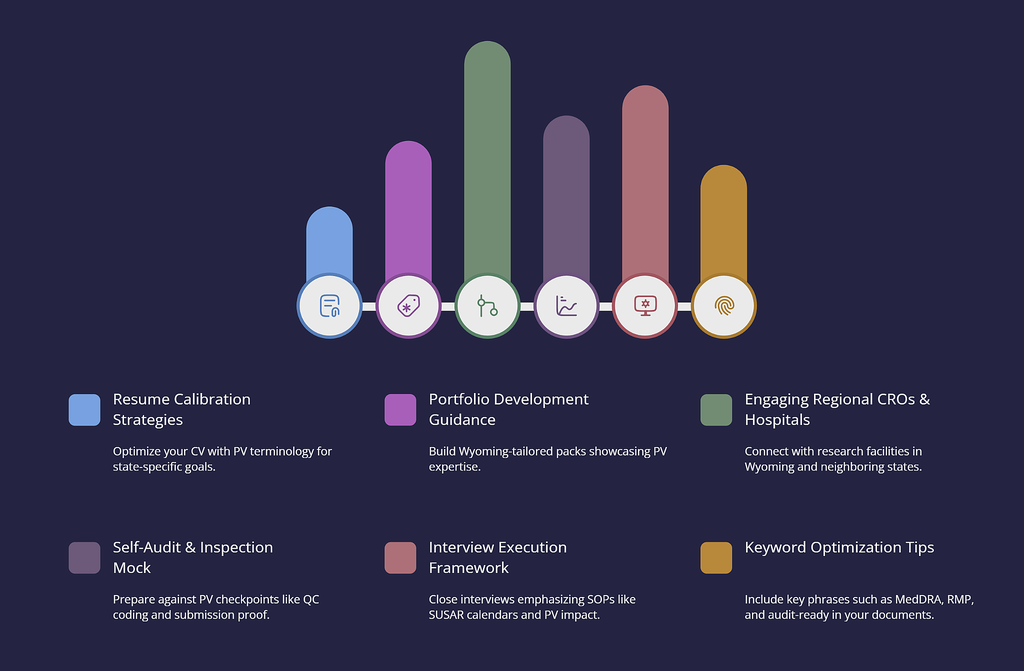
Day 1–2 — Calibrate your resume to PV language.
Borrow phrasing from inspection-aware states like Rhode Island and high-volume Ohio. Add keywords: SUSAR, E2B(R3), MedDRA, PBRER, DSUR, RMP, CAPA, audit-ready.
Day 3–5 — Build a Wyoming-specific portfolio pack.
Bundle 2 narratives, coding rulebook, timeline grid, signal memo, PBRER shell. Title your pack “PV-Wy-Readiness” and cite regional familiarity via pages like North Dakota and South Carolina.
Day 6–8 — Target CROs and hospital research offices.
Pitch your remote coverage for Wyoming + adjacent states. Link to state playbooks (New Mexico, Utah, Colorado-adjacent analysis via Nebraska) to demonstrate regional literacy.
Day 9–11 — Mock an inspection.
Run a self-audit against a 10-point PV checklist (clock-starts, expectedness, seriousness, follow-ups, coding QC, narrative clarity, submission evidence). Borrow documentation patterns from process-heavy Oregon and QC-minded Wisconsin.
Day 12–14 — Interview sprints.
Answer with mini SOPs: “Here’s my SUSAR Day-15 calendar, coding rules, follow-up letter template, CAPA for late submissions.” Close with your hybrid travel bands. Reinforce with links to regional pages like Wyoming CRA, Idaho-adjacent via Oregon, and remote-friendly Nevada.
5) Career Ladders, Compensation, and How to Advance to Signal/Aggregate Leadership
Year 0–1 — PV Associate/Case Processor.
Focus on on-time expedited submissions, error-free MedDRA, and strong narratives. Showcase metrics: Day-15 compliance rate, coding QC pass rate, and follow-up closure times. Cite discipline language similar to Pennsylvania and New York in performance reviews.
Year 1–3 — Safety Scientist.
Own signal detection, aggregate inputs, and deviation CAPAs. Build a signal dashboard that tracks disproportionality reviews and literature alerts. Tie your analytical style to inspection-savvy phrasing from Rhode Island and CRO-dense North Carolina.
Year 3–5 — PV Manager/Aggregate Reports Lead.
Build PSUR/PBRER on schedule; coach juniors on narratives and coding. Pitch regional PV hubs to sponsors covering Wyoming + Colorado/Utah. Use networking and document rigor modeled by states like Washington and Virginia.
Compensation tactics.
Show savings from avoided late SUSARs, audit findings closed, coding rework reduction, and aggregate cycle times improved. Use remote coverage of multiple states as leverage—similar to how CRA roles in Nevada and Montana justify higher bands.
6) FAQs: Pharmacovigilance Certification in Wyoming (2025-2026)
-
Pick an accredited PV certificate with hands-on case processing and MedDRA drills; compile two narratives, a coding ruleset, and a SUSAR timeline grid as you learn. Use CCRPS state pages like Ohio and Pennsylvania to align terminology. Apply to hybrid/remote roles covering the Mountain West.
-
They care that you can execute the PV lifecycle: intake → seriousness/expectedness → narrative → coding → E2B(R3) → submissions → follow-ups. If your background is trial-heavy, add post-market case simulations and aggregate report shells. Mirror documentation standards seen in New York and audit-awareWisconsin.
-
-
Create a clock-start matrix (US/EU/UK/Canada) with alarms, plus a CAPA for missed deadlines. Keep submission evidence (screenshots/logs). Borrow timeline framing language from Tennessee and high-complianceRhode Island.
-
Yes. Leverage clinical judgment (seriousness/causality), documentation discipline, and exact SOPs. Build mock cases and aggregate inputs. Show inspection-readiness by aligning your documents to clarity seen in Virginia and Washington.
-
-
-
Absolutely. Wyoming PV hiring leans remote; what matters is proof of competence: E2B(R3) exports, MedDRA QC, SUSAR on-time metrics, aggregate report input quality, and signal memos. Use multi-state positioning across Idaho-adjacent via Oregon, South Dakota, and North Dakota to strengthen your case.
