
The Clinical Research Project Manager certification exam evaluates how effectively professionals understand clinical trial planning, regulatory responsibilities, budget management, quality oversight, and operational decision-making. Candidates often struggle because they memorize project management terminology without understanding how those concepts apply when recruitment falls behind, vendors miss deadlines, or participant safety concerns arise. This guide explains the CCRPS exam format, verified passing requirements, important study areas, realistic practice questions, and a preparation strategy that helps candidates develop the judgment required to manage complex clinical research projects.

1. Clinical Research PM Certification Exam Format: Requirements, Scoring, and Assessment Structure
The CCRPS Advanced Clinical Project Management Certification (ACPMC) includes a competency assessment designed for professionals developing or validating clinical research management skills. According to CCRPS's published program information, the assessment consists of 50 multiple-choice questions, requires a minimum passing score of 70%, and includes two examination attempts.
For straightforward, equally weighted scoring, 70% represents 35 correct answers out of 50. Candidates should aim for approximately 80–85% on unfamiliar practice questions to create a buffer against difficult scenarios. That higher target is a preparation recommendation rather than an additional certification requirement.
The program is delivered online through a self-paced learning environment. CCRPS also states that candidates who fail their first attempt can review targeted feedback before attempting the examination again, without an additional waiting period or examination fee.
Understand what has actually been confirmed
Several exam characteristics are important when preparing:
Question count: 50 multiple-choice questions.
Passing threshold: 70%.
Attempts included: Two.
Assessment emphasis: Clinical research project management competencies.
Exam duration: Confirm the current time allowance in the assessment portal.
Negative marking: Confirm the scoring rules in the assessment instructions.
Question navigation: Check whether previously answered questions can be reviewed before submission.
The published exam description provides the first three numerical requirements. Candidates should verify the remaining operational details inside their own examination environment.
The best preparation starts with understanding how clinical research project management competencies translate into study responsibilities. Topics such as clinical trial milestone management, project quality management, and clinical research team leadership should be understood through operational examples.
Candidates should also recognize the relationships between clinical trial site oversight, principal investigator responsibilities, clinical data integrity, and regulatory compliance. These functions frequently interact during actual project delivery.
Why clinical research PM questions require operational judgment
Consider a multicenter trial in which enrollment is 25% behind its planned target. The sponsor requests accelerated site activation, while the clinical operations team identifies increasing screen-failure rates at existing sites.
A project manager must determine whether the recruitment problem comes from insufficient site capacity, restrictive eligibility criteria, ineffective patient identification, or operational delays.
Opening additional sites without diagnosing the cause may increase project expenditure without resolving the recruitment problem.
A stronger approach integrates site operations oversight, trial timeline management, budget management principles, and cross-functional communication.
The same principle applies when a monitoring visit identifies a serious protocol deviation. An appropriate response requires assessing participant impact, involving qualified decision-makers, ensuring required reporting, investigating root causes, and implementing appropriate controls.
These responsibilities connect GCP monitoring practices, adverse event reporting, research protocol adherence, and ethical participant protection.
The practical preparation objective is to identify the appropriate action, explain its justification, recognize the responsible decision-maker, and understand the documentation required to demonstrate compliance.
| Competency Area | What You Must Understand | Practical Assessment Scenario | Correct Decision Principle | Common Mistake |
|---|---|---|---|---|
| 1. Trial lifecycle | Study initiation through close-out | Identify dependencies before activation | Map predecessors using trial milestone management | Assuming tasks are independent |
| 2. Project scope | Scope baseline and controlled changes | Sponsor requests unplanned procedures | Assess scope, costs, timing and quality implications | Accepting changes without authorization |
| 3. Critical path | Dependent activities and float | One approval delays several milestones | Recalculate the controlling schedule path | Accelerating noncritical tasks |
| 4. Recruitment forecasting | Screening, randomization and enrollment rates | Recruitment is 25% below forecast | Analyze site-level conversion and site performance | Adding sites before diagnosing problems |
| 5. Site feasibility | Patient access, staffing and capacity | Choose between two potential sites | Evaluate evidence of operational feasibility | Selecting by recruitment promises alone |
| 6. Resource allocation | Workload, skills and coverage | Monitoring capacity becomes insufficient | Prioritize critical tasks and team capacity planning | Distributing work without capacity analysis |
| 7. Risk registers | Likelihood, impact, triggers and owners | A possible vendor delay threatens database lock | Assign mitigation, owner and risk escalation thresholds | Recording risks without responses |
| 8. Issue management | Active problems versus potential risks | A vendor has already missed its deadline | Activate corrective action and stakeholder communication | Leaving active issues in a risk register |
| 9. Budget variance | Actual costs against approved baseline | Project spending exceeds forecast | Identify drivers through budget variance analysis | Cutting costs without assessing impact |
| 10. Earned value | CPI, SPI, EV, AC and PV | Interpret CPI below 1.0 | Investigate cost efficiency using PM performance calculations | Confusing cost and schedule indices |
| 11. Vendor qualification | Capability, quality and contractual suitability | Select a central laboratory | Examine qualifications and quality controls | Choosing solely on price |
| 12. Vendor performance | KPIs, deviations and remediation | Repeated laboratory transfer failures | Assess data integrity impact and corrective action | Accepting verbal assurances |
| 13. Sponsor oversight | Delegation and retained sponsor responsibility | A CRO fails to complete assigned activities | Follow documented oversight obligations | Assuming outsourcing removes accountability |
| 14. Investigator authority | Clinical judgment and participant care | Safety concerns require medical evaluation | Refer to qualified professionals under investigator responsibilities | Project manager making clinical decisions |
| 15. Informed consent | Participant rights and valid consent processes | A participant undergoes a procedure before consent | Prioritize ethical participant protection and escalation | Treating the issue as paperwork alone |
| 16. Serious adverse events | Reporting pathways and timeliness | A site informs the PM of an SAE | Activate safety reporting procedures promptly | Waiting for routine status meetings |
| 17. Protocol deviations | Impact assessment and CAPA | Several sites repeat the same error | Investigate systemic causes using protocol adherence controls | Relying on retraining without analysis |
| 18. Risk-based monitoring | Critical data and focused oversight | Monitoring resources become constrained | Prioritize according to risk-based monitoring | Measuring quality by visit count alone |
| 19. TMF quality | Essential records and inspection readiness | Important trial documents are missing | Verify completeness and document reconciliation | Closing findings without evidence |
| 20. Data integrity | Traceability, accuracy and reliable records | An unexplained change affects endpoint data | Investigate through data integrity controls | Accepting undocumented corrections |
| 21. Regulatory approvals | Required authorizations before implementation | A protocol amendment affects sites | Determine applicable regulatory and ethics requirements | Implementing changes prematurely |
| 22. Medical monitoring | Clinical review and safety escalation | Safety trends emerge across sites | Engage designated medical monitoring functions | Allowing unqualified clinical assessment |
| 23. Safety signal assessment | Pattern recognition and benefit-risk review | Unexpected adverse event clusters emerge | Coordinate qualified safety data assessment | Making unsupported causality claims |
| 24. Stakeholder communication | Escalation, ownership and decision records | Site and sponsor disagree over priorities | Apply structured leadership and escalation | Leaving commitments undocumented |
| 25. Change control | Impact assessment and authorization | A new vendor tool affects study workflows | Assess validation, training and change management | Deploying without impact assessment |
| 26. Inspection readiness | Traceability and evidence of oversight | An inspector requests records of a deviation | Present documented audit and inspection evidence | Reconstructing undocumented decisions |
| 27. Database lock | Data cleaning and reconciliation dependencies | Critical queries remain unresolved | Complete required data review controls | Locking databases to meet an arbitrary deadline |
| 28. Project close-out | Deliverables, reconciliation and archival | Sponsor requests premature project closure | Verify close-out requirements | Closing without documented completion |
| 29. Team performance | Accountability and corrective leadership | Multiple deadlines are missed by one function | Identify workload and performance barriers | Blaming individuals before investigating systems |
| 30. Executive reporting | Risk summaries, forecasts and decisions | A steering committee requests project status | Present actionable milestone and risk information | Reporting activity without implications |
2. What the Clinical Research PM Exam Content Actually Tests
A clinical research project manager must coordinate several interconnected functions while maintaining timelines, financial accountability, participant protection, and reliable study data. The central preparation challenge involves understanding which decisions belong to the project manager, which require medical judgment, and which must be authorized through sponsor governance.
The 30-topic preparation matrix above covers the major competencies candidates should study. It provides a practical study framework rather than an officially published percentage-weighted examination blueprint.
Project planning, milestones, and dependencies
Project planning questions assess whether candidates can build realistic schedules, identify dependencies, anticipate delays, and evaluate recovery strategies.
A trial timeline may involve protocol finalization, vendor selection, ethics approvals, site contracts, investigator training, site initiation, recruitment, monitoring, database lock, and close-out.
Candidates should understand how these activities influence one another through trial milestone planning, research logistics coordination, and site operations oversight.
For example, accelerating site contracts provides limited benefit when ethics approval remains the controlling dependency. Likewise, increasing recruitment targets without evaluating site feasibility may create forecasts that existing resources cannot support.
A useful preparation exercise involves creating a ten-activity project schedule and identifying the earliest achievable first-patient-in milestone. Revise one dependency at a time and calculate its effect on completion.
Clinical trial financial management
Budget questions may require candidates to distinguish between planned expenditure, actual expenditure, earned value, and forecasted completion costs.
These concepts connect directly to clinical trial budget management, project performance monitoring, and clinical research quality planning.
Consider a project with a $1 million approved budget and $650,000 already spent. That information alone cannot establish whether the project is financially healthy. The manager must also determine how much planned work has been completed and what additional expenditure remains necessary.
Candidates should practice interpreting cost performance index (CPI) and schedule performance index (SPI) rather than memorizing their formulas without context.
For CPI, a value below 1.0 indicates that the project has earned less value than the cost incurred under the earned-value model. For SPI, a value below 1.0 indicates performance behind the planned earned-value schedule baseline.
These calculations must be interpreted alongside actual trial milestones, vendor performance, and resource allocation decisions.
GCP compliance, safety, and project accountability
Clinical trials operate within a regulated environment in which inadequate decisions may affect participants, study validity, and inspection readiness.
Candidates should understand the application of Good Clinical Practice principles, investigator responsibilities, safety reporting obligations, and ICH E6(R3) expectations.
One critical distinction is the difference between operational coordination and clinical authority.
A project manager can coordinate escalation, document the status of an investigation, and ensure appropriate resources are available. Medical decisions must be made by appropriately qualified professionals within their assigned responsibilities.
Similarly, contracting a CRO to perform monitoring activities does not eliminate the sponsor's oversight responsibilities.
Candidates should therefore examine how clinical monitoring strategies, medical monitoring functions, data integrity controls, and sponsor governance interact during trial execution.
Risk management, vendor oversight, and inspection readiness
Candidates should recognize the practical difference between a risk and an issue.
A risk concerns an uncertain future event. An issue concerns an event that has already occurred and requires management.
If a central laboratory might miss its next data-transfer deadline, the project manager should evaluate the risk, assign an owner, and establish mitigation measures.
If the transfer deadline has already been missed, the situation requires issue management, impact assessment, corrective action, and escalation according to its significance.
These distinctions appear throughout project quality management, clinical data review, inspection preparation, and project close-out procedures.
An important exam skill is recognizing when documentation demonstrates that an action occurred and when additional evidence is required to establish that the underlying problem has been effectively resolved.
3. Clinical Research PM Certification Practice Questions: Six Realistic Assessment Scenarios
The following original practice scenarios illustrate useful clinical project management question styles. They are preparation examples, not reproduced CCRPS examination questions.
Scenario 1: Recruitment delay and project recovery
Question: A clinical trial is 30% behind its enrollment target. The sponsor recommends activating five additional sites immediately. Screening data indicate increasing screen-failure rates across existing sites. What should the project manager do first?
A. Approve five additional sites immediately.
B. Analyze recruitment and screening failures before recommending corrective actions.
C. Reduce monitoring frequency to finance recruitment.
D. Extend the study completion date without assessing the underlying problem.
Correct answer: B.
The key issue is determining why recruitment is underperforming. Additional sites can introduce contracting, training, monitoring, and financial obligations without correcting restrictive eligibility criteria or poor screening conversion.
The project manager should examine screening-to-randomization rates, site-specific performance, recruitment barriers, and available patient populations.
The subsequent recovery proposal should incorporate site performance management, milestone recovery planning, trial budget implications, and cross-functional coordination.
Key assessment principle: Investigate the cause before selecting an expensive corrective strategy.
Scenario 2: Earned value and budget interpretation
Question: A clinical project reports the following financial performance:
Planned Value (PV): $400,000
Earned Value (EV): $320,000
Actual Cost (AC): $360,000
What are the CPI and SPI, and what do they indicate?
Calculation:
\[ \text{CPI}=\frac{EV}{AC}=\frac{320,000}{360,000}=0.89 \]
\[ \text{SPI}=\frac{EV}{PV}=\frac{320,000}{400,000}=0.80 \]
Correct interpretation: The project is demonstrating cost inefficiency and is behind its earned-value schedule baseline.
A CPI of approximately 0.89 means the project has generated about $0.89 of earned value for each dollar spent.
An SPI of 0.80 means earned progress represents approximately 80% of planned progress under this measurement method.
The project manager should investigate the underlying work packages and adjust forecasts through budget management procedures, schedule performance review, and quality-focused project controls.
Key assessment principle: Financial ratios must be translated into actionable project decisions.
Scenario 3: Critical-path scheduling
Question: A study requires eight working days for protocol package preparation. Once completed, ethics review requires 22 working days and contracting requires 16 working days. These activities run in parallel. Site initiation requires four additional days after both are completed.
What is the earliest site initiation completion time?
Calculation:
\[ 8+\max(22,16)+4=34\text{ working days} \]
Correct answer: 34 working days, assuming the stated dependencies and durations are complete.
The ethics review is the controlling activity because it takes longer than contracting.
Reducing contracting by four days would produce no improvement in the overall completion date while ethics review remains unchanged.
This demonstrates why candidates must understand critical-path scheduling, site activation dependencies, and research logistics planning.
Key assessment principle: Identify the dependency controlling completion before reallocating project resources.
Scenario 4: Serious protocol deviation
Question: During monitoring, a CRA identifies repeated investigational product administration before completion of a protocol-required safety assessment. The study is under pressure to meet recruitment targets. What is the most appropriate management response?
A. Continue recruitment and address the issue at the next meeting.
B. Provide informal retraining and close the finding.
C. Promptly involve the investigator and appropriate safety functions, assess participant impact, and initiate required investigation and escalation.
D. Delete the affected records and repeat the assessments.
Correct answer: C.
The situation potentially affects participant safety and protocol compliance. Appropriate management requires timely involvement of qualified personnel, impact assessment, reporting according to applicable requirements, and documented corrective action.
A complete response incorporates adverse event reporting requirements, protocol adherence controls, medical safety oversight, and clinical research ethics.
Retraining may contribute to corrective action, but a repeated significant deviation requires an investigation into its underlying cause.
Key assessment principle: Participant safety, qualified assessment, and required reporting take priority over operational convenience.
Scenario 5: Sponsor and CRO accountability
Question: A sponsor delegates several monitoring and data-review activities to a CRO. A critical data discrepancy remains unresolved shortly before database lock. Who is responsible for ensuring appropriate oversight?
A. Only the CRO.
B. Only the site coordinator.
C. The sponsor, through appropriate oversight of delegated activities and coordinated investigation.
D. The project manager acting independently of the assigned governance structure.
Correct answer: C.
The sponsor retains overarching responsibilities for appropriate oversight of delegated activities. The CRO remains responsible for performing the activities assigned to it, while relevant investigators and qualified data or medical personnel retain their specific responsibilities.
The project manager should coordinate the required assessment and ensure decisions are documented.
Candidates should review clinical trial data integrity, regulatory compliance, investigator GCP responsibilities, and clinical project team leadership.
Key assessment principle: Understand the distinction between delegated execution, retained oversight, and the authority to make specific decisions.
Scenario 6: Corrective action versus preventive action
Question: A central laboratory fails to transfer safety laboratory results within the agreed timeline. The vendor sends the missing files after receiving an escalation. What additional steps might be required?
Correct approach: Assess the immediate impact, investigate the cause, implement proportionate measures to prevent recurrence, and verify their effectiveness.
Sending the missing files corrects the immediate problem. A recurring failure may require a formal corrective and preventive action process.
For example, the underlying problem might involve an ineffective interface control, inadequate staffing, or an unmonitored transfer schedule.
A reliable response should connect quality management techniques, medical safety data assessment, pharmacovigilance inspection practices, and project documentation controls.
Key assessment principle: Distinguish immediate correction from systematic prevention, with effectiveness verification where appropriate.
4. How to Answer Clinical Research PM Exam Questions More Accurately
Multiple-choice assessments become difficult when several options sound professionally reasonable. The strongest answer typically depends on the timing of the action, the decision-maker's authority, the available evidence, and the potential consequences of acting prematurely.
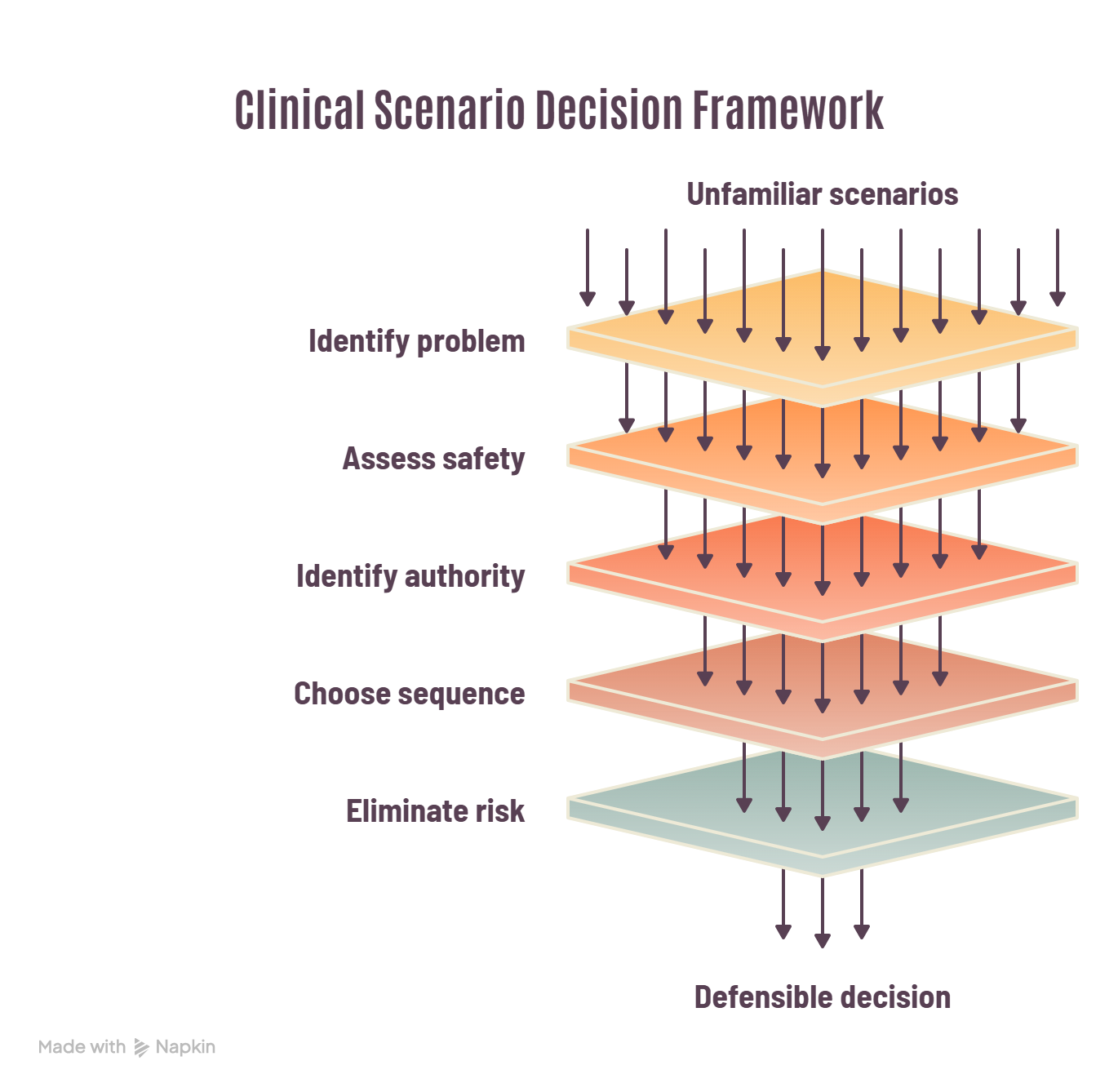
Candidates should approach unfamiliar clinical project management scenarios through a structured decision framework.
Step 1: Identify the actual problem
Separate the visible symptom from the underlying issue.
A missed enrollment target may result from inadequate site capacity, restrictive eligibility criteria, delayed activation, or poor screening conversion.
Likewise, missing documentation may represent an isolated filing issue or a broader breakdown in data integrity controls.
The correct initial response depends on identifying the factual problem through site operations review, project milestone analysis, and quality oversight procedures.
Step 2: Assess participant safety and data reliability
Determine whether the issue may affect participants, critical trial data, or regulatory obligations.
A scheduling problem with no safety implications may be handled through routine project controls. A potentially serious safety concern may require immediate involvement of designated medical and safety functions.
This decision should reflect ethical GCP requirements, adverse event reporting procedures, medical monitoring responsibilities, and risk-based clinical monitoring.
A useful technique is to flag answers that postpone required escalation merely to preserve a project deadline.
Step 3: Identify who has decision-making authority
Clinical research projects involve separate operational, medical, regulatory, and contractual responsibilities.
A project manager may coordinate the resolution of a safety issue, while the investigator and designated medical professionals perform the clinical assessment.
Similarly, protocol amendments and scope changes may require regulatory, ethics, sponsor, and contractual approvals depending on the change involved.
Candidates should study investigator authority, sponsor oversight, team management responsibilities, and ICH E6(R3) operational expectations.
A common distractor assigns responsibility to someone who is involved operationally but lacks the required authority.
Step 4: Choose an action with a defensible sequence
Many questions test whether candidates recognize what should happen first.
For instance, a proposed recovery plan may involve increasing recruitment expenditure, extending the study timeline, or activating new sites. The project manager should first establish whether available performance data support the proposed action.
A defensible sequence typically involves identifying the problem, assessing consequences, involving the appropriate decision-makers, selecting corrective measures, and verifying the outcome.
Apply this reasoning to trial risk management, budget decisions, operational escalation, and protocol compliance.
Step 5: Eliminate answers that create additional uncontrolled risk
Watch for choices involving undocumented changes, premature closure of findings, inappropriate delegation, or decisions based on incomplete information.
For example, closing a vendor issue after receiving missing data may be insufficient when the underlying transfer process repeatedly fails.
The better option may require documented investigation, corrective action, assigned accountability, and evidence that the measure is effective.
These principles are important in vendor quality oversight, clinical data review, audit and inspection preparation, and study close-out management.
An effective preparation exercise is to write one sentence explaining why each incorrect option fails. Candidates who understand the weaknesses of plausible distractors are better equipped to handle unfamiliar questions.
5. Four-Week Clinical Research PM Certification Exam Preparation Strategy
A productive study plan should connect foundational knowledge, scenario-based application, and repeated performance assessment. The following four-week framework can be adjusted for candidates with different levels of clinical operations experience.
Week 1: Build the regulatory and operational foundation
Primary objective: Understand study governance and identify responsible decision-makers.
Begin with the clinical trial lifecycle, major operational functions, regulatory responsibilities, and essential GCP principles.
Concentrate on the relationship between the sponsor, CRO, principal investigator, project manager, CRA, CRC, medical monitor, and data management team.
Use investigator responsibility guidance, GCP ethical principles, ICH E6(R3) expectations, and clinical research project management topics.
Develop a responsibility matrix covering at least ten common situations, including informed consent problems, SAE reporting, vendor deviations, missing data, protocol amendments, and study close-out.
Complete 20–25 self-test questions using free clinical research training resources and research assistant training foundations where needed.
Expected outcome: You can identify the appropriate decision-maker and escalation route for common clinical research problems.
Week 2: Develop scheduling, forecasting, and financial analysis skills
Primary objective: Convert project performance information into management decisions.
Create a fictional multicenter trial with a baseline schedule, recruitment targets, budget allocation, monitoring requirements, and vendor deliverables.
Practice calculating critical-path duration, recruitment conversion, planned versus actual progress, CPI, and SPI.
Then introduce project disruptions such as a delayed ethics approval, slower-than-expected screening, or an unexpected central laboratory expense.
Assess the appropriate response using clinical trial milestone techniques, budget management essentials, site operations oversight, and research logistics coordination.
Practice explaining each calculation in business terms. A result indicating schedule inefficiency should lead to an investigation of the affected work packages and an evidence-based recovery plan.
Review how these actions affect project quality management and team resource allocation.
Expected outcome: You can interpret project metrics and identify appropriate recovery actions without relying on formula recognition alone.
Week 3: Practice complex GCP and operational scenarios
Primary objective: Improve judgment when several answers appear plausible.
Develop case studies involving serious adverse events, protocol deviations, vendor failures, missing consent documentation, incomplete TMF records, and unresolved data discrepancies.
For every case, document five elements: immediate action, impact assessment, responsible authority, required evidence, and follow-up verification.
Use adverse event reporting guidance, clinical safety oversight, protocol adherence requirements, clinical trial data integrity, and risk-based monitoring techniques.
Pay particular attention to the distinction between correcting an individual problem and preventing a systemic recurrence.
For example, a missing source document may require retrieval or reconstruction according to applicable controls. Repeated missing records may indicate broader deficiencies in documentation workflows and training.
Strengthen this analysis with project quality strategies, inspection readiness techniques, and trial close-out requirements.
Expected outcome: You can distinguish immediate operational correction, formal escalation, and longer-term corrective action.
Week 4: Complete realistic mock assessments and close knowledge gaps
Primary objective: Demonstrate reliable performance across mixed clinical project management subjects.
Complete two original 50-question practice assessments reflecting the number of questions published for the CCRPS competency examination.
Record performance by topic rather than concentrating only on total scores.
For example, a candidate might achieve 84% overall but answer only half of the safety-governance questions correctly. That pattern deserves attention despite the strong total.
Use a suggested practice target of 80–85% across unfamiliar questions, with particular emphasis on correcting errors involving participant safety, role accountability, and regulatory decisions.
Review weak areas through clinical PM exam preparation resources, trial leadership techniques, medical safety assessment guidance, budget management concepts, and GCP monitoring methods.
Candidates transitioning from clinical research coordinator positions may need additional practice with cross-site budgets and sponsor governance. Professionals following the CRA-to-clinical-trial-manager pathway may benefit from deeper work on contracts, resource forecasting, and executive decision-making.
If the first certification attempt is unsuccessful, use the targeted feedback to determine precisely which subjects need additional study before using the second attempt.
Expected outcome: You can select appropriate answers, justify your reasoning, and recognize when a seemingly attractive option creates unacceptable operational or compliance consequences.
6. FAQs About the Clinical Research PM Certification Exam
-
The CCRPS Advanced Clinical Project Management Certification assessment is described as a 50-question multiple-choice competency examination.
Candidates should prepare across the major areas of clinical trial planning, scheduling, financial oversight, risk management, GCP compliance, and team leadership.
Completing 50-question mixed practice assessments can help evaluate knowledge breadth and consistency. The clinical PM exam preparation guide, trial milestone management resource, and quality management framework provide useful areas for focused preparation.
-
CCRPS publishes a 70% passing threshold and two included attempts.
For an equally weighted 50-question examination, 35 correct answers correspond to 70%. Candidates should follow the assessment system's actual scoring instructions.
The program also describes targeted feedback after an unsuccessful attempt and permits a retake without an additional waiting period.
A productive retake strategy involves examining incorrect answers by competency and reviewing clinical trial budgeting, GCP oversight responsibilities, clinical data management risks, and project management competencies where necessary.
-
The public CCRPS exam descriptions reviewed confirm the question count and passing requirements but do not establish a dependable examination-specific time allowance.
Candidates should check the current learning portal instructions for examination timing, navigation permissions, and submission rules.
During preparation, use a practice duration that allows you to measure how long factual, numerical, and scenario-based questions take. Gradually improve efficiency through PM topic practice, clinical trial scheduling exercises, and budget calculation practice.
-
The published course scope supports preparing for clinical trial management applications, including project planning, risk, budgets, quality, and regulatory responsibilities. The precise distribution of factual, numerical, and scenario-based questions has not been publicly established.
Candidates should therefore practice all three categories.
A useful scenario bank includes recruitment and site oversight problems, protocol deviations, serious adverse event escalation, budget variance management, and clinical trial quality decisions.
Each practice answer should identify the rationale and required follow-up evidence.
-
The CCRPS ACPMC assessment concentrates on clinical research project management, including the operational and regulatory requirements of clinical trials.
The Project Management Professional examination administered by PMI has its own requirements, blueprint, and examination rules.
Clinical research candidates should prioritize trial-specific applications such as GCP responsibilities, risk-based monitoring, clinical safety oversight, study milestone planning, and clinical project leadership.
-
CRCs often possess valuable experience with participant visits, site documentation, recruitment, and protocol implementation. Their preparation may need additional attention to multicenter budgets, vendor oversight, project forecasting, and sponsor governance.
CRAs may already understand monitoring findings and site compliance, while benefiting from additional practice in resource management, contractual changes, and portfolio-level reporting.
The CRC-to-CTM career pathway, CRA-to-clinical-trial-manager transition guide, site versus CRO versus sponsor comparison, and trial leadership framework can help identify these differences.
