
Will AI Replace Pharmacovigilance Jobs? Reddit Workflow Pain Points, Automation Risk & Drug-Safety Skills That Gain Value
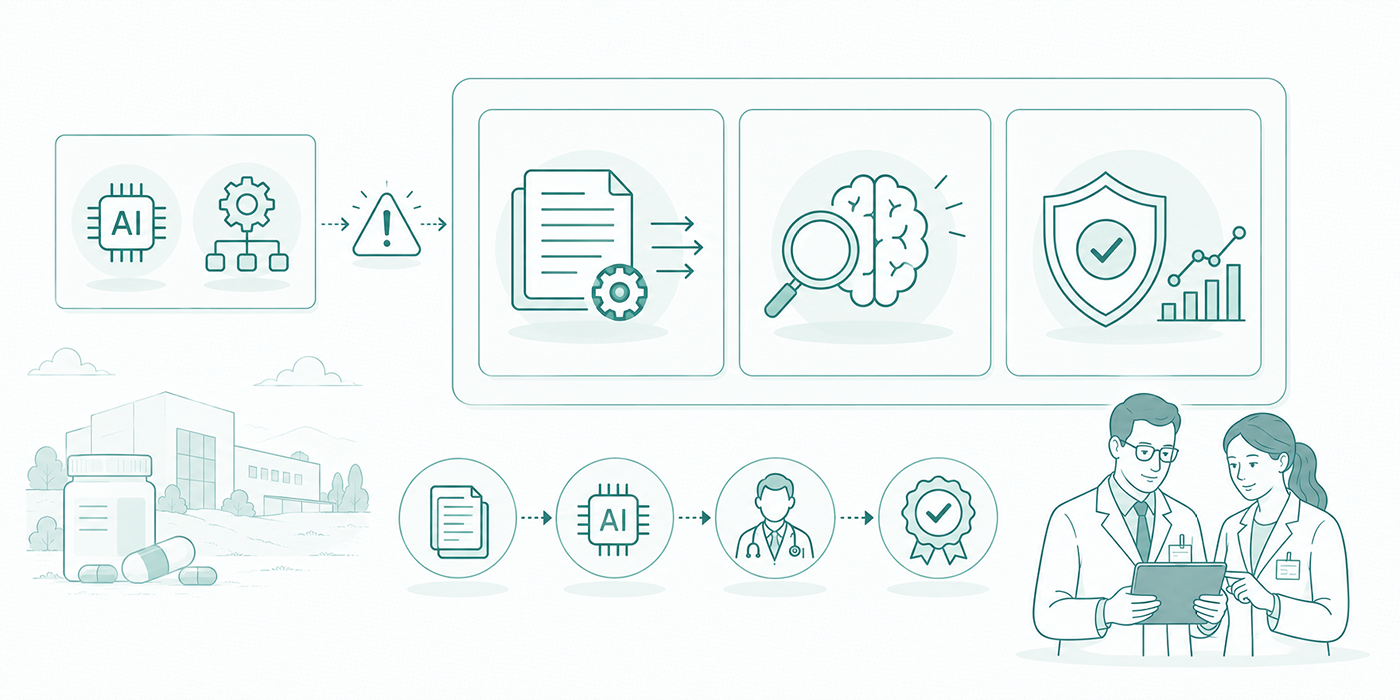
AI is already changing pharmacovigilance through automated case intake, data extraction, literature screening, narrative drafting, coding assistance, and signal workflows. The career risk sits unevenly across the field. Professionals whose value comes mainly from repetitive processing face stronger pressure, while expertise in global pharmacovigilance compliance, clinical-trial safety oversight, adverse-event reporting, and PV inspection readiness becomes more valuable as automation expands. The real career question is which portions of drug-safety work employers will still pay humans to own.
1. What AI Is Already Automating in Pharmacovigilance—and Where the Real Job Risk Begins
Pharmacovigilance contains exactly the kind of work automation handles well: large volumes of structured or semi-structured information, repeatable workflows, regulatory deadlines, coding systems, classification decisions, document comparison, and standardized outputs. That makes AI particularly relevant to professionals working with adverse-event reporting workflows, clinical safety data, data-integrity requirements, and global regulatory obligations.
The FDA's Emerging Drug Safety Technology Program says early adopters are already using emerging technology to automate adverse-event intake, data entry, and case processing, while exploring larger and more diverse datasets for safety surveillance. FDA has also stressed that expert human judgment remains essential for harder activities such as causality assessment.
EMA activity points in the same direction. Its 2026 work includes AI applications for literature screening, serious-report triage, ADR data extraction, AI-enhanced case adjudication, literature monitoring for signals, and knowledge extraction from previous safety reviews. EMA's multi-stakeholder forum emphasized ongoing human quality control and performance monitoring because AI outputs can still be inconsistent or wrong.
For someone processing ICSRs, that has immediate career implications. Tasks such as extracting patient information, identifying products, suggesting MedDRA terms, populating structured fields, finding duplicates, drafting initial narratives, and generating E2B information can increasingly be machine-assisted. Professionals who understand adverse-event compliance, clinical data integrity, quality-management principles, and PV audit requirements therefore need to understand how to supervise automation as well as execute the original workflow.
Narrative drafting is another exposed activity. EMA has described industry use of large language models to assist safety-case narratives, allowing human experts to concentrate more heavily on clinical interpretation and judgment. AI has also been used for extracting safety-report information and redacting personally identifiable information, with human review remaining part of the process.
This creates an important distinction for careers.
A Drug Safety Associate whose daily value comes from manually transferring predictable information between fields carries greater automation exposure. A professional who can identify contradictions in medical history, distinguish missing information from genuinely unavailable information, assess whether follow-up is worthwhile, recognize a potentially serious safety issue, and defend the case during an audit or inspection possesses harder-to-automate value.
Current employers are already building around that distinction. Regeneron recently advertised a senior ICSR-intake position responsible for AI-enabled intake tools, NLP, automated data ingestion, workflow automation, compliance, quality, and global safety operations. Amgen has advertised PV leadership responsible for advancing automation and AI across the safety ecosystem. Parexel is hiring AI engineers specifically to develop pharmacovigilance agents for source-document parsing, field extraction, coding suggestions, narrative drafting, causality logic, and E2B(R3) generation.
The emerging career divide therefore sits between executing a standardized safety workflow and owning its quality, exceptions, interpretation, governance, and improvement.
Someone building a career through pharmacovigilance certification, clinical research training, trial-safety expertise, or global PV compliance skills should optimize for the second category.
| PV Task | Automation Exposure | What AI Can Assist With | Human Value That Remains | Career Move |
|---|---|---|---|---|
| Case intake | High | Extraction, classification, routing | Exception handling and source interpretation | Learn adverse-event workflow logic. |
| Structured data entry | Very high | Field population and normalization | Validation of ambiguous or conflicting data | Develop data-integrity expertise. |
| Duplicate detection | High | Similarity matching across cases | Complex duplicate adjudication | Learn why duplication affects regulatory quality. |
| Reporter classification | High | Extracting profession and source type | Resolving incomplete source information | Build case-validity judgment. |
| Product extraction | High | Identifying suspect and concomitant products | Clinical interpretation of exposure | Strengthen medication and safety knowledge. |
| MedDRA coding suggestions | High | Candidate-term generation | Selecting the medically faithful concept | Practice coding judgment, not term memorization. |
| Initial narrative drafting | High | Chronology and summarization | Medical coherence and relevant-detail selection | Build stronger clinical safety interpretation. |
| Literature screening | High | Search triage and candidate identification | Borderline-case and reportability judgment | Learn scientific appraisal and documentation. |
| PII redaction | High | Automated entity recognition and masking | Quality verification and privacy governance | Gain compliance and system-validation skills. |
| Case routing | High | Prioritization and workflow assignment | Escalation of unusual safety scenarios | Learn global PV requirements. |
| Follow-up drafting | Moderate-high | Generating standardized questions | Determining which missing information matters | Develop clinical reasoning and communication. |
| Seriousness classification | Moderate-high | Rule-supported flagging | Ambiguous medical-context assessment | Master reporting criteria. |
| Expectedness support | Moderate | Reference-document comparison | Product-specific regulatory interpretation | Build regulatory-document expertise. |
| Causality assessment | Lower near-term | Evidence retrieval and suggestion | Clinical and scientific judgment | Develop medical-review depth. |
| Case quality control | Moderate-high | Automated discrepancy detection | Interpreting meaningful versus cosmetic errors | Study quality management. |
| E2B(R3) output generation | High | Structured message generation | Submission validation and exception resolution | Learn technical submission standards. |
| Reconciliation | High | Matching safety and clinical records | Investigating mismatches and missing cases | Pair safety knowledge with data integrity. |
| Signal screening | Moderate | Pattern detection and prioritization | Clinical interpretation and signal validation | Move toward safety science and analytics. |
| Signal validation | Lower | Evidence aggregation | Benefit-risk and clinical judgment | Build scientific-evaluation capability. |
| Aggregate-report drafting | Moderate | First drafts and evidence synthesis | Interpretation, argument, and regulatory accountability | Develop safety-writing expertise. |
| Benefit-risk assessment | Low-moderate | Evidence organization and trend surfacing | Clinical context and decision ownership | Strengthen medical safety expertise. |
| Inspection preparation | Moderate | Document retrieval and gap detection | Defending processes and decisions | Master PV inspection readiness. |
| CAPA investigation | Low-moderate | Pattern surfacing and documentation support | Root-cause and corrective-action judgment | Develop quality-system competence. |
| Vendor oversight | Low | KPI analysis and exception alerts | Accountability, escalation, negotiation | Build leadership skills. |
| Safety-system validation | Low | Test support and anomaly identification | Validation design and compliance judgment | Learn GxP technology governance. |
| AI model monitoring | Growing field | Automated performance metrics | Defining acceptable safety performance | Combine PV expertise with analytics. |
| AI exception review | Growing field | Flagging low-confidence outputs | Resolving edge cases safely | Become an automation-aware PV SME. |
| AI governance | Growing value | Monitoring support | Validation, accountability, compliance, auditability | Pair PV compliance with technology governance. |
| Safety strategy | Low | Evidence synthesis and scenario analysis | Accountable scientific decisions | Build strategic safety-science depth. |
| Regulatory inspection defense | Low | Evidence retrieval | Explaining why decisions and controls were appropriate | Develop inspection expertise. |
2. Which Pharmacovigilance Jobs Face the Highest Automation Risk?
The greatest pressure falls on roles where output can be standardized and quality can be measured against predictable rules.
That puts high-volume entry-level case-processing work near the front of the automation wave. Intake, field extraction, straightforward coding suggestions, standard narratives, duplicate screening, routing, literature triage, and basic reconciliation all contain substantial repeatability. Professionals whose resumes revolve almost entirely around these activities should deepen into global PV compliance, safety-case judgment, quality systems, and inspection readiness.
The likely effect can appear as headcount compression before full role elimination.
If ten case processors previously handled a given volume and AI doubles the amount each trained reviewer can safely manage, an organization may need fewer new hires even while keeping humans in the process. That creates a painful labor-market outcome: the occupation still exists, yet entry openings become scarcer and productivity expectations rise.
A May 2026 clinical-research Reddit discussion captured exactly this concern. Contributors argued that AI may allow companies to produce equivalent output with fewer people, and pharmacovigilance was specifically named among exposed functions. Other participants emphasized the continuing need for expert review because a single high-stakes error can carry enormous consequences.
This makes junior hiring especially important.
Historically, repetitive work often served as the apprenticeship through which a new Drug Safety Associate learned case structure, MedDRA, regulations, medical chronology, follow-up, narratives, and quality control. Automation can remove part of that apprenticeship. Someone pursuing pharmacovigilance certification, trying to break into clinical research, confronting the experience catch-22, or comparing certification with experience should therefore expect a higher competence bar.
Literature-surveillance positions also face significant pressure because AI can retrieve, classify, summarize, and prioritize large document sets efficiently. The remaining human value moves toward reportability decisions, scientific context, gap analysis, signal relevance, and defensible documentation. Those skills overlap strongly with clinical safety oversight, regulatory compliance, quality-management systems, and trial data integrity.
QC-only roles can experience similar pressure. Software can flag inconsistent dates, missing fields, duplicate information, coding mismatches, narrative inconsistencies, and improbable values. Human reviewers increasingly create value by deciding which discrepancies materially matter, determining root cause, and recognizing systematic process failures.
The safer end of the spectrum includes safety physicians, experienced signal scientists, PV quality professionals, inspectors and audit specialists, safety-system owners, AI-validation specialists, regulatory strategists, and leaders responsible for vendor or global-process oversight. These positions involve accountable judgment, ambiguity, cross-functional decision-making, inspection defense, or governance.
Current hiring activity already reflects that direction. Veeva is recruiting an AI-focused pharmacovigilance implementation consultant to help clients implement, validate, govern, and continuously monitor AI agents inside safety workflows. Amgen's PV operations leadership role combines safety-system performance, data integrity, inspection readiness, regulatory compliance, and AI adoption.
These are clues about where career value is moving.
3. Reddit Pharmacovigilance Pain Points Explain Why AI Feels Threatening Even Before Layoffs
The fear around AI makes more sense when viewed alongside existing pharmacovigilance working conditions.
In an April 2026 Reddit discussion about PV and AI careers, one professional described working 12–14-hour days simply to close cases, leaving little time for family, reskilling, process improvement, or career development. The same thread described a slow hiring market and limited visibility of dedicated “PV + AI” roles, while another contributor argued that AI capabilities are often being absorbed into existing PV Operations, Signal Detection, Safety Systems, Automation, and Compliance positions.
That creates a brutal career paradox.
The employees most exposed to automation may also be the people with the least time to prepare for it.
A processor buried in daily case volume cannot easily study global safety compliance, build audit expertise, understand clinical safety oversight, or deepen quality-management skills when every evening is spent recovering from production pressure.
Another Reddit thread from June 2026 focused on the divide between skills training programs advertise and skills employers actually value. The poster highlighted hands-on E2B(R3) submission experience, complex case narratives, literature gap analysis, signal-detection tools, and aggregate-report knowledge as more useful than merely listing theoretical guideline knowledge.
That observation matters even more in an AI-heavy environment.
When software can recall definitions instantly, the economic value of memorizing definitions falls. When software can draft standardized text instantly, the value of generic drafting falls. The employee becomes valuable through verification, interpretation, exception management, system understanding, and accountable decisions.
This is also why adding another generic certificate may fail to solve AI anxiety. Someone already holding pharmacovigilance certification may gain more career protection from mastering real safety workflows, inspection techniques, clinical safety judgment, and regulatory compliance.
The second pain point is outsourcing and cost pressure.
AI arrives in an industry that already measures case volumes, turnaround times, service-level agreements, quality rates, and labor costs closely. Automation gives employers another way to increase throughput per employee. The professional response should be to move closer to responsibilities where organizations cannot optimize purely on cost: inspection accountability, medical interpretation, difficult cases, vendor governance, signal decisions, regulatory strategy, safety-system ownership, and quality oversight.
4. The Drug-Safety Skills That Gain Value as AI Handles More Routine Work
The first skill gaining value is exception judgment.
Automated systems perform best when information resembles what they were designed to process. Career value rises when a case is messy: conflicting dates, multiple suspect products, an ambiguous hospitalization, incomplete medical history, contradictory reporter statements, a poorly described outcome, unusual causality, or a regulatory edge case. Someone who understands adverse-event reporting, clinical safety oversight, data integrity, and patient-safety principles can resolve those situations more safely.
The second is AI output validation.
A PV professional should increasingly know how to evaluate false positives, false negatives, extraction errors, hallucinated details, coding mismatches, narrative omissions, drift, confidence thresholds, and performance across different source types. FDA has repeatedly emphasized the need for human oversight, while EMA guidance highlights critical thinking, cross-checking, data security, and responsible AI use.
That makes quality expertise more valuable. Understanding clinical quality management, PV inspection requirements, global compliance, and data-integrity controls can position a safety professional to supervise the systems changing their function.
A third durable skill is signal interpretation.
AI can rank patterns, search large datasets, surface disproportionality signals, review literature, and aggregate evidence. Humans still need to decide whether the pattern is biologically plausible, clinically meaningful, confounded, already known, actionable, or worthy of further evaluation. This is the kind of scientific interpretation that can lead from operational case processing toward safety science, signal management, epidemiology, and benefit-risk work.
A fourth is regulatory judgment.
Rules vary by case source, region, product, seriousness, expectedness, study context, reporting pathway, and agreement. Understanding global pharmacovigilance compliance, clinical-trial adverse-event reporting, regulatory submissions, and inspection defense gives professionals a layer of decision-making authority that generic automation cannot easily replace.
The fifth is safety-system fluency.
Future PV professionals should understand how source channels, intake tools, safety databases, MedDRA coding, E2B(R3), literature platforms, signal systems, analytics, vendor feeds, and regulatory gateways connect. Recent roles at Amgen, Regeneron, Veeva, Novartis, and Johnson & Johnson explicitly combine PV knowledge with automation, safety platforms, AI, data governance, and system performance.
The sixth is governance.
Someone has to define what an AI tool may do, what requires human confirmation, how performance will be monitored, what error rates are acceptable, which populations or input types require additional testing, how model changes are controlled, how audit trails are maintained, and what happens when the system fails.
That work rewards people with both technology literacy and PV compliance expertise, quality-management ability, inspection readiness, and clinical safety knowledge.

5. How Entry-Level and Experienced PV Professionals Should Prepare for AI Now
Entry-level candidates should avoid competing with AI on its strongest terrain.
A resume built around “data entry, case intake, narrative writing, and literature screening” will become increasingly vulnerable unless those skills are paired with medical reasoning, quality, regulation, systems knowledge, and exception handling. Someone considering pharmacovigilance certification should prioritize training in adverse-event reporting, global PV compliance, safety oversight, and data quality.
Learn the full ICSR lifecycle. Understand what makes a report valid, how day zero is established, how seriousness differs from severity, where expectedness enters the process, how follow-up is prioritized, why coding accuracy matters, how narratives preserve chronology, how E2B(R3) works, and how quality checks detect meaningful failure.
Then learn where automation fits into that lifecycle.
For someone facing the entry-level experience catch-22, clinical research certification questions, or a broader attempt to break into clinical research, this produces a stronger interview position than claiming that AI knowledge alone makes you future-proof.
Mid-career professionals should audit their work differently.
Ask what percentage of your week involves production, what percentage involves judgment, and what percentage involves ownership.
If 80% of your time involves executing standardized case-processing steps, your priority should be moving toward complex-case review, compliance, signal management, aggregate reporting, PV quality, audits, system ownership, vendor oversight, analytics, or automation governance.
A professional experienced in PV audits and inspections, global regulatory compliance, clinical safety oversight, and quality-management strategy can become the person who decides whether an automated workflow is actually safe enough to use.
Managers should become fluent in automation economics.
If a tool reduces average case-processing time by 40%, management needs to know whether error rates changed, whether low-confidence cases are correctly routed, whether reviewers become complacent, whether critical information is systematically missed, whether performance differs by language or source type, whether system upgrades cause drift, and whether audit evidence remains defensible.
EMA and FDA now explicitly collaborate internationally on AI in pharmacovigilance, and EMA's current framework treats AI as a major medicines-lifecycle issue.
That gives PV professionals a clear direction: become qualified to judge the automation rather than merely being measured against it.
6. FAQs About AI, Pharmacovigilance Jobs, Automation Risk, and Career Skills
-
Full replacement across pharmacovigilance is unlikely in the near term because safety workflows include ambiguous medical information, causality questions, regulatory exceptions, quality accountability, and inspection risk. The more immediate pressure is higher productivity per employee and fewer people needed for standardized work.
FDA specifically identifies ICSR intake and processing as areas being explored for automation while emphasizing continued human expertise for nuanced assessments. Professionals should therefore build beyond routine processing into adverse-event judgment, clinical safety, quality management, and PV compliance.
-
High-volume ICSR intake, straightforward data entry, routine coding support, basic narrative drafting, literature triage, reconciliation, duplicate detection, and some first-pass QC activities have high exposure.
Career protection improves when someone can perform complex review, inspection preparation, global compliance work, clinical safety assessment, or quality-system oversight.
-
It can still be a strong pharmaceutical career, although the entry strategy needs to reflect automation. Beginners should expect employers to value applied case knowledge, medical terminology, regulatory understanding, systems familiarity, data quality, and judgment alongside formal training.
Candidates should use pharmacovigilance certification to build practical competence, understand the experience-versus-certification trade-off, address the entry-level experience problem, and build real adverse-event reporting knowledge.
-
You do not need to become a machine-learning engineer for most PV careers. You should understand what AI can automate, how to validate outputs, which errors matter, how performance is monitored, and how automation fits inside regulated workflows.
Professionals interested in systems, analytics, or transformation can go deeper. Current roles from Veeva, Amgen, Regeneron, Novartis, and Parexel show growing demand at the intersection of pharmacovigilance, AI, automation, governance, and safety systems.
-
High-value skills include medical judgment, causality reasoning, signal validation, benefit-risk interpretation, complex regulatory decisions, root-cause analysis, inspection defense, vendor oversight, system validation, governance, and communicating ambiguous risks to decision-makers.
Those capabilities strengthen when professionals combine clinical safety expertise, global PV regulation, quality systems, and audit readiness.
-
Automation can reduce repetitive work, although organizations may also use efficiency gains to increase case throughput per employee. The outcome therefore depends on staffing decisions, workflow design, validation requirements, and whether saved time is reinvested in higher-value safety work.
EMA has described AI use cases that could reduce manual work while emphasizing continued human oversight and quality monitoring. Employees can increase their leverage by becoming proficient in PV quality, global compliance, safety oversight, and automation governance.
