
Medical Science Liaison Career Without a PhD: Reddit Experiences, Degree Barriers & Alternative Paths That Employers Accept
A PhD remains one of the strongest credentials for entering Medical Affairs, yet it is only one route into a Medical Science Liaison career. Current MSL hiring shows meaningful alternatives for PharmDs, physicians, NPs, PAs, experienced master's-level clinicians, and occasionally bachelor's-level professionals with substantial Medical Affairs experience. The challenge is understanding which employers actually accept those alternatives and what experience must compensate for the missing doctorate.
For candidates already building clinical research experience, the degree question deserves a much more precise answer than “get a PhD.”

1. Can You Become a Medical Science Liaison Without a PhD? Understand What the Degree Barrier Really Means
The first distinction is crucial: “without a PhD” and “without a doctorate” describe very different applicants.
A PharmD, MD, DO, or other doctorate-level clinician already satisfies the advanced-degree expectation found in many MSL postings. Those candidates still need therapeutic-area expertise, scientific communication ability, and often meaningful clinical or research experience, yet the absence of a PhD itself creates little concern.
The harder category includes candidates with master's or bachelor's degrees.
The Medical Science Liaison Society describes MSLs as professionals with advanced scientific training whose credentials generally include PhD, PharmD, or MD degrees. Its 2022 global survey found that 77% of U.S. MSLs and 69% globally held doctorate degrees. That makes doctoral education the prevailing industry standard, especially for applicants entering Medical Affairs without extensive therapeutic-area experience, clinical research exposure, or established healthcare-provider relationships.
Current hiring practices are more flexible than the headline standard suggests.
An Amgen U.S. MSL opening posted August 31, 2026 lists three routes under basic qualifications: a doctorate; a master's degree plus three years of Medical Affairs experience; or a bachelor's degree plus five years of Medical Affairs experience. Its preferred qualifications still include PharmD, PhD, MD, or DO credentials, showing exactly how many employers structure the issue: an advanced doctorate improves competitiveness while substantial Medical Affairs experience can satisfy the formal minimum.
That same qualification structure appears in other current Amgen MSL postings, including oncology and senior oncology roles.
Clinical credentials can create another route. A current Johnson & Johnson Senior MSL posting accepts PharmD, PhD, MD, NP, or PA candidates with relevant neurology, immunology, or neuromuscular experience. A current Takeda U.S. Senior MSL posting prefers a doctoral degree while setting a master's-level health-sciences credential such as MSN, NP, or PA as its minimum educational requirement.
Those examples reveal what employers are really buying: enough scientific credibility to conduct sophisticated peer-to-peer exchanges with physicians, investigators, and healthcare decision-makers while operating within Medical Affairs compliance requirements.
The degree therefore functions partly as a risk-reduction signal.
A doctorate gives a hiring manager evidence that the applicant has already spent years learning how to evaluate scientific literature, discuss experimental design, defend interpretations, absorb complex evidence, and communicate with experts. Candidates without that signal need to demonstrate comparable credibility through clinical expertise, clinical research responsibilities, publications, teaching, conference presentations, investigator relationships, industry experience, Medical Affairs exposure, or deep therapeutic-area knowledge.
This is why an oncology PA with ten years of specialist practice occupies a completely different competitive position from someone holding a general master's degree and no clinical experience. The degree level may look similar on an ATS screen; the scientific credibility behind it is dramatically different.
2. Which Non-PhD Backgrounds Do MSL Employers Actually Accept?
The strongest alternative routes share one characteristic: they replace academic credential strength with another form of credible expertise.
NPs and PAs are particularly important examples. Their master's-level credentials may fall below the doctorate preference in many postings, yet years of specialist practice can give them something extremely valuable: direct knowledge of the patients, treatment algorithms, competing therapies, diagnostic challenges, unmet needs, and healthcare systems relevant to the therapeutic area.
A September 2026 Reddit post provides a current example. An NP working in clinical research at a major academic medical center reported landing an MSL role after roughly five years in the clinical/research position and several months of searching. The route makes sense because years of disease-area practice can support credible discussions around clinical evidence, patient safety, investigator responsibilities, and clinical trial operations.
Older Reddit discussions provide multiple similar examples involving PAs and NPs entering MSL teams through deep therapeutic-area experience. One PA reported colleagues in MSL roles without doctorates, while another contributor described a PA with years of dermatology and clinical-trial experience obtaining an MSL position. These remain individual experiences, so candidates should treat them as evidence of possible pathways rather than universal hiring rules.
Current employer requirements independently support the same pattern. Johnson & Johnson's recent Senior MSL criteria explicitly include NP and PA candidates alongside PharmD, PhD, and MD applicants when relevant therapeutic experience is present.
Master's-level scientists face a different challenge.
An MSc can demonstrate scientific training, research design experience, literature evaluation, and technical depth. The candidate still needs to establish the peer-level clinical credibility required for external scientific exchange. A master's-level professional with strong clinical research experience, investigator interaction, regulatory knowledge, and scientific communication experience becomes much more defensible than someone entering immediately after graduate school.
That distinction explains why Reddit advice to master's students often sounds harsh. In a late-2025 discussion, a Medical Science master's student with little clinical experience asked about MSL entry. Contributors emphasized the difficulty of breaking into U.S. and Canadian MSL roles with that combination, while also noting that experienced NPs and PAs can sometimes transition because their clinical expertise changes the equation.
Current postings show that the barrier is real without being absolute. Amgen accepts a master's degree plus three years of Medical Affairs experience for multiple U.S. MSL openings. BioMarin advertised a 2026 U.S. MSL position requiring a master's in science while listing a terminal doctorate as preferred.
A bachelor's-only pathway exists at the experienced end of the market as well. Amgen's current basic qualifications explicitly provide a bachelor's-plus-five-years-of-Medical-Affairs route. A September 2026 bioMérieux MSL Lead listing required a bachelor's degree plus six years of relevant clinical, laboratory, or healthcare experience. Boston Scientific also advertised a U.S. MSL role requiring a bachelor's degree plus at least five years in a clinical, medical, or scientific position involving regular HCP interaction.
The employer, product type, therapeutic area, and geography therefore matter enormously. Pharmaceutical MSL teams in complex oncology or rare disease may enforce doctoral credentials much more heavily than some diagnostic or medical-device teams. Candidates should build role-specific clinical research experience, Medical Affairs compliance knowledge, scientific presentation skills, and therapeutic-area expertise around the actual segment they intend to enter.
3. What Reddit MSL Success Stories Reveal About Breaking In Without the Perfect Degree
Reddit MSL discussions repeatedly expose the same hiring reality: the first MSL position is the hardest transition because employers are simultaneously assessing scientific credibility, field readiness, therapeutic knowledge, communication ability, and the risk of hiring somebody who has never performed the role.
The degree becomes one convenient screening mechanism.
A May 2026 Reddit success post from a clinical PharmD who landed an MSL job after a difficult search emphasized ATS-readable résumé formatting, job-description keywords, referrals, intensive preparation at every interview stage, and presentation preparation. The PharmD credential cleared the educational hurdle; the candidate still had to prove the rest.
That experience matters for non-PhD candidates because removing the PhD does not remove the remaining barriers. An applicant still needs evidence of clinical expertise, scientific communication, clinical-research literacy, regulatory compliance, and confident external engagement.
The most successful alternative path is often therapeutic-area matching.
A psychiatry PA should initially target psychiatry or neuroscience MSL roles. An oncology NP should prioritize oncology. A dermatology PA with years of clinical practice already understands treatment sequencing, real-world patient challenges, physician concerns, and the expert landscape in a way that can compensate for part of the academic-degree gap.
This is also why clinical research experience can be so powerful. A CRC who has supported investigators, handled protocol adherence, managed trial documentation, participated in adverse-event reporting, and communicated with sponsors understands parts of the scientific ecosystem an MSL operates within.
An experienced CRA can build an even stronger bridge. On-site and remote monitoring, investigator relationships, protocol interpretation, site problem-solving, sponsor communication, and understanding CRO versus sponsor environments provide substantial industry context. The remaining task is proving field-medical scientific exchange rather than operational monitoring.
Medical Information, Clinical Scientist, Medical Affairs Associate, HEOR, RWE, scientific communications, and clinical-development roles can also function as bridges. They build experience interpreting evidence, responding to scientific questions, working within regulated communication requirements, understanding clinical development, and collaborating with internal medical teams.
Candidates with bachelor's or master's degrees should pay particular attention to internal mobility. Getting hired directly into an MSL position requires one hiring manager to overlook a credential disadvantage before seeing your performance. Joining a company in an adjacent scientific function gives colleagues direct evidence of your judgment, work quality, therapeutic knowledge, and cross-functional communication.
That can materially change the conversation when a field-medical opening appears.
4. What MSL Employers Screen for When You Do Not Have a PhD
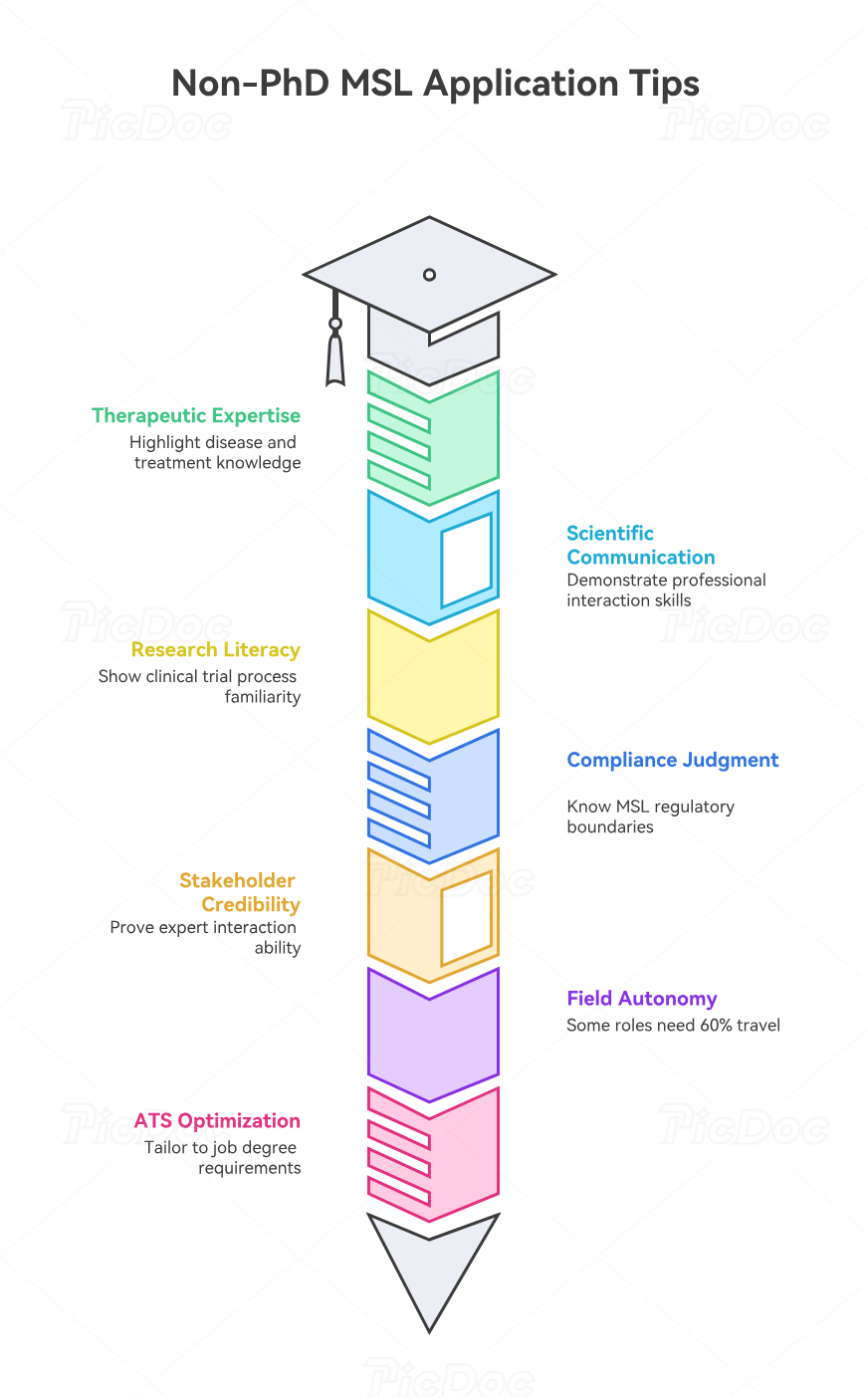
A non-PhD applicant needs to make the compensating evidence obvious within seconds.
The first category is therapeutic-area expertise. Employers want someone capable of discussing disease biology, treatment pathways, landmark trials, current guidelines, pipeline developments, competing therapies, evidence limitations, and unresolved scientific questions with specialists. Years spent treating the same patient population can create tremendous value when the applicant can connect clinical experience with evidence interpretation, patient safety, clinical research methodology, and ethical research conduct.
The second is scientific communication. An MSL may need to explain complicated trial findings to leading clinicians, respond to challenging questions, discuss limitations without overstating conclusions, present scientific decks, support congress activity, capture field insights, and communicate those insights internally. Current Amgen MSL responsibilities explicitly include in-depth scientific exchange, interaction with investigators, congress activities, field insights, and relationships with opinion leaders.
Candidates should therefore document presentations to clinicians, journal clubs, conference presentations, publications, teaching, advisory-board participation, medical education, investigator meetings, or other examples demonstrating high-level professional communication.
The third is clinical research literacy. MSLs frequently interact with investigators and support research-related activities, which makes familiarity with investigator responsibilities, clinical trial monitoring, protocol requirements, trial data integrity, and clinical trial site operations valuable.
The fourth is compliance judgment. Medical Affairs operates under strict boundaries surrounding scientific exchange, unsolicited requests, off-label information, adverse-event reporting, promotional separation, documentation, and internal procedures. Understanding MSL regulatory compliance, adverse-event reporting, patient-safety principles, and quality-management systems makes an applicant safer to hire.
The fifth is external stakeholder credibility. MSL hiring managers need evidence that you can enter a room with physicians, researchers, pharmacists, and other experts and contribute meaningfully. Existing relationships with specialists, investigators, academic centers, professional societies, or clinical networks can become a substantial advantage.
The sixth is field autonomy. MSLs manage territories, extensive travel, competing stakeholder priorities, congresses, internal projects, CRM documentation, preparation, follow-up, and changing strategic needs. Current Amgen and J&J listings describe travel levels around 60% for some territories. That makes examples involving project coordination, team leadership, trial logistics, and independent stakeholder management useful.
Finally, optimize for ATS reality. Search the educational section before spending twenty minutes tailoring an application. A posting that explicitly requires PharmD, MD, or PhD may create an automatic screen. A posting listing “advanced degree preferred,” “master's minimum,” or experience-based alternatives deserves a different level of attention.
This targeted approach is particularly important for candidates already facing the broader clinical research experience Catch-22. Fifty applications to roles whose formal requirements exclude your profile create far less value than ten applications where your experience directly matches the educational exception.
5. Should You Get a PhD Just to Become an MSL?
A PhD represents several years of research training, opportunity cost, intellectual work, and career specialization. The decision deserves a broader justification than access to one job title.
The doctorate can be extremely valuable for someone who genuinely wants advanced scientific training, independent research experience, publication depth, disease-mechanism expertise, experimental-design mastery, and access to careers where those capabilities matter. Those strengths also translate beautifully into clinical research, Medical Affairs, clinical development, translational science, and evidence-generation roles.
Candidates considering a PhD primarily because an MSL role sounds attractive should compare the alternative timeline carefully.
Imagine an experienced PA in immunology. Three or four additional years spent obtaining another degree may strengthen the educational line. The same period spent participating in clinical research, presenting at conferences, becoming involved with investigators, publishing, building relationships with current MSLs, and targeting immunology positions can strengthen therapeutic credibility, clinical-trial exposure, scientific communication, and Medical Affairs readiness.
Reddit experiences reinforce this tradeoff. A 2025 discussion involving a PA with many years of allergy/immunology experience included MSL professionals who described PA and NP colleagues successfully entering the role, often through deep specialty experience and networking. One contributor reported entering MSL work as a PA after extensive dermatology practice and clinical-trial involvement.
Candidates with a general master's degree and little clinical experience face a different calculation. Current industry evidence suggests that direct MSL entry is substantially harder from that starting point. A bridge through clinical research roles, CRA development, Medical Information, Clinical Scientist, Medical Affairs, HEOR, RWE, or scientific communications can provide a faster test of industry fit before committing to years of additional education.
Certification deserves the same scrutiny. The MSL Society's MSL-BC credential requires at least one year of full-time MSL or equivalent experience and explicitly excludes aspiring MSLs from eligibility. Someone trying to break into the profession should therefore focus on the same principle that applies to clinical research certification ROI: identify the hiring gap first and invest only in training that genuinely helps close it.
For many non-PhD candidates, the highest-return question is:
What can I build over the next 12 months that makes my existing degree matter less?
That may be therapeutic-area depth, clinical research experience, publications, investigator relationships, presentations, Medical Affairs exposure, direct HCP engagement, or an internal pharmaceutical-industry move.
That is a much more useful career question than collecting credentials without a defined hiring problem.
6. FAQs About Becoming a Medical Science Liaison Without a PhD
-
A PhD is a common and highly valued MSL credential, while several other educational routes are accepted.
Current employers provide concrete examples. Amgen lists a doctorate, a master's plus three years of Medical Affairs experience, or a bachelor's plus five years of Medical Affairs experience as alternative basic qualification paths for current U.S. MSL roles. Johnson & Johnson currently accepts PharmD, PhD, MD, NP, or PA backgrounds for a Senior MSL opening when relevant experience requirements are met.
Applicants should combine the strongest available credential with clinical expertise, Medical Affairs compliance knowledge, research literacy, and scientific communication ability.
-
Yes, selected employers accept master's-level candidates, particularly when significant relevant experience accompanies the degree.
Takeda's current U.S. Senior MSL requirements list a master's in health sciences such as MSN, NP, or PA as the minimum, with a doctoral degree preferred. Amgen uses a master's-plus-Medical-Affairs-experience route in several current postings.
The strongest master's-level candidates usually bring substantial therapeutic-area experience, clinical research knowledge, investigator exposure, publications, scientific presentations, or direct Medical Affairs experience.
-
Yes. Current hiring evidence and MSL career reports show PA routes into field Medical Affairs.
J&J explicitly includes PA applicants in current Senior MSL qualifications. Reddit discussions also contain multiple PA examples, including professionals who transitioned after extensive dermatology, psychiatry, immunology, or other specialty experience.
A PA has the strongest positioning when targeting the same therapeutic area they already know clinically and when they can discuss trial evidence, patient safety, clinical research, and regulatory boundaries confidently.
-
Some employers accept experienced master's-level NPs, and current real-world examples demonstrate that pathway.
A September 2026 Reddit poster described moving from an NP clinical-research role at an academic medical center into an MSL position after roughly five years of relevant experience. Takeda also lists master's-level NP qualifications within its minimum educational criteria for a current Senior MSL position.
Specialty depth, clinical trial exposure, safety knowledge, scientific presentations, publications, research involvement, and existing specialist relationships can materially strengthen an MSN-level application.
-
Yes, experience-based exceptions exist and are visible in current hiring.
Amgen accepts a bachelor's degree plus five years of Medical Affairs experience under the basic qualifications for current MSL postings. Boston Scientific advertised a 2026 MSL position requiring a bachelor's degree plus at least five years of clinical, medical, or scientific work involving frequent HCP interaction.
That route typically requires a substantial record of industry experience, clinical expertise, scientific communication, and stakeholder relationships.
-
The strongest bridge roles are those that build scientific credibility, industry context, and external stakeholder exposure.
Useful paths can include Clinical Scientist, Medical Information, Medical Affairs Associate, scientific communications, HEOR, RWE, experienced CRA work, field clinical specialist roles, clinical education, and specialized clinical-research positions. A candidate moving through CRC or CTA work can build protocol knowledge, site experience, data-integrity experience, and investigator relationships before moving closer to Medical Affairs.
