
Managing Adverse Event Reviews: Medical Monitor’s Essential Guide
Managing adverse event (AE) reviews is where medical judgment meets regulatory reality. A medical monitor isn’t just “reviewing safety”—they’re preventing avoidable protocol deviations, keeping sites aligned, protecting patient welfare, and making sure every safety decision is defensible under inspection. If your process is slow, inconsistent, or undocumented, you don’t just risk findings—you risk delayed action on real signals. This guide breaks AE review into an execution system: what to verify, how to decide seriousness/causality/expectedness, how to communicate, and how to stay audit-ready.
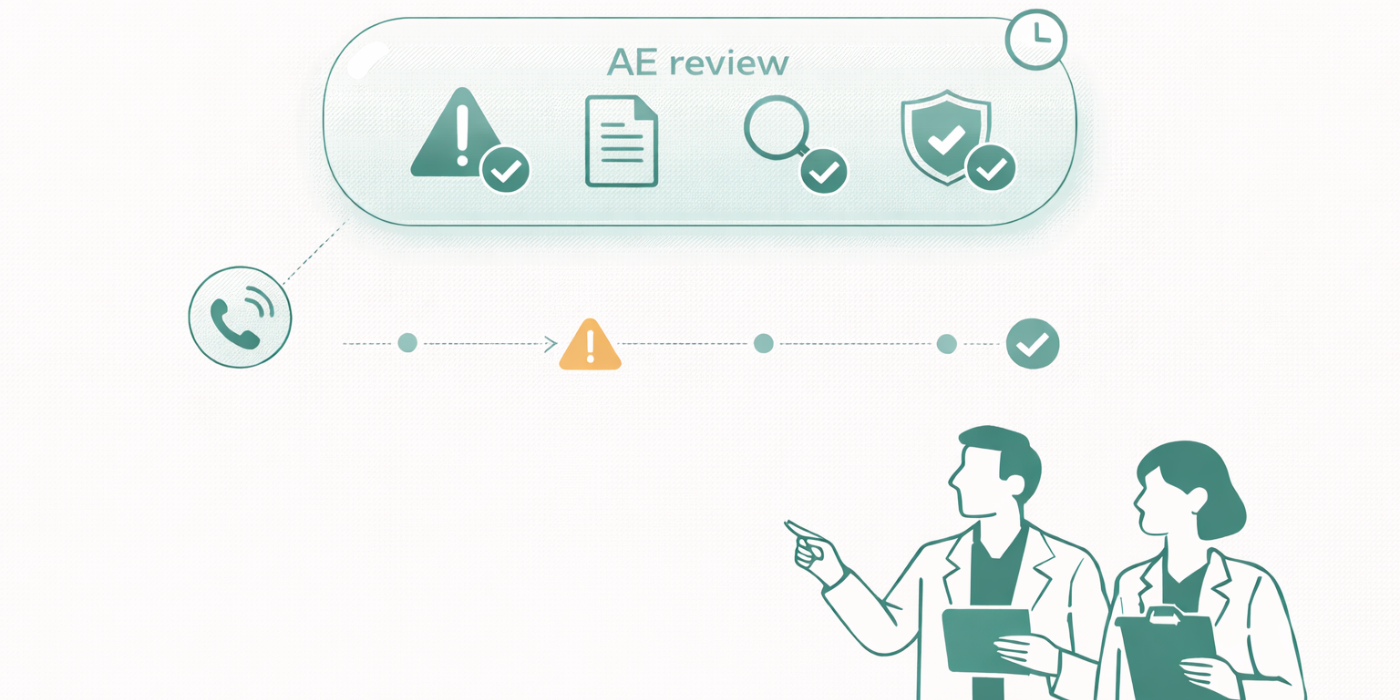
1. The Medical Monitor’s AE Review Job: What “Good” Actually Looks Like
AE review becomes fragile when the medical monitor is treated like a last-step “sign off.” Your job starts earlier: shaping how the study defines, captures, escalates, and closes events—so downstream AE reporting is consistent and defensible (and doesn’t collapse under queries). Your north star is patient safety oversight with a paper trail that stands up to inspection, aligned with GCP thinking and sponsor expectations (patient safety oversight in clinical trials).
Here’s what elite AE review looks like in practice:
Define the review scope up front: What the medical monitor reviews in real time vs periodic review vs signal detection meetings, and how that ties to the protocol’s safety section and escalation rules (clinical trial protocol management).
Control the “data inputs”: If AE source capture is sloppy, your review becomes guesswork. Align AE review with documentation discipline, including consistent note structure and traceable source-to-CRF mapping (managing study documentation, case report form best practices).
Stop preventable errors before they become regulatory problems: Missing onset dates, vague diagnoses (“felt bad”), absent severity grades, or inconsistent seriousness criteria create rework and late submissions—exactly what regulators punish (drug safety reporting timelines & requirements).
Be consistent in medical judgment: Causality and expectedness aren’t vibes. They require a repeatable logic path supported by protocol, IB/SmPC, patient history, labs, and temporal plausibility—documented in a way that a reviewer can understand months later (adverse event handling guidelines).
Build inspection-ready safety governance: Safety doesn’t live only in individual cases; it also lives in committees, trending, and escalation routes (Data Monitoring Committee roles, aggregate reports in pharmacovigilance).
A harsh truth: most AE “delays” are not caused by workload. They’re caused by unclear definitions, inconsistent documentation, missing minimum clinical details, and indecisive escalation pathways. Fix those and you get faster reviews and stronger safety.
2. The AE Review Workflow: Intake → Medical Judgment → Follow-Up → Closure
An AE review workflow fails when it’s treated as “read and approve.” The medical monitor needs a repeatable sequence with tight handoffs and evidence-based checkpoints that map directly to safety reporting expectations (managing adverse event reviews, drug safety reporting timelines).
1) Intake triage: decide the lane immediately
Within minutes of seeing a new AE, you should know which lane it belongs to:
Routine AE (standard documentation + periodic medical review).
Priority AE (needs rapid clarification because it may be serious, special interest, or plausibly related).
Escalation AE (potential SAE/SUSAR/AESI/death/unblinding/urgent risk).
This triage only works if AE capture is aligned with the minimum dataset and source-quality discipline—otherwise triage becomes guesswork and delays explode (CRF best practices, managing study documentation).
Minimum clinical dataset you should require for every AE (even “minor”):
Clear event term (ideally diagnosis when possible) + context
Onset date/time, stop date/time (or ongoing)
Severity (grade) and seriousness (criteria) clearly separated
Action taken with IP (none/held/reduced/discontinued)
Treatment given and response
Outcome and sequelae
Concomitant meds and relevant history
Relevant tests (labs/vitals/imaging) and what they showed
If that dataset isn’t present, your fastest “medical” move is not judgment—it’s high-quality queries that force the missing facts into the record.
2) Follow-up strategy: ask for records, not opinions
Sites often respond to queries with interpretations (“probably unrelated”). That’s noise. You need objective data: discharge summaries, imaging impressions, lab panels, ED notes, consult notes, and a chronology. Your aim is to turn a story into a defensible timeline aligned to protocol exposure windows (clinical trial protocol management).
A useful follow-up request always includes:
A list of exact documents (not generic “more info”)
A deadline aligned with reporting windows
A target question (what decision the missing info will change)
A reminder to maintain confidentiality and avoid patient identifiers in free text (keep it compliant with good documentation habits under GCP expectations) (GCP compliance essentials for CRAs, GCP compliance for CRCs).
3) Closure: your review isn’t “done” until contradictions are gone
AEs get “closed” in systems while contradictions remain—different dates in narrative vs CRF fields, seriousness checked without evidence, or outcome recorded as “recovered” with ongoing treatment. Those contradictions are inspection magnets because they look like uncontrolled data processes (clinical trial auditing & inspection readiness).
A closure standard should require:
Narrative and CRF fields reconciled
Clear rationale for seriousness/relatedness/expectedness decisions
Follow-up status explicit (complete vs ongoing with next data due)
Escalations logged with timestamps and recipients
Any late reporting addressed (deviation/CAPA if applicable)
3. Medical Judgment Done Right: Seriousness, Causality, Expectedness, and Risk
Medical monitors get paid for judgment—but judgment has to be structured. If your rationale can’t be explained cleanly, it’s not defensible. Your job is to make decisions consistent across cases, sites, and time, so safety reporting and aggregate analyses don’t get contaminated by inconsistent logic (pharmacovigilance essentials, aggregate reports step-by-step).
Seriousness vs severity: the classic failure point
Severity = intensity (mild/moderate/severe; or graded scales).
Seriousness = regulatory criteria (death, life-threatening, hospitalization, disability, congenital anomaly, other medically important condition).
A common failure: a “severe headache” is coded as serious because it sounds bad. But seriousness depends on criteria and evidence. Conversely, a “moderate” event might be serious if it caused hospitalization. Your review must explicitly separate these two concepts and document the reasoning (adverse event reporting techniques for CRCs).
Causality: build a repeatable logic path
Instead of “related/unrelated,” force yourself into a structured causality narrative:
Temporal relationship (onset relative to exposure)
Dechallenge/rechallenge (did it improve when drug stopped? recur when restarted?)
Biologic plausibility (mechanism, class effect, known pharmacology)
Alternative etiologies (disease progression, infections, procedures, interactions)
Objective evidence (labs, imaging, specialist notes)
That structure protects you from inconsistent decisions and helps your PV team produce higher-quality narratives and submissions (mastering regulatory submissions in pharmacovigilance).
Expectedness: always anchor to the correct reference
Expectedness is not “have I seen this before?” It is “is this described in the current reference safety information (e.g., IB/SmPC) in a way that matches the clinical phenotype and severity/seriousness?” A sloppy expectedness decision can misroute reporting and create regulatory exposure (drug safety reporting timelines).
Risk thinking: individual case vs emerging signal
One AE can be alarming and still not be a signal; a pattern of borderline events can be a signal and still be missed. Your job is to connect individual review to signal awareness—especially for AESIs, clustered events, or events with plausibility that “feels small” until frequency rises (DMC roles, aggregate reports).
4. Documentation & Communication That Survives Audits (and Prevents Rework)
Most AE review pain is not the medical decision—it’s the documentation and communication around it. If your safety narrative is unclear, your PV team can’t submit confidently, your CRAs can’t monitor effectively, and your sponsor’s safety governance becomes slow and defensive (clinical trial documentation for CRAs).
Write narratives like an inspector will read them cold
A strong AE narrative is not long. It’s complete, chronological, and decision-oriented:
What happened: symptom/diagnosis + context
When it happened: onset → peak → resolution timeline
What was done: investigations, treatment, IP actions
What changed: response to intervention, follow-up findings
What you decided: seriousness, causality, expectedness + why
What’s next: follow-up plan or closure rationale
If your narrative can’t be summarized into 6–10 lines without losing meaning, it’s probably missing structure. If it’s 2 lines long, it’s probably missing evidence.
Communication: stop spraying messages; route decisions through a system
High-performing studies don’t rely on ad hoc emails. They use routing logic:
Site ↔ CRC for missing data and source alignment (CRC responsibilities)
CRA ↔ site for monitoring follow-up and documentation reconciliation (CRA roles and skills)
Medical monitor ↔ PV for reportability, SUSAR triage, and narrative quality (pharmacovigilance guide)
Medical monitor ↔ sponsor safety governance/DMC for patterns, AESIs, or risk updates (DMC roles)
Your communications should always create artifacts: escalation logs, decision memos, and traceable timestamps. No artifact = no defense when questions come later.
Query writing: the fastest way to “upgrade” site performance
Bad queries create slow studies. Good queries train sites.
A high-value query:
Specifies exactly what’s missing (not “please clarify”)
States why it matters (which decision it affects: seriousness, relatedness, expectedness)
Requests objective evidence (specific documents/tests)
Sets a deadline aligned with reporting requirements (drug safety reporting timelines)
Over time, sites submit better AEs because your queries set expectations. That’s how medical monitors reduce workload without “working faster.”

5. Building an Inspection-Ready AE Review System: Metrics, Governance, and Failure-Proofing
If your AE review exists only as case-by-case decisions, you’ll eventually get hit by the same failure modes: inconsistent causality, late follow-ups, messy narratives, and escalation confusion. You need system-level controls.
1) Governance: define who decides what, and when
Clarify decision rights:
Site investigator provides clinical context and initial assessment (PI ethical responsibilities)
Medical monitor ensures consistency, triage, escalation, and benefit-risk framing (AE handling for PIs)
PV ensures reportability pathways and regulatory submissions are correct (PV submissions mastery)
DMC/safety governance addresses emerging patterns and risk management (DMC roles)
When governance is unclear, everything becomes personal judgment—and that’s when studies become inconsistent and slow.
2) Metrics that actually matter (and drive fixes)
Track metrics that identify failure modes early:
Time to first medical review (not just time to closure)
Follow-up cycle time (how long records/labs take)
Re-open rate (cases “closed” then reopened due to contradictions)
Query density per AE (high density = poor intake quality)
Seriousness reclassification rate (training gap indicator)
Narrative completeness score (simple checklist audit)
Then use those metrics to target training and process changes—especially for CRCs and CRAs who shape the quality of the upstream data (GCP compliance for CRCs, GCP compliance essentials for CRAs).
3) Audit readiness: assume everything will be questioned later
Auditors don’t only ask “what did you decide?” They ask:
When did you know?
What did you do next?
What evidence supported your judgment?
Was the process consistent across sites?
Were timelines met and documented?
Your best defense is a process that makes correct documentation the default—then your team doesn’t scramble when inspections arrive (clinical trial auditing & inspection readiness).
6. FAQs: Managing Adverse Event Reviews as a Medical Monitor
-
Missing minimum clinical details at intake. When onset, exposure actions, objective findings, and outcome aren’t documented cleanly, every case turns into multiple query cycles. Fixing intake quality (and narrative standards) reduces workload more than “reviewing faster,” and aligns directly with solid documentation practice (CRF best practices).
-
Use a required decision tree: (1) severity grade, (2) seriousness criterion with evidence, (3) documentation artifact. Train CRCs and CRAs to recognize the difference and enforce it at reconciliation—before it reaches medical review (essential AE reporting techniques for CRCs, CRA documentation techniques).
-
Use a repeatable structure: temporal relationship, dechallenge/rechallenge, biologic plausibility, alternative etiologies, and objective evidence. If you can’t cite which elements support the conclusion, your rationale is weak—even if your conclusion is correct. Tie your approach to pharmacovigilance expectations so downstream submissions are clean (pharmacovigilance guide).
-
When there’s a plausible risk change, clustering of events, AESIs trending upward, serious/unexpected patterns, or protocol/ICF implications. Escalation should be logged with timestamps and decisions, not handled informally, and it should connect case-level reviews to aggregate thinking (DMC roles, aggregate reports in PV).
-
Enforce reconciliation: narrative matches CRF fields, seriousness/expectedness decisions have explicit evidence and references, and follow-up status is either complete or has a dated plan. Re-openings usually come from contradictions and missing artifacts—both preventable with closure checklists and monitoring alignment (clinical trial auditing & inspection readiness).
-
Write queries that teach: specify missing facts, request objective documents, state why the info matters, and set deadlines aligned to reporting requirements. Over time, sites preemptively include the required details because they learn what “acceptable” looks like—reducing queries and speeding reviews (drug safety reporting timelines).
