Managing Study Documentation: Essential RA Skills
Managing study documentation is where great Regulatory Affairs (RA) talent quietly separates from “paper pushers.” If you can build a documentation system that survives pressure—protocol amendments, site churn, vendor handoffs, late safety intel, shifting endpoints—you become the person sponsors trust with timelines and inspection outcomes. This guide breaks down the essential RA documentation skills that prevent missing signatures, wrong versions, inconsistent endpoints, TMF gaps, and audit panic—without risking confidentiality. Along the way, we’ll connect documentation decisions to GCP, protocol control, AE reporting, and inspection readiness so your work translates into real career leverage.
1) Study documentation is your risk-control system (not admin work)
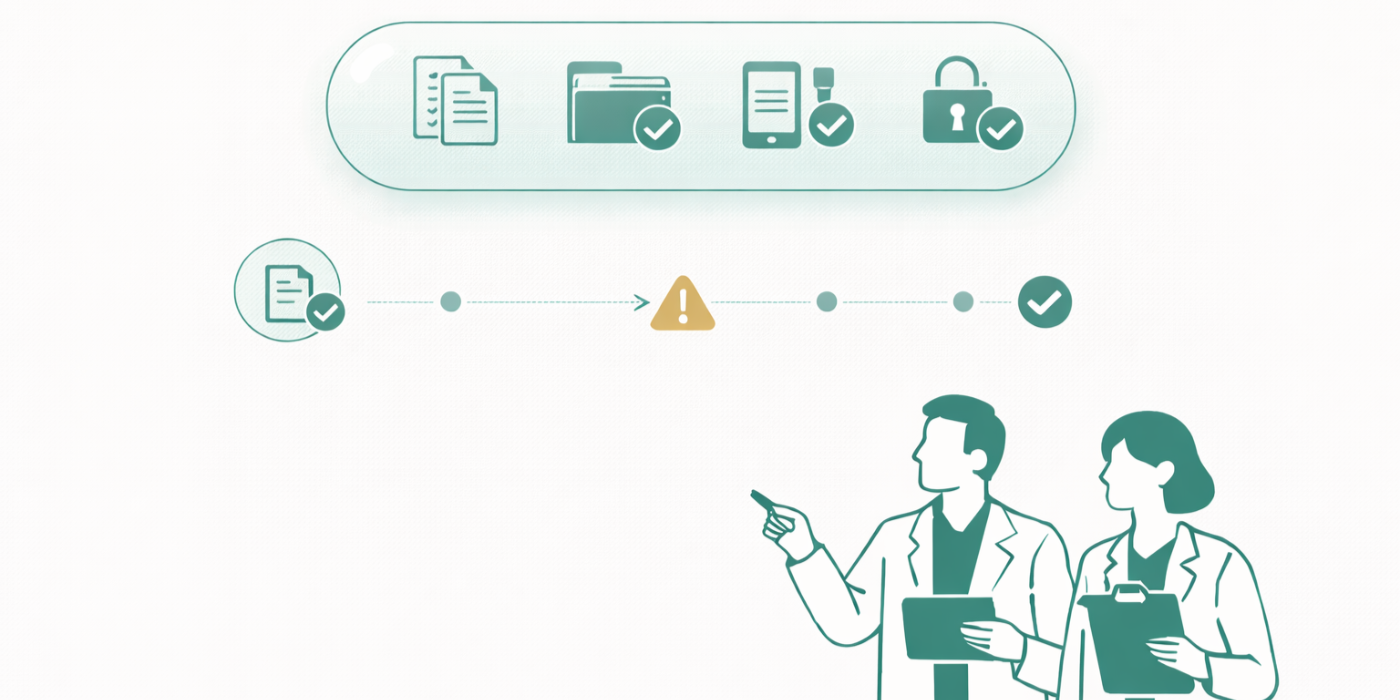
RA documentation isn’t about “keeping files.” It’s about controlling regulatory risk while speed, uncertainty, and multiple stakeholders collide. The sponsor, CRO, sites, and vendors all generate artifacts—but RA owns the logic and defensibility of the documentation story.
Here’s what hiring managers and study leaders watch for when they assess RA documentation maturity:
Traceability: Can you trace why a decision was made, who approved it, which version was active, and what downstream documents must match? This becomes critical when endpoints evolve (see primary vs secondary endpoints) or when the trial design uses tight controls like randomization and blinding.
Consistency under change: Protocol amendments ripple into ICFs, manuals, eCRFs, monitoring plans, safety plans, vendor specs, and training. If your documentation system can’t absorb change, you create invisible noncompliance.
Inspection-readiness by default: If you’re “planning to clean up later,” you’re already behind. Real RA skill is making everyday documentation decisions that make inspections boring (tie your approach to ICH guidelines, IRB roles, and study governance).
Quality signals: The best RAs don’t just store documents; they prevent “preventable deviations” by using documentation to clarify responsibilities and workflows—especially across CRC/CRA/PM handoffs (see CRC responsibilities and CRA roles).
If you’ve ever been blamed for a missing signature page, a wrong protocol version at a site, a misaligned endpoint definition, or a TMF artifact that didn’t exist when auditors asked—this is what you’re feeling: documentation is a risk system. And RA is the system designer.
| Documentation Area | Best For | What “Good” Looks Like | Risks / Failure Modes | How RA Wins Inside It |
|---|---|---|---|---|
| Protocol master & history | Start-up, amendments | Single source of truth; locked effective dates; full change log | Sites use wrong version; downstream documents drift | Release gates + amendment impact map + required training evidence |
| Protocol synopsis alignment | Feasibility, onboarding | Synopsis fields auto-match protocol (endpoints, visits, eligibility) | Synopsis becomes “alternate protocol” | Field-level cross-checks + synopsis refresh at each amendment |
| Investigator’s Brochure (IB) control | Safety updates, site readiness | Distribution log + site acknowledgements + archive of superseded IBs | Outdated IB at site; missing acknowledgment | Controlled distribution lists + “read/ack” tracker + escalation thresholds |
| Informed Consent Form (ICF) version set | Activation, re-consent | IRB-approved version + implementation date + re-consent criteria documented | Wrong consent used; re-consent missed | Activation gates: IRB approval → site training → go-live confirmation |
| IRB/IEC approval tracking | All patient-facing activity | Central tracker with expiry dates and submission/renewal status | Lapsed approval; unapproved materials used | Expiry dashboard + stop-work triggers + escalation timeline |
| Patient-facing materials library | Recruitment, retention | Only IRB-approved materials accessible; version stamps | Old flyers/scripts re-used | Locked “approved-only” folder + retirement of superseded items |
| Site Regulatory Binder / eBinder map | Site setup, audits | Standard binder index + where each artifact must live + owner | Documents exist but are not findable | Binder template + monthly binder health checks |
| Delegation of authority log | Initiation, turnover | Tasks mapped to roles; dates match training & access rights | Tasks done by non-delegated staff | Delegation ↔ training ↔ system access triad enforced |
| Training matrix (role-based) | Before task execution | Role-to-task mapping; targeted re-training on amendments | Training exists but irrelevant or incomplete | Micro-training modules + proof requirements per critical task |
| Training evidence (signatures/attestations) | Inspection readiness | Version-specific training tied to effective date | “Trained” claim without proof | Audit-ready training packets + retrieval within 2 minutes |
| Investigator CVs & licenses | Start-up, renewals | Current CV + valid license + tracked expirations | Expired license unnoticed | Expiry alerts + periodic verification cadence |
| Site staff qualification records | High-risk procedures | Competency evidence stored for task-critical roles | Unqualified staff performs key tasks | Qualification checklist + delegation constraints until completed |
| Regulatory submission package checklist | Milestones (initial, amendments) | Jurisdiction-specific completeness + QC signoff | Missing component; submission delays | Submission QC gates + “ready-to-submit” proof bundle |
| Essential correspondence log | Decision traceability | Key decisions captured with date, approver, rationale | Verbal decisions disappear | Decision memo discipline + link decisions to impacted artifacts |
| Amendment impact map | Change control | List of every downstream doc/training/system affected | Protocol changes but ICF/CRF/manuals don’t | Impact map + owner + due date + implementation evidence |
| Vendor manual version control (lab/IRT/imaging) | Site activation, changes | Current manual + distribution acknowledgment + archive | Old manual in circulation | Controlled release + “superseded” retirement + site confirmation |
| Vendor deliverables tracker (SOW artifacts) | Timelines, accountability | Deliverable list with due dates, format, QC, owner | Deliverables late or unusable | Artifact-based acceptance criteria + rejection rules |
| Safety management plan | AE/SAE workflow | Clear responsibility + escalation + reconciliation steps | “Who reports what” confusion | RACI + timeline rules + evidence expectations |
| AE/SAE narrative QC rules | Safety compliance | Minimum dataset checklist; consistent chronology and terminology | Inconsistent narratives; missing dates/severity | QC checklist + rework loop + reconciliation with source |
| Safety reporting timelines sheet | Regulatory clocks | Defined clock start/stop rules + examples | Wrong clock start date; late reports | Decision-tree timelines + “if/then” scenarios (de-identified) |
| Safety reconciliation log (PV ↔ clinical) | Accuracy across systems | Regular reconciliation cadence; documented discrepancies resolved | Safety cases mismatch clinical records | Monthly reconciliation + discrepancy closure evidence |
| CRF / eCRF completion guidelines | Data quality | Field-level rules; consistent coding; endpoint-aligned capture | Inconsistent data entry; avoidable queries | Guidelines + training + query trend feedback loop |
| CRF change release notes | Mid-study DB changes | What changed + why + who must do what + effective date | Sites unaware of new fields | Release notes + retraining + site “go-live” confirmations |
| Data Management Plan (DMP) evidence mapping | DB lock readiness | Clear query closure rules; audit trail expectations | “Clean” undefined; inconsistent query closure | Define clean criteria + discrepancy workflows + documented rationale |
| Risk-based monitoring evidence list | Monitoring consistency | Critical data/process list + what proof must exist | Generic monitoring outputs; weak follow-up | Evidence-driven monitoring templates + closure verification rules |
| Deviation classification taxonomy | Trend detection | Standard categories + severity + impact definition | Deviations logged vaguely; no learning | Root cause taxonomy + preventive action tracking + trend reports |
| CAPA effectiveness evidence | After findings | Proof the fix worked (not just “completed”) | Paper closure; recurrence | Effectiveness checks + recurrence monitoring |
| TMF index / artifact map | TMF completeness | What must exist, where it originates, who files it, when due | Artifacts exist but not filed or not traceable | Monthly completeness checks + reconciliation with systems of record |
| TMF QC checklist | Inspection readiness | Signatures, dates, legibility, correct version, cross-doc consistency | Filed but unusable (unsigned, wrong, unreadable) | QC thresholds + rework triggers + evidence of QC performed |
| 2-minute evidence drill list | Audit simulations | Predefined inspection questions + retrieval standard | Panic hunting during inspection | Monthly drills + gap log + closure proof |
| Close-out documentation plan | End-of-study control | Rolling closeout + pre-lock evidence review + final TMF freeze | Last-minute gaps delay close-out | Closeout timeline + artifact checklist + final QC signoff bundle |
2) Build a documentation system that survives pressure (RA’s setup skills)
If your documentation approach depends on everyone “remembering to do the right thing,” you don’t have a system—you have hope. RA skill is engineering documentation behavior.
A. Create a “single source of truth” with controlled release gates
Every study needs a master authority for “current approved version.” If multiple folders, inboxes, and vendor portals compete, your study will leak wrong versions. The best RAs build release gates:
Gate 1: Approval authority (e.g., IRB/IEC for consent, sponsor sign-off for protocol, vendor sign-off for manuals).
Gate 2: Distribution control (who receives it, where it lives, how you confirm receipt).
Gate 3: Activation rule (when it becomes active, what must be updated downstream).
This is especially vital when documents tie directly to trial design mechanics like randomization techniques, blinding types, or study governance bodies like a DMC.
B. Master “amendment impact mapping” (the RA superpower)
Most documentation disasters happen after amendments. The protocol changes—but ten dependent documents don’t. RA’s job is to build an impact map that answers:
Which documents must change? (ICF, manuals, CRFs, monitoring plan, safety plan, training, vendor specs)
Who owns each update? (sponsor, CRO, vendor, site)
What evidence proves alignment? (updated version filed, training completed, site acknowledgement)
What cannot proceed until the change is implemented? (enrollment, procedures, database changes)
When endpoints shift, tie your impact map to the definitions in primary vs secondary endpoints and don’t let different teams “interpret” the change differently.
C. Documentation that prevents safety timeline failures
Safety documentation isn’t just forms—it’s timelines, decision logic, and proof. Build documentation rules around:
What counts as an AE vs SAE (anchor with adverse events identification & reporting)
Reporting timelines and clock starts (connect to drug safety reporting timelines)
PV handoffs and aggregate logic (link to what is pharmacovigilance and aggregate reports)
RA value shows up when safety narratives are consistent, complete, and defensible without “creative writing” or hidden assumptions.
D. Use CRF and database alignment as documentation quality control
Even if you’re not building the database, RA needs to detect when CRFs drift from protocol intent. Your control questions:
Do eCRF fields support the endpoint definitions? (again: endpoints clarification)
Are protocol-required assessments represented and timed correctly?
Are edit checks documented with rationale?
RA who can speak CRF logic gains leverage with data management teams (use CRF best practices as your baseline).
3) Execution skills: how elite RAs keep documentation clean during chaos
Setup is theory. Execution is where most professionals get exposed.
Skill 1: Version control that actually works in real life
Good version control is not “vFinal_FINAL2.” It’s:
Clear naming conventions
Immutable archive of superseded versions
Documented effective dates
A distribution log for critical documents (protocol, ICF, IB, key manuals)
This protects blinding and randomization integrity (see placebo-controlled trials plus blinding).
Skill 2: QC as a preventive workflow
Most people QC after something goes wrong. Elite RAs QC as a standard workflow:
Signature completeness: signed/dated where required, correct role/title
Internal consistency: names, site numbers, protocol ID, visit windows
Legibility and audit trail: scans are readable; electronic systems show who/when/why
If you’ve worked with CRAs, you know what gets flagged: missing training evidence, inconsistent delegation, outdated ICFs, unclear deviation narratives (align with CRA documentation techniques).
Skill 3: TMF completeness without “artifact hunting”
TMF success is not filing more—it’s filing the right evidence with traceability. To do this:
Maintain a living artifact map (what exists, where it originates, who owns it)
Reconcile against real-world operations (monitoring reports, safety workflows, vendor deliverables)
Run monthly “proof checks”: can you produce evidence for key processes within minutes?
This supports audit readiness discussed in clinical trial auditing & inspection readiness even if the RA role is different—inspectors don’t care about your job title, they care about evidence.
Skill 4: Documentation that makes stakeholders behave
Documentation should reduce miscommunication—not create it. Use:
One-page “rules of engagement” for vendors (deliverables, naming, QC, handoff)
Site-facing cheat sheets (what version is current, what changed, what training is required)
Escalation pathways (who decides, what evidence is required)
These are operational skills that mirror high-performing PM communication patterns (see stakeholder communication strategies and vendor management).
What is your biggest study documentation blocker right now?
4) Stakeholder control: how RA gets sites, CROs, and vendors to follow the system
This is where many RAs get stuck: you can build a perfect process, but people still do what they do. Elite RA documentation skill is behavior design backed by proof.
A. Use “proof-based requests” instead of reminders
Instead of “Please upload training,” ask for specific evidence:
“Upload the signed training attestation for Protocol vX effective date Y.”
“Confirm the site has activated ICF vX; provide the IRB approval letter and site implementation date.”
“Provide vendor manual vX plus distribution acknowledgment list.”
This reduces back-and-forth and protects you in audits (tie to inspection readiness).
B. Build a RACI for documentation (and enforce it with release gates)
RACI is not a slide—it’s enforcement. For each critical artifact class:
Responsible: who drafts and updates
Accountable: who signs off
Consulted: who must review for alignment (medical, stats, DM, PV)
Informed: who must implement (sites, CRAs, vendors)
This becomes essential when safety reporting intersects PV and RA workflows (connect with pharmacovigilance essentials and drug safety reporting timelines).
C. Stop “tool wars” by documenting the workflow, not the software
Different teams prefer different tools. Your role is to standardize:
“What is the authoritative copy?”
“Where is the audit trail?”
“How are changes approved and communicated?”
“What proof is required for compliance?”
Even for data flows, you can speak the language of documentation and evidence rather than arguing platforms (ground yourself in CRF best practices and how documentation supports endpoint integrity).
D. Make documentation training short, role-based, and actionable
Training fails when it’s generic. Build micro-training tied to tasks:
CRC micro-training anchored to GCP compliance strategies for CRCs + “what evidence must exist before X task.”
CRA micro-training anchored to GCP compliance essentials for CRAs + “what must match what.”
PV micro-training anchored to aggregate reports + “what timelines/proof are non-negotiable.”
If your documentation training can be completed in 12 minutes and used in 12 seconds, teams will follow it.

5) Inspection readiness: the RA playbook that makes audits boring
Inspections don’t reward “we tried our best.” They reward evidence that matches the story.
Step 1: Define your “inspection spine”
Your inspection spine is the set of artifacts that prove core GCP operations happened correctly:
Protocol version history + training evidence
Consent control + IRB approvals
Delegation + qualifications + training
Safety reporting proof + reconciliation
Data integrity proof (CRF alignment, query workflow evidence)
TMF completeness proof
Anchor the spine to key regulatory concepts like ICH guidelines simplified and ethics oversight through IRB roles.
Step 2: Run “2-minute evidence drills”
Once per month, choose 5 evidence requests and enforce a 2-minute retrieval standard:
“Show the active ICF version and its approval path.”
“Show evidence the site implemented protocol vX on date Y.”
“Show the safety reporting timeline rule and a compliant example (de-identified).”
“Show TMF artifact completeness for a site and the QC evidence.”
If you cannot retrieve evidence quickly, you don’t have readiness—you have storage.
Step 3: Use discrepancy lists as your early-warning system
Create a recurring discrepancy check:
Protocol vs ICF: procedures, risks, visit schedule
Protocol vs CRF: endpoints, assessments, windows
Delegation vs training: tasks done vs evidence of competence
Safety narratives vs source: dates, severity, causality decisions
Monitoring findings vs CAPAs: closure and effectiveness
This is where RA becomes a strategic partner—because you’re preventing findings before they exist. Tie your checks into operational realities: protocol management responsibilities, AE reporting techniques, and documentation discipline that supports CRA monitoring (see documentation techniques for CRAs).
Step 4: Make your documentation system “handoff-proof”
The hidden inspection killer: staff turnover. Your system must survive when people leave. That means:
Documentation rules are written, not tribal
The artifact map is maintained, not assumed
Release gates don’t rely on one person’s memory
Training is role-based, not person-based
If you can onboard a new team member using your documentation system in a day, you’re building inspection resilience—not heroics.
6) FAQs: Managing study documentation as an RA
-
Build release gates: approval → controlled distribution → activation. Then enforce a site acknowledgment step for high-impact documents like protocol, ICF, and key manuals. Tie this to amendment impact mapping so protocol changes automatically trigger downstream updates.
-
Share frameworks, checklists, and failure modes—not study specifics. For example, teach “amendment impact mapping” and “2-minute evidence drills” without naming a sponsor, indication, site, or timeline. You can cite general concepts like ICH guidelines and GCP principles rather than referencing any sensitive operational detail.
-
Start with the inspection spine: protocol control, ICF/IRB control, delegation/qualification/training, safety reporting proof, TMF artifact map/QC, and alignment items like CRF best practices. These prevent the findings that trigger the worst outcomes.
-
Maintain an artifact map and reconcile it monthly against “systems of record” (monitoring outputs, safety systems, vendor deliverables). Use sampling plus risk-based focus: critical process evidence first, then expand. If auditors ask, you need fast proof—use readiness patterns aligned with audit & inspection readiness.
-
Because changes propagate through multiple dependent artifacts and teams interpret the change differently. Prevent this with an impact map tied to design mechanics like endpoints, randomization, and blinding—then enforce retraining and implementation evidence.
-
Stop requesting “updates” and start requesting evidence: specific artifact, version, effective date, approval proof, and implementation confirmation. This turns documentation from a conversation into a defensible system—especially when safety reporting and PV workflows depend on precision (see drug safety reporting timelines and pharmacovigilance essentials).
