
Quality Assurance QA Specialist Career Roadmap: Steps and Salaries
Quality Assurance (QA) Specialists are the people who quietly protect every clinical trial from collapse. While others chase patient recruitment or flashy AI tools, QA makes sure your protocol, data, and documentation can actually survive an audit, inspection, or lawsuit. If you’re detail-obsessed, love systems, and care about patient safety, QA offers a high-leverage career path with global demand, strong salaries, and genuine impact on how medicines reach the market. This roadmap will walk you through concrete steps, skills, and salary milestones from your first role to senior QA leadership.

1. Why QA Specialists Are Becoming Indispensable in Clinical Research
Most sponsors now run complex, multi-country, tech-heavy trials where a single unmitigated deviation can derail timelines or invalidate data. QA Specialists sit at the intersection of operations, regulation, and technology, translating ICH-GCP and local laws into daily practice and partnering closely with Clinical Compliance Officers. In AI-driven studies, where tools predict failures before they happen or automate monitoring, QA ensures algorithms, vendors, and remote audits remain compliant. As decentralization, wearables, smart pills, and drone-delivered medications expand risk surfaces, organizations that under-invest in QA see inspection findings, delays, and reputational damage. That’s why QA roles keep expanding even when monitoring headcount shrinks. In board-level conversations, QA is increasingly framed as revenue protection rather than “paperwork,” because every clean inspection preserves launch timelines and market access. Sponsors that embed QA early in protocol design, vendor selection, and data-flow architecture consistently see fewer critical findings and lower remediation costs across their portfolio.
2. Step-by-Step Career Roadmap: From Entry-Level to QA Leader
A realistic QA roadmap doesn’t start with “Head of QA”; it starts with proximity to data and protocol execution. Many QA Specialists begin as CRCs, CRAs, or research assistants who deeply understand site workflows, documentation gaps, and data-entry pain points. Transitioning into QA usually means taking responsibility for document control, SOP tracking, or internal audits under supervision. From there you move into cross-site GCP auditing, vendor audits, and TMF health ownership, partnering with project managers on risk-based quality plans. Senior QA leaders then shape global quality strategy—aligning PV quality with case processing, signal detection, and RMPs to minimize field-level risk.
Concrete Roadmap Milestones
0–2 years: Join as CRC/CTA/QC assistant; master GCP documentation rules and protocol deviation workflows. Shadow internal audits.
2–4 years: Move into QA Associate; own SOP logs, training records, and CAPA tracking; participate in TMF QC. Support inspection readiness for one key program.
4–7 years: Become QA Specialist / GCP Auditor; lead site/vendor audits; perform risk-based sampling; design CAPAs linked to clinical trial budget and timeline impacts.
7–10+ years: Progress to QA Manager or Head of QA; define global quality KPIs, oversee inspection strategy, and mentor cross-functional leaders including medical monitors, PV leads, and MSLs on compliance culture.
This roadmap is not linear—lateral moves into PV, data management, or compliance can make you a more versatile QA leader later.
3. Skills, Tools, and Certifications That Fast-Track Your QA Career
The fastest-moving QA specialists treat themselves as system architects, not checklist police. Technically, you need mastery of ICH-GCP, local regulations, protocol deviation management, and inspection guidances from FDA/EMA/PMDA. Operationally, you must understand how CRAs, site staff, PV teams, and clinical compliance officers really work so your CAPAs are practical. On the tools side, familiarity with eTMF, EDC, QMS software, PV databases, and AI-driven risk dashboards (for example, those predicting trial failures) is now expected.
Certifications in clinical research, PV, or GCP auditing tilt interviews in your favor, especially when combined with hands-on exposure to modern trial models like virtual reality-enabled designs or blockchain for trials. Recruiters want candidates who can speak fluently about risk-based quality, global site diversity (Africa, India, China), and hybrid decentralized setups rather than just quoting regulations.
What’s Your Biggest Challenge in Growing Into a QA Specialist Role?
4. Realistic Salary Progression for QA Specialists in Clinical Research
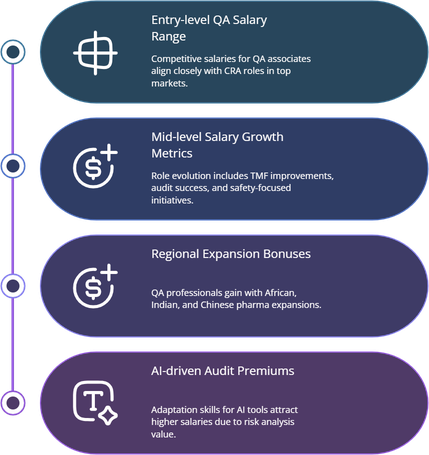
Most professionals underestimate QA earning potential because they only see “compliance overhead,” not risk insurance. At entry level, QA Associates in many US and Western EU markets earn salaries comparable to CRAs, with the added benefit of predictable hours and less travel. As you move into mid-level QA roles, your salary starts reflecting the value of clean inspections, strong TMF scores, and robust PV safety systems. Companies facing aggressive AI adoption, remote audits, and global decentralization often pay a premium for QA talent who can interpret new risks—think Africa expansion, India’s boom, or China’s growth.
How to Actively Lift Your Salary
You rarely get big jumps by “waiting to be noticed.” Instead, document measurable QA wins: reduced critical audit findings, faster CAPA closure cycles, fewer protocol deviations, or successful inspections in complex programs like smart-device trials or decentralized designs. Link these outcomes directly to revenue, time saved, or inspection risk avoided. Use internal salary bands and market data to negotiate, and don’t hesitate to look at CROs from top hiring lists where QA leads sponsor-level outcomes, not just paperwork.
5. How to Position Yourself for Promotions, Global Roles, and Remote Work
Promotions in QA rarely depend on who knows the most regulations; they go to people who make quality easier for everyone else. Start by partnering with Clinical Operations and project managers to design risk-based quality plans that focus on the few things that genuinely drive inspection risk—consent, eligibility, endpoints, safety reporting. Offer to run training sessions for CRAs, site staff, or PV teams based on real audit findings, and align your materials with GCP best practices and deviation management strategies.
To access remote or global roles, show comfort with technology and diverse trial geographies. Familiarity with AI-enabled oversight, regional regulations across the US/EU/Asia, and operational realities in markets like the UK post-Brexit or Africa gives you an international profile. Over time, you can evolve into a cross-domain leader working with medical monitors, PV heads, and digital health partners to design quality into every new trial model instead of bolting it on afterwards.
6. FAQs: Quality Assurance QA Specialist Career Roadmap & Salaries
-
Start by volunteering for quality-adjacent tasks in your current job: TMF clean-ups, site file QC, or internal audit preparation. Ask to shadow inspections or internal audits to see how findings are identified and written. Document your contributions as concrete outcomes—such as reduced missing documents or faster query resolution. Parallel to this, deepen your knowledge of GCP documentation requirements, protocol deviation handling, and sponsor SOPs. When you apply for QA Associate positions, emphasize that you understand site realities and operational constraints, so your CAPAs will be both compliant and feasible, which is exactly what QA managers want.
-
Experience is critical, but structured learning compresses your growth curve and de-risks you for employers. A strong certification shows you’ve internalized regulations, inspection expectations, and cross-functional quality concepts rather than learning only your company’s narrow SOPs. Pairing a robust certification with hands-on exposure to activities like audit support, CAPA design, and risk-based project planning makes you competitive for QA Specialist and GCP Auditor roles. Certifications also help when you’re switching geographies or moving from site-level to sponsor/CRO positions, where hiring managers may not know your current institution but will recognize your credential.
-
Many QA professionals become “document reviewers” rather than risk strategists. They check boxes—SOP compliance, training completion—without linking quality to business outcomes. Salaries stall when leadership sees your function as a cost center rather than an enabler of faster approvals, cleaner inspections, and reliable AI-driven scaling. To avoid this, quantify your impact: track reductions in critical findings, improved TMF health scores, or time saved in inspection prep. Connect your work to major initiatives like DCT rollouts, PV system upgrades, or AI-based monitoring. When you speak the language of risk, timelines, and cost, you position yourself for senior-level salary bands.
-
The mindset is similar—risk, documentation, inspection readiness—but workflows and systems differ. PV QA focuses on safety case intake, data entry, medical review, signal management, RMP execution, and regulatory reporting timelines. Clinical trial QA covers protocol adherence, informed consent, endpoint data, and TMF integrity. If you’re already in PV operations (case processing or RMP design), pivoting into PV QA lets you leverage system knowledge while gaining strategic oversight. Many global companies value professionals who can bridge both PV and clinical QA, since safety signals and trial data are increasingly integrated in AI-driven platforms.
-
AI will likely reshape QA rather than eliminate it. Tools that auto-flag anomalies, reconstruct protocol deviations, or predict audit hot spots will reduce manual checklist work—but someone still needs to validate models, challenge assumptions, and design human-in-the-loop quality strategies. QA Specialists who understand both technology and regulation will lead these efforts, especially in domains like AI-powered monitoring, remote audits, or VR-enabled trials. If you stay curious about new tools while defending core GCP and PV principles, AI becomes an amplifier for your career rather than a threat.
-
Yes, and your location can be an advantage if you leverage it strategically. Many sponsors are expanding trials in India and Africa, as described in regional outlook articles and India’s boom analyses. You gain early exposure to operational realities—site resourcing, documentation challenges, infrastructure variability—that regulators worry about. Combine this with strong English communication, global GCP training, and experience handling sponsor or health-authority inspections, and you can move into remote QA roles for US/EU-based CROs. Over time, your on-the-ground understanding becomes an asset for designing realistic global quality strategies.
-
A deep QA background opens multiple exit routes. You can move into Head of QA or Chief Compliance roles overseeing clinical, PV, and medical functions, or pivot into clinical compliance officer positions where you own policy, training, and inspection strategy. Some professionals transition into senior project management, regulatory intelligence, or consulting—helping sponsors prepare for inspections, remediate deficiencies, and design quality systems for new markets or novel trial models like blockchain-enabled studies. Your ability to see patterns across trials, vendors, and regions gives you a strategic vantage point that many other functions never develop.
