
How Elon Musk’s Neuralink Could Disrupt Clinical Research Forever: Predictions 2025
Neuralink is forcing clinical research to confront a new category: continuously streaming, high-resolution neural data from implanted devices that update like software. Even if your pipeline has nothing to do with brain–computer interfaces, the operating model they normalize—sensor-first endpoints, real-time RBQM, and device-drug combinations—will ripple across protocol design, monitoring, safety, and careers. Below is a practical, no-fluff field guide for sponsors, CROs, and sites to get “neural-ready” in 2025, with playbooks linked from AI-powered trials, remote AI audits, and patient retention prediction.

1) Neuralink in 2025: What It Is—and Why Every Study Team Should Care
Neuralink’s public narrative is human-computer interaction, but for clinical operations the deeper shift is neural telemetry as an endpoint: continuous signals, firmware updates, and tight human-factors loops. That model doesn’t stay in neurology; it spills into pain, psychiatry, movement disorders, sleep, and cognition—areas starving for objective, high-frequency measures. Expect sponsors outside neuro to borrow methods: adaptive protocols (see AI-powered trials), decentralized logistics (pair with drone-delivered medications), and centralized analytics similar to RBQM 2.0 (end of clinical trial monitors).
For resourcing, compare salary reality across roles in the 2025 salary report and CRA salaries worldwide. Teams skilled in AI literacy, device interoperability, and patient-centric DCT workflows will out-earn peers—echoed in top 10 highest-paying jobs.
| Domain | What Changes with Neural Implants | Operational Win | Risk to Manage | CCRPS Resource |
|---|---|---|---|---|
| Endpoints | High-frequency neural signals replace coarse scales | Smaller N, higher power | Validation burden | AI-powered trials |
| Protocol Design | Firmware-aware visit schedules; adaptive arms | Fewer amendments | Model hallucinations | Acronyms guide |
| Eligibility | Phenotyping via EEG/biometrics + history | Higher screen pass rate | Bias in models | Retention prediction |
| Recruitment | Site selection by neuro-surgical capacity | Faster activation | Center concentration | Top countries 2025 |
| DCT Logistics | Home monitoring + in-clinic implant checkups | Less travel burden | Device compliance | Drone meds |
| RBQM | Autonomous alerts on telemetry drift/outliers | Fewer on-site visits | False positives | Remote AI audits |
| Source Data | eSource ingest of neural streams | Audit-ready traceability | Mapping gaps | Acronyms guide |
| Safety/ICSR | NLP-drafted narratives from device + clinic notes | Faster case closure | Signal drift | PV careers |
| Signal Detection | Cross-study neural patterns with RWD | Earlier risk flags | Data licensing | AI & jobs |
| Medical Writing | LLM-assisted IB/CSR with device specifics | Weeks off timelines | Citation errors | Test strategies |
| Stats | Bayesian models for continuous endpoints | Adaptive decisions | Regulator alignment | AI-powered trials |
| Site Ops | Neuro-surgery + device programming windows | Predictable throughput | Scheduling conflicts | CRO directory |
| Training | Firmware, telemetry, explant AE workflow | Lower deviation rate | Skill gaps | Study environment |
| Consent | eConsent with firmware update comprehension | Fewer re-consents | Usability scrutiny | Acronyms guide |
| Device Supply | Implant kits + programmer logistics | Lower cancellations | Cold-chain analogs | Drone meds |
| Vigilance | Adverse neural events taxonomy | Consistent reporting | Under-/over-reporting | PV careers |
| Audits | Telemetry playback for inspectors | Faster close-outs | Explainability | Remote AI audits |
| Vendors | Device + cloud ecosystems | Unified data plumbing | Lock-in risk | Big Tech entry |
| Geos | Concentration in high-skill centers | Fewer underperformers | Access equity | India boom |
| China Strategy | Local data/implant rules | Scale potential | Localization | China 2030 |
| UK/EU | Post-Brexit divergence | Niche fast lanes | Duplicated submissions | Brexit impacts |
| Africa | Capacity mapping for implant follow-ups | Diverse cohorts | Infrastructure gaps | Africa frontier |
| Careers | Analyst-operator CRAs/CRCs | Higher pay band | Obsolescence | CRA salaries |
| Remote Work | Telemetry review from anywhere | Hybrid teams | Security posture | Remote CRA jobs |
| Exam Prep | Device-centric question banks | Faster credentialing | Over-reliance on AI | Assistant certification |
| Communication | Explain neural risk/benefit in plain language | Higher consent quality | Mistrust | Study environment |
| Cost/Timeline | Front-loaded device cost, leaner ops later | Cycle-time compression | Capex shocks | Country mix |
2) Ten Concrete Disruptions Neural Implants Trigger in Trial Design & Ops
1. Objective, continuous endpoints replace memory-biased scales. With neural telemetry, sponsors can track moment-to-moment change, boosting power with fewer participants; use modeling tactics from AI-powered trials.
2. Adaptive designs become default. Firmware updates behave like protocol amendments—plan Bayesian interims as in robots will run trials.
3. RBQM runs on telemetry. Outlier detection and drift analysis trigger targeted source checks (remote AI audits).
4. Consent becomes interactive. eConsent should demonstrate comprehension of software updates and explant scenarios; align language with the acronyms guide.
5. Site selection concentrates. Centers with neurosurgical capacity and device programmers dominate activation (see countries winning 2025).
6. DCT logistics reconfigure. At-home monitoring with in-clinic implant checks lowers dropouts, especially when paired with drone-delivered meds and the retention tactics in dropout prediction.
7. Safety narratives accelerate. NLP drafts ICSR narratives by fusing device logs and clinic notes; calibrate PV roles with PV specialist salaries.
8. Medical writing shifts to “explainability.” LLM-assisted CSRs must cite datasets precisely; apply discipline from test-taking strategies.
9. Cost curves bend. Upfront device cost, then leaner monitoring via RBQM reduces travel and rework; scope savings with salary report 2025.
10. Careers evolve to analyst-operator hybrids. CRAs/CRCs who read model outputs and validate signals will command premiums—see CRA salaries worldwide.
3) Data, Ethics, and Regulatory Pathways You Must Model Now
Data architecture. Treat implants as eSource producers. You need immutable logs, time sync with clinical events, and RAG (retrieval-augmented generation) to keep LLM outputs grounded. Build an SOP that enforces traceable citations—language aligned to the top 100 acronyms.
Ethics & equity. Neural implants can concentrate access in wealthy metros. Offset with travel stipends, home care, and telemetry-driven virtual check-ins. Design retention plans with the science inside patient dropout prediction and DCT logistics from drone-delivered meds.
Regulatory approach. Expect inspectors to request model inventories, data lineage, and performance monitoring—exactly the transparency culture promoted in remote AI audits. Mixed device-drug submissions will also raise vendor oversight complexity; review CRO options using the CRO directory and remote staffing via the remote CRA jobs list.
Biggest Roadblock to Neural-Ready Trials in 2025?
4) Site, CRO, and Talent Strategy—Who Wins, Who Gets Squeezed
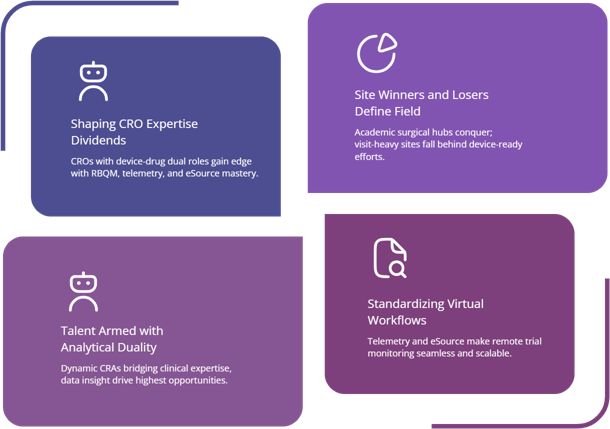
Winners: academic neurosurgical hubs, CROs with device-drug experience, and teams fluent in RBQM + eSource. These groups will standardize telemetry pipelines, validate models, and run virtual data reviews from anywhere—mirroring practices in end of clinical trial monitors. Talent that can toggle between operator and analyst—CRAs who read feature importances, CRCs who run device checks, medical writers who build explainability sections—will ride the salary curves outlined in the 2025 salary report and CRA salaries report.
Squeezed: small clinics without device capacity and sponsors glued to visit-based thinking. The pattern echoes broader consolidation forces mapped in countries winning 2025 and cloud/logistics power described in Amazon & Google’s entry. For resilience, mix geographies using India’s acceleration, China strategy, and Africa capacity building (frontier analysis).
Tactical staffing moves: recruit from the CRO directory, plug gaps with remote CRA programs, and onboard with standardized learning from exam anxiety playbook and test strategies.
5) A 12-Month, Neural-Ready Action Plan (Start Monday)
Quarter 1 — Foundation & Governance
Stand up a model inventory: purpose, owners, datasets, validation status, monitoring plan—mirrors the regulator-friendly posture in remote AI audits.
Define Critical Data & Processes (CDP) for neural endpoints; align terminology via the acronyms guide.
Choose cloud vendors with proven healthcare data lineage; pressure-test lock-in risks using insights from Big Tech entry.
Quarter 2 — Data & Protocols
Build an eSource pipeline for high-frequency signals; time-sync with EDC and clinic events.
Convert your next protocol into an adaptive design with Bayesian interims—methodology sketched in AI-powered trials.
Prototype explainable consent: comprehension checks on firmware updates, explant AEs, and tele-follow-ups.
Quarter 3 — RBQM & Safety
Deploy telemetry-aware RBQM: drift/outlier detection triggers remote source checks rather than blanket visits (end of monitors).
Stand up NLP-assisted PV: auto-narratives with human adjudication; skill map teams against PV salary growth.
Pilot DCT logistics for post-implant care with home vitals + drone-delivered meds.
Quarter 4 — Scale & Careers
Formalize neural centers of excellence within your network; rotate staff through device programming practicums.
Publish explainability artifacts (model cards, performance dashboards) to inspection portals; cross-reference language with the acronyms guide.
Ladder staff into higher bands using frameworks in top 10 highest-paying roles and CRA salaries; hire from the CRO directory and remote programs.
6) FAQs: Neuralink & Clinical Research (Hard Practical Answers)
-
Because operating models travel. Neural telemetry normalizes high-frequency endpoints, adaptive designs, and RBQM that triggers on data drift. Those methods apply to pain, sleep, psych, and rehab. Start with the frameworks in AI-powered trials and inspection-proofing from remote AI audits.
-
Use retrieval-augmented generation tied to validated libraries and enforce citation checks. Build a “no unsupported claim” SOP; train writers using test-taking strategies and standardized prompts from study environment.
-
Well-structured programs routinely achieve 10–25% attrition reduction by blending telemetry-based nudges, home nursing, and travel support—tactics mapped in dropout prediction and logistics from drone-delivered meds.
-
Anchor in metros with neurosurgical capacity and device programmers; then mix cost/speed using countries winning 2025, scale in India, and navigate China’s localization rules. Evaluate Africa (frontier analysis) for indications requiring diversity or rapid accrual.
-
No—repetitive admin shrinks; judgment-heavy work grows. Roles tilt to analyst-operator hybrids validating signals and designing CAPAs. Salary data in the 2025 report and CRA salaries shows premiums for AI-literate staff.
-
Pick one high-leverage agent: telemetry-aware RBQM or NLP PV narratives. Prove cycle-time and audit-finding impact; publish model cards and change logs as per remote AI audits. Lock team confidence with exam anxiety guidance.
-
Upskill a core squad via micro-learning sprints and CCRPS guides, then backfill with specialized FSPs from the CRO directory and remote talent via the CRA programs list.
-
Cloud, security, and ML ops become the substrate of study ops. Vendors that deliver data lineage + explainability win; lock-in is the tax. Read the implications in Amazon & Google’s entry and plan exit ramps in contracts.
