
Clinical Research Monitor Career Roadmap: Steps to a Successful CRA Career
Clinical Research Monitors are the frontline defenders of data integrity, patient safety, and protocol compliance. When trials derail, it is often because monitoring broke down before leadership noticed. A successful CRA career is not built on travel tolerance or checklist completion. It is built on risk awareness, site intelligence, and the ability to detect problems early and act decisively. This guide breaks down how to enter the CRA role, how to advance fast, and how to avoid the hidden traps that stall most monitoring careers.

1) What a Clinical Research Monitor Really Does (Beyond the Job Description)
A Clinical Research Monitor, commonly called a CRA, is responsible for verifying that clinical trials are conducted according to protocol, GCP, and regulatory expectations. But that definition hides the real value of the role. A strong CRA is not an auditor. A strong CRA is an early-warning system. You are the person who sees whether enrollment assumptions are failing, whether source documentation habits are deteriorating, and whether site staff truly understand the protocol or are just copying procedures blindly.
CRAs sit at the intersection of multiple high-risk workflows. You interact with investigators, coordinators, data managers, safety teams, and project managers. That is why CRA experience is often a launchpad into leadership roles such as Clinical Research Project Manager, [Clinical Trial Lead], or even long-term progression toward roles like Principal Investigator.
What separates an average CRA from a high-performing one is judgment. You must know when a deviation is noise and when it signals systemic failure. You must know how to escalate without burning site relationships. You must understand how your monitoring findings affect downstream data cleaning, safety reporting, and regulatory inspection readiness. If you do not understand those connections, your career stalls at mid-level monitoring.
Understanding the broader ecosystem helps CRAs advance faster. Reading adjacent role expectations like the Clinical Data Manager roadmap or the Quality Assurance Specialist career guide sharpens your monitoring instincts. Great CRAs think beyond the visit report. They think in systems.
2) Step-by-Step Career Path to Becoming a CRA
Most CRAs do not enter the role directly. The most reliable entry points are operational support roles that expose you to trial workflows. Common starting positions include Clinical Trial Assistant (CTA), Clinical Research Assistant, and site-level CRC roles. These positions teach document control, site coordination, and protocol familiarity.
The mistake many candidates make is focusing only on promotion timing instead of skill acquisition. To become a CRA, you must demonstrate three things before anyone trusts you with sites:
You understand GCP deeply, not superficially
You can interpret protocol intent, not just follow instructions
You can communicate corrective actions without damaging site relationships
Studying structured learning paths such as CCRPS certification programs and reviewing real-world monitoring expectations through salary and scope reports like the CRA salary report helps align expectations early.
Once you transition into a CRA I role, your first goal is not speed. It is consistency. Early CRAs fail when they rush visits without understanding patterns. You should spend your first year mastering informed consent review, eligibility verification, and source-to-EDC reconciliation. These are the foundations of inspection readiness and are closely tied to downstream quality expectations highlighted in the QA Specialist career roadmap.
Promotion to CRA II and Senior CRA comes when your sites stabilize under your oversight. Managers notice when deviation frequency drops, queries resolve faster, and coordinators become proactive instead of defensive. That is your real performance metric.
3) Skills That Make or Break a CRA Career
Technical knowledge alone does not sustain a CRA career. What matters is how you apply that knowledge under pressure. CRAs who plateau usually share the same weaknesses: passive monitoring, weak escalation, and poor prioritization.
Risk-based monitoring thinking is now mandatory. You must understand why certain data points matter more than others and how to adjust visit focus accordingly. This aligns closely with modern trial designs and the expanding use of remote oversight tools described in resources like the Top 50 remote clinical trial monitoring tools.
Communication is a survival skill. CRAs must deliver difficult feedback without triggering resistance. This skill becomes even more critical if you plan to move into leadership roles such as Clinical Research Project Manager. PMs who were once CRAs succeed because they learned how sites actually operate under pressure.
Data literacy is another differentiator. Understanding how your findings affect database lock timelines requires familiarity with EDC workflows and data cleaning cycles. Reviewing platforms covered in the Top 100 EDC systems guide strengthens this competency.
4) Salary Growth, Travel Reality, and Burnout Prevention
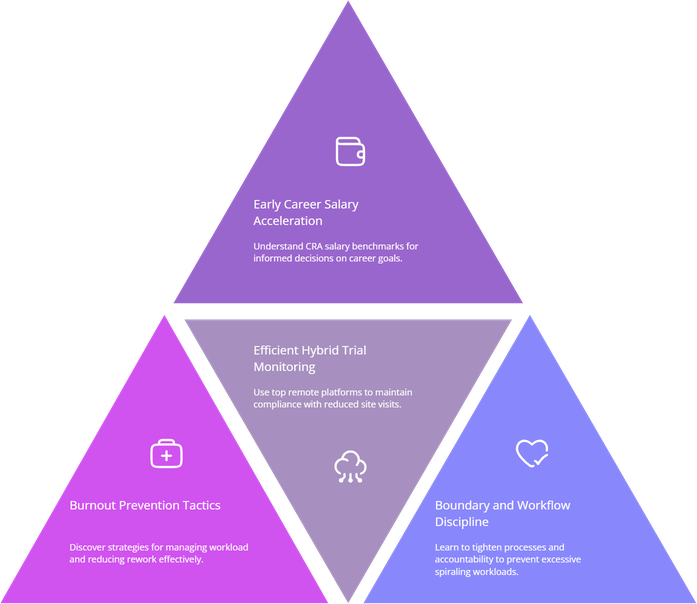
CRA compensation grows quickly in the early years, as shown in the CRA salaries worldwide 2025 data report. However, that growth often comes with heavy travel, rapid study ramp-ups, and workload spikes around enrollment surges, protocol amendments, and database lock pressure. Burnout is common among CRAs who do not learn boundary management early because the role quietly punishes disorganization. If your visit planning is weak, your follow-up discipline is inconsistent, or you let sites drag out action items, the workload multiplies and starts feeling endless.
The key to sustainability is efficiency, not endurance. High-performing CRAs reduce rework by addressing root causes instead of repeating findings visit after visit. That means tightening site training, fixing process gaps, and escalating early when patterns repeat, not when the situation becomes unmanageable. They also leverage remote monitoring tools strategically, reducing unnecessary on-site visits while maintaining oversight quality, especially when working within hybrid models supported by resources like the top 50 remote clinical trial monitoring tools and platforms 2025 guide. This is how experienced CRAs protect both performance and personal sustainability without compromising compliance.
Understanding adjacent salary trends such as the Clinical Research Coordinator salary guide 2025 and broader benchmarks in the clinical research salary report 2025 helps CRAs plan long-term career moves instead of reacting to burnout. When you know what roles pay, what skills are rewarded, and which paths grow faster, you stop making desperate job switches and start making strategic upgrades.
5) Long-Term CRA Career Paths and Exit Opportunities
CRA experience opens multiple doors because it gives you something most roles never touch: real site-level truth. Many CRAs transition into project management, quality assurance, training, or vendor oversight roles because they already understand what breaks trials in the real world and how to stop it. Others move closer to the science through roles like Medical Science Liaison or grow into investigator support pathways that align with the responsibilities outlined in the Principal Investigator career roadmap and the Sub-Investigator pathway.
What matters is intentional skill stacking. If you want leadership, start owning site performance metrics and learn how that performance rolls up into trial-wide delivery expectations like you see in the Clinical Research Project Manager salary trends guide. If you want QA, focus on deviation trend analysis, CAPA quality, and inspection readiness standards that connect directly to the scope in the Quality Assurance specialist career roadmap. If you want PM, learn timelines, stakeholder escalation, and budget impact, then benchmark your value using the Clinical Research salary report 2025. CRAs who drift without strategy often feel stuck despite strong resumes because they collect experience, but they do not build ownership proof.
6) Frequently Asked Questions (FAQs)
-
Most people reach a CRA role in 2 to 4 years, but the timeline depends on whether you are building real trial exposure or just collecting titles. The fastest path usually runs through roles like Clinical Trial Assistant (CTA) or Clinical Research Assistant, where you learn documentation flow, site communications, and protocol handling. If you want to speed up your readiness, build a clean study routine using creating the perfect clinical research certification study environment and apply structured performance tactics from proven test taking strategies for clinical research exams. The real signal is not time served. It is whether you can independently detect risk and stabilize sites.
-
Yes, travel is still common, but the intensity depends on the sponsor, trial design, and how much oversight can be handled through remote workflows. Hybrid and remote monitoring continue to grow, especially when teams leverage platforms outlined in the top 50 remote clinical trial monitoring tools and platforms 2025 guide. Your best strategy is to become strong in risk based oversight so you can justify fewer unnecessary visits and focus your time where risk is highest. When you understand how monitoring workload connects to compensation and demand trends, the CRA salaries worldwide 2025 data report helps you set realistic expectations and avoid taking roles that burn you out fast.
-
The certifications that matter are the ones that improve execution, not the ones that only look good on paper. A strong GCP foundation improves your ability to catch consent errors, eligibility gaps, and source inconsistencies before they turn into inspection findings, and you can benchmark the market value of that capability using GCP certified professional salaries global trends 2025. If you struggle with test pressure or information overload, use proven test taking strategies for clinical research exams so you learn faster with fewer wasted hours. Certification alone does not get you hired. Being able to explain monitoring decisions and risk logic does.
-
CRA burnout usually comes from rework and chaos, not effort. It happens when you carry too many sites, chase the same findings repeatedly, and escalate too late, which forces emergency cleanups near milestones. Prevention is about building systems: tight visit planning, clear follow up discipline, and using remote oversight tools intelligently, supported by resources like the top 50 remote clinical trial monitoring tools and platforms 2025 guide. It also helps to understand how your workload fits into industry pay and role expectations using the clinical research salary report 2025. Burnout drops when you stop trying to be everywhere and start managing risk like a professional.
-
Yes, CRA to PM is one of the most common and powerful transitions because monitoring builds real site level judgment. The key is to start owning more than visits: take responsibility for site performance trends, escalation paths, and timeline impacts, then translate those into sponsor ready reporting. When you are ready to map your next move, use the pay and scope lens in the clinical research project manager salary trends complete 2025 guide. If you want to sharpen cross functional awareness, reviewing adjacent role roadmaps like the clinical data manager career roadmap also helps you understand where monitoring decisions affect database timelines and quality risk.
-
Promotion happens when your sites improve because of you, not when you simply survive more travel. Managers look for CRAs who reduce repeat deviations, tighten consent compliance, and keep documentation clean enough that issues do not multiply between visits. If you want a market benchmark for how advancement typically tracks with compensation, review the CRA salaries worldwide 2025 data report. Your fastest promotion lever is risk based monitoring maturity, which also becomes more valuable as teams adopt remote workflows like those covered in the top 50 remote clinical trial monitoring tools and platforms 2025 guide. Senior CRAs do not just find problems. They prevent repeat failures through training, process correction, and smart escalation timing.
-
Yes, demand remains strong because sponsors and CROs cannot scale trials without reliable monitoring oversight. What is changing is the skill mix: teams increasingly want CRAs who can operate inside hybrid and remote models and still protect quality. Understanding the wider tooling ecosystem and vendor landscape gives you an edge, so scanning resources like the top 50 contract research vendors and solutions platforms every CRA should know 2025 buyers guide helps you speak intelligently about operational environments. For salary context and role positioning across regions, use the clinical research salary report 2025 so you can target the right employers and negotiate with confidence.
